
In the field of wear-resistant steel, high manganese steel casting is one of the most commonly used materials. Since its invention by R. A. Hadfield in 1883, it has been widely applied for over a century. High manganese steel, designated as ZGMn13, exhibits a single austenitic structure after water toughening treatment, resulting in excellent toughness and low surface hardness. However, it possesses remarkable work-hardening properties; under intense impact or compression during use, the surface microstructure hardens significantly, increasing hardness and wear resistance. This makes high manganese steel casting ideal for engineering machinery, mining, and metallurgy applications, such as blade corners for bulldozers. Yet, due to its high manganese content and alkaline nature of the molten steel, casting often leads to sand sticking, adversely affecting the appearance and dimensional accuracy of high manganese steel casting components.
The primary challenge in producing high manganese steel casting lies in achieving superior surface quality, which is critical for components like bulldozer blades that are used without machining. This article explores the factors influencing surface quality, with a focus on chemical sand sticking, and proposes the use of magnesium olivine sand as a molding material to enhance the surface finish of high manganese steel casting. Through experimental investigations, we analyze the composition, heat treatment, and performance of high manganese steel, identify the root causes of defects, and present optimized molding sand formulations to improve the overall quality of high manganese steel casting.
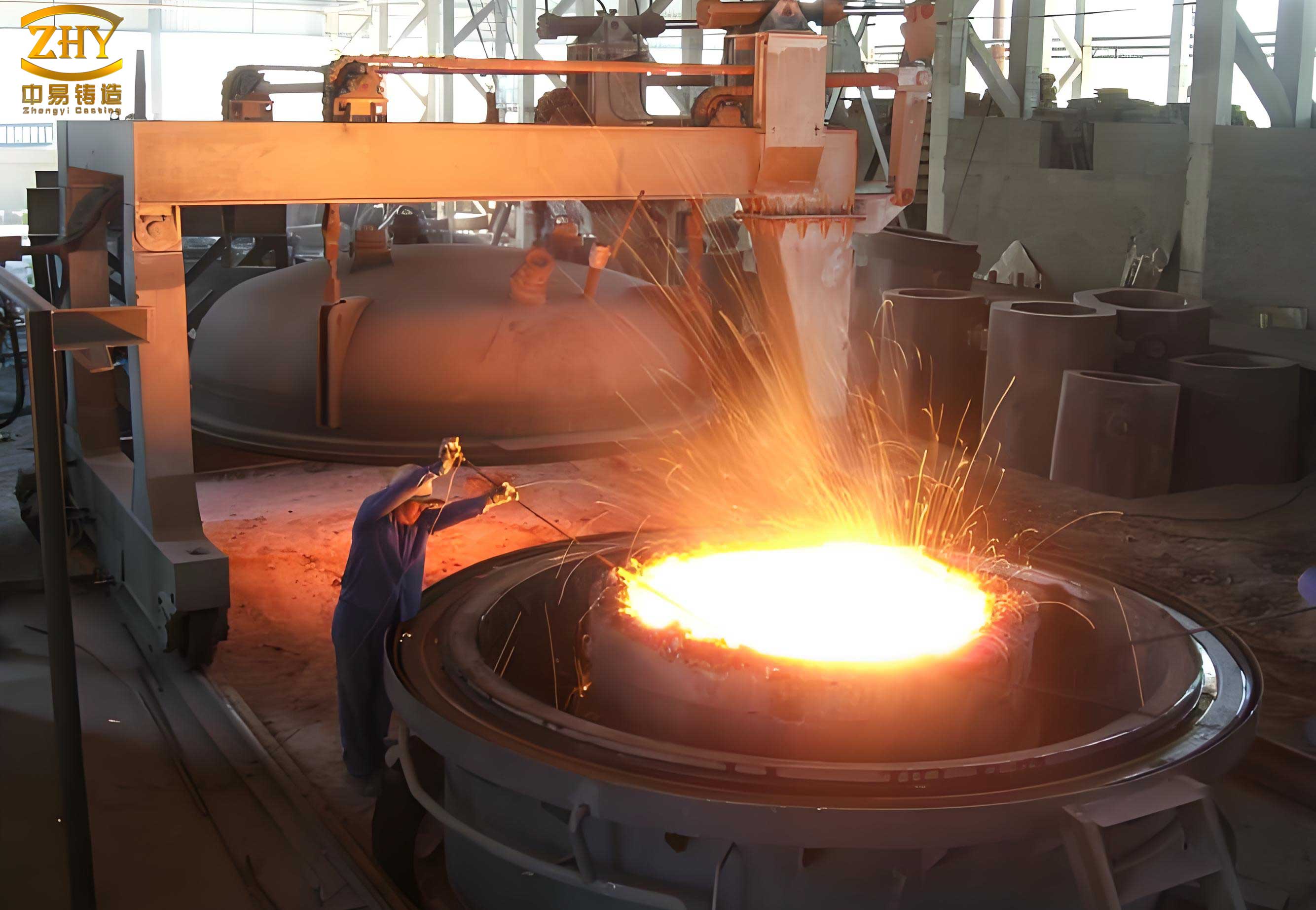
High manganese steel casting typically contains carbon and manganese in specific ratios to balance toughness and hardness. The chemical composition varies based on the application, as detailed in Table 1. Carbon content ranges from 0.9% to 1.5% by mass, while manganese content is between 11.0% and 14.0%. Higher manganese levels coupled with lower carbon enhance toughness but reduce hardness. In China, high manganese steel is classified into four grades according to its intended use, each with distinct chemical requirements to ensure optimal performance in high manganese steel casting components.
| Grade | C (Mass %) | Mn (Mass %) | Si (Mass %) | S (Mass %) | P (Mass %) | Application |
|---|---|---|---|---|---|---|
| ZGMn13-1 | 1.10–1.50 | 11.00–14.00 | 0.30–1.00 | ≤0.050 | ≤0.090 | Low-impact parts |
| ZGMn13-2 | 1.00–1.40 | 11.00–14.00 | 0.30–1.00 | ≤0.050 | ≤0.080 | General parts |
| ZGMn13-3 | 0.90–1.30 | 11.00–14.00 | 0.30–0.80 | ≤0.080 | ≤0.080 | Complex parts |
| ZGMn13-4 | 0.90–1.20 | 11.00–14.00 | 0.30–0.80 | ≤0.070 | ≤0.070 | High-impact parts |
The as-cast microstructure of high manganese steel consists of austenite and carbides. At room temperature, for a composition with 13% Mn and 1.3% C, the microstructure includes α-phase and M₃C carbides. During casting and cooling, non-equilibrium phase transformations occur, leading to a mixture of austenite, carbides, and pearlite. The presence of carbides significantly reduces toughness. To prevent carbide formation, high manganese steel undergoes water toughening treatment: heating to a critical temperature range of 1050–1100°C, holding for a specific time (e.g., 1 hour per 25 mm of wall thickness), and then rapidly quenching in water. This process dissolves carbides into the austenite matrix, resulting in a uniform austenitic structure. The relationship between temperature and carbide dissolution can be expressed using the Arrhenius equation for diffusion: $$ k = A e^{-E_a / (RT)} $$ where \( k \) is the rate constant, \( A \) is the pre-exponential factor, \( E_a \) is the activation energy, \( R \) is the gas constant, and \( T \) is the temperature in Kelvin. This treatment enhances the work-hardening capability of high manganese steel casting, with surface hardness increasing from ≤229 HBS to over 450–550 HBW under impact, providing exceptional wear resistance.
After water toughening, the mechanical properties of high manganese steel casting grades ZGMn13-1 to ZGMn13-4 include tensile strength (σ_b) ≥637–735 MPa, yield strength (σ_s) ≥396 MPa, and impact toughness (a_k) ≥15 × 10⁵ J/m². The strong work-hardening effect makes machining difficult, so high manganese steel casting components are typically used as-cast, with features like grooves and holes formed during casting. This underscores the importance of surface quality in high manganese steel casting, as any defects can compromise performance.
Chemical sand sticking is a major defect in high manganese steel casting, primarily due to the high manganese oxide (MnO) content in the molten steel. MnO is alkaline and reacts readily with acidic materials such as silica-based molding sands (e.g., quartz) and refractory coatings. The reaction can be represented as: $$ \text{MnO} + \text{SiO}_2 = \text{MnO} \cdot \text{SiO}_2 $$ This produces a low-melting-point compound that flows into sand interstices and adheres to the casting surface upon cooling, causing sand sticking. Factors like secondary oxidation, inadequate deoxidation, and high pouring temperatures exacerbate this issue in high manganese steel casting. For bulldozer blade corners, which require precise dimensions without post-casting machining, chemical sand sticking leads to high rejection rates, sometimes up to 25%, due to poor surface roughness and defects.
Initially, quartz sand was used as the molding material for high manganese steel casting, but it resulted in severe sand sticking and rough surfaces. Switching to alcohol-based magnesia coatings provided some improvement, but not enough. To address this, we explored non-silica sands like zircon, chromite, olivine, and brown alumina. After trials, magnesium olivine sand, with the chemical formula (Mg,Fe)₂SiO₄, was selected for its neutral properties and resistance to chemical reactions with high manganese steel casting. Magnesium olivine sand is a solid solution of forsterite (Mg₂SiO₄) and fayalite (Fe₂SiO₄). Pure forsterite melts at 1870°C, but the presence of fayalite (5–10% by mass) lowers the melting point to 1600–1760°C. The sintering point is around 1200°C, lower than quartz sand, but it resists wetting by molten metal and exhibits chemical inertness, making it highly refractory. When in contact with molten steel, the sand surface sinters to form a dense layer, preventing sand sticking and veining in high manganese steel casting.
Magnesium olivine sand appears gray-green or light green, with a density of 3.2–3.6 g/cm³, bulk density of 1.6–1.7 g/cm³, and Mohs hardness of 6.5–7.5. It contains impurities like serpentine, chlorite, and talc, which must be removed via water washing or calcination at 1100°C to avoid defects such as pinholes. Its thermal expansion is lower and more uniform than quartz sand, reducing risks like scabbing. The physical and chemical properties of magnesium olivine sand are graded as shown in Table 2, based on MgO and SiO₂ content, loss on ignition, refractoriness, and moisture. This sand’s neutrality and high refractoriness (up to 1700°C) make it ideal for producing smooth, dimensionally accurate high manganese steel casting with minimal defects.
| Grade | MgO (Mass %) | SiO₂ (Mass %) | Fe₂O₃ (Mass %) | Loss on Ignition (Mass %) | Refractoriness (°C) | Moisture (Mass %) |
|---|---|---|---|---|---|---|
| 1 | ≥47 | ≤40 | ≤10 | ≤1.5 | ≥1690 | ≤0.5 |
| 2 | ≥44 | ≤41 | ≤10 | ≤1.5 | ≥1690 | ≤0.5 |
For high manganese steel casting applications, the sand is processed to specific grain sizes, as categorized in Table 3. We used sizes 70/140 mesh and 100/200 mesh for our experiments, with calcium bentonite as a binder. The grain size distribution ensures optimal packing and permeability for high manganese steel casting molds.
| Group | 0.425 mm | 0.3 mm | 0.212 mm | 0.15 mm | 0.106 mm | 0.075 mm | 0.053 mm | Pan |
|---|---|---|---|---|---|---|---|---|
| 15 (70/140) | ≤15% | ≥75% | ≤10% | – | – | – | – | – |
| 10 (100/200) | ≤15% | ≥75% | ≤10% | – | – | – | – | – |
To improve the surface quality of high manganese steel casting for bulldozer blade corners, we developed three molding sand formulations using magnesium olivine sand, as detailed in Table 4. The sand was mixed in an S114-type mixer: backing sand for 3–5 minutes and facing sand for 8–13 minutes. Pouring temperature was controlled at approximately 1470°C, and molds were coated with magnesium olivine-based refractory paint. The process parameters, such as mixing time and moisture content, were optimized to achieve desirable properties for high manganese steel casting.
| Formulation | Sand Composition (%) | Mixing Time (min) | Wet Compressive Strength (MPa) | Wet Permeability | Moisture (%) | Compactibility (%) |
|---|---|---|---|---|---|---|
| A | 100% magnesium olivine sand, 10% calcium bentonite | 8–13 | 0.08 | 200 | 5 | 55 |
| B | 100% magnesium olivine sand, 8% calcium bentonite | 8–13 | 0.075 | 280 | 4 | 50 |
| C | 100% magnesium olivine sand, 6% calcium bentonite | 8–13 | 0.050 | 320 | 3 | 55 |
After casting and cooling, the high manganese steel casting components were evaluated. Formulation B yielded the best results: easy sand removal, smooth surfaces, clear contours, and minimal defects. A black protective layer formed during cooling and detached automatically, revealing a surface roughness comparable to precision castings. The used sand showed no burning and could be reused up to 90%. In contrast, Formulation A required manual cleaning, and Formulation C led to sand drop and inclusions. The rejection rate due to chemical sand sticking dropped from 15–25% to ≤3% with Formulation B, demonstrating the effectiveness of magnesium olivine sand in enhancing high manganese steel casting quality.
The relationship between bentonite content and sand properties can be modeled using linear regression. For instance, wet compressive strength (S) correlates with bentonite content (B) as: $$ S = k_1 B + c_1 $$ where \( k_1 \) and \( c_1 \) are constants derived from experimental data. Similarly, permeability (P) decreases with increasing bentonite: $$ P = k_2 / B + c_2 $$ These equations help optimize formulations for high manganese steel casting. In mass production, we adjusted the formulation to 100% magnesium olivine sand, 5–7% calcium bentonite, mixing time of about 10 minutes, and moisture control at 3–4%. The facing sand thickness was maintained at 20–300 mm, with ordinary clay sand as backing sand, to balance cost and quality for high manganese steel casting.
Key process controls included meticulous mold assembly to ensure cavity cleanliness, proper gating and riser design, controlled sand compaction for venting, and regulation of pouring temperature and speed. These measures, combined with magnesium olivine sand, consistently produced high-quality high manganese steel casting with excellent surface finish and dimensional accuracy. The economic viability of this approach is high, as the sand can be largely recycled, reducing material costs for high manganese steel casting production.
In conclusion, the use of magnesium olivine sand as a molding material significantly improves the surface quality of high manganese steel casting by mitigating chemical sand sticking. Through systematic experimentation, we identified optimal sand formulations and process parameters that enhance surface smoothness, contour clarity, and dimensional precision. This advancement not only reduces rejection rates but also extends the applicability of high manganese steel casting in demanding environments like bulldozer blades. Future work could explore further refinements in sand composition and heat treatment cycles to push the boundaries of high manganese steel casting performance.