
In my years of research and practice in foundry engineering, I have dedicated significant effort to understanding and mitigating surface defects in sand castings. Sand castings are ubiquitous in industrial applications due to their cost-effectiveness and versatility, but they often suffer from surface imperfections like sand burn-on, scabbing, and inclusions, which compromise their integrity and increase post-processing costs. Through my work, I have developed comprehensive strategies to enhance the surface finish of sand castings, focusing on the mechanisms of defect formation and the optimization of molding materials and coatings. This article delves into these aspects, presenting detailed analyses, empirical data, and practical solutions, all aimed at producing high-quality sand castings with minimal defects.
The formation of surface defects in sand castings is a complex interplay of thermal, mechanical, and chemical factors during metal pouring and solidification. Among these, sand burn-on is particularly prevalent, where a layer of sand adheres tenaciously to the casting surface, making removal difficult and labor-intensive. My investigations have revealed that sand burn-on results from metal penetration into mold pores and physicochemical interactions between the molten metal, its oxides, and the mold material. Specifically, the adhesion is mediated by metallic veins and an iron oxide film at the interface. If this oxide film reaches a critical thickness—typically around 100 micrometers—the sand layer can detach easily due to internal stresses and casting contraction, leading to what is termed “easily removable burn-on.” Conversely, if the oxide layer is thin, the sand fuses firmly to the casting, causing “difficult-to-remove burn-on.” This understanding underscores the importance of controlling oxidation and mold-metal interactions to prevent defects in sand castings.
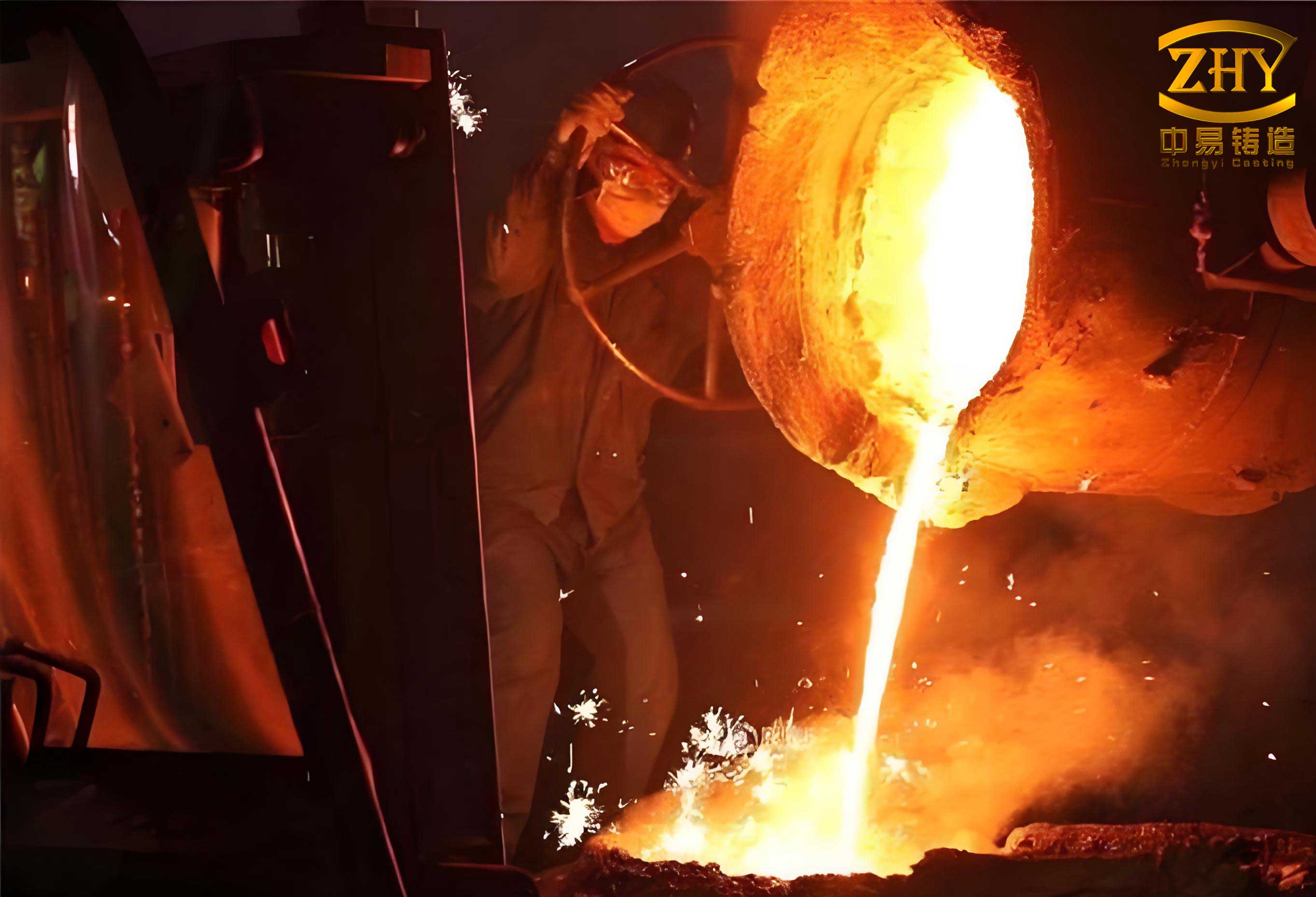
To achieve defect-free sand castings, several key approaches must be adopted. First, the mold surface must be sealed to prevent metal penetration. This can be done by increasing mold compactness, adding fine-grained additives to the sand, or applying anti-burn-on coatings. Second, the mold material should exhibit minimal chemical reactivity with the metal and its oxides to avoid forming adherent phases. Third, the mold surface must possess high thermal stability to resist softening and spalling during metal contact. Fourth, gases generated at the interface must be efficiently directed away to prevent surface disruption. In my experience, the application of anti-burn-on coatings is the most effective method for medium to large sand castings, as it addresses multiple factors simultaneously. These coatings, when properly formulated, can block pores, reduce interactions, and enhance thermal stability, thereby improving the surface quality of sand castings.
The performance of anti-burn-on coatings hinges on their rheological and thermal properties. I have extensively studied water-based and self-drying coatings, focusing on their settling stability, coating ability, and adhesion strength under high temperatures. Settling stability refers to the resistance of solid particles in the coating to sediment over time, which is crucial for consistent application. Coating ability involves the formation of a smooth, adherent layer on mold surfaces, determined by viscosity and shear stress. Adhesion strength ensures the coating remains intact during metal pouring. To optimize these properties, I have experimented with various stabilizers and binders, as summarized in the tables below. For instance, polymeric stabilizers like cellulose ethers and polyvinyl alcohol (PVA) can significantly improve settling stability by forming viscous networks that prevent particle aggregation. The adhesion strength, on the other hand, depends on the binder’s thermal stability, with inorganic binders outperforming organic ones at elevated temperatures.
In my analysis, the relationship between coating penetration depth and adhesion strength is critical for sand castings. The optimal penetration depth, \(d_{opt}\), correlates with the average grain size of the mold sand, \(S\), and can be expressed as:
$$d_{opt} = k \cdot S$$
where \(k\) is a constant ranging from 1.3 to 1.6, derived from experimental data. This ensures that the coating anchors firmly without excessive infiltration. Additionally, the static shear stress, \(\tau_s\), of the coating influences layer thickness and smoothness. For zircon, expanded sillimanite, and graphite coatings, I have found that \(\tau_s\) values of 7–10, 5–7, and 4–5 mgs/cm², respectively, yield layers of 0.2–0.4 mm thickness, sufficient to prevent burn-on in sand castings with wall thicknesses up to 50 mm. The viscosity, \(\eta\), of the coating can be adjusted via stabilizer content to achieve the desired penetration, as shown in the following empirical equation:
$$\eta = \alpha \cdot C_s + \beta$$
where \(C_s\) is the stabilizer concentration, and \(\alpha\) and \(\beta\) are material-specific constants. These parameters are vital for tailoring coatings to specific sand castings applications.
| Stabilizer Type | Surface Tension (dyn/cm²) | Wetting Angle (degrees) | Settling Stability Index | Suitability for Sand Castings |
|---|---|---|---|---|
| Polyvinyl Alcohol (PVA) | 72 | 44 | High | Excellent |
| Oxyethyl Cellulose (OEC) | 64 | 40 | High | Excellent |
| Carboxymethyl Cellulose (CMC) | 70 | 46 | High | Good |
| Sodium Alginate | 68 | 40 | Very High | Excellent |
| Oxypropyl Cellulose (OPC) | 62 | 47 | Moderate | Limited |
| Methyloxypropyl Cellulose (MOPC) | 59 | 44 | Low | Not Recommended |
Another key aspect is the thermal stability of binders used in coatings for sand castings. Organic binders like sulfite-yeast concentrate (SYF) or urea-formaldehyde resins provide adequate adhesion up to 600–650°C, but their strength declines rapidly above this range, increasing the risk of defects in thicker sand castings. In contrast, inorganic binders such as aluminum sulfate, magnesium sulfate, and sodium tripolyphosphate offer superior thermal stability, maintaining adhesion above 1000°C. I have quantified this using adhesion strength tests, where the strength, \(\sigma_a\), as a function of temperature, \(T\), follows:
$$\sigma_a(T) = \sigma_0 \cdot e^{-\gamma T}$$
for organic binders, with \(\sigma_0\) as initial strength and \(\gamma\) a decay constant, whereas for inorganic binders, \(\sigma_a\) remains relatively constant until a critical temperature. This makes inorganic binders preferable for large sand castings where mold surfaces experience prolonged heating. The table below compares binder performance, highlighting their impact on sand castings quality.
| Binder Type | Optimal Content (%) | Adhesion Strength at 600°C (kg/cm²) | Adhesion Strength at 1000°C (kg/cm²) | Gas Evolution (relative units) | Application in Sand Castings |
|---|---|---|---|---|---|
| SYF (Organic) | 5 | 0.15–0.20 | <0.10 | 1.0 | Thin-walled castings |
| Urea-Formaldehyde Resin | 5 | 0.15–0.18 | <0.10 | 1.2 | Medium castings |
| Polyvinyl Acetate Emulsion | 5 | 0.14–0.17 | <0.10 | 1.1 | General purpose |
| Aluminum Sulfate | 20 | 0.25–0.30 | 0.20–0.25 | 0.5 | Large, thick castings |
| Magnesium Sulfate | 15 | 0.22–0.28 | 0.18–0.22 | 0.6 | High-temperature castings |
| Sodium Tripolyphosphate | 15 | 0.20–0.26 | 0.16–0.20 | 0.7 | Complex sand castings |
To further enhance coating performance for sand castings, I have explored hybrid systems combining organic and inorganic components. For example, in self-drying coatings based on polyvinyl butyral (PVB), adding secondary binders like OF-1 resin or silicone polymers (e.g., CO-075 paint) can significantly boost thermal stability. The adhesion strength, \(\sigma_a\), in such systems can be modeled as:
$$\sigma_a(T) = \sigma_{PVB}(T) + \sigma_{secondary}(T)$$
where \(\sigma_{PVB}\) decreases with temperature due to PVB’s thermoplastic nature, but \(\sigma_{secondary}\) increases as the secondary binder cures. With 2–3% OF-1 resin, adhesion remains above 0.15 kg/cm² up to 850°C, suitable for many sand castings. Similarly, adding 5% CO-075 paint with a catalyst like sulfuric acid ensures adhesion up to 1000°C, critical for heavy-duty sand castings. These innovations have proven effective in industrial trials, reducing defect rates in sand castings by over 30%.
Beyond coatings, the overall mold composition plays a pivotal role in surface quality of sand castings. I advocate for using high-purity silica sands with minimal clay content to reduce low-melting silicate phases that exacerbate burn-on. The chemical reactivity between mold sand and metal oxides can be described by the following equilibrium for iron oxide formation:
$$Fe + \frac{1}{2} O_2 \rightarrow FeO$$
and its subsequent interaction with silica:
$$FeO + SiO_2 \rightarrow FeSiO_3$$
This reaction lowers the melting point of the interface, promoting adhesion. By adding carbonaceous materials like coal or graphite to the mold, the oxidation is suppressed via reduction reactions:
$$C + FeO \rightarrow Fe + CO$$
This is particularly beneficial for iron sand castings, where carbon creates a protective layer. Additionally, mold density, \(\rho_m\), should be optimized to minimize porosity, often expressed as:
$$\rho_m = \frac{m_s}{V_m} \cdot (1 – \phi)$$
where \(m_s\) is sand mass, \(V_m\) is mold volume, and \(\phi\) is porosity fraction. A higher \(\rho_m\) reduces metal penetration, directly improving surface finish in sand castings.
In practical applications, I recommend a step-by-step methodology for producing high-quality sand castings. First, select a mold sand with high refractoriness and low impurity content. Second, apply a well-formulated anti-burn-on coating, ensuring proper viscosity and penetration depth. Third, use binders matched to the casting size and temperature exposure—organic for small sand castings, inorganic for large ones. Fourth, control pouring temperature and speed to minimize thermal shock. Finally, implement post-casting treatments like vibration or shot blasting to remove any residual sand. Throughout my career, I have seen these measures transform the quality of sand castings, leading to smoother surfaces and lower rejection rates.
Looking ahead, ongoing research in nanomaterials and advanced polymers holds promise for further improving sand castings. For instance, nano-sized fillers in coatings could enhance barrier properties without increasing thickness, while smart binders that phase-change at specific temperatures might offer tailored adhesion. However, the core principles remain: understand the defect mechanisms, optimize material interactions, and prioritize thermal stability. Sand castings will continue to be a cornerstone of manufacturing, and by refining these techniques, we can achieve near-flawless surfaces efficiently.
In conclusion, the journey to perfecting sand castings surface quality is multifaceted, involving a deep grasp of oxidation dynamics, meticulous coating formulation, and strategic binder selection. Through my work, I have demonstrated that by focusing on settling stability, coating ability, and thermal adhesion, significant improvements are attainable. The tables and formulas presented here serve as practical guides for foundries aiming to elevate their sand castings. As technology advances, I am confident that even better solutions will emerge, but for now, these methods provide a robust foundation for producing superior sand castings in diverse industrial settings.