
In the production of precision lost wax casting components, particularly those with stringent quality requirements for critical applications, the occurrence of casting defects is a paramount concern. Among these, cracks are arguably the most challenging and costly, often leading to significant scrap rates. These defects can be macroscopic, visible to the naked eye, or microscopic, requiring magnification or X-ray inspection for detection. The persistent nature of this problem necessitates a deep, systematic understanding of its root causes and the development of robust preventive measures from a first-principles and practical perspective.
Cracks fundamentally originate from the stresses induced during the solidification and cooling of metal within the ceramic mold. When the stresses—arising from liquid contraction, solidification shrinkage, and solid-state thermal contraction—exceed the material’s strength at a given temperature, fracture occurs. We primarily classify these defects into two categories: hot tears (hot cracks) and cold cracks. Understanding their distinct characteristics and formation mechanisms is the first step toward control.
Hot tears form in the later stages of solidification, when a coherent solid skeleton exists but interdendritic liquid films remain. The casting is in a semi-solid, low-strength state. If contraction is hindered by the mold or the casting’s own geometry, tensile stresses can pull this weak network apart. The fracture surface of a hot tear is typically intergranular, oxidized (appearing dark), and irregular or jagged in morphology. In contrast, cold cracks form well after the casting has completely solidified, once it has cooled below the ductile-to-brittle transition temperature into the fully elastic regime. Here, the material has lost its plasticity. When the residual stress exceeds the ultimate tensile strength of the now-brittle material, catastrophic fracture occurs. Cold crack surfaces are usually transgranular, straight, shiny, and less oxidized. However, in practice, post-casting processes like wet vibratory descaling often oxidize or corrode all cracks, making visual differentiation difficult. Empirical observation suggests hot tearing is the more prevalent mode in precision lost wax casting, with purely mechanical handling damage accounting for a minor fraction of incidents.
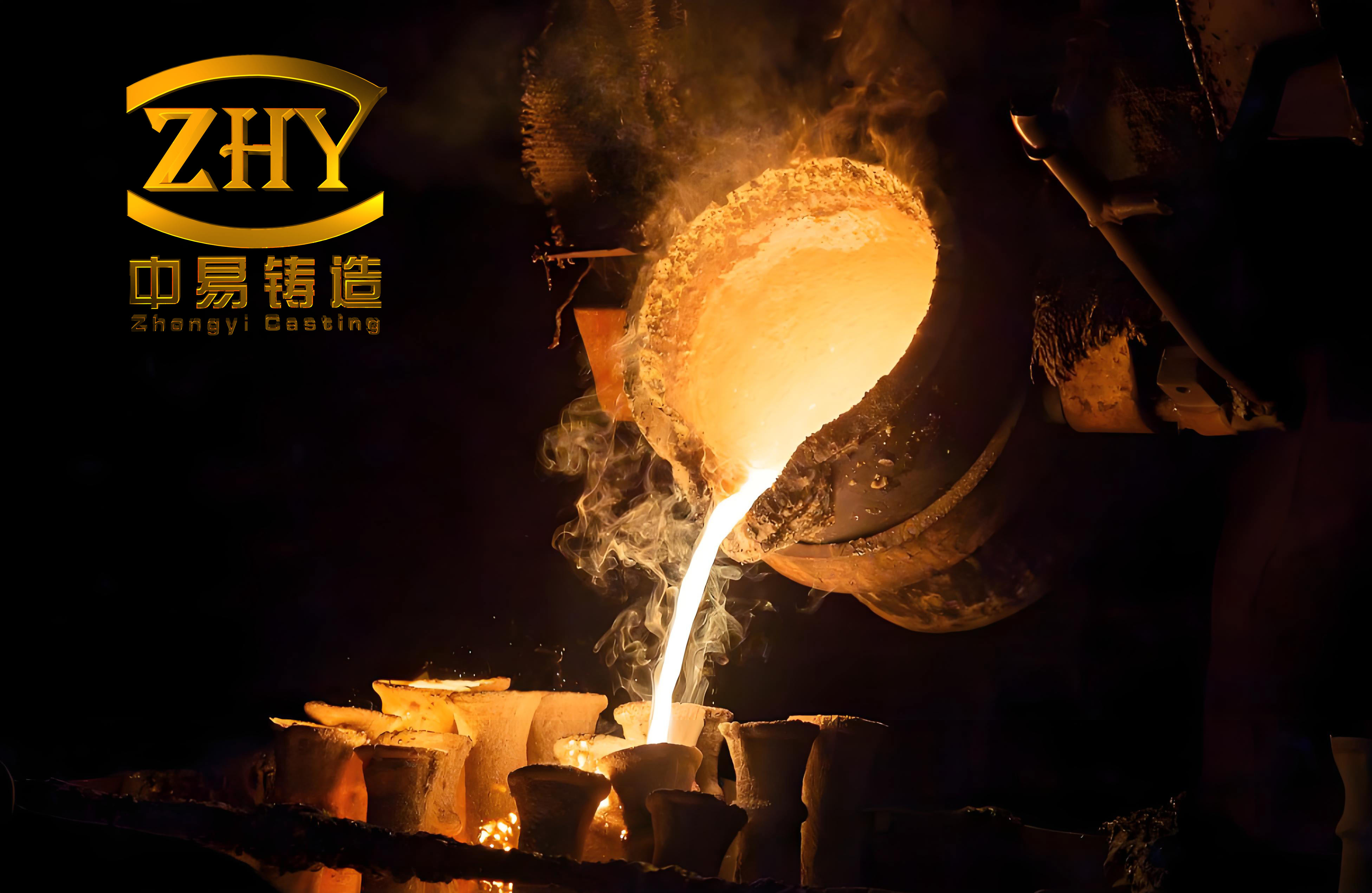
1. Theoretical Mechanisms of Crack Formation
The formation of cracks can be modeled by examining the interplay between thermal strain, mechanical constraint, and the temperature-dependent mechanical properties of the alloy. A simplified view of the stress development considers the casting’s inability to contract freely.
The total strain ($\varepsilon_{total}$) in a constrained section of a cooling casting can be expressed as:
$$\varepsilon_{total} = \varepsilon_{thermal} + \varepsilon_{mechanical}$$
Where $\varepsilon_{thermal} = \alpha \cdot \Delta T$ (α being the coefficient of thermal expansion and ΔT the temperature drop). If the casting is fully constrained, the mechanical strain ($\varepsilon_{mechanical}$) must accommodate the thermal strain, leading to stress ($\sigma$):
$$\sigma = E(T) \cdot \varepsilon_{mechanical}$$
Here, $E(T)$ is the temperature-dependent Young’s modulus. Cracking occurs when $\sigma \ge \sigma_{UTS}(T)$, where $\sigma_{UTS}(T)$ is the temperature-dependent ultimate tensile strength (for cold cracks) or hot tearing strength (for hot tears).
The vulnerability to hot tearing is highest within the “brittle temperature range” (BTR), the interval between the coherency temperature (where solid grains form a network) and the solidus temperature. Within this range, the strength is minimal, and ductility is near zero. The susceptibility can be conceptualized by the integral of strain rate over time within the BTR. A critical factor is the feeding ability to compensate for intergranular separation.
2. Influence of Alloy Composition and Metallurgy
The chemical composition of the steel is the primary determinant of its solidification behavior, phase transformation, and final mechanical properties, thereby fundamentally influencing its cracking propensity in precision lost wax casting.
2.1 Role of Key Alloying Elements
The effects are multifaceted and often interactive. The table below provides a detailed summary.
| Element | Influence on Fluidity | Influence on Hot Tearing | Influence on Cold Cracking | Primary Mechanism & Remarks |
|---|---|---|---|---|
| Carbon (C) | Significantly improves fluidity; higher carbon lowers liquidus temperature. | Complex effect. Very low (<0.1%) and high (>0.5%) carbon increase susceptibility. Medium range (~0.2%) offers better resistance. | High carbon increases susceptibility markedly due to reduced toughness and increased martensite hardenability. | Controls solidification range, phase proportions (ferrite/pearlite/martensite). High C promotes carbide networks. |
| Silicon (Si) | Moderate improvement as a deoxidizer. | Beneficial in typical casting ranges (0.2-0.45%). Acts as a ferrite strengthener. Excess can promote coarse grain growth. | Minor direct effect. High Si can slightly reduce toughness. | Powerful deoxidizer. Solid solution strengthener of ferrite. Influences graphitization in high-C alloys. |
| Manganese (Mn) | Minor positive effect. | Generally beneficial. Optimizes around 0.8-1.0%. Counteracts sulfur’s detrimental effect. | High Mn can increase hardenability, potentially increasing risk in high-strength steels. | Forms MnS inclusions, preventing low-melting FeS films at grain boundaries. Increases strength and hardenability. |
| Phosphorus (P) | Improves fluidity significantly (like C). | Strongly increases susceptibility. Severe segregation to grain boundaries. | Very detrimental. Dramatically reduces impact toughness, causing severe embrittlement. | Forms low-strength, brittle phosphide films at grain boundaries. Harmful even at low levels (<0.04%). |
| Sulfur (S) | Reduces fluidity if forms solid oxides/sulfides. | Extremely detrimental. Promotes formation of low-melting point FeS/MnS eutectics at grain boundaries. | Increases susceptibility by reducing overall ductility and toughness. | Mn is added to neutralize S as globular MnS. Residual FeS is catastrophic for hot strength. |
| Aluminum (Al) (as deoxidizer) | Improves fluidity by deoxidation. | Excess (>0.1% residual) can increase susceptibility by promoting finer grain size and altering inclusion morphology. | Can have complex effects on transformation behavior. | Primary deoxidizer. Forms Al2O3 inclusions. Fine AlN precipitates can pin grains but affect hot ductility. |
2.2 Deoxidation Practice
Inadequate deoxygenation leaves dissolved oxygen, which precipitates as FeO or other oxide inclusions along grain boundaries during cooling. These inclusions sever the metallic continuity, drastically reducing the effective load-bearing area and acting as stress concentrators. This weakens both the high-temperature strength (promoting hot tears) and the room-temperature ductility and fatigue strength (promoting cold cracks). A properly killed steel, typically using aluminum or silicon-manganese, is essential for crack-resistant precision lost wax casting. The deoxidation reaction can be summarized as:
$$3[FeO] + 2[Al] \rightarrow Al_2O_3(s) + 3[Fe]$$
The solid alumina must float out to the slag; residual clusters within the casting are detrimental.
3. Process Factors in Precision Lost Wax Casting
The unique nature of the precision lost wax casting process introduces specific vulnerabilities and control points.
3.1 Casting Design and Gating
This is often the most critical factor under the foundry’s control. Poor design guarantees problems.
- Section Thickness Variation: Large differences in wall thickness create non-uniform cooling. Thin sections cool and contract first, placing the still-hot thick sections in tension. Later, the thick sections contract, putting the now-rigid thin sections in tension. This cyclic stress can induce cold cracking. The stress magnitude can be related to the differential cooling rate.
- Hot Spots and Junctions: Areas where sections meet (like T-junctions, L-junctions) become thermal centers or hot spots. These areas solidify last, are poorly fed, and are subjected to tensile stresses from the surrounding, already solidified material. They are prime locations for hot tears.
- Gating System Design: The gate acts as a massive hot spot. If a single gate feeds a large or complex casting, it creates a severe thermal gradient.
- Solution: Multiple Gates to distribute heat input and reduce the thermal mass of any single feed point.
- Solution: Gate Location should avoid direct impingement on thin sections or delicate features and should be placed away from stress-concentrating geometries.
- Solution: Gate Geometry should be designed to minimize its own hot spot effect. Tapered or stepped sections are better than abrupt, chunky attachments.
3.2 Temperature Regimes: Metal and Mold
Controlling thermal gradients is the essence of controlling stress.
- Metal Pouring Temperature: A higher superheat increases the total heat content, widening the solidification time difference between thin and thick sections, exacerbating thermal gradients and shrinkage stress. The goal is “low temperature pouring” – the minimum temperature that ensures complete mold filling without mistuns. The relationship between cracking tendency and pouring temperature ($T_{pour}$) is often exponential within the working range.
$$Cracking\ Index \propto e^{k(T_{pour} – T_{liquidus})}$$
where \(k\) is a process-dependent constant. - Mold (Shell) Temperature: Pouring into a cold shell creates an immense initial thermal shock and a steep temperature gradient. A pre-heated (“hot shell”) mold reduces this gradient, allowing slower, more uniform initial cooling. For steel, a shell temperature of 400-500°C is typically targeted. The thermal shock stress is proportional to the temperature difference:
$$\sigma_{thermal\ shock} \propto E \cdot \alpha \cdot (T_{metal} – T_{shell})$$
| Parameter | Target Range | Rationale |
|---|---|---|
| Steel Tap Temperature | 1580 – 1610 °C | Allows for deoxidation, alloy adjustment, and temperature loss during transfer. |
| Steel Pouring Temperature | 1550 – 1580 °C (depending on section thickness) | Minimizes superheat while maintaining fluidity. Thinner sections require higher end of range. |
| Shell Preheat (Bake-out) Temperature | 850 – 950 °C | Ensures complete burnout of pattern residues and thermal stabilization. |
| Shell Pouring Temperature | 400 – 500 °C | Reduces thermal shock, promotes directional solidification towards feeders. |
3.3 Cooling and Knock-out Cycle
This stage is crucial for preventing cold cracks. After pouring, the casting-in-shell must cool in a controlled manner.
- In-Mold Cooling Time: Premature handling or movement of the filled mold can impose external mechanical stresses on the still-hot, weak casting. A minimum in-mold cooling time (e.g., 30 minutes for medium steel castings) must be enforced to allow the casting to gain sufficient strength to handle its own weight and minor handling loads.
- Controlled Cooling to Room Temperature: After shell knockout, rapid or uneven cooling (e.g., water quenching, air-blast, or cooling on a cold floor in winter) introduces severe thermal stresses. The casting must cool slowly and uniformly in still air. For high-restraint castings, even burying in dry sand or using insulating blankets post-knockout can be beneficial. The cooling rate ($\dot{T}$) directly influences the development of thermal stress. A simplified relation is:
$$\sigma_{therm} \propto \frac{E \cdot \alpha}{1-\nu} \cdot \dot{T} \cdot t$$
where $\nu$ is Poisson’s ratio and $t$ is a characteristic dimension.
| Stage | Action & Duration | Purpose |
|---|---|---|
| Post-Pour | Undisturbed in firing zone or insulated area for >30 min. | Allows casting to solidify fully and gain high-temperature strength. |
| Shell Removal | Transfer to knockout unit only after initial cooling. | Prevents mechanical shock to hot casting. |
| Deshaling | Wet vibratory or grit blasting only after casting is cool to touch (<50°C). | Prevents thermal shock from water or cold air. Allows stress relaxation during slow cooling. |
| Final Cooling | Ambient still-air cooling to room temperature. (Often >2 hours for medium parts). | Minimizes residual stress from final cooling phase. |
4. Integrated Prevention Strategy and Conclusions
Eliminating cracks in precision lost wax casting is not about a single silver bullet but implementing a holistic, controlled process chain. The following integrated strategy summarizes the key actionable points:
- Metallurgical Control: Maintain steel composition within an optimal window: C~0.2%, Si 0.35-0.45%, Mn 0.8-1.0%, with P and S aggressively minimized (<0.025% each). Execute effective killing/deoxidation using Al, with total Al addition controlled to avoid excess residual.
- Design for Manufacturability (DFM): Collaborate with designers to minimize drastic section changes and inherent hot spots. When design is fixed, use intelligent gating as a corrective tool: employ multiple, properly sized gates placed to balance thermal input and avoid critical areas. Use feeder heads strategically to ensure hot spots are under hydrostatic pressure until solidified.
- Thermal Management: Strictly adhere to the “low pour, hot mold” principle. Calibrate furnaces and pyrometers. Monitor and record shell preheat temperatures consistently. The thermal gradient driving force must be managed.
$$Thermal\ Driving\ Force = f(\Delta T, \kappa_{shell}, \kappa_{metal})$$
where $\kappa$ is thermal conductivity. - Process Discipline in Cooling: Establish and enforce standardized cooling cycles. Treat the time between pouring and final deshaling as a critical process parameter, not dead time. Protect castings from drafts and rapid cooling, especially in cold environments.
- Process Monitoring and Feedback: Implement statistical process control (SPC) on key variables: chemistry, temperatures, cooling times. Correlate this data with crack incidence in radiographic or dye-penetrant inspection. This data-driven approach allows for continuous refinement of the process window for precision lost wax casting.
In conclusion, while the inherent nature of metal solidification makes casting stress inevitable, cracks are not. Through a comprehensive understanding of the metallurgical principles and a disciplined control over every stage of the precision lost wax casting process—from alloy selection and melt practice to gating design, thermal regime control, and post-solidification cooling—it is entirely feasible to reduce crack-related scrap to negligible levels. The process demands respect for the complex interplay of material science and thermal mechanics, and the reward is the reliable production of high-integrity, defect-free components.