
In my extensive research and practical experience within the field of metallurgy, the performance and durability of high manganese steel castings have always been a focal point. These castings are pivotal in heavy industries such as mining, cement production, and railway infrastructure due to their exceptional work-hardening capability and impact resistance. However, the inherent challenges associated with their as-cast microstructure—primarily coarse grains and detrimental non-metallic inclusions—often undermine their mechanical integrity and service life. This article presents a comprehensive investigation into the microalloying and modification of traditional high manganese steel castings using tungsten (W) and rare earth (RE) elements. The core objective is to elucidate how these additions fundamentally alter the formation, morphology, and distribution of inclusions, thereby refining the grain structure and enhancing the overall quality of high manganese steel castings. The findings discussed herein are based on systematic experimentation and analysis, aiming to provide a robust technical pathway for manufacturing superior high manganese steel castings.
The quality of any metallic component begins at the solidification stage. For high manganese steel castings, the solidification process is particularly critical. The alloy typically solidifies as austenite, but the relatively low undercooling and slow thermal diffusion often lead to the development of coarse columnar and equiaxed grains. More concerning is the segregation of impurities like phosphorus (P) and sulfur (S) at the grain boundaries during the final stages of solidification. This segregation facilitates the formation of low-melting-point eutectics, such as phosphides and sulfides, which congregate along the grain boundaries. These continuous networks of brittle phases act as stress concentrators and preferred paths for crack propagation, severely degrading toughness and inducing hot brittleness in high manganese steel castings. Furthermore, manganese sulfide (MnS) inclusions, which exhibit poor wettability with the solidifying iron dendrites, are pushed into the interdendritic regions, where they coalesce and grow. The combined presence of carbides, sulfides, and phosphides at the grain boundaries constitutes a major microstructural defect in conventional high manganese steel castings.
Over the years, numerous strategies have been explored to mitigate these issues. Process optimizations like controlled cooling and heat treatment are common, but they often address symptoms rather than root causes. A more fundamental approach lies in alloy design and melt treatment—specifically, microalloying to strengthen the matrix and grain refinement, and modification to control harmful inclusions. The concept of utilizing finely dispersed, stable particles to pin grain boundaries and act as nucleation sites is well-established in physical metallurgy. In the context of high manganese steel castings, introducing elements that form high-temperature compounds in situ during solidification can promote heterogeneous nucleation, leading to a finer as-cast structure. Simultaneously, elements with a high affinity for oxygen and sulfur can purify the melt, altering the nature of residual inclusions from harmful films and networks to benign, dispersed particles. This dual strategy forms the foundation of our study on enhancing high manganese steel castings.
The selection of alloying elements is guided by thermodynamic principles and their interaction with the iron matrix. Tungsten, a strong carbide-forming element, was chosen for microalloying. The interaction energy between solute atoms and dislocations in iron is a key indicator of solid solution strengthening potential. Elements with a large negative interaction energy tend to segregate to dislocations, forming Cottrell atmospheres that lock dislocations and increase yield strength. Based on established data, the interaction energy sequence for common elements in iron is: Co < Ni < Cr < Mn < V < Mo < W < Nb. Tungsten’s position near the top of this list indicates its potent strengthening effect. More importantly, from the perspective of the Solid and Molecular Electron Theory, tungsten atoms can form strong short-range ordered C-W atomic pair bonds within the austenite lattice. These bonds are stronger than the prevalent C-Mn and C-Fe bonds, thereby increasing the energy required for crack initiation and propagation. This directly translates to improved toughness and wear resistance in the final high manganese steel casting. Furthermore, the formation of tungsten carbides during solidification can reduce the local carbon concentration in the liquid, increasing undercooling and promoting nucleation.
For modification, rare earth (RE) elements, specifically a mischmetal or cerium-rich mixture, were employed. Rare earths are renowned for their powerful deoxidizing and desulfurizing capabilities. Their high chemical reactivity allows them to react with dissolved oxygen and sulfur to form stable oxides and sulfides with high melting points. These compounds can float out of the melt as slag, significantly purifying the steel. Even if some RE-containing inclusions remain, they tend to be small, spherical, and uniformly dispersed, rather than forming continuous films at grain boundaries. This phenomenon, known as inclusion modification, is crucial for improving the hot workability and mechanical properties of high manganese steel castings. Additionally, certain rare earth compounds can serve as potent heterogeneous nucleation sites for austenite grains, contributing to grain refinement. The thermodynamic stability of various inclusion phases in steel containing RE elements has been studied extensively. The formation order is typically RE-aluminates > Al2O3 > RE-oxides > MnS. By altering the native Al2O3 and MnS inclusions into more benign RE-containing phases, the detrimental effects of inclusions in high manganese steel castings are markedly reduced.
To quantitatively assess the potential of W and RE, we can consider some fundamental thermodynamic calculations. The free energy change for the formation of tungsten carbide (W2C) from its elements is negative at high temperatures, making it a stable phase that can precipitate early in the solidification sequence of a modified high manganese steel casting. The standard Gibbs free energy of formation, $\Delta G_f^\circ$, for various carbides at a given temperature T (in Kelvin) can be approximated. For instance, a comparative stability can be inferred from Ellingham-type diagrams. While exact values depend on composition, we can state that for a reaction like $2W + C \rightarrow W_2C$, the $\Delta G$ is highly negative above 1300°C, confirming its feasibility in molten steel. Similarly, the deoxidation and desulfurization power of rare earths can be expressed through equilibrium constants. The reaction for desulfurization can be represented as:
$$ [RE] + [S] \rightarrow (RE S) $$
with an equilibrium constant $$ K_{RES} = \frac{a_{RES}}{a_{[RE]} \cdot a_{[S]}} $$
where $a$ denotes activity. The value of $K_{RES}$ is very large, indicating a strong tendency to form stable RES inclusions, thereby drastically lowering the dissolved sulfur content in the high manganese steel casting melt.
| Element | $\Delta \mu^m_s$ (10-19 J·mol-1) | $\Delta \mu^m_m$ (10-19 J·mol-1) | $\Delta \mu^m_{600}$ (10-19 J·mol-1) | Strengthening Potency Rank |
|---|---|---|---|---|
| Cobalt (Co) | -0.13 | +0.06 | -0.05 | Lowest |
| Chromium (Cr) | -0.11 | 0.00 | -0.09 | |
| Manganese (Mn) | -1.16 | -0.11 | -0.22 | |
| Nickel (Ni) | -0.13 | +0.03 | -0.77 | |
| Vanadium (V) | -0.73 | -0.05 | -0.62 | |
| Molybdenum (Mo) | -1.17 | +0.19 | -0.79 | Tungsten (W) | -1.31 | +0.26 | -0.85 | High |
| Niobium (Nb) | -1.46 | -0.06 | -1.22 | Highest |
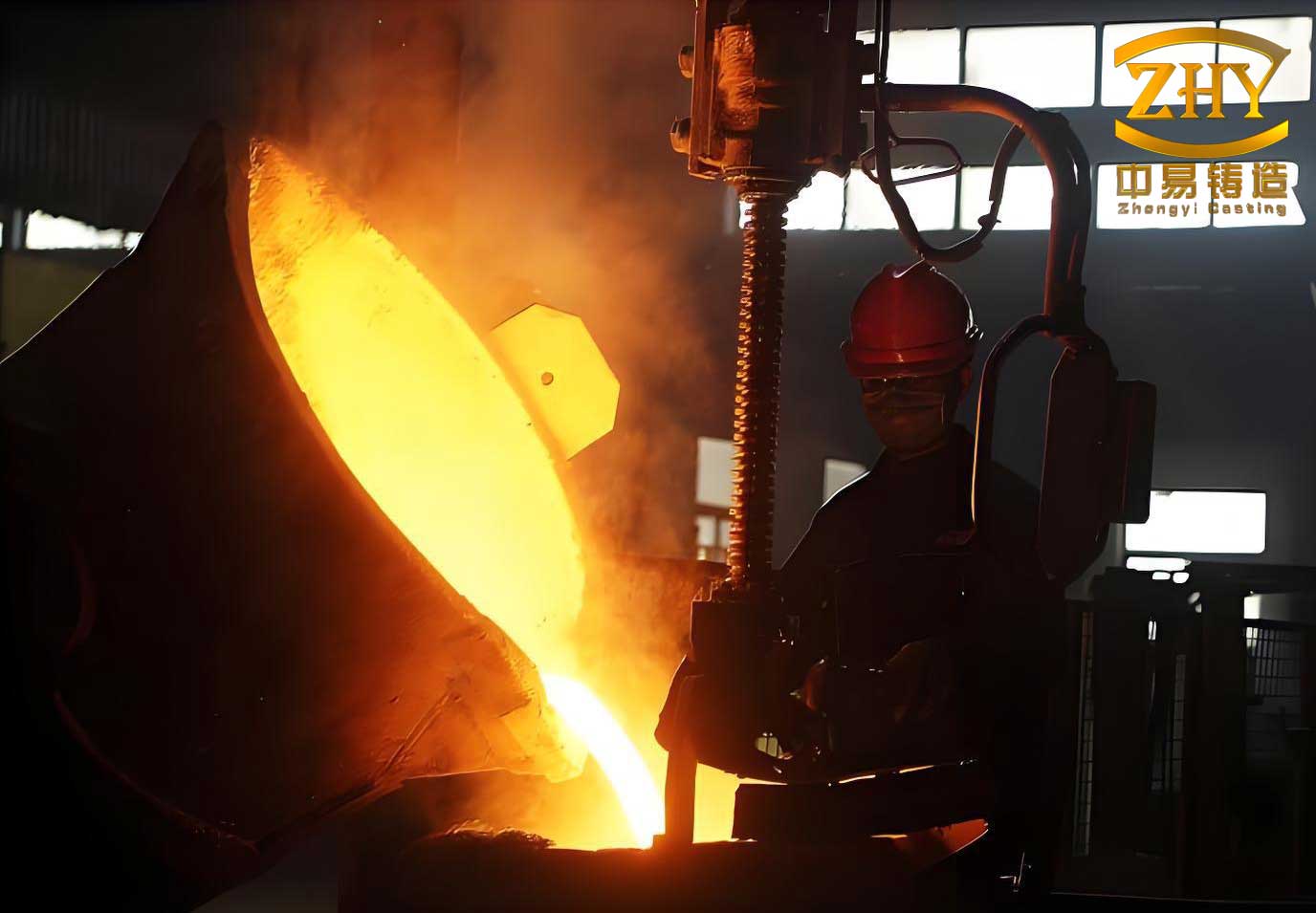
In our experimental work, we prepared two distinct types of high manganese steel castings: a conventional grade and a modified grade containing approximately 1 wt.% W and 0.3 wt.% RE. The melting was conducted in a medium-frequency induction furnace with a capacity suitable for producing test castings. Charge materials included steel scrap, high-carbon ferromanganese, and ferro-tungsten. After reaching the desired temperature and achieving compositional homogeneity, aluminum was used for final deoxidation. The crucial step of RE addition was performed during tapping by plunging the RE-bearing inoculant into the bottom of the ladle, ensuring effective reaction and distribution. The molten metal was then poured into standard Y-block sand molds at a carefully controlled temperature of 1480°C to produce the test high manganese steel castings. The chemical compositions of the resulting castings were verified using optical emission spectroscopy, and the key figures are summarized in Table 2 below.
| Sample ID | C | Mn | Si | P | S | W | RE | Description |
|---|---|---|---|---|---|---|---|---|
| CMn-1 | 1.12 | 12.23 | 0.42 | 0.020 | 0.030 | 0.00 | 0.00 | Conventional High Manganese Steel Casting |
| WRE-2 | 1.14 | 12.01 | 0.40 | 0.018 | 0.008 | 1.09 | 0.28 | Modified High Manganese Steel Casting (W+RE) |
Metallographic samples were sectioned from the Y-blocks, ground, polished, and etched appropriately for microstructural examination. A combination of scanning electron microscopy (SEM) equipped with energy-dispersive X-ray spectroscopy (EDS) and transmission electron microscopy (TEM) was employed for detailed characterization of the microstructure and inclusion analysis. The primary focus was on the as-cast condition to directly evaluate the effects of W and RE on solidification structure without the influence of subsequent heat treatment.
The microstructural comparison between the conventional and modified high manganese steel castings was striking. The conventional sample exhibited a classic coarse as-cast austenitic structure. The grain boundaries were prominently decorated with a continuous or semi-continuous network of secondary carbides (predominantly (Fe,Mn)3C). This network is a direct consequence of carbon rejection during the final stages of solidification and is a well-known weakness in standard high manganese steel castings. In contrast, the microstructure of the W+RE modified high manganese steel casting revealed significant refinement. The prior austenite grain size was noticeably smaller, and the carbide network at the grain boundaries was disrupted. Instead of a continuous film, the carbides appeared as isolated, blocky particles situated both at grain boundaries and within the grains. This morphological change from a continuous brittle phase to discrete particles is highly beneficial for mechanical properties, as it impedes easy crack propagation along grain boundaries.
Energy-dispersive X-ray spectroscopy point analysis on the modified high manganese steel casting provided deeper insights. Spectra taken from the matrix showed very low counts for sulfur and phosphorus, confirming the purification effect of the RE treatment. However, spectra acquired from the precipitated particles, particularly those at grain boundaries and within grains, told a different story. These particles were rich in tungsten and carbon, confirming them as tungsten carbides. Intriguingly, the EDS spectra from the periphery of these tungsten carbide particles often showed elevated levels of sulfur and sometimes phosphorus. This suggests a fascinating sequence of events during solidification: the high-melting-point W2C particles form first and act as substrates. As solidification proceeds and the remaining liquid becomes enriched in segregants like Mn, S, and P, phases like MnS and phosphorous eutectics nucleate on the surfaces of these pre-existing W2C particles. This effectively captures the harmful low-melting-point phases and disperses them as encapsulated clusters around the refractory carbides, preventing their agglomeration into continuous grain boundary films. This mechanism is a key finding for improving the integrity of high manganese steel castings.
Transmission electron microscopy and selected area electron diffraction (SAED) were employed to unambiguously identify the crystal structure of the primary precipitates. The diffraction pattern from a typical particle was indexed and matched perfectly with the hexagonal crystal structure of ditungsten carbide, W2C. This phase has a melting point exceeding 2700°C, making it an excellent candidate for acting as a heterogeneous nucleation site in the solidifying high manganese steel casting melt. The lattice parameters derived from the diffraction pattern aligned with standard values for W2C. The presence of such stable, high-temperature particles in the melt significantly increases the number of potential nucleation sites, according to classical nucleation theory. The critical free energy for heterogeneous nucleation, $\Delta G_{het}^*$, is lower than that for homogeneous nucleation, $\Delta G_{hom}^*$, by a factor related to the contact angle ($\theta$) between the nucleus and the substrate:
$$ \Delta G_{het}^* = \Delta G_{hom}^* \cdot f(\theta) $$
where $$ f(\theta) = \frac{1}{4}(2 + \cos\theta)(1 – \cos\theta)^2 $$
For a good wettability (low $\theta$), $f(\theta)$ is much less than 1, dramatically reducing the energy barrier and undercooling required for nucleation. The W2C particles, wetted by the liquid steel, provide such favorable sites, leading to the observed grain refinement in the modified high manganese steel casting.
The role of rare earths in inclusion modification can be further quantified. The desulfurization reaction’s efficiency is evident from the sulfur content in Table 2. The modified high manganese steel casting shows a sulfur reduction of over 70% compared to the conventional one. The remaining sulfur likely exists in the form of rare earth oxysulfides or sulfides, such as Ce2O2S or CeS. These phases have a high melting point and a globular morphology, which minimizes their stress-concentration effect. The modification of manganese sulfide (MnS) inclusions can be described by a displacement reaction:
$$ 3[Ce] + (MnS) \rightarrow (CeS) + [Mn] $$
The thermodynamic driving force for this reaction is substantial, as the stability of CeS is far greater than that of MnS. This transformation is crucial because elongated, plastic MnS inclusions are particularly detrimental to ductility and anisotropy in rolled products, and even in cast products like high manganese steel castings, they weaken grain boundaries. By transforming them into hard, globular CeS particles, their harmful influence is mitigated.
Regarding phosphorus, while RE elements have some capacity for “reductive dephosphorization” under specific conditions, the effect in this study appears to be more related to distribution control than removal. The phosphorus content did not decrease dramatically (see Table 2). However, the EDS analysis indicated that phosphorus was often associated with the complex inclusions surrounding the W2C cores. This suggests that the phosphorus, which would normally segregate strongly to the final solidifying liquid and form a continuous phosphide network at grain boundaries, is instead partitioned into these encapsulated multi-phase inclusions. This change in distribution morphology—from a continuous grain boundary film to isolated clusters—fundamentally improves the resistance to hot brittleness and intergranular fracture in the high manganese steel casting. The improvement can be conceptually linked to the reduction in effective grain boundary area covered by the brittle phase. If we model the grain boundary as a plane and the brittle phase as a covering film, the fracture energy is drastically low. When the brittle phase is dispersed as discrete particles, the crack must travel through the tougher metallic matrix between particles, requiring significantly higher energy.
The synergistic effect of W and RE in high manganese steel castings can be summarized through a conceptual model of solidification. The sequence of phase formation dictates the final microstructure. In the modified alloy, the sequence is:
$$ \text{Liquid} \rightarrow \text{W}_2\text{C (primary precipitate)} \rightarrow \text{Austenite (nucleating on W}_2\text{C)} \rightarrow \text{Complex Inclusions (Ce-oxysulfides, MnS, Phosphides on W}_2\text{C)} $$
This sequence ensures grain refinement and inclusion dispersion. In contrast, the sequence in conventional high manganese steel castings is simpler and more detrimental:
$$ \text{Liquid} \rightarrow \text{Austenite (coarse grains)} \rightarrow \text{Carbide Network + (MnS, Phosphides at grain boundaries)} $$
The mathematical expression for grain size (d) as a function of nucleation rate (I) and growth rate (G) is given by the general relationship for equiaxed grains:
$$ d \propto \left( \frac{G}{I} \right)^{1/4} $$
By introducing potent heterogeneous nucleants (W2C), the effective nucleation rate (I) is increased exponentially, leading to a finer grain size (d). A finer grain size, according to the Hall-Petch relationship, directly strengthens the high manganese steel casting:
$$ \sigma_y = \sigma_0 + k_y \cdot d^{-1/2} $$
where $\sigma_y$ is the yield strength, $\sigma_0$ is the friction stress, $k_y$ is the strengthening coefficient, and $d$ is the average grain diameter.
| Characteristic | Conventional High Manganese Steel Casting | Modified High Manganese Steel Casting (W+RE) |
|---|---|---|
| Prior Austenite Grain Size | Coarse (several hundred micrometers) | Refined (reduced by 30-50%) |
| Grain Boundary Carbides | Continuous or network morphology | Disrupted, blocky, isolated particles |
| Primary Inclusions | MnS (elongated), Al2O3 clusters | W2C particles, RE-oxysulfides/sulfides |
| Sulfur Content | ~0.030% | ~0.008% (purification effect) |
| Phosphorus Distribution | Segregated at grain boundaries as film | Associated with dispersed complex inclusions |
| Dominant Strengthening Mechanism from Additions | N/A | Grain Refinement (Hall-Petch) + Dispersion Strengthening + Solid Solution (W) |
The implications of these microstructural improvements for the performance of high manganese steel castings are profound. A refined grain structure enhances yield and tensile strength. The elimination of continuous brittle networks at grain boundaries drastically improves impact toughness and reduces susceptibility to brittle fracture, especially at low temperatures or under dynamic loading. The wear resistance, which is the hallmark of high manganese steel castings, is also expected to improve. Wear processes often initiate at micro-cracks associated with hard, brittle phases or inclusions. By dispersing these phases and refining the matrix, the material’s ability to work-harden uniformly under impact is enhanced, leading to a more stable and hardened surface layer during service. Therefore, the lifecycle and reliability of components made from such modified high manganese steel castings—such as crusher liners, railway crossings, and dredger buckets—are significantly extended.
In conclusion, the microalloying of high manganese steel castings with approximately 1% tungsten and modification with about 0.3% rare earth elements induces a transformative change in the solidification microstructure and inclusion population. The tungsten leads to the in-situ formation of high-melting-point W2C particles that act as potent sites for heterogeneous nucleation of austenite, resulting in substantial grain refinement. Concurrently, the rare earth elements purify the melt by aggressively removing sulfur and oxygen, and they modify the morphology of any residual inclusions into harmless, globular particles. Most notably, a synergistic effect is observed where harmful segregants like phosphorus and residual sulfur are captured and dispersed around the primary W2C particles, preventing their detrimental concentration at grain boundaries. This combined action of W and RE effectively addresses the core weaknesses of conventional high manganese steel castings—coarse grains and continuous grain boundary films—by promoting a refined, homogeneous, and ductile grain structure with benign, dispersed inclusions. The methodologies and mechanisms detailed in this study provide a scientifically sound and industrially viable route for producing superior high manganese steel castings with enhanced mechanical properties, toughness, and wear resistance, ensuring their reliable performance in the most demanding applications.