
In my extensive experience within the foundry industry, the adoption of Lost Foam Casting (LFC), also known as Expendable Pattern Casting (EPC), represents a significant technological advancement. This process involves using a foam pattern cluster, coated with refractory material and embedded in unbonded sand under vacuum, which is then replaced by molten metal during pouring. While it offers superior dimensional accuracy, reduced surface roughness, and simplified production compared to traditional green sand or investment casting, it introduces unique quality challenges. Among these, the slag inclusion defect stands out as a particularly insidious and prevalent issue affecting the internal soundness of castings. This defect, often microscopic and hidden beneath the surface, can severely compromise the mechanical properties and service reliability of cast components, especially in safety-critical applications like railway components. This article details a comprehensive investigation into the nature, origins, and, most importantly, the effective prevention strategies for slag inclusion defects in lost foam cast iron, drawing from systematic analysis and practical process refinements.
The manifestation of a slag inclusion defect in lost foam castings is often deceptive. Unlike gross slag pockets visible to the naked eye, the problematic form is frequently microscopic. These inclusions typically concentrate in sub-surface regions and at stress-critical locations such as transition fillets or corners. Visually, they appear as irregular black streaks, flakes, or clusters within the metal matrix. Their color makes them difficult to distinguish by origin—whether they are traditional metallic slag or unique pattern decomposition residues. In a specific case study involving a non-machined railway coupler component, destructive sectioning revealed such micro inclusions at a key load-bearing fillet. Microscopic analysis showed these slag inclusion defects constituted approximately 10% of the area in that localized zone, presenting a clear fracture initiation risk. This underscored that the slag inclusion defect is not merely a surface imperfection but a fundamental internal integrity concern that demands rigorous control.
To effectively combat the slag inclusion defect, a root cause analysis is essential. We determined that the origins are bimodal, stemming from both conventional metallurgical sources and the distinctive LFC process kinetics. The first category involves insufficiently cleaned molten iron, where oxides, slag, and reaction products (like magnesium silicate residues from nodularization) are entrained during pouring. The second, and often more dominant category in LFC, arises from incomplete pattern degradation. The pouring process triggers intense thermal decomposition of the foam pattern. Ideally, the pattern should gasify completely, and the resulting vapors should be evacuated swiftly by the vacuum system. However, if local conditions hinder this—due to low pattern permeability, high density, inadequate vacuum, or rapid metal front advancement—the pattern may pyrolyze into liquid or solid carbonaceous residues. These residues can be trapped by the advancing metal front or pushed into the casting skin by internal gas pressure, leading to the characteristic sub-surface slag inclusion defect. The competition between metal filling velocity ($v_m$), pattern gasification rate ($\dot{G}$), and gas evacuation rate ($\dot{E}$) is critical. A simplified model for defect formation risk ($R$) can be conceptualized as:
$$ R \propto \frac{\rho_p \cdot v_m}{P_v \cdot \kappa_c \cdot \kappa_s} $$
where $\rho_p$ is the pattern density, $P_v$ is the applied vacuum pressure, $\kappa_c$ is the coating permeability, and $\kappa_s$ is the sand permeability. A higher $R$ indicates greater propensity for pattern residue-based slag inclusion defect formation.
The prevention strategy must be holistic, targeting all potential sources of the slag inclusion defect. Our approach was structured around four pillars: molten metal treatment, pouring discipline, pattern and coating optimization, and sand/vacuum management. The following table summarizes the core operational objectives:
| Process Stage | Primary Goal | Key Control Parameters |
|---|---|---|
| Melting & Treatment | Minimize metallic slag generation and entrainment | Charge cleanliness, slagging frequency, temperature cycling, inoculant preparation |
| Pouring Procedure | Prevent slag entry and maintain stable filling | Pouring cup design, slag baffling, pouring continuity, vacuum stability |
| Pattern & Coating | Maximize complete pattern gasification and gas evacuation | Pattern density, bead size, coating permeability, adhesive usage |
| Sand & Vacuum | Ensure high and consistent permeability for gas flow | Sand grain distribution, dust content, vacuum level and consistency |
Underpinning the pattern-related measures is the critical control of foam density. The density ($\rho_p$) directly influences the mass of material to be gasified and the volume of gases produced. We established an optimal density range through experimental trials. The relationship between pattern density and the total gas volume ($V_g$) generated at a given temperature can be approximated by considering the pyrolysis reaction. Assuming the foam is primarily expanded polystyrene (EPS), its decomposition can be simplified as:
$$ (C_8H_8)_n \rightarrow n \cdot (8C + 4H_2) \quad \text{(simplified)} $$
The molar volume of gas produced is substantial. Therefore, minimizing the initial mass via lower density is paramount. For the railway component, we successfully controlled the main pattern density to $0.018 – 0.026\ g/cm^3$ and the gating system pattern density to $0.016 – 0.022\ g/cm^3$. The gas evolution rate $\dot{G}$ is temperature-dependent and follows an Arrhenius-type relationship:
$$ \dot{G} = A \cdot e^{-E_a / (R T)} $$
where $A$ is a pre-exponential factor, $E_a$ is the activation energy for pyrolysis, $R$ is the universal gas constant, and $T$ is the absolute temperature at the metal-foam interface. Ensuring the coating has high permeability ($\kappa_c$) allows these gases to escape without building pressure that forces residues into the metal. Coating permeability is a function of refractory grain size distribution, binder type, and layer thickness. We optimized the coating formulation to achieve maximum gas permeability while maintaining adequate structural strength and surface finish.
The melting and treatment procedures were rigorously standardized to tackle the metallic aspect of the slag inclusion defect. The sequence involved multiple slag-off steps at specific temperature plateaus. The efficiency of slag removal using a聚渣剂 (slag coagulant) can be related to the interfacial tension between the slag and metal. The driving force for slag droplet coalescence and flotation is governed by Stokes’ law and surface energy minimization. After nodularization treatment for ductile iron, a prolonged holding period of 3-5 minutes was instituted, followed by repeated slag skimming. All additives (inoculants, covering agents) were preheated to eliminate moisture and volatiles, which could otherwise generate gaseous by-products and promote slag formation.
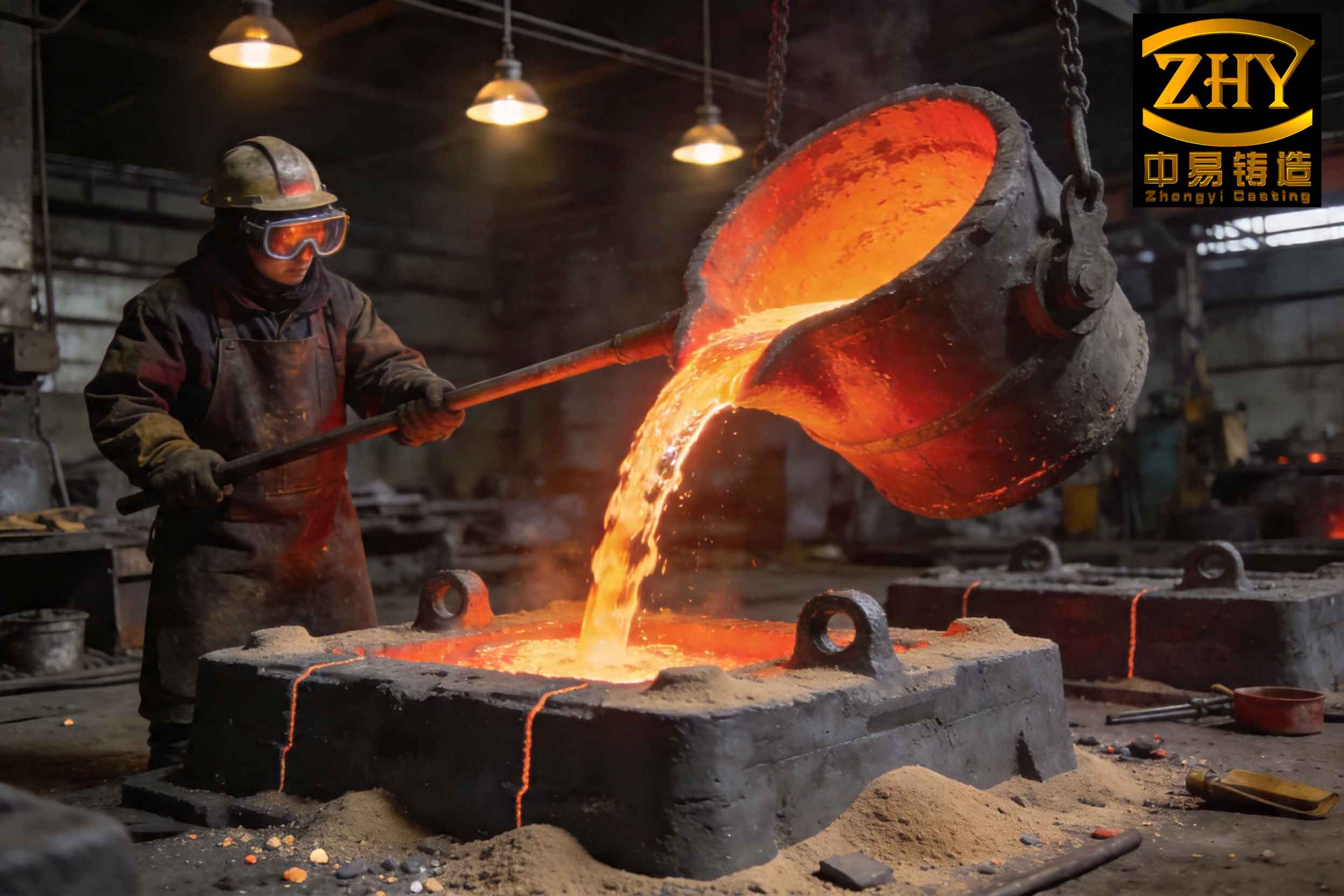
Pouring discipline is a often-underestimated factor in controlling the slag inclusion defect. We mandated the use of ceramic fiber or sand-bonded pouring cups instead of simple foam cup extensions, as they provide better slag trapping. The pouring practice required a full sprue cup to establish a positive pressure head and a steady, non-turbulent flow. The vacuum pressure within the flask was actively monitored and controlled to remain within a tight band, typically ±0.05 MPa around the set point, to ensure consistent gas evacuation without causing sand instability. Turbulent flow can entrain both metallic slag and pattern residues; thus, the gating design aimed for a gradual flow transition. The initial filling velocity $v_0$ should be controlled to balance mold filling and pattern degradation. A modified Bernoulli’s equation with a term for gas back-pressure ($P_g$) illustrates this balance:
$$ \frac{P_{atm}}{\rho_m g} + h = \frac{v^2}{2g} + \frac{P_g}{\rho_m g} + h_f $$
where $h$ is the metallostatic head, $h_f$ represents friction losses, and $\rho_m$ is the metal density. Managing $P_g$ through vacuum and permeability is key to maintaining a favorable $v$.
The sand system plays a crucial supporting role. Dry, rounded silica sand with a controlled grain size distribution was used to ensure high and uniform bulk permeability ($\kappa_s$). The permeability can be estimated using the Carman-Kozeny equation:
$$ \kappa_s \approx \frac{\phi^3}{K (1-\phi)^2 S^2} $$
where $\phi$ is the sand porosity, $S$ is the specific surface area of the grains, and $K$ is a shape factor. Regular sand cleaning and dedusting were implemented to maintain $\phi$ and prevent fines from clogging the inter-granular spaces, which would impede gas flow and increase the risk of a pattern-related slag inclusion defect.
The efficacy of these integrated preventive measures was validated through structured trials. For the initial test batch, 100% of the castings were destructively sectioned at critical locations. No microscopic slag inclusion defect was found in the previously problematic fillet areas. This was a significant improvement. Subsequently, five more production heats were monitored with a 50% sampling rate for destructive testing. Out of 960 inspected castings, only two exhibited visible slag defects in non-critical areas (hole edges), and crucially, microscopic examination of the load-bearing fillets confirmed the absence of the sub-surface slag inclusion defect. The statistical defect rate for the critical micro-slag was reduced to virtually zero. The table below quantifies some of the key process parameters before and after optimization:
| Parameter | Pre-Optimization State | Post-Optimization Target | Impact on Slag Inclusion Risk |
|---|---|---|---|
| Pattern Density (g/cm³) | 0.028 – 0.035 | 0.018 – 0.026 | Reduces mass of decomposable material, lowers $\dot{G}$ |
| Coating Permeability (AFS Units) | ~15-20 | 25-35 | Enhances gas evacuation, lowers $P_g$ |
| Vacuum Fluctuation (MPa) | ±0.10 | ±0.05 | Stabilizes metal front and gas flow |
| Post-Nodularization Hold Time (min) | 1-2 | 3-5 | Improves metallic slag flotation and removal |
| Pouring Cup Type | Foam Extension | Refractory Lined | Physically blocks metallic slag entry |
The successful mitigation of the slag inclusion defect allowed for the reliable batch production of the railway component using the lost foam process. The consistent absence of this defect in critical zones validated the systemic approach. It became clear that controlling the slag inclusion defect is not about a single silver bullet but about synchronizing multiple process variables. The interplay between pattern degradation dynamics, gas transport, and metal flow is complex. Continuous monitoring of parameters like vacuum pressure curves and pouring temperatures can provide diagnostic insights. For instance, an abnormal pressure spike during pouring might indicate localized gas entrapment, signaling a potential slag inclusion defect risk in that batch.
In conclusion, the challenge of microscopic slag inclusion defects in lost foam cast iron castings is formidable but manageable. It requires a deep understanding of the dual origins—metallurgical and pyrolytic—of the defect. Through a methodical strategy encompassing stringent metal treatment, disciplined pouring, optimized low-density patterns with highly permeable coatings, and controlled sand and vacuum environments, the incidence of this harmful defect can be reduced to negligible levels. The experience underscores that in advanced casting processes like LFC, achieving internal quality is as much about controlling the physics and chemistry of the pattern disappearance as it is about traditional metallurgical excellence. Future work may involve more sophisticated real-time monitoring and closed-loop control of these parameters to further robustify the process against the ever-present threat of the slag inclusion defect.