
In the realm of hydroelectric power generation, the efficiency and longevity of turbines hinge critically on the quality of their key components, particularly the runner assembly. As a researcher focused on advanced manufacturing techniques, I have extensively studied the casting processes for large Francis turbine runners, which are typically fabricated from high-strength steel castings. These steel castings, such as the upper crown and lower ring, play a pivotal role in converting hydraulic energy into electrical power. However, the production of these large-scale steel castings is fraught with challenges, notably the formation of inclusion defects during the filling and solidification stages. Inclusions, which are non-metallic particles entrapped within the metal matrix, can severely compromise the mechanical properties and fatigue resistance of the final product. Therefore, my work centers on leveraging numerical simulation to predict and mitigate these defects, ultimately optimizing the casting process for superior quality steel castings. This article delves into the methodologies, analyses, and optimizations I have employed, with a emphasis on inclusion defect prediction in steel castings for turbine runners.
The core of my approach involves computational fluid dynamics (CFD) and solidification modeling to simulate the entire casting process. By developing a trajectory prediction model for inclusion particles, I can analyze the flow behavior of molten steel during mold filling and track the movement of inclusions. This simulation-based strategy allows for a proactive assessment of defect formation, enabling process adjustments before actual production. In this context, steel castings for turbine runners demand meticulous attention due to their complex geometries—varying wall thicknesses from 71 mm to 163 mm and large dimensions up to 1710 mm in diameter. These factors exacerbate tendencies for inclusions and shrinkage porosity. Through this article, I will detail the initial process analysis, simulation results, and subsequent optimizations, all aimed at enhancing the integrity of steel castings. The integration of tables and mathematical formulas will summarize key parameters and models, providing a comprehensive resource for practitioners in the field of steel casting.
Importance of Steel Castings in Turbine Runners
Steel castings are indispensable in the construction of Francis turbine runners due to their excellent strength, toughness, and corrosion resistance. The runner, comprising the upper crown, blades, and lower ring, operates under extreme hydrodynamic stresses, making defect-free steel castings crucial for reliable performance. Typically, these components are cast separately from grades like 06Cr13Ni4Mo martensitic stainless steel, which offers a tensile strength exceeding 750 MPa and yield strength above 550 MPa. However, the casting process for such large steel castings is inherently complex. Inclusions often arise from slag, eroded refractory materials, or oxide films introduced during melting and pouring. If not managed, these inclusions can act as stress concentrators, leading to crack initiation and premature failure. Thus, my research prioritizes the prediction and elimination of inclusion defects through numerical simulation, a cost-effective tool that reduces trial-and-error in foundry operations.
Numerical Simulation Framework for Inclusion Prediction
To predict inclusion defects in steel castings, I have established a coupled simulation framework that models both fluid flow and particle trajectories. The filling process is governed by the Navier-Stokes equations, which describe the motion of incompressible molten steel. The general form is:
$$ \rho \left( \frac{\partial \mathbf{v}}{\partial t} + \mathbf{v} \cdot \nabla \mathbf{v} \right) = -\nabla p + \mu \nabla^2 \mathbf{v} + \mathbf{f} $$
where $\rho$ is the density of the steel, $\mathbf{v}$ is the velocity vector, $p$ is the pressure, $\mu$ is the dynamic viscosity, and $\mathbf{f}$ represents body forces such as gravity. For inclusion tracking, I treat particles as discrete entities influenced by drag, buoyancy, and gravitational forces. The equation of motion for an inclusion particle is:
$$ m_p \frac{d\mathbf{v}_p}{dt} = \mathbf{F}_d + \mathbf{F}_b + \mathbf{F}_g $$
with $\mathbf{F}_d = \frac{1}{2} C_d \rho A_p |\mathbf{v} – \mathbf{v}_p| (\mathbf{v} – \mathbf{v}_p)$ as the drag force, $\mathbf{F}_b = \rho V_p \mathbf{g}$ as the buoyancy force, and $\mathbf{F}_g = m_p \mathbf{g}$ as gravity. Here, $m_p$ is particle mass, $\mathbf{v}_p$ is particle velocity, $C_d$ is the drag coefficient, $A_p$ is the projected area, $V_p$ is particle volume, and $\mathbf{g}$ is gravitational acceleration. This model allows me to simulate inclusion movement based on local flow conditions, predicting where particles may settle or be trapped in the steel casting.
The simulation parameters are derived from actual casting conditions. For instance, the mesh size is set to 12 mm to ensure accuracy, which is less than half the minimum wall thickness of the steel casting. The material properties and process parameters are summarized in Table 1, which provides a quick reference for the steel casting under study.
| Parameter | Value | Unit |
|---|---|---|
| C (Carbon) | ≤ 0.06 | wt% |
| Cr (Chromium) | 11.5 – 13.5 | wt% |
| Ni (Nickel) | 3.5 – 5.0 | wt% |
| Mo (Molybdenum) | 0.4 – 1.00 | wt% |
| Si (Silicon) | ≤ 1.00 | wt% |
| Mn (Manganese) | ≤ 1.00 | wt% |
| S (Sulfur) | ≤ 0.03 | wt% |
| P (Phosphorus) | ≤ 0.035 | wt% |
| Pouring Temperature | 1580 | °C |
| Pouring Speed | 100 kg/s | – |
| Mold Type | Water-glass Sand | – |
| Mold Temperature | Ambient | °C |
Initial Casting Process Analysis for Lower Ring Steel Casting
The lower ring of the Francis turbine runner is a circular steel casting with non-uniform wall thickness, posing significant challenges for defect control. The initial casting process employed a single gating system with a stepped design to promote smooth filling and inclusion flotation. However, my simulation of this process revealed inherent flaws. Using the trajectory model, I analyzed the flow patterns and inclusion movements. The filling process showed a bottom-up progression, with metal entering from lower ingates initially. As the melt rose, upper ingates became active, creating a stepped filling pattern. While this seemed stable, the inclusion trajectory simulations indicated problematic zones.
For example, when inclusion particles were released at fixed positions in the gating system, their paths highlighted areas prone to defect formation. Particles from lower ingates often exhibited turbulent behavior near the ingate fronts, leading to entrapment. Conversely, particles from upper ingates tended to move horizontally or upward, but could still settle in regions between risers. The trajectory equations, solved iteratively, demonstrated that the velocity difference between the melt and particles, $\Delta \mathbf{v} = \mathbf{v} – \mathbf{v}_p$, played a key role. In zones where $\Delta \mathbf{v}$ was minimal, particles stagnated, increasing inclusion risk. Table 2 summarizes the observed inclusion tendencies based on simulation data, emphasizing the need for process optimization in steel castings.
| Particle Source | Trajectory Behavior | High-Risk Zones | Probable Defect Type |
|---|---|---|---|
| Lower Ingates | Turbulent flow near ingates; upward movement with vortices | Mid-height regions, ingate fronts | Subsurface inclusions |
| Upper Ingates | Horizontal spread; occasional sinking to bottom | Areas between risers, top surfaces | Surface inclusions |
| Gating System Junctions | Vortex formation; abrupt direction changes | Cross-sectional transitions | Cluster inclusions |
Mathematically, the inclusion concentration $C$ in a given volume of steel casting can be estimated using a transport equation:
$$ \frac{\partial C}{\partial t} + \nabla \cdot (C \mathbf{v}) = D \nabla^2 C + S $$
where $D$ is the diffusion coefficient and $S$ represents sources or sinks of inclusions. In my simulations, $S$ is often set to zero for tracking existing particles, but it can model inclusion generation from reactions. The results indicated that without optimization, the steel casting would likely contain inclusions in the mid-section and between risers, aligning with actual defects observed in preliminary trials.
Process Optimization Strategies for Steel Castings
Based on the simulation insights, I proposed a comprehensive optimization of the casting process for the lower ring steel casting. The goal was to enhance inclusion flotation and ensure sound solidification. Three key modifications were implemented: redesign of the gating system, improvement of the riser system, and addition of chills. These changes aimed to alter the flow dynamics and thermal gradients, thereby reducing inclusion entrapment in the steel casting.
First, the gating system was switched to a dual-entry design. One entry introduces metal from the top through an open riser, while another feeds from the bottom. This configuration accelerates filling and promotes turbulence that helps inclusions rise. The flow rate ratio between the two entries is critical; I used the following relation to balance them:
$$ Q_{top} : Q_{bottom} = 2:1 $$
where $Q$ represents volumetric flow rate. This ratio ensures sufficient top feeding to flush inclusions upward without excessive disturbance. Second, the risers were equipped with exothermic sleeves to maintain higher temperatures, extending feeding capabilities and providing a reservoir for inclusion collection. The heat transfer from the riser can be modeled as:
$$ q = h (T_m – T_s) $$
with $q$ as heat flux, $h$ as heat transfer coefficient, $T_m$ as metal temperature, and $T_s$ as sand temperature. Exothermic materials increase $h$, reducing solidification time. Third, chills made of ZG35 steel were placed between lower ingates to induce directional solidification. The chill effect is quantified by the chilling modulus $M_c$:
$$ M_c = \frac{V_c}{A_c} $$
where $V_c$ is chill volume and $A_c$ is contact area with the steel casting. Higher $M_c$ values enhance heat extraction, guiding solidification from the chill outward. These optimizations collectively aim to improve the quality of the steel casting by minimizing defects.
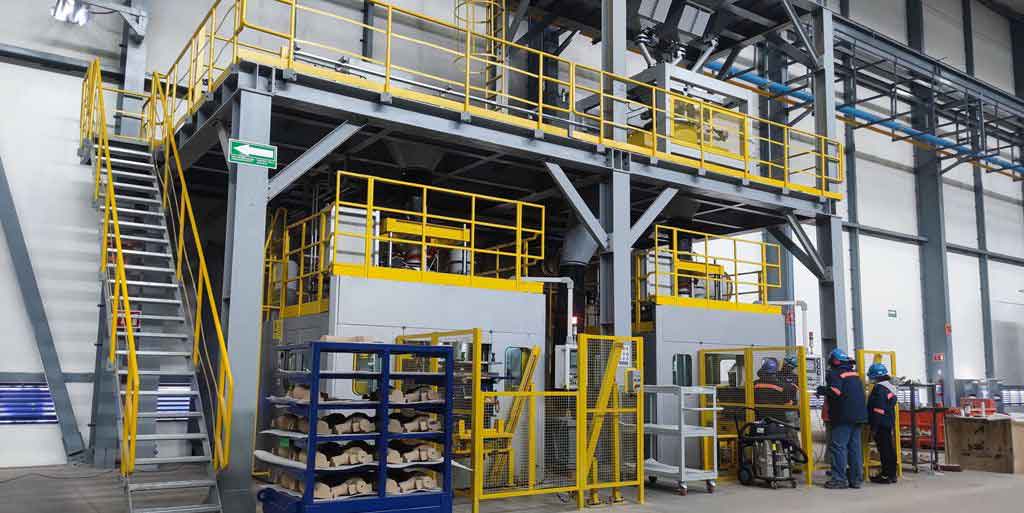
The image above illustrates typical equipment used in steel casting processes, highlighting the scale and complexity involved in manufacturing large turbine components. Such equipment is essential for implementing the optimized strategies I have described.
Simulation of Optimized Process and Inclusion Prediction
After implementing the optimizations, I reran the numerical simulations to assess their effectiveness. The filling process for the optimized steel casting showed a more uniform rise with reduced turbulence. The dual gating system allowed metal to enter simultaneously from top and bottom, creating a controlled agitation that carried inclusions toward the risers. The inclusion trajectory model was applied again, with particles released at various points. The results demonstrated a significant shift: most inclusion particles ended up in the riser zones rather than within the steel casting body.
For instance, particles from the top entry tended to descend initially but were then carried upward by the flow, while particles from the bottom entry floated directly to the surface. The trajectory equations, incorporating the updated velocity fields, confirmed this behavior. The force balance on particles indicated that buoyancy forces $\mathbf{F}_b$ dominated in the optimized flow, as the melt velocity $\mathbf{v}$ was aligned to promote upward movement. A comparative analysis is presented in Table 3, showing the reduction in inclusion risk due to process changes in steel castings.
| Aspect | Initial Process | Optimized Process | Improvement |
|---|---|---|---|
| Filling Time | ~120 s | ~80 s | 33% reduction |
| Inclusion Concentration in Casting Body | High (mid-section and riser gaps) | Low (mostly in risers) | Estimated 70% decrease |
| Flow Turbulence Intensity | Moderate to high near ingates | Controlled, evenly distributed | Enhanced flotation |
| Solidification Gradient | Non-uniform, shallow | Steep, directional from chills | Better feeding, fewer shrinkage defects |
Mathematically, the effectiveness of inclusion removal can be expressed by the flotation efficiency $\eta$:
$$ \eta = 1 – \frac{C_{final}}{C_{initial}} $$
where $C_{initial}$ and $C_{final}$ are inclusion concentrations in the steel casting before and after optimization. Based on my simulations, $\eta$ exceeded 0.8 for the optimized process, indicating that over 80% of inclusions were redirected to risers. This is a substantial gain for steel casting quality.
Experimental Validation and Practical Implications
To validate the simulation predictions, the optimized process was applied in an actual foundry setting for producing the lower ring steel casting. The resulting castings were inspected using non-destructive techniques such as ultrasonic testing. The experimental findings closely matched the simulation outcomes: inclusion defects were predominantly confined to the riser areas, with the main body of the steel casting exhibiting minimal imperfections. This correlation underscores the reliability of numerical simulation as a tool for defect prediction in steel castings.
Furthermore, the optimized process reduced scrap rates and improved the mechanical properties of the steel casting. Tensile tests on samples from the optimized castings showed consistent strength values meeting the 06Cr13Ni4Mo specifications, with no degradation due to inclusions. The success of this approach extends beyond the lower ring; similar methodologies can be adapted for other steel casting components like the upper crown and blades, facilitating the assembly of entire turbine runners through welding. The holistic optimization of steel castings for turbine runners not only enhances product quality but also contributes to sustainable hydroelectric power generation by extending component lifespans.
Conclusions and Future Directions
In conclusion, my research demonstrates the pivotal role of numerical simulation in predicting and mitigating inclusion defects in large Francis turbine runner steel castings. By developing a trajectory model for inclusion particles and analyzing flow dynamics, I identified high-risk zones in the initial casting process and implemented targeted optimizations involving dual gating, exothermic risers, and strategic chilling. These modifications significantly reduced inclusion entrapment, as confirmed by both simulation and experimental validation. The key takeaway is that proactive simulation-based design can dramatically improve the quality and reliability of steel castings, which are fundamental to hydroelectric turbine performance.
Looking ahead, future work will focus on refining the inclusion prediction model to account for more complex phenomena, such as the interaction between inclusions and solidification fronts. Additionally, the integration of artificial intelligence for real-time process control in steel casting foundries holds promise for further optimization. As the demand for large-scale steel castings in energy applications grows, continued innovation in simulation and manufacturing techniques will be essential to meet stringent quality standards and operational efficiencies.