
As a dedicated steel castings manufacturer, we constantly encounter and address challenges related to defect formation in continuous casting processes. Drawing parallels from aluminum casting issues, such as the agglomeration of TiB2 particles and formation of Ti-V intermetallics, we recognize similar phenomena in steel production, where non-metallic inclusions can lead to pores, cracks, and reduced mechanical properties. This article delves into the mechanisms of inclusion formation, aggregation, and precipitation in steel continuous casting, offering insights and strategies from our experience as a steel castings manufacturer. We will extensively utilize tables and formulas to summarize key concepts, ensuring a comprehensive understanding of inclusion control for high-quality steel castings.
In steel continuous casting, molten steel is solidified into slabs, blooms, or billets through a water-cooled mold. As a steel castings manufacturer, we prioritize minimizing inclusions—non-metallic compounds like oxides, sulfides, and nitrides—that originate from deoxidation products, slag entrapment, or refractory erosion. These inclusions can agglomerate and precipitate within the casting nozzle or mold, akin to the TiB2 accumulation described in aluminum processes. When detached, they become embedded in the steel matrix, causing defects such as the hole formation observed in aluminum foil. For a steel castings manufacturer, controlling these inclusions is critical for achieving superior product integrity, especially in applications demanding high purity, such as automotive or aerospace components.
To systematically analyze inclusion behavior, we categorize common inclusions in steel casting. The table below summarizes their types, sources, and impacts, based on data from our operations as a steel castings manufacturer.
| Inclusion Type | Chemical Formula | Primary Sources | Typical Size Range (µm) | Impact on Steel Properties |
|---|---|---|---|---|
| Alumina (Al2O3) | Al2O3 | Deoxidation with Al, refractory wear | 1-50 | Reduces ductility, causes nozzle clogging |
| Calcium Aluminates | xCaO·yAl2O3 | Calcium treatment for sulfide shape control | 5-100 | Can improve machinability if controlled |
| Magnesia (MgO) | MgO | Refractory lining degradation | 2-30 | Induces brittle phases |
| TiN and TiC | TiN, TiC | Alloying with Ti, high nitrogen content | 0.5-10 | Enhances strength but may promote crack initiation |
| MnS | MnS | Sulfur impurity, solidification segregation | 1-20 | Reduces toughness, especially in rolled products |
As a steel castings manufacturer, we leverage thermodynamic principles to predict inclusion formation. For instance, the stability of oxides can be assessed using Gibbs free energy changes. For deoxidation reactions, such as the formation of alumina from aluminum in steel:
$$2[Al] + 3[O] \rightarrow Al_2O_3(s)$$
The equilibrium constant K is given by:
$$K = \frac{a_{Al_2O_3}}{[a_{Al}]^2 [a_{O}]^3}$$
where \(a\) denotes activity. In practice, as a steel castings manufacturer, we use such calculations to optimize deoxidation practices and minimize residual oxygen, thereby reducing alumina inclusion content. Similarly, for titanium-based inclusions like TiN, the solubility product is crucial:
$$[Ti][N] = K_{TiN} \exp\left(-\frac{\Delta G^\circ}{RT}\right)$$
Here, \(K_{TiN}\) is the equilibrium constant, \(\Delta G^\circ\) is the standard Gibbs free energy change, \(R\) is the gas constant, and \(T\) is temperature in Kelvin. By controlling Ti and N levels, we prevent excessive TiN precipitation, which can mimic the TiB2 issues in aluminum. Our role as a steel castings manufacturer involves continuous monitoring of these parameters through ladle metallurgy and secondary refining processes.
The agglomeration and precipitation of inclusions follow kinetic models. For spherical particles in molten steel, Stokes’ law describes the settling velocity \(v\):
$$v = \frac{2(\rho_p – \rho_m) g r^2}{9\eta}$$
where \(\rho_p\) is particle density, \(\rho_m\) is molten steel density, \(g\) is gravitational acceleration, \(r\) is particle radius, and \(\eta\) is dynamic viscosity. As a steel castings manufacturer, we apply this to estimate removal rates in tundishes or molds. However, agglomeration complicates this—particles can cluster due to van der Waals forces or turbulent flows, increasing effective size and precipitation likelihood. The rate of agglomeration can be expressed via Smoluchowski’s equation for perikinetic aggregation:
$$\frac{dN}{dt} = -k N^2$$
with \(N\) as particle number concentration and \(k\) as aggregation kernel. In casting nozzles, similar to the aluminum case, inclusions may accumulate and detach periodically, leading to defect formation. We, as a steel castings manufacturer, mitigate this by optimizing nozzle design and flow control to reduce stagnation zones.
Intermetallic compounds, such as Ti-V phases in aluminum, have analogs in steel, like complex carbides or nitrides. Their precipitation during solidification can be analyzed using phase diagrams and Scheil-Gulliver simulations. For a steel castings manufacturer, controlling cooling rates is vital to avoid detrimental phases. The volume fraction of precipitates \(f\) can be estimated from:
$$f = \frac{C_0 – C_s}{C_p – C_s}$$
where \(C_0\) is initial solute concentration, \(C_s\) is solute in solid solution, and \(C_p\) is solute in precipitate. We integrate such models into our process controls to ensure fine, dispersed precipitates that enhance properties rather than cause defects.
Preventive measures adopted by a steel castings manufacturer include rigorous melt purification, effective slag practices, and advanced filtration. The table below outlines key strategies and their effectiveness based on our production data.
| Strategy | Description | Inclusion Reduction Efficiency (%) | Implementation Cost |
|---|---|---|---|
| Argon Stirring | Gas injection in ladle to promote inclusion flotation | 40-60 | Moderate |
| Tundish Flux Cover | Using basic fluxes to absorb inclusions | 30-50 | Low |
| Ceramic Filters | Placement in casting stream to trap particles >20 µm | 70-90 | High |
| Electromagnetic Braking | Reducing turbulent flow in mold to prevent agglomeration | 50-70 | High |
| Alloy Design Optimization | Limiting elements prone to inclusion formation (e.g., Ti, V) | 20-40 | Low to Moderate |
As a steel castings manufacturer, we emphasize that inclusion control is not a one-step process but a holistic approach from raw material selection to final solidification. For example, we closely monitor the behavior of titanium and vanadium additions, which can form hard intermetallics analogous to TiV compounds in aluminum. Thermodynamic software, such as FactSage, aids in predicting phase equilibria, with calculations for complex systems like Fe-Ti-V-C-N. The formation energy \(\Delta G_f\) for a compound like (Ti,V)C can be approximated by:
$$\Delta G_f = \sum x_i \mu_i^\circ + RT \sum x_i \ln x_i + \Delta G^{ex}$$
where \(x_i\) are mole fractions, \(\mu_i^\circ\) are standard chemical potentials, and \(\Delta G^{ex}\) is excess Gibbs energy. By adjusting compositions, we minimize harmful precipitates, ensuring that our products meet stringent standards as a trusted steel castings manufacturer.
In practice, we have implemented real-time monitoring systems for inclusion detection, such as ultrasonic testing and total oxygen analysis. These tools help us correlate process variables with defect rates. For instance, regression analysis might reveal that tundish temperature \(T_t\) and casting speed \(v_c\) influence inclusion content \(I\) according to:
$$I = \alpha + \beta T_t + \gamma v_c + \delta T_t v_c + \epsilon$$
with coefficients determined empirically. As a steel castings manufacturer, we use such models to optimize parameters, reducing hole-like defects in final products. Additionally, we collaborate with research institutions to explore novel techniques, such as nanoparticle additions for inclusion modification, though this remains an emerging field.
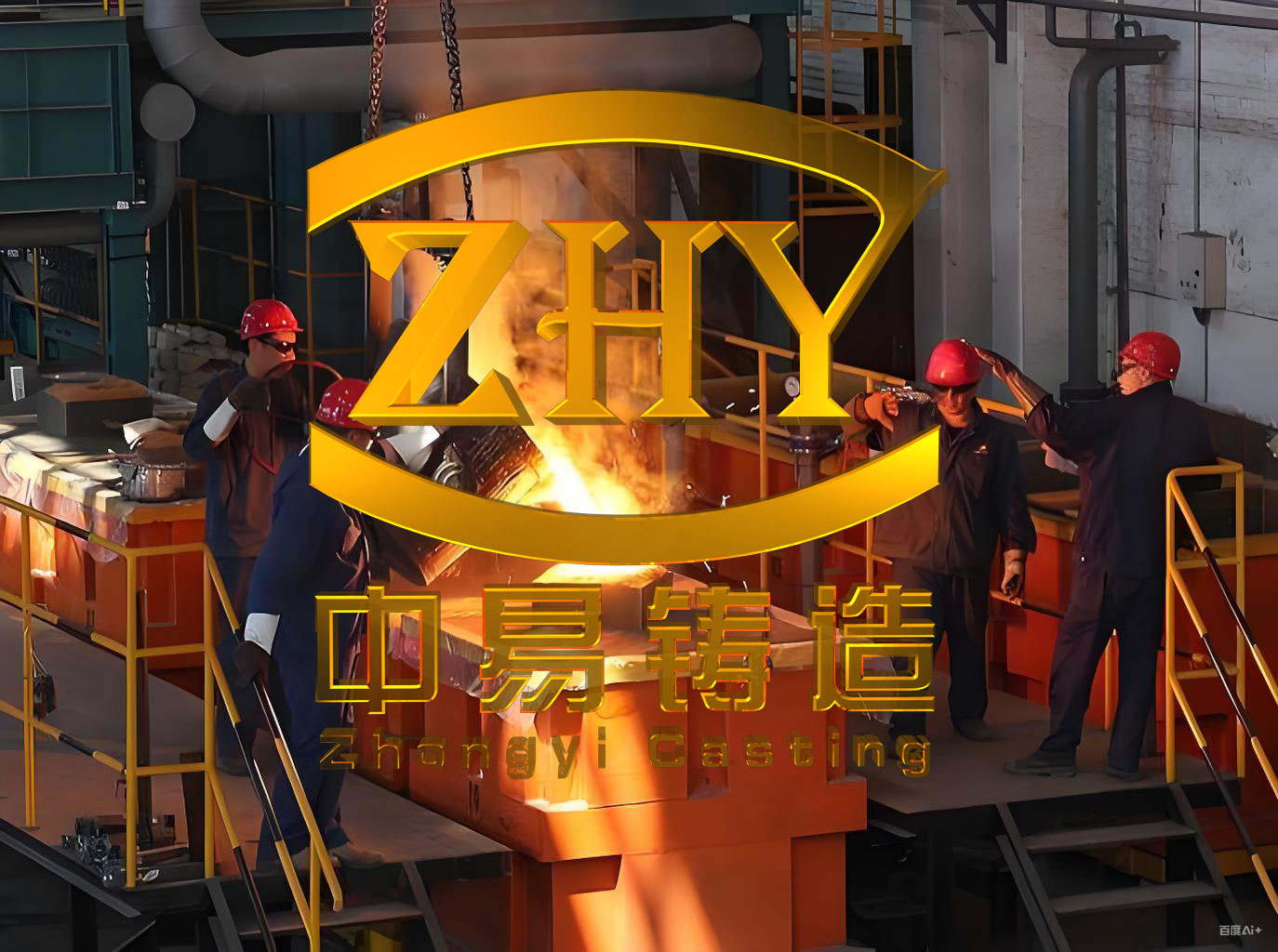
The integration of advanced technologies is paramount for a modern steel castings manufacturer. For example, automation in ladle furnace operations ensures precise deoxidation, while computational fluid dynamics (CFD) simulations visualize flow patterns in casting nozzles, identifying zones where inclusions might accumulate. We derive governing equations from Navier-Stokes for incompressible flow:
$$\rho \left( \frac{\partial \mathbf{v}}{\partial t} + \mathbf{v} \cdot \nabla \mathbf{v} \right) = -\nabla p + \mu \nabla^2 \mathbf{v} + \mathbf{f}$$
where \(\mathbf{v}\) is velocity, \(p\) is pressure, \(\mu\) is viscosity, and \(\mathbf{f}\) represents body forces. By solving these numerically, we design nozzles that minimize recirculation, thereby reducing inclusion deposition risks. This proactive approach distinguishes a leading steel castings manufacturer from competitors, as it directly enhances product reliability.
Furthermore, as a steel castings manufacturer, we address the role of refractory materials in inclusion generation. Low-quality refractories can erode, introducing oxides into the melt. We select high-alumina or zirconia-based refractories with low reactivity, and their wear rate \(W\) can be modeled using an Arrhenius-type equation:
$$W = A \exp\left(-\frac{E_a}{RT}\right) t^b$$
with \(A\) as pre-exponential factor, \(E_a\) activation energy, \(t\) time, and \(b\) an exponent. Regular maintenance schedules based on such models help us sustain clean steel production. Additionally, we consider the economic aspects: inclusion-related defects can lead to scrap rates of 5-10%, impacting profitability for any steel castings manufacturer. Hence, investing in prevention yields long-term savings.
To illustrate the cumulative impact of these strategies, we present a case study from our facility. Over a year, we reduced inclusion-induced defects by 60% through combined measures: optimizing argon stirring patterns, installing ceramic filters, and tightening compositional controls. Statistical process control charts tracked key variables, with capability indices like Cpk exceeding 1.33. This success underscores the importance of a systematic approach for a steel castings manufacturer aiming for excellence.
Looking ahead, as a steel castings manufacturer, we are exploring machine learning algorithms to predict inclusion behavior from historical data. Neural networks can correlate input parameters (e.g., melt chemistry, temperature) with output defects, providing real-time adjustments. The general form for a prediction model might be:
$$y = f\left(\sum_{i=1}^n w_i x_i + b\right)$$
where \(y\) is defect probability, \(x_i\) are inputs, \(w_i\) weights, \(b\) bias, and \(f\) an activation function. Such innovations will redefine inclusion management, making processes more adaptive. Moreover, sustainability drives us to recycle scrap efficiently, but this introduces inclusion risks from contaminants; thus, as a steel castings manufacturer, we balance circular economy goals with quality assurance.
In conclusion, controlling inclusions in continuous casting is a multifaceted challenge that requires deep thermodynamic and kinetic insights. As a steel castings manufacturer, we have detailed how inclusions form, agglomerate, and precipitate, drawing parallels to aluminum casting issues. Through tables and formulas, we summarized inclusion types, prevention strategies, and analytical models. By leveraging advanced technologies and continuous improvement, a steel castings manufacturer can significantly reduce defects, ensuring high-quality products for demanding applications. Our commitment as a steel castings manufacturer is to innovate and share knowledge, advancing the industry toward zero-defect casting processes. The journey involves constant learning—from melt treatment to solidification control—and we are proud to contribute as a dedicated steel castings manufacturer in this evolving landscape.