
In the realm of advanced manufacturing, prototype investment casting represents a critical technique for producing complex metal components with high precision and surface quality. Traditional methods involve multiple steps such as wax pattern creation, ceramic slurry coating, stuccoing, drying, and high-temperature firing, which are time-consuming and limited by pattern geometry. However, the advent of additive manufacturing (AM) technologies has revolutionized this field, enabling direct fabrication of casting shells through processes like ceramic slurry extrusion. This study focuses on investigating the effect of sintering temperature on the mechanical and physical properties of prototype investment casting shells produced via AM, with an emphasis on optimizing performance for practical applications. The keyword “prototype investment casting” will be repeatedly emphasized to highlight its relevance in this context.
The development of prototype investment casting shells using AM offers significant advantages, including reduced lead times, cost-effectiveness for small batches, and the ability to create intricate geometries that are challenging with conventional techniques. Among various AM methods, ceramic slurry extrusion-based AM stands out due to its versatility in material selection, low equipment costs, and suitability for producing porous structures essential for shell permeability. In this process, a water-based ceramic paste is extruded and layer-by-layer deposited to form green bodies, which are then sintered at high temperatures to achieve the desired strength and stability. The sintering temperature plays a pivotal role in determining the final properties of the shell, such as bending strength, porosity, and shrinkage, which are crucial for successful prototype investment casting operations.
To explore this, I prepared shell material specimens using a ceramic slurry composed of bauxite powder (average particle size 24 μm, purity ≥86%), silica sol (SiO₂ content 30%), yttrium oxide powder (purity 99%, particle size 1 μm), glycerol, sodium polyacrylate, and fatty alcohol polyoxyethylene ether (JFC). The formulation is summarized in Table 1, designed to achieve optimal rheology for extrusion. After thorough mixing via ball milling for 12 hours, the slurry’s pH was adjusted to around 3-4 using dilute hydrochloric acid to ensure suitable viscosity for additive manufacturing. The specimens were designed as rectangular bars with dimensions of 40 mm × 10 mm × 4 mm, modeled in CAD software and converted to STL files for AM processing.
| Component | Mass Percentage (%) |
|---|---|
| Bauxite Powder | 65.50 |
| Silica Sol | 29.00 |
| Yttrium Oxide | 3.00 |
| Glycerol | 1.70 |
| Sodium Polyacrylate | 0.55 |
| JFC | 0.25 |
The additive manufacturing process involved extrusion through a nozzle with a diameter of 1.2 mm, layer height of 0.8 mm, and 5 layers to build up the specimens. The path planning ensured a closed outer surface with internal microporosity from交叉的挤出丝, balancing strength and permeability for prototype investment casting. After printing, the green bodies were freeze-dried at -30°C under vacuum for 3 hours to remove moisture without causing cracks. Sintering was conducted in a tubular furnace under air atmosphere, with heating rates of 10°C/min to target temperatures of 900°C, 950°C, 1000°C, 1050°C, and 1100°C, each held for 3 hours before furnace cooling. This range was selected to study the temperature-dependent evolution of properties critical for prototype investment casting shells.
To assess the performance, I measured bending strength using a three-point bend test with a span of 30 mm, porosity via Archimedes’ principle, and shrinkage by comparing pre- and post-sintering dimensions. Microstructural analysis was performed using scanning electron microscopy (SEM) on fracture surfaces, and phase composition was determined through X-ray diffraction (XRD). The results are systematically presented below, with a focus on how sintering temperature influences these parameters for prototype investment casting applications.
The bending strength of the sintered specimens, as shown in Figure 1 (described in text due to no image insertion), exhibited a brittle fracture behavior typical of ceramic materials. The stress-strain curves indicated linear elasticity until sudden failure, confirming the absence of plastic deformation. Quantitatively, the bending strength increased significantly from 3.42 MPa at 900°C to 7.31 MPa at 1000°C, representing a 113.7% improvement. Beyond 1000°C, the strength plateaued, reaching only 7.73 MPa at 1100°C, a mere 5.7% increase. This trend suggests that 1000°C is a critical threshold for strength development in these prototype investment casting shells. The data are summarized in Table 2, which correlates sintering temperature with key properties.
| Sintering Temperature (°C) | Bending Strength (MPa) | Porosity (%) | Shrinkage in Length (%) | Shrinkage in Width (%) | Shrinkage in Height (%) | Average Shrinkage (%) |
|---|---|---|---|---|---|---|
| 900 | 3.42 | 45.8 | 0.60 | 0.68 | 0.52 | 0.60 |
| 950 | 5.18 | 44.7 | 0.75 | 0.77 | 0.61 | 0.71 |
| 1000 | 7.31 | 43.6 | 0.83 | 0.85 | 0.69 | 0.79 |
| 1050 | 7.45 | 40.2 | 0.85 | 0.88 | 0.72 | 0.82 |
| 1100 | 7.73 | 36.8 | 0.89 | 0.92 | 0.74 | 0.85 |
Porosity, a vital parameter for gas escape during metal pouring in prototype investment casting, decreased continuously with rising sintering temperature. From 45.8% at 900°C, it dropped to 43.6% at 1000°C and further to 36.8% at 1100°C. This reduction is attributed to enhanced particle sintering and pore closure at higher temperatures. For prototype investment casting, optimal porosity ranges between 36% and 44% to balance strength and permeability; thus, 1000°C yields a suitable value of 43.6%. Shrinkage, which affects dimensional accuracy, increased in all directions with temperature, but the increments diminished above 1000°C. The average shrinkage rose from 0.60% at 900°C to 0.79% at 1000°C, then slowly to 0.85% at 1100°C. Low shrinkage is desirable for precise prototype investment casting, and 1000°C offers a compromise with minimal distortion.
To elucidate the underlying mechanisms, I analyzed the phase transformations using XRD. The bauxite powder contained phases like diaspore (Al₂O₃·H₂O), kaolinite (Al₂O₃·2SiO₂·2H₂O), and pyrophyllite (Al₂O₃·4SiO₂·H₂O), which undergo dehydration and recombination during sintering. The reactions can be expressed with LaTeX formulas as follows:
For diaspore dehydration (450-800°C):
$$ \text{Al}_2\text{O}_3 \cdot \text{H}_2\text{O} \rightarrow \text{Al}_2\text{O}_3 + \text{H}_2\text{O} $$
For kaolinite dehydration (400-700°C):
$$ \text{Al}_2\text{O}_3 \cdot 2\text{SiO}_2 \cdot 2\text{H}_2\text{O} \rightarrow \text{Al}_2\text{O}_3 \cdot 2\text{SiO}_2 + 2\text{H}_2\text{O} $$
For pyrophyllite dehydration (>700°C):
$$ \text{Al}_2\text{O}_3 \cdot 4\text{SiO}_2 \cdot \text{H}_2\text{O} \rightarrow 3\text{Al}_2\text{O}_3 \cdot 4\text{SiO}_2 + \text{H}_2\text{O} $$
At higher temperatures, metakaolin and metastable phases transform into mullite and silica. For instance, above 980°C:
$$ 3(\text{Al}_2\text{O}_3 \cdot 2\text{SiO}_2) \rightarrow 3\text{Al}_2\text{O}_3 \cdot 2\text{SiO}_2 + 4\text{SiO}_2 $$
And above 1080°C:
$$ 3(\text{Al}_2\text{O}_3 \cdot 4\text{SiO}_2) \rightarrow 3\text{Al}_2\text{O}_3 \cdot 2\text{SiO}_2 + 10\text{SiO}_2 $$
The XRD spectra revealed that at 900°C and 950°C, minor mullite phases were present due to residual mullite in the bauxite. By 1000°C, the phases predominantly consisted of mullite (3Al₂O₃·2SiO₂), alumina (Al₂O₃), and yttria (Y₂O₃), with complete conversion of kaolinite and pyrophyllite. This phase evolution correlates with the strength plateau beyond 1000°C, as mullite provides high-temperature reinforcement and silica-based binders crystallize, enhancing cohesion. The increase in mullite content can be quantified using the Scherrer equation for crystallite size, but qualitatively, it drives the performance improvements in prototype investment casting shells.
Microstructural examination via SEM further supported these findings. At 900°C, the fracture surface showed a layered structure from AM, with particles loosely connected by bridges and numerous pores, indicating limited sintering. Cracks were visible due to thermal stress. At 1000°C, particles became rounded and fused, with reduced pore size and improved bonding, explaining the strength jump. At 1100°C, extensive particle coalescence occurred, obliterating original shapes and decreasing porosity but with diminishing returns on strength. This microstructural evolution is critical for understanding how sintering temperature tailors properties for prototype investment casting. To visualize a typical investment casting process, consider the following image that illustrates the concept, though in this study, we focus on shell fabrication via AM:
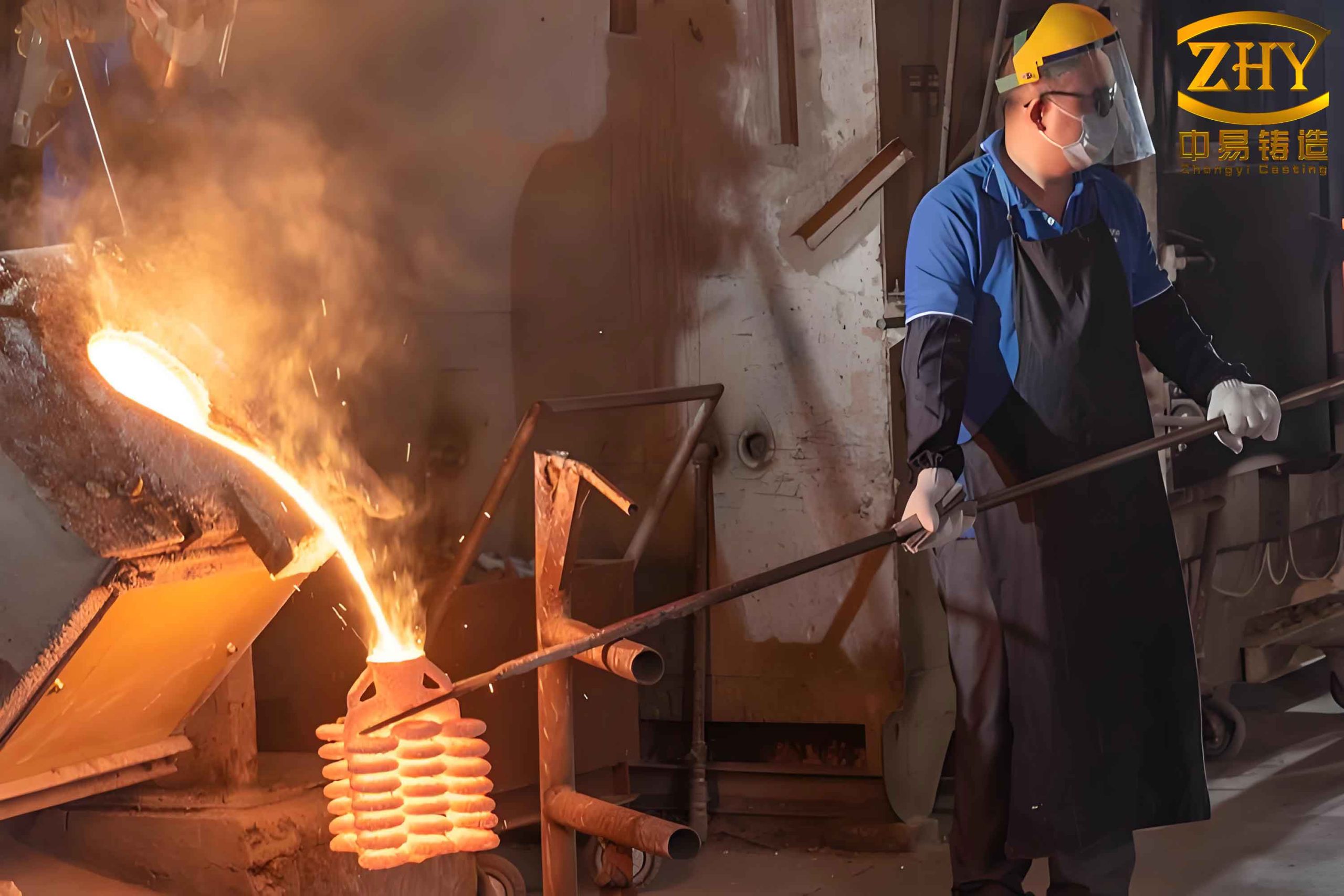
The image above depicts a conventional investment casting setup, but in our work, the shell is produced additively, bypassing the need for wax patterns. This innovation aligns with the goals of rapid prototype investment casting for complex geometries. The interplay between sintering temperature and material properties can be modeled using empirical equations. For instance, the bending strength (σ) as a function of temperature (T) can be approximated by a sigmoidal curve:
$$ \sigma(T) = \sigma_{\text{max}} – \frac{\sigma_{\text{max}} – \sigma_{\text{min}}}{1 + e^{k(T – T_c)}} $$
where σ_max is the maximum strength (around 7.7 MPa), σ_min is the minimum strength (3.42 MPa), k is a constant related to sintering kinetics, and T_c is the critical temperature (1000°C). Similarly, porosity (P) decreases exponentially with temperature:
$$ P(T) = P_0 e^{-\alpha T} $$
with P_0 as initial porosity and α as a sintering parameter. These models help optimize sintering for prototype investment casting shells.
In practice, I also fabricated prototype investment casting shell demonstrators, such as cylindrical and truncated pyramid hollow shells, to assess formability. Using the optimized slurry and AM parameters, followed by freeze-drying and sintering at 1000°C, the shells exhibited clear contours, no delamination, and the ability to form inclines up to 20° without supports. This demonstrates the feasibility of direct shell manufacturing for prototype investment casting, reducing steps and enabling customization. The success hinges on the balanced properties at 1000°C: sufficient strength for handling and pouring, adequate porosity for venting gases, and low shrinkage for dimensional fidelity.
To further contextualize, the advantages of this AM approach for prototype investment casting include sustainability by eliminating wax burn-off emissions, and flexibility in alloy selection since the shells withstand high temperatures. Compared to traditional methods, where shell cracking and residue are issues, AM-produced shells offer more consistent microstructures. However, challenges remain, such as optimizing slurry rheology for finer features and scaling up for large parts. Future work could explore other ceramic systems or hybrid compositions to enhance performance for demanding prototype investment casting applications.
In summary, sintering temperature profoundly affects the properties of additively manufactured prototype investment casting shells. Based on my experiments, 1000°C is identified as the optimal sintering temperature, yielding a bending strength of 7.31 MPa, porosity of 43.6%, and average shrinkage of 0.79%. These values meet the requirements for prototype investment casting in terms of mechanical integrity, gas permeability, and dimensional accuracy. The strength enhancement is primarily due to mullite phase formation and crystallization of silica-based binders, as confirmed by XRD and SEM. This research contributes to the advancement of rapid manufacturing techniques for prototype investment casting, enabling more efficient production of complex metal components. As additive manufacturing evolves, further refinements in sintering protocols will continue to improve the viability of prototype investment casting for industrial applications.