
In my extensive experience working with cast iron materials for automotive components, particularly brake discs, I have observed that the controlled addition of alloying elements is paramount for achieving desired performance characteristics. While gray iron, with its flake graphite structure, is traditionally favored for brake discs due to its excellent thermal conductivity and damping capacity, the study of elements like titanium (Ti) reveals insights that extend to other iron families, including nodular cast iron. This article delves into the effects of titanium content variations on the microstructure, mechanical properties, and manufacturability of HT200 gray iron brake discs. Furthermore, I will frequently draw comparisons to nodular cast iron to highlight how compositional adjustments can influence material behavior across different cast iron grades. The goal is to provide a comprehensive understanding that aids in optimizing material design for specific engineering demands.
The fundamental difference between gray iron and nodular cast iron lies in the morphology of the graphite phase. Gray iron contains interconnected flake graphite, which facilitates heat dissipation but can act as stress concentrators. Nodular cast iron, produced through magnesium or cerium inoculation, features spheroidal graphite nodules that blunt crack propagation, significantly enhancing toughness and tensile strength. The equation for the volume fraction of graphite, a critical microstructural parameter, can be expressed as:
$$ V_g = \frac{\rho_{matrix} – \rho_{bulk}}{\rho_{matrix} – \rho_{graphite}} $$
where $V_g$ is the graphite volume fraction, $\rho_{matrix}$ is the density of the metallic matrix (approximately 7.8 g/cm³ for ferrite/pearlite), $\rho_{bulk}$ is the measured density of the cast iron, and $\rho_{graphite}$ is the density of graphite (2.25 g/cm³). In both gray and nodular cast iron, alloying elements like titanium interact with carbon and other constituents, influencing graphite nucleation, growth, and matrix formation. The presence of titanium can form stable carbides and nitrides, such as TiC and TiN, which are extremely hard and can affect machinability. The free energy of formation for titanium carbide is given by:
$$ \Delta G_f^\circ(TiC) \approx -184,000 + 12.5T \text{ J/mol} $$
This high thermodynamic stability means that even small additions of titanium can lead to the precipitation of these compounds, altering the material’s behavior during solidification and service.
To systematically investigate the role of titanium, I designed an experimental series based on standard HT200 brake disc production. The base iron chemistry was maintained within a narrow range to isolate the effect of titanium. Three distinct melts were prepared with targeted titanium contents, as summarized in Table 1.
| Designation | C | Si | Mn | P | S | Cr | Cu | Sn | Ti |
|---|---|---|---|---|---|---|---|---|---|
| Low-Ti | 3.31 | 1.95 | 0.80 | 0.03 | 0.08 | 0.25 | 0.29 | 0.05 | 0.01 |
| Medium-Ti | 3.30 | 1.98 | 0.79 | 0.03 | 0.08 | 0.25 | 0.29 | 0.05 | 0.03 |
| High-Ti | 3.32 | 1.99 | 0.76 | 0.03 | 0.07 | 0.26 | 0.28 | 0.05 | 0.12 |
The melts were produced in a medium-frequency induction furnace. After preparing the base iron for the Low-Ti variant, ferrotitanium (75% Ti) was added to subsequent batches to achieve the Medium-Ti and High-Ti levels. All melts were poured into identical brake disc molds to ensure consistent cooling conditions. Samples for mechanical testing and metallography were extracted from standardized locations on the disc casting—specifically from the central section to avoid edge effects. Brinell hardness (HBW 10/1000) and tensile strength were measured according to ASTM standards. Metallographic examination involved sample preparation by grinding, polishing, and etching with 2% nital to reveal the microstructure. Graphite morphology, eutectic cell count, and matrix constituents were analyzed using optical microscopy and image analysis software.
The mechanical property data revealed a non-linear relationship with titanium content. Figure 1 (represented by the data below) shows the average Brinell hardness and tensile strength for each variant. Interestingly, both properties exhibited a minimum at a titanium content around 0.03%, increasing again at the higher 0.12% level. This suggests a dualistic role of titanium: at lower levels, it may act as a mild graphitizer, while at higher levels, it promotes matrix strengthening through solid solution and dispersion hardening effects.
| Titanium Content (wt.%) | Brinell Hardness (HBW) | Tensile Strength (MPa) |
|---|---|---|
| 0.01 | 168 | 205 |
| 0.03 | 160 | 195 |
| 0.12 | 172 | 200 |
To model the hardness response, a second-order polynomial can be fitted. Let [Ti] represent the weight percentage of titanium. The hardness (HB) can be approximated as:
$$ HB([Ti]) = 168.5 – 425[Ti] + 3541.7[Ti]^2 $$
Similarly, for tensile strength ($\sigma_t$):
$$ \sigma_t([Ti]) = 205.8 – 583.3[Ti] + 4166.7[Ti]^2 $$
These empirical relationships highlight the inflection point near 0.03-0.04% Ti. This behavior is less pronounced in nodular cast iron, where the graphite shape is decoupled from the direct influence of minor elements on flake formation. In nodular cast iron, titanium primarily affects the matrix and the stability of the nodularizing elements, potentially leading to carbide formation that can impair ductility if not controlled.
The microstructural evolution with increasing titanium was profound. Under the microscope, the Low-Ti sample exhibited predominantly Type A flake graphite, uniformly distributed in a fully pearlitic matrix. The Medium-Ti sample showed a noticeable coarsening of the graphite flakes, indicating a graphitizing effect. This correlates with the slight drop in hardness and strength. In contrast, the High-Ti sample displayed a mixed structure: areas of finer Type A graphite alongside significant regions of undercooled (Type D) graphite. Furthermore, the matrix revealed an increase in ferrite content, approximately 5%, surrounding the graphite phases. The eutectic cell structure also changed markedly. The number of eutectic cells per unit area decreased for the Medium-Ti sample, indicating larger cell sizes, and then increased again for the High-Ti sample, indicating refinement. This is quantified in Table 3.
| Titanium Content (wt.%) | Predominant Graphite Morphology | Eutectic Cell Count (cells/cm²) | Matrix Constituents (Estimated) |
|---|---|---|---|
| 0.01 | Type A Flakes | ~260 | >99% Pearlite |
| 0.03 | Coarsened Type A Flakes | ~130-260 | >99% Pearlite |
| 0.12 | Type A + Type D (Undercooled) | ~260-520 | 95% Pearlite, 5% Ferrite |
The change in eutectic cell count ($N_{ec}$) can be related to the nucleation potency of inclusions. Titanium-rich compounds can act as both nucleants and growth inhibitors. A simple model for cell count is:
$$ N_{ec} = N_0 \exp\left(-\frac{\Delta G^*}{k_B T}\right) $$
where $N_0$ is a pre-exponential factor, $\Delta G^*$ is the activation energy for nucleation, $k_B$ is Boltzmann’s constant, and $T$ is the solidification temperature. Titanium alters $\Delta G^*$ by changing the interfacial energy between graphite and the melt. The transition to undercooled graphite at high Ti levels is a classic sign of constitutional undercooling, where solute (Ti) buildup at the solid-liquid interface destabilizes planar growth, promoting a finer, more disordered structure. This phenomenon is also relevant in nodular cast iron processing, where excessive titanium can interfere with the nodulizing process, leading to degenerate graphite forms like compacted or vermicular graphite, which degrade mechanical properties.
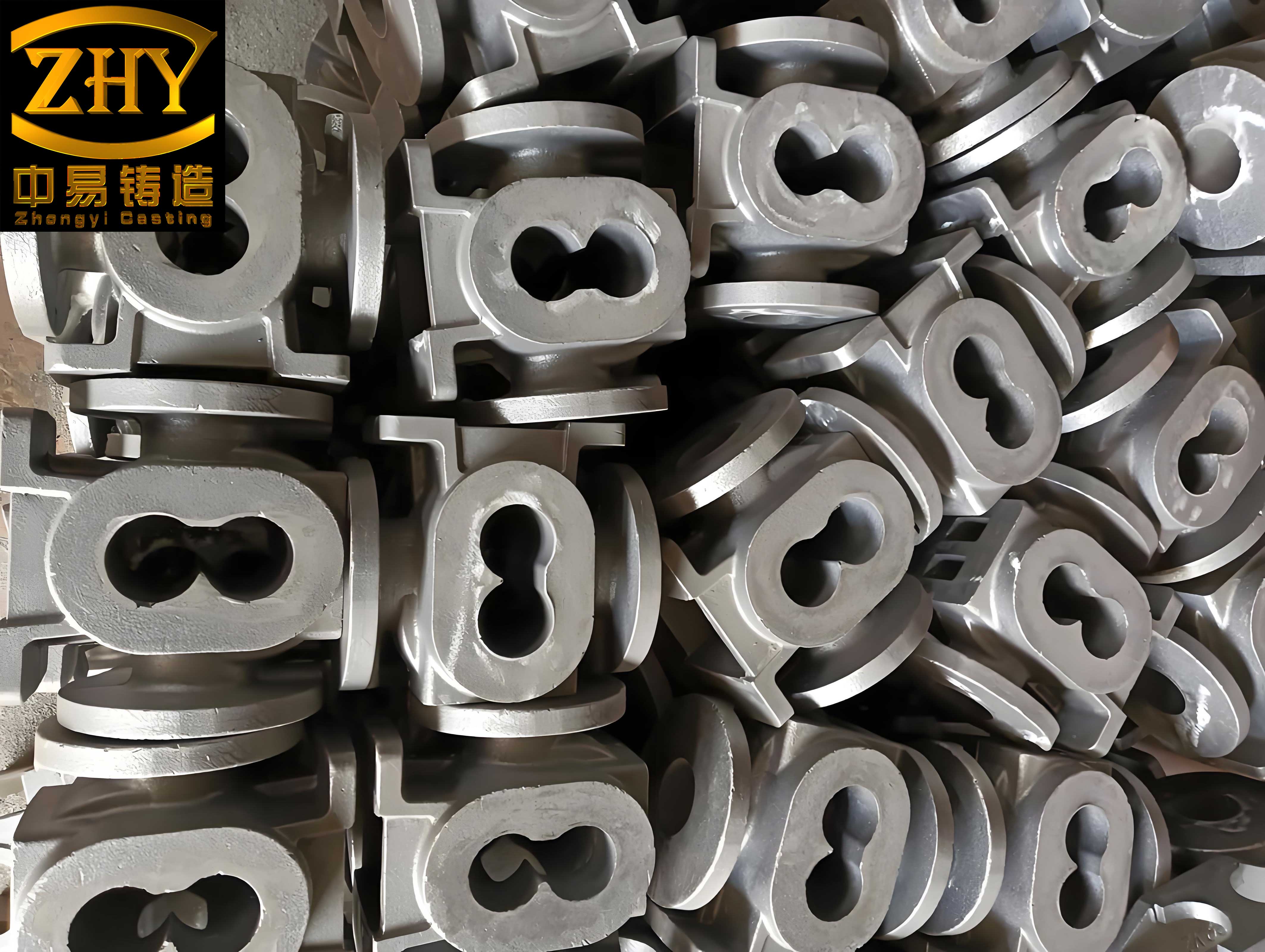
The visual contrast between the flake graphite of gray iron and the spheroidal graphite of nodular cast iron is stark, as hinted in the linked image. While this study focuses on gray iron, the principles of how titanium affects solidification kinetics and phase formation provide valuable cross-applications for nodular cast iron production. For instance, in nodular cast iron, titanium levels are typically kept very low (often below 0.04%) to prevent the formation of hard carbides that can reduce machinability and impact toughness.
Beyond static properties, the influence of titanium on casting soundness and manufacturability is critical for industrial production. Non-destructive testing via X-ray radiography revealed a clear trend: the incidence of shrinkage porosity increased dramatically with titanium content. The Low-Ti castings were virtually free of shrinkage defects. The Medium-Ti batch showed a minor percentage (approx. 1%) of discs with porosity, while the High-Ti batch exhibited shrinkage porosity in all castings examined. This can be explained by titanium’s effect on the solidification range and feeding characteristics. Titanium promotes a pasty mode of solidification by stabilizing carbides and altering the graphite formation sequence, which impedes interdendritic feeding. The Niyama criterion, a common model for predicting shrinkage porosity, can be adapted:
$$ G / \sqrt{\dot{R}} \leq C $$
where $G$ is the temperature gradient, $\dot{R}$ is the cooling rate, and $C$ is a constant. Titanium additions effectively reduce the critical value of $C$ for sound casting, making the alloy more prone to shrinkage. This is a significant concern for both gray and nodular cast iron, as shrinkage defects act as stress raisers and can lead to premature failure under cyclic loading, such as in brake disc applications.
The machinability assessment yielded equally important findings. During turning and grinding operations, the Low-Ti and Medium-Ti discs behaved normally, with acceptable tool wear and surface finish. However, the High-Ti discs presented severe machining challenges. Turning produced unusually high noise levels and rapid tool wear. Grinding operations were particularly problematic; the abrasive wheels seemed unable to efficiently cut the material, leaving visible turning marks on the surface—a clear indication of poor grindability. This is directly attributable to the hard titanium carbonitride (Ti(C,N)) precipitates that form at higher titanium levels. The hardness of these particles often exceeds that of common tool materials like cemented carbide or even aluminum oxide abrasives. The volume fraction of these hard phases ($V_{hp}$) can be estimated from the stoichiometry:
$$ V_{hp} \approx \frac{[Ti] – [Ti]_{sol}}{A_{Ti}} \cdot \frac{\rho_{iron}}{\rho_{TiC}} $$
where $[Ti]_{sol}$ is the titanium in solid solution (very low), $A_{Ti}$ is the atomic weight of titanium, and $\rho$ denotes densities. Even a small volume fraction of these ultra-hard particles can drastically increase the abrasive wear during machining. In nodular cast iron, similar issues arise if titanium levels are not controlled, though the spherical graphite generally provides better chip breaking and lower cutting forces compared to gray iron’s continuous flakes.
To synthesize these findings into practical guidelines for both gray and nodular cast iron production, I propose the following framework. The optimal titanium content is a balance between potential benefits (like wear resistance enhancement through hard phases) and detriments (reduced machinability, increased shrinkage, and potential matrix softening at intermediate levels). For HT200-grade gray iron brake discs, my experimental data strongly suggests maintaining titanium at or below 0.03 wt.%. At this level, the graphitizing effect is mild, mechanical properties meet specifications, casting soundness is good, and machinability remains acceptable. For applications where higher wear resistance is desired, alternative alloying elements like chromium or molybdenum, which provide solid solution strengthening without the severe machinability penalty of titanium, should be considered.
The implications for nodular cast iron are parallel but nuanced. While nodular cast iron inherently possesses higher strength and toughness, its production is more sensitive to trace elements. Titanium is known to be a potent anti-nodularizing element; it can consume nodulizers like magnesium or cerium, leading to graphite degeneration. Therefore, in high-quality nodular cast iron (e.g., grades like EN-GJS-400-18 or EN-GJS-700-2), titanium is typically specified at very low maximum levels, often 0.04% or lower. Exceeding these limits risks the formation of titanium carbides and nitrides, which not only impair machinability—a key consideration for many nodular cast iron components like crankshafts or gearboxes—but can also nucleate fatigue cracks, reducing component life. The relationship between fatigue strength ($\sigma_f$) and inclusion size (like TiN particles) often follows a power law:
$$ \sigma_f \propto d^{-1/2} $$
where $d$ is the inclusion diameter. Controlling titanium content is thus crucial for minimizing harmful large inclusions.
In conclusion, this investigation into titanium’s role in gray iron brake discs underscores the complex, concentration-dependent nature of alloying effects in cast irons. Titanium transitions from a mild graphitizer at low levels to a promoter of undercooled graphite and hard particle formation at high levels, with significant consequences for mechanical properties, casting integrity, and most notably, machinability. These insights are not confined to gray iron; they resonate strongly with the production and performance of nodular cast iron. Both families of materials require meticulous control over titanium and other trace elements to achieve the optimal balance of castability, service properties, and manufacturability. Future work could involve modeling the thermodynamic equilibrium of titanium compounds in multicomponent systems common to both gray and nodular cast iron, further refining compositional windows for specific applications. The continuous interplay between microstructure, governed by composition and processing, and macroscopic performance remains the cornerstone of advanced cast iron metallurgy.