
In the pursuit of advanced materials for critical infrastructure, such as railway systems operating in harsh climatic conditions, the development of spheroidal graphite cast iron with superior mechanical properties at ultra-low temperatures has become a paramount objective. My research focuses on engineering spheroidal graphite cast iron grades that simultaneously exhibit high strength, high toughness, and excellent impact resistance at temperatures as low as -40°C. This work is driven by stringent industrial standards, like TJ/JW 065—2015, which demand materials surpassing conventional ductile iron grades like QT500-7 in both tensile strength and low-temperature ductility. Traditional grades often fall short, necessitating alloy design and process optimization to achieve a unique combination of properties without costly heat treatments. Through systematic experimentation, I have explored the effects of key alloying elements, impurity control, and inoculation practices on the microstructure and mechanical performance of spheroidal graphite cast iron. The ultimate goal is to establish reliable production guidelines for spheroidal graphite cast iron components, such as gearboxes, that ensure safety and durability in frigid environments. This article details my comprehensive investigation, presenting data, analyses, and conclusions aimed at advancing the field of high-integrity spheroidal graphite cast iron.
The foundation of this study lies in the meticulous control of composition and processing. I began by selecting raw materials to minimize detrimental elements and provide a consistent base. The primary charge materials included Q10 pig iron, high-purity pig iron, steel scrap, and various ferroalloys. Their chemical compositions are summarized in Table 1. To achieve graphite spheroidization and inoculation, specific nodulizing and inoculating agents were employed, with their compositions detailed in Table 2. Controlling these inputs is critical for producing high-quality spheroidal graphite cast iron.
| Material | C | Si | Mn | P | S | V | Ti |
|---|---|---|---|---|---|---|---|
| Q10 Pig Iron | 4.39 | 0.54 | 0.06 | 0.022 | 0.013 | 0.01 | 0.03 |
| High-Purity Pig Iron | 4.21 | 0.09 | 0.04 | 0.031 | 0.005 | 0.01 | 0.01 |
| Steel Scrap | 0.16 | 0.17 | 0.61 | 0.015 | 0.009 | – | – |
| Agent | Si | Mg | RE | Ca | Ba | Al | MgO |
|---|---|---|---|---|---|---|---|
| Nodulizer | 44-47 | 4.5-5.5 | 0.6-1.0 | 0.8-1.2 | – | 1.0 | 0.4 |
| Inoculant | 65-75 | – | – | 1-1.2 | 1.8-2.5 | 0.6-1.0 | – |
Melting was conducted in a 100 kg medium-frequency induction furnace, with temperatures carefully monitored: melting at 1500–1550°C, tapping at 1500–1520°C, and pouring at 1380–1420°C. The treatment process involved a sandwich method for nodulization, using 1.0–1.5% nodulizer, followed by inoculation via bottom-of-the-ladle addition and a second inoculation when about 80% of the iron was tapped. A final inoculant was added during pouring using a proprietary feeding device. Test specimens were cast as Y-blocks, with dimensions standardized for subsequent mechanical and microstructural evaluation. The microstructure of the spheroidal graphite cast iron was examined using metallographic microscopy according to ISO 945, while mechanical testing included tensile tests, Brinell hardness measurements, and Charpy impact tests at room temperature and -40°C. The integrity of the spheroidal graphite morphology is fundamental to the performance of spheroidal graphite cast iron.
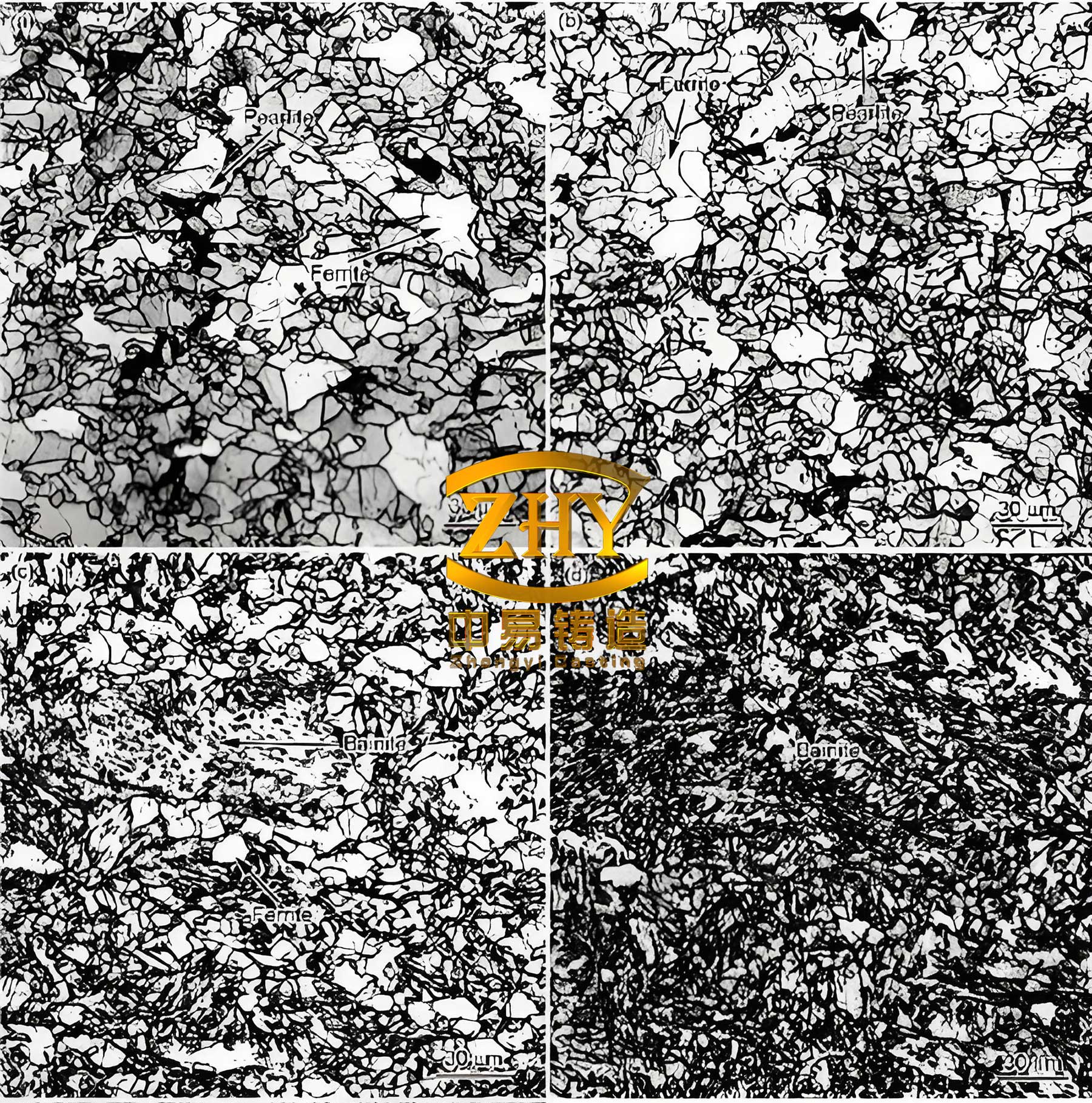
The first phase of experimentation assessed the individual and combined effects of alloying elements on the base spheroidal graphite cast iron grades QT500-7 and QT600-7. Nickel is known to enhance toughness and low-temperature performance in spheroidal graphite cast iron. I initially examined the impact of nickel alone, varying its content from 0.9% to 1.9% in a QT500-7 matrix. The results, plotted in Figure 2, showed that nickel addition improved low-temperature impact energy and elongation, but tensile strength only exceeded 500 MPa when nickel reached 1.9%. This implied that relying solely on nickel for strength enhancement in spheroidal graphite cast iron is economically inefficient. The microstructure, as seen in Table 3, transitioned from ferrite-dominated to ferrite-pearlite mixtures with increasing nickel. The relationship between nickel content and tensile strength can be approximated by a linear model for the range studied:
$$ R_m(Ni) = 450 + 30 \times [Ni] \quad \text{(MPa, for [Ni] in wt.%)} $$
where $R_m$ is the tensile strength. While effective, the high nickel requirement prompted exploration of composite additions.
| Experiment | Ni (wt.%) | Graphite Morphology (ISO 945) | Matrix Structure |
|---|---|---|---|
| 1 | 0.9 | 85% VI5/6 + 15% V5/6 | Ferrite + <10% Pearlite |
| 2 | 1.3 | 85% VI5/6 + 15% V5/6 | Ferrite + (10–20)% Pearlite |
| 3 | 1.6 | 85% VI5/6 + 15% V5/6 | Ferrite + (15–25)% Pearlite |
| 4 | 1.9 | 85% VI5/6 + 15% V5/6 | Ferrite + (25–35)% Pearlite |
Next, I evaluated a nickel-molybdenum combination, fixing molybdenum at 0.17% while varying nickel from 0.6% to 1.0%. As shown in Figure 3 and Table 4, this pairing provided adequate low-temperature impact values (above 4 J at -40°C) but failed to consistently achieve the target tensile strength of 500 MPa for spheroidal graphite cast iron. Molybdenum’s potency as a pearlite promoter at higher levels would detrimentally affect ductility and toughness, and its cost is significant. Thus, this route was deemed less suitable for producing cost-effective high-strength spheroidal graphite cast iron.
| Experiment | Ni (wt.%) | Graphite Morphology (ISO 945) | Matrix Structure |
|---|---|---|---|
| 1 | 0.6 | 85% VI5/6 + 15% V5/6 | Ferrite + (5–10)% Pearlite |
| 2 | 0.7 | 85% VI5/6 + 15% V5/6 | Ferrite + (10–20)% Pearlite |
| 3 | 0.8 | 80% VI5/6 + 20% V5/6 | Ferrite + (15–25)% Pearlite |
| 4 | 0.9 | 80% VI5/6 + 20% V5/6 | Ferrite + (25–35)% Pearlite |
| 5 | 1.0 | 80% VI5/6 + 20% V5/6 | Ferrite + (25–35)% Pearlite |
The most promising results emerged from the nickel-copper synergistic addition. Copper is a cost-effective strengthener that promotes pearlite formation without severely compromising toughness in controlled amounts. I conducted extensive trials on both QT500-7 and QT600-7 base spheroidal graphite cast iron, systematically varying nickel and copper contents. The data, summarized in Figures 4 and 5 and Table 5, reveal a clear optimization window. For a spheroidal graphite cast iron grade analogous to QT500-7LT (designed for ultra-low temperature service), the optimal ranges are nickel 0.8–2.0% and copper 0.1–0.2%. This combination yields tensile strength above 500 MPa, elongation over 8%, and -40°C impact energy averaging ≥4 J. For a higher-strength variant, QT600-7LT spheroidal graphite cast iron, the ranges are nickel 1.0–2.0% and copper 0.2–0.5%, achieving tensile strength exceeding 600 MPa, yield strength (Rp0.2) ≥370 MPa, elongation ≥7%, and satisfactory low-temperature impact resistance. The strengthening contribution can be modeled using a composite equation, considering the solid solution and matrix-stabilizing effects:
$$ R_m(Ni, Cu) = R_{m0} + k_{Ni}[Ni] + k_{Cu}[Cu] – k_{S}[S] $$
where $R_{m0}$ is the base strength of the unalloyed spheroidal graphite cast iron, and $k_{Ni}$, $k_{Cu}$, and $k_{S}$ are coefficients determined empirically. For the studied spheroidal graphite cast iron systems, approximate values are $k_{Ni} \approx 25–35$ MPa/wt.%, $k_{Cu} \approx 80–100$ MPa/wt.%, and $k_{S} \approx -2000$ MPa/wt.%, highlighting the profound negative effect of sulfur.
| Experiment | Cu (wt.%) | Graphite Morphology (ISO 945) | Matrix Structure |
|---|---|---|---|
| 1 | 0.12 | 80% VI6/7 + 20% V6 | Ferrite + (5–15)% Pearlite |
| 2 | 0.15 | 85% VI6/7 + 15% V6 | Ferrite + (10–20)% Pearlite |
| 3 | 0.18 | 85% VI6/7 + 15% V6 | Ferrite + (15–25)% Pearlite |
| 4 | 0.20 | 80% VI6/7 + 20% V6 | Ferrite + (20–30)% Pearlite |
| 5 | 0.22 | 85% VI6/7 + 15% V6/7 | Ferrite + (30–40)% Pearlite |
Sulfur content proved to be a critical factor influencing the consistency and performance of spheroidal graphite cast iron. High sulfur levels increase the demand for nodulizing agents, promote inclusions, and deteriorate mechanical properties. I compared melts using high-purity pig iron (low sulfur, ≤0.008%) versus regular Q10 pig iron (higher sulfur, ≥0.012%), keeping nickel and copper constant. The results, depicted in Figure 6, are striking: the low-sulfur spheroidal graphite cast iron exhibited tensile strength above 550 MPa, while the high-sulfur variant struggled to reach 500 MPa. The impact energy and elongation were also superior in the low-sulfur material. This underscores the necessity of maintaining sulfur within a tight window of 0.004–0.008% for producing premium-grade spheroidal graphite cast iron. The detrimental effect of sulfur on nodule count and shape can be quantified by an inverse relationship, where the nodule count $N$ per unit area decreases as sulfur increases:
$$ N \propto \frac{1}{[S]^{0.5}} $$
Thus, stringent control of sulfur is non-negotiable for achieving the desired microstructure in high-performance spheroidal graphite cast iron.
Beyond composition, the inoculation and nodulization process plays a pivotal role in defining the final properties of spheroidal graphite cast iron. I investigated two distinct approaches: conventional single-stage inoculation versus a compound inoculation process involving multiple stages and possibly different inoculant types. The compound process aimed to enhance graphite nucleation, improve spheroidization efficiency, and promote a finer, more uniform distribution of graphite nodules in the spheroidal graphite cast iron matrix. For the QT600-7LT grade, the comparison results are tabulated in Table 6. The compound inoculation consistently yielded a higher percentage of small, well-formed graphite nodules (85% VI6/7 versus 80% VI6/7) and a slightly higher ferrite content in the pearlitic-ferritic matrix. This microstructural refinement translated directly into enhanced low-temperature toughness: the -40°C Charpy impact energy increased by 9.3% to 25% compared to conventional inoculation. This improvement can be attributed to the reduction in stress concentration sites and the more favorable crack propagation resistance offered by the refined spheroidal graphite cast iron microstructure. The efficacy of compound inoculation can be represented by a parameter $I_{eff}$, which correlates with the final impact energy $KV_{-40}$:
$$ KV_{-40} = \alpha \cdot I_{eff} + \beta \cdot [F] + \gamma $$
where $[F]$ is the ferrite volume fraction, and $\alpha, \beta, \gamma$ are constants. $I_{eff}$ is higher for compound processes due to increased nucleation sites.
| Process | Specimen | Graphite Morphology (ISO 945) | Matrix Structure | -40°C Impact Energy (J) Single / Average |
|---|---|---|---|---|
| Conventional Inoculation | 1-1 | 80% VI6/7 + 20% V6 | Pearlite + (5–30)% Ferrite | 4, 4, 5 / 4.3 |
| 1-2 | 80% VI6/7 + 20% V6 | Pearlite + (5–30)% Ferrite | 4, 5, 4 / 4.3 | |
| 1-3 | 80% VI6/7 + 20% V6 | Pearlite + (5–30)% Ferrite | 4, 4, 4 / 4.0 | |
| Compound Inoculation | 2-1 | 85% VI6/7 + 15% V6 | Pearlite + (10–35)% Ferrite | 5, 5, 5 / 5.0 |
| 2-2 | 85% VI6/7 + 15% V6 | Pearlite + (10–35)% Ferrite | 4, 5, 5 / 4.7 | |
| 2-3 | 85% VI6/7 + 15% V6 | Pearlite + (10–35)% Ferrite | 5, 5, 5 / 5.0 |
In conclusion, my research demonstrates a viable pathway for developing high-strength, high-toughness spheroidal graphite cast iron suitable for ultra-low temperature applications. The nickel-copper alloying system, within specified ranges (Ni 0.8–2.0%, Cu 0.1–0.2% for QT500-7LT; Ni 1.0–2.0%, Cu 0.2–0.5% for QT600-7LT), provides an optimal balance of strength, ductility, and low-temperature impact resistance for spheroidal graphite cast iron. Rigorous control of sulfur impurity below 0.008% is essential to ensure consistent mechanical performance and graphite morphology in spheroidal graphite cast iron. Furthermore, adopting a compound inoculation and nodulization practice significantly enhances the low-temperature toughness by refining the graphite structure and promoting a beneficial matrix phase distribution. These findings offer practical guidelines for foundries aiming to produce advanced spheroidal graphite cast iron components that meet the demanding requirements of modern transportation and energy sectors. Future work may explore the effects of other minor elements, cooling rate optimization, and the long-term stability of these spheroidal graphite cast iron grades under cyclic thermal and mechanical loading. The continuous evolution of spheroidal graphite cast iron technology holds great promise for enabling safer and more reliable infrastructure in extreme environments.
The journey of optimizing spheroidal graphite cast iron is both challenging and rewarding. Each variable—from the purity of the charge materials to the timing of inoculant addition—interacts in complex ways to define the final cast iron’s character. Through this systematic study, I have reinforced the principle that excellence in spheroidal graphite cast iron production hinges on integrated control of chemistry and process. The data and models presented here serve as a foundation for further innovation, pushing the boundaries of what spheroidal graphite cast iron can achieve. As industries continue to seek materials that perform reliably from the arctic to the tropics, the role of engineered spheroidal graphite cast iron will only grow in importance, driven by its unique combination of castability, mechanical properties, and cost-effectiveness.