
As a foundry engineer deeply immersed in the field of machine tool casting, I have witnessed transformative advancements that redefine how we produce high-quality castings. The pursuit of excellence in machine tool casting drives our every experiment, and I am excited to share insights from our recent breakthroughs. In this narrative, I will detail two key innovations: the use of facing sand on clay cores and the application of vanadium-titanium rare earth iron, both of which have significantly enhanced the performance and quality of machine tool castings. Throughout this discussion, I will emphasize the critical role of machine tool casting in manufacturing, employing tables and formulas to encapsulate data, and repeatedly highlighting the term “machine tool casting” to underscore its importance.
Our journey began with a challenge in traditional foundry practices. For decades, the conventional method involved applying coatings on clay cores to improve surface finish, but this often led to issues like poor surface smoothness and difficult sand removal. Inspired by philosophical principles that encourage bold experimentation, we embarked on a mission to revolutionize this process. We hypothesized that adding facing sand to clay cores could yield superior results, and our trials confirmed this, leading to a paradigm shift in machine tool casting.
In our foundry, we focused on refining the core sand mixture to optimize performance. The core sand formulation is pivotal for achieving desired properties in machine tool casting, and we developed a recipe that balances strength, permeability, and collapsibility. Below is a table summarizing our core sand配方, with all components expressed as percentages relative to the total sand weight (a blend of river sand and red sand):
| Component | Percentage (%) | Function |
|---|---|---|
| Clay (Bentonite) | 5–6 | Binder for green strength |
| Water | 1–2 | Activates clay and controls moisture |
| Coal Dust | 0–2 (adjusted as needed) | Enhances surface finish and reduces sticking |
The properties of this core sand are critical for machine tool casting. We measure wet tensile strength, dry tensile strength, and permeability to ensure consistency. For instance, the wet tensile strength should exceed 0.28 kg/cm², which can be expressed using the formula for tensile stress: $$\sigma_t = \frac{F}{A}$$ where $\sigma_t$ is the tensile stress, $F$ is the force applied, and $A$ is the cross-sectional area. In our tests, we achieve values like $\sigma_t \geq 0.28 \, \text{kg/cm}^2$, ensuring the cores withstand handling during machine tool casting processes. Similarly, dry tensile strength is maintained above 0.7 kg/cm², and permeability exceeds 100 units, vital for allowing gases to escape during pouring.
For the facing sand used on clay cores, we modify the配方 by adding 6–8% more coal dust. This adjustment enhances the surface quality of machine tool castings, as the coal dust forms a protective layer that minimizes metal penetration and improves finish. The process of mixing and core making remains unchanged, making it cost-effective and efficient. When we cast parts using these cores, the internal cavities emerge remarkably smooth—akin to those produced by metal molds—and the sand detaches easily with a light tap. This innovation has been applied to critical components like engine cylinder blocks, a common element in machine tool casting, with consistent results since implementation. Notably, the lower sections of castings show slightly less smoothness than upper sections, possibly due to gravitational effects during solidification, but overall, the improvement is substantial.
Transitioning to another breakthrough, we explored the use of vanadium-titanium rare earth iron for producing high-strength machine tool castings. Leveraging abundant domestic resources, we developed a铸铁 that eliminates the need for scrap steel, relying solely on vanadium-titanium pig iron. This approach aligns with sustainable practices in machine tool casting. The chemical composition of the treated iron is meticulously controlled, as shown in the table below:
| Element | Composition Range (%) |
|---|---|
| Carbon (C) | 3.7–4.0 |
| Silicon (Si) | 2.6–2.8 |
| Manganese (Mn) | 0.7–0.8 |
| Phosphorus (P) | < 0.12 |
| Sulfur (S) | < 0.015 |
| Vanadium (V) | > 0.3 |
| Titanium (Ti) | > 0.1 |
| Rare Earth (RE) | 0.045–0.075 |
The treatment method involves a two-step process. First, we tap two-thirds of the molten iron and add 1.8% rare earth alloy into the trough, stirring thoroughly. Then, we add the remaining one-third of iron along with 0.8% ferrosilicon (75% Si) for inoculation. After rapid stirring and slag removal, we cover the melt with 0.3% cryolite powder and草灰 to protect it, ensuring quick pouring. This procedure enhances the microstructure and mechanical properties, crucial for durable machine tool casting.
The resulting铸铁 exhibits exceptional performance, with tensile strength reaching 45–50 kg/mm², peaking at 58 kg/mm². We express this using the engineering stress formula: $$\sigma = \frac{P}{A_0}$$ where $\sigma$ is the tensile strength, $P$ is the load, and $A_0$ is the original cross-sectional area. For bending strength, values range from 70 to 98 kg/mm², up to 106 kg/mm², with deflection exceeding 4 mm over a 300 mm gauge length. The hardness, measured on the Brinell scale, is 180–230 HB. These properties make it ideal for machine tool casting, where components face high stresses.
Moreover, the wear resistance of this material is outstanding, outperforming conventional孕育铸铁 HT32-52 by 5–6 times in阿姆斯拉 testing. This can be quantified using the wear rate formula: $$W = \frac{\Delta m}{A \cdot d}$$ where $W$ is the wear rate, $\Delta m$ is the mass loss, $A$ is the contact area, and $d$ is the sliding distance. The enhanced耐磨性 stems from vanadium and titanium forming hard compounds with nitrogen, reinforcing the matrix. In terms of microstructure, graphite appears as thick flakes, dots, with some clusters and spheroids, while the matrix is pearlitic, and eutectic cells are refined and irregular—a hallmark of improved machine tool casting quality.
In practical applications, we have successfully produced various machine tool castings, such as磨床 worktables,磨床 beds, hydraulic cylinders, and hydraulic tanks. These components demonstrate the versatility and reliability of our methods in machine tool casting. To visualize the outcome, consider the following image that captures the precision achievable in modern machine tool casting:
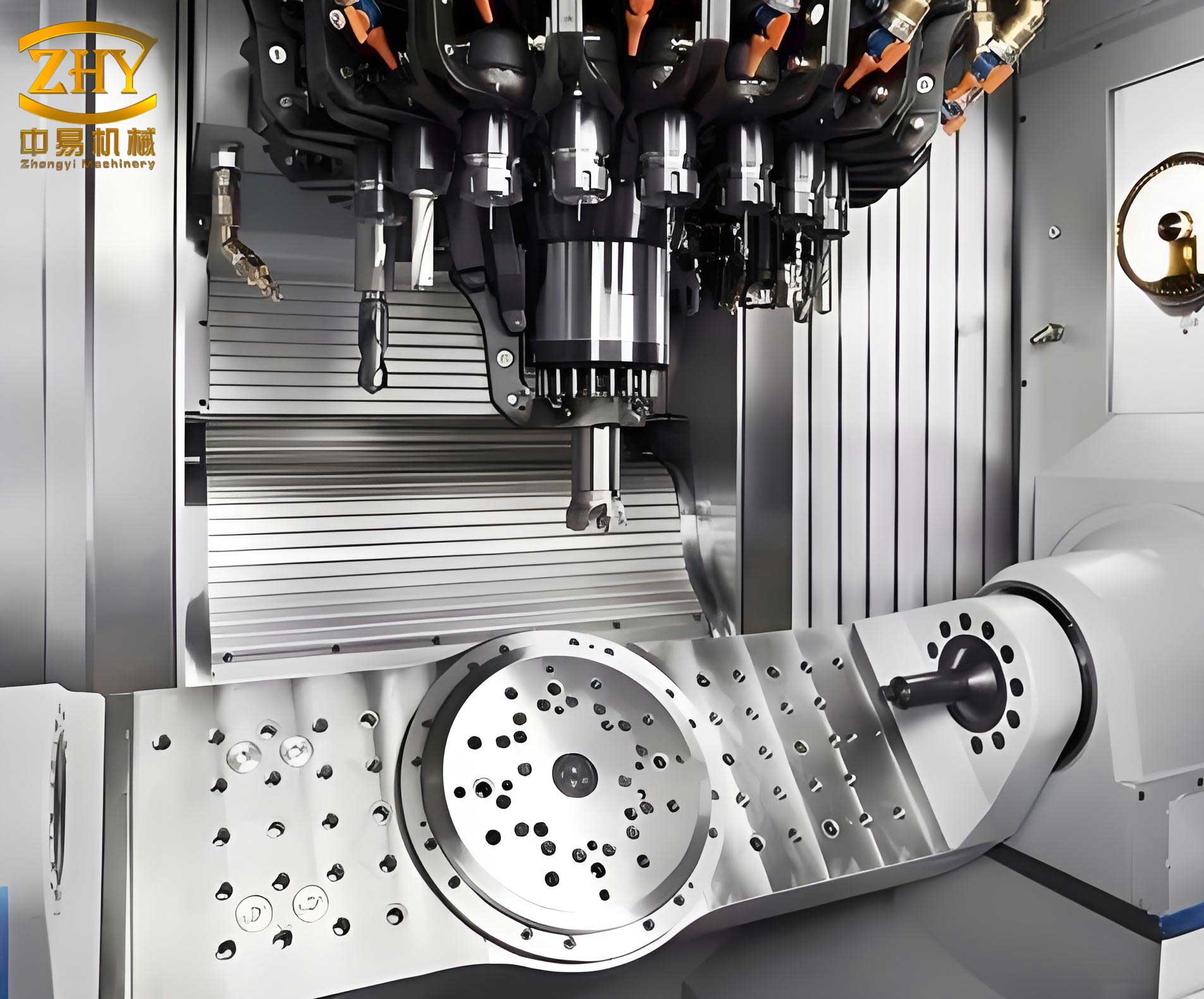
This image exemplifies the smooth surfaces and intricate details we attain through these innovations, underscoring the importance of machine tool casting in industrial manufacturing. Our ongoing research continues to push boundaries, with experiments on optimizing cooling rates and alloy additions to further enhance machine tool casting performance. For instance, we are investigating the relationship between cooling rate and tensile strength using the公式: $$\sigma_b = \sigma_0 + k \cdot \log(\dot{T})$$ where $\sigma_b$ is the ultimate strength, $\sigma_0$ is a material constant, $k$ is a coefficient, and $\dot{T}$ is the cooling rate. This helps tailor properties for specific machine tool casting applications.
In conclusion, the integration of facing sand on clay cores and vanadium-titanium rare earth iron has revolutionized our approach to machine tool casting. These advancements not only improve surface finish and清砂 ease but also boost mechanical properties and耐磨性, making machine tool casting more efficient and cost-effective. As we refine these techniques, the future of machine tool casting looks promising, with potential applications in aerospace, automotive, and beyond. I am proud to contribute to this evolving field, and I encourage fellow engineers to embrace innovation in machine tool casting for sustainable industrial growth. Through continuous experimentation and data-driven analysis—using tables, formulas, and empirical observations—we can elevate machine tool casting to new heights, ensuring that every casting meets the highest standards of quality and performance.