
In the realm of railway infrastructure, the durability and performance of critical components like frog heart rails are paramount. As a researcher engaged in foundry technology, I have focused on the casting process for high manganese steel combined frog heart rails, which are essential for modern railway systems. The unique properties of manganese steel, including its exceptional toughness, work-hardening capability, and wear resistance, make it an ideal material for these applications. However, the casting of such components presents significant challenges, particularly in avoiding defects that can compromise service life. Through extensive study and practical application in a manganese steel casting foundry, we have developed and refined a casting工艺 that addresses these issues, ensuring high-quality products for railway networks.
The initial casting process, as implemented in our manganese steel casting foundry, involved a horizontal gating system with multiple risers to mitigate shrinkage defects. This setup, while conventional, led to several issues in the castings. The design included four risers placed along the length of the heart rail, with a runner system aimed at ensuring smooth metal flow. However, upon inspection of the initial batch, defects such as gas porosity, slag inclusions, shrinkage cavities, and micro-cracks were prevalent. These defects, often located at critical sections like the transition zones where the cross-section changes, posed a risk of horizontal and vertical cracking during service, ultimately leading to premature failure. In a manganese steel casting foundry, such defects are unacceptable due to the high-stress environment of railway operations.
| Parameter | Details |
|---|---|
| Gating System | Horizontal with runner and ingates |
| Riser Configuration | Four risers (1# to 4#) with exothermic covers |
| Casting Orientation | Flat position |
| Metal Pouring | Ladle pouring for controlled speed |
| Defects Observed | Gas holes, slag, shrinkage, micro-cracks |
To analyze these defects, we conducted a thorough investigation in our manganese steel casting foundry. The gas porosity and slag inclusions were attributed to prolonged exposure of the mold’s upper surface to molten metal, causing sand erosion and trapping gases. The shrinkage-related issues, including micro-cracks, stemmed from inconsistent cooling rates. In manganese steel casting, the high shrinkage tendency exacerbates these problems, especially in thick sections like the heart rail, which has an effective cross-section of 120 mm × 90 mm. The risers, while intended for feeding, created thermal gradients that led to tensile stresses at the riser roots, resulting in micro-cracks. Additionally, the presence of five small holes along the axis of the casting interrupted the feeding path, complicating補縮. This analysis underscored the need for工艺改进 in our manganese steel casting foundry.
The first major改进 involved changing the casting orientation from horizontal to倾斜浇注. By tilting the mold by 3° at the tail end, we improved slag and gas expulsion from the upper regions. This adjustment required modifying the riser heights: riser 2# was increased by 30 mm, riser 3# by 60 mm, and riser 4# by 100 mm, while riser 1# remained unchanged. Furthermore, risers 1# and 3# were repositioned by 150–180 mm to optimize feeding and venting. In a manganese steel casting foundry, such tilting techniques are crucial for enhancing metal flow and reducing defects. The impact of this change can be quantified using fluid dynamics principles, where the pressure gradient due to倾斜 affects flow stability. For instance, the modified pressure difference ΔP can be expressed as: $$ \Delta P = \rho g \sin(\theta) L $$ where ρ is the metal density, g is gravity, θ is the tilt angle, and L is the characteristic length. This helped minimize gas entrapment in our manganese steel casting foundry process.
Next, to address shrinkage and micro-crack defects, we introduced chill blocks at the riser roots and in the end zones. Chills accelerate cooling in specific areas, promoting directional solidification and reducing thermal stresses. In manganese steel casting foundry operations, this is vital for achieving uniform microstructure. The use of chills shortened the feeding distance of the risers, enhancing their efficiency. However, initial trials with only chills showed partial success. Therefore, we reconsidered the casting design itself. By implementing a “lightening” measure on the bottom surface (top during pouring) between risers 1#–2# and 2#–3#, we created a frame-like structure that reduced the mass in those areas. This design change, common in foundry practice, decreased the required feeding distance and improved riser performance. In our manganese steel casting foundry, this structural optimization was key to eliminating shrinkage defects.
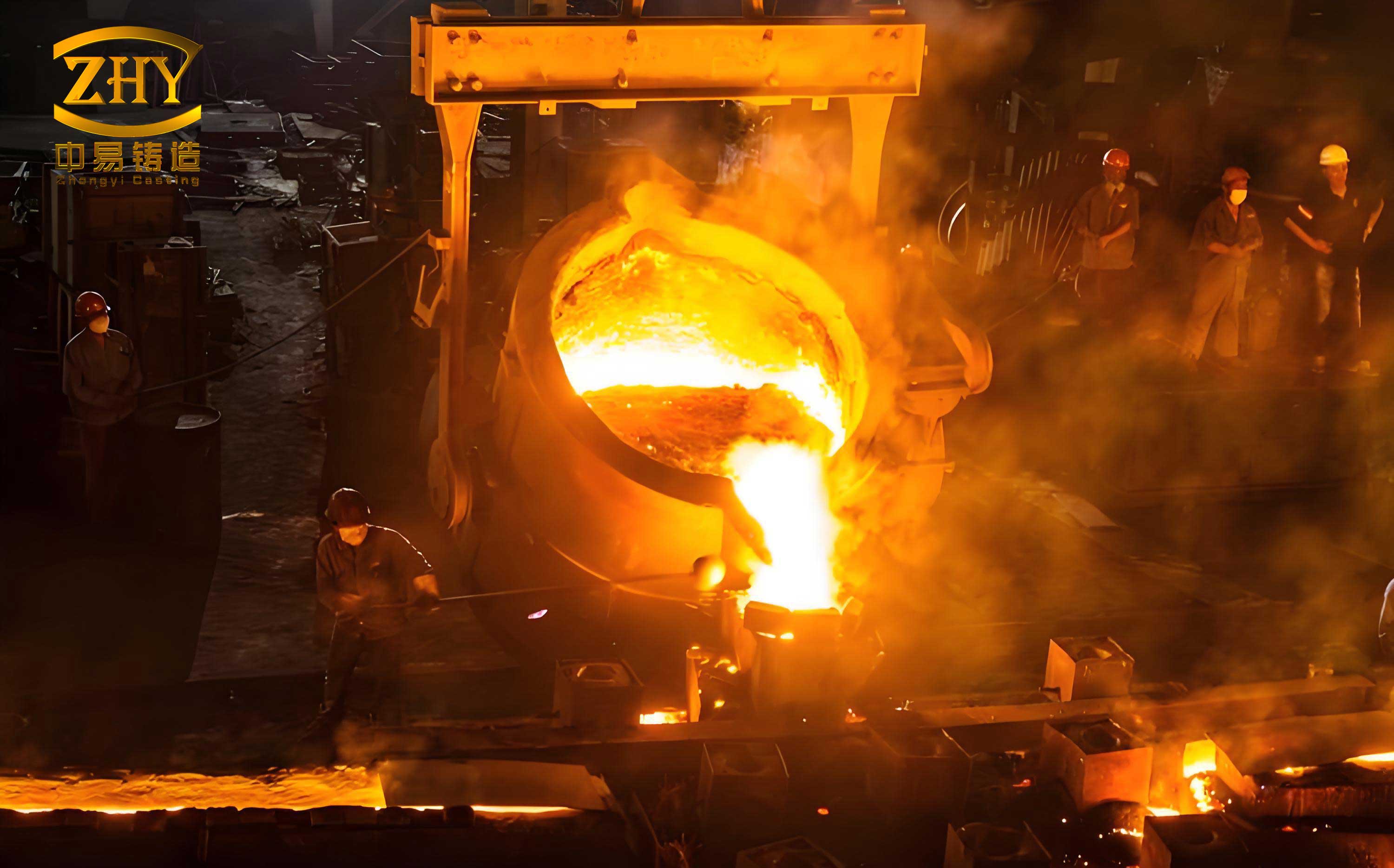
The final optimized casting工艺 in our manganese steel casting foundry integrates these改进. It features a tilted gating system with adjusted risers, strategic placement of chill blocks, and a modified casting geometry. This approach ensures balanced solidification and minimal defect formation. The工艺 parameters are summarized in the table below, highlighting the evolution from the initial to the optimized state. In a manganese steel casting foundry, such detailed工艺 control is essential for reproducible quality.
| Aspect | Initial工艺 | Optimized工艺 |
|---|---|---|
| Gating Orientation | Horizontal | Tilted by 3° |
| Riser Design | Four risers with equal height | Adjusted heights and positions |
| Chill Usage | None | Chills at riser roots and end zones |
| Casting Structure | Solid bottom surface | Frame-like lightened sections |
| Defect Reduction | High incidence of defects | Minimal defects observed |
Beyond工艺改进, the chemical composition of the manganese steel plays a critical role in the casting outcome. In our manganese steel casting foundry, we specified the alloy composition to balance hardness and toughness, crucial for railway applications. The table below outlines the targeted化学成分, with a focus on maintaining a high manganese-to-carbon ratio to suppress carbide formation and enhance austenite stability. This composition supports the work-hardening behavior, described by the equation: $$ H = H_0 + k \epsilon^m $$ where H is the hardness, H₀ is the initial hardness, ε is the strain, and k and m are constants for manganese steel. By controlling elements like carbon and silicon, we reduce the risk of hot tearing and shrinkage in the manganese steel casting foundry process.
| Element | Target Range (wt%) | Role in Manganese Steel Casting Foundry |
|---|---|---|
| Carbon (C) | 1.0–1.2 | Enhances hardness and wear resistance |
| Silicon (Si) | 0.3–0.6 | Improves fluidity and deoxidation |
| Manganese (Mn) | 11.0–12.5 | Promotes austenite structure and toughness |
| Phosphorus (P) | < 0.045 | Minimizes brittleness |
| Sulfur (S) | < 0.030 | Reduces hot shortness |
| Mn/C Ratio | ≥ 10 | Ensures optimal work-hardening capacity |
Heat treatment is another vital step in the manganese steel casting foundry流程. After casting, the components undergo a solution heat treatment to dissolve carbides and achieve a homogeneous austenitic microstructure. In our manganese steel casting foundry, we employ a specific thermal cycle: heating to 1050–1100°C, holding for sufficient time based on section thickness, followed by rapid quenching in water. This process can be modeled using the Austin-Rickett equation for diffusion-controlled transformation: $$ f = 1 – \exp(-k t^n) $$ where f is the fraction transformed, k is a rate constant, t is time, and n is an exponent. The heat treatment curve involves precise temperature control to avoid re-precipitation of carbides, which could embrittle the steel. By optimizing this step, we enhance the impact toughness and wear resistance of the castings from our manganese steel casting foundry.
The success of these改进 is evident in the performance of the cast heart rails. After implementing the optimized工艺 in our manganese steel casting foundry, the defect rate dropped significantly. Field tests on railway lines demonstrated extended service life, with the components enduring over 200 million gross tons of traffic before replacement. This translates to reduced maintenance costs and improved safety for railway operations. The economic and social benefits are substantial, as reliable manganese steel casting foundry products contribute to efficient transportation networks. The integration of工艺, composition, and heat treatment represents a holistic approach in modern foundry practice.
In conclusion, the research and application of advanced casting techniques for high manganese steel frog heart rails have yielded significant improvements. Through iterative工艺优化 in the manganese steel casting foundry, including倾斜浇注, strategic use of risers and chills, and design modifications, we have overcome common casting defects. The careful control of chemical composition and heat treatment further ensures the desired material properties. This comprehensive methodology not only enhances product quality but also underscores the importance of innovation in the manganese steel casting foundry sector. As railway demands grow, such advancements will continue to play a pivotal role in developing durable and efficient infrastructure components.