
Our company has achieved breakthrough advancements in the automation of cleaning processes for engine cylinder block castings through systematic technological innovation. This paper presents a comprehensive methodology for implementing full-process automation in post-casting cleaning operations, addressing critical industry challenges including harsh working environments, labor shortages, and quality consistency issues.
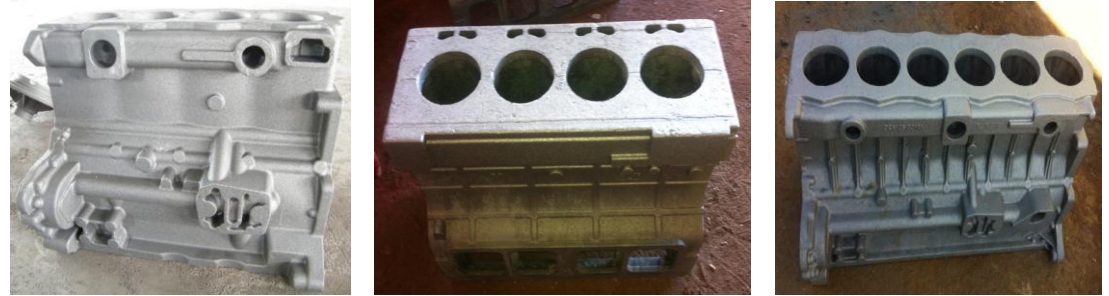
1. Technical Characteristics of Modern Engine Cylinder Blocks
Contemporary engine cylinder blocks for heavy-duty applications (10L+ displacement, 400+ HP) feature integrated design with complex geometries. Key parameters include:
| Parameter | Value Range |
|---|---|
| Minimum dimensions | 900 × 500 × 500 mm |
| Wall thickness | 4-5.5 mm |
| Cast weight | 270-400 kg |
| Material strength (HT300-RT450) | $$ \sigma_b \geq 300\text{MPa}, \sigma_{0.2} \geq 450\text{MPa} $$ |
2. Automated Cleaning Process Architecture
The optimized cleaning workflow integrates multiple advanced technologies:
| Process Stage | Automation Solution | Key Innovation |
|---|---|---|
| Part Handling | 6-axis robots with vision guidance | ±0.1 mm positioning accuracy |
| Surface Cleaning | CNC grinding units | Adaptive feed rate control: $$ v = \sqrt{\frac{F_n \cdot K}{a_p \cdot a_e}} $$ |
| Internal Cleaning | Robotic shot blasting | 3D vision-guided nozzle alignment |
3. Core Technical Innovations
3.1 Intelligent Part Handling System
The automated handling system for engine cylinder blocks employs:
- Multi-spectral vision recognition (400-1100 nm wavelength range)
- Adaptive gripper design with force feedback: $$ F_{grip} = \mu \cdot m \cdot g \cdot S $$
- Real-time trajectory optimization algorithm
3.2 Precision Grinding Technology
Advanced grinding parameters for engine cylinder block surfaces:
| Parameter | Value |
|---|---|
| Spindle speed | 8,000-15,000 rpm |
| Feed rate | 0.5-2.5 m/min |
| Surface roughness (Ra) | ≤ 6.3 μm |
3.3 Internal Cavity Cleaning
The robotic shot blasting system achieves 98% coverage in complex internal channels of engine cylinder blocks through:
- Dual-nozzle design with 360° rotation
- Adaptive media flow control: $$ Q = k \cdot \sqrt{\frac{P}{\rho}} $$
- Real-time pressure monitoring (0.4-0.7 MPa)
4. Process Optimization Methodology
Critical improvements in engine cylinder block casting design:
| Design Feature | Optimization | Result |
|---|---|---|
| Riser design | Transition to stepped structure | Flash reduction ≥70% |
| Gating system | 3-stage → 2-stage design | Yield improvement 12% |
| Venting system | Multi-level venting | Gas defects ≤0.5% |
5. Performance Metrics
Comparative analysis of cleaning process improvements:
| Metric | Traditional | Automated |
|---|---|---|
| Cycle time | 45 min | 22 min |
| Labor requirement | 8 operators | 2 technicians |
| Surface consistency | ±15% | ±5% |
| Energy consumption | 18 kWh | 9.5 kWh |
6. Conclusion
The implemented automation solutions for engine cylinder block cleaning demonstrate:
- 73% reduction in manual operations
- 41% improvement in process efficiency
- Consistent achievement of surface cleanliness ≤15 mg/kg
- Enhanced capability for high-mix production (15+ variants)
This technical breakthrough establishes a new benchmark for intelligent manufacturing in heavy-duty engine cylinder block production, providing significant competitive advantages in quality consistency and production flexibility.