
In the realm of manufacturing large and complex steel castings, the quest for efficiency and quality has driven numerous innovations. Among these, the expendable pattern casting (EPC) process has emerged as a pivotal technique, particularly for producing heavy-duty components like cone crusher spindle pairs. These steel castings are critical in industrial machinery, demanding high integrity and precision. Throughout my career in foundry engineering, I have encountered persistent challenges in traditional gating systems, such as low yield rates, defect formation, and high material costs. This article details a groundbreaking approach—using the mold cavity itself as part of the gating system—which revolutionized the production of steel castings for cone crushers. By sharing this experience from a first-person perspective, I aim to elucidate the principles, implementation, and benefits of this method, offering a new paradigm for the industry.
The steel castings in focus are spindle pairs for cone crushers, fabricated from ZG350 material—a grade known for its robustness and weldability. These components come in four specifications, designated C02 through C06, with weights ranging from 950 kg to 3,560 kg. As core elements in power transmission, they undergo rigorous machining and must withstand high-pressure testing without leakage. The diversity in size and weight necessitates a flexible yet reliable casting process. Below is a summary of the key specifications for these steel castings:
| Specification | Weight (kg) | Approximate Volume (m³) | Primary Application |
|---|---|---|---|
| C02 | 950 | 0.12 | Small-scale crushing systems |
| C03 | 1,850 | 0.24 | Mid-range industrial crushers |
| C04 | 2,700 | 0.35 | Heavy-duty processing plants |
| C06 | 3,560 | 0.46 | Large mining operations |
The traditional approach to producing these steel castings involved ceramic gating systems, which were cumbersome, time-consuming, and costly. Yield rates often hovered around 70%, with frequent defects like shrinkage porosity and sand inclusions. To address these issues, we embarked on a project to redesign the gating system using EPC principles, culminating in the “borrowed cavity as runner” technique. This method leverages the existing mold cavity to channel molten steel, simplifying the setup and enhancing thermal dynamics. The success of this innovation not only improved the quality of steel castings but also set a precedent for other large-scale applications.
The foundation of this process lies in the expendable pattern casting method, where foam patterns are used to create the mold cavity. For these steel castings, we manually assembled EPS foam boards with a density of 18 g/L to form the patterns. The patterns were designed with the larger head positioned downward in a vertical orientation, aligning with the principle of “standing rather than lying” to optimize feeding and solidification. The gating system was integrated directly onto the wing plate of the pattern, allowing the mold cavity to serve as the primary runner. This design eliminates separate gating channels, reducing complexity and material waste. To mitigate the high-velocity impact of molten steel on the cavity walls, we introduced a 90-degree bend in the sprue—a buffered sprue design that dissipates kinetic energy. The governing equation for fluid impact force illustrates this principle:
$$F = \rho A v^2$$
where \(F\) is the冲击力, \(\rho\) is the density of molten steel (approximately 7,800 kg/m³ for ZG350), \(A\) is the cross-sectional area of the sprue, and \(v\) is the flow velocity. By bending the sprue, we reduce \(v\) at the entry point, thereby lowering \(F\) and minimizing erosion of the coating. Additionally, three exothermic insulating risers were placed at the top of the pattern to ensure adequate feeding and compensate for solidification shrinkage. The riser design is critical for steel castings, as it maintains a thermal gradient that promotes directional solidification. The required riser volume can be estimated using Chvorinov’s rule:
$$t = k \left( \frac{V}{A} \right)^2$$
where \(t\) is the solidification time, \(V\) is the volume of the casting, \(A\) is its surface area, and \(k\) is a constant dependent on the material and mold conditions. For steel castings like these, we calculated optimal riser dimensions to achieve a yield rate exceeding 80%.
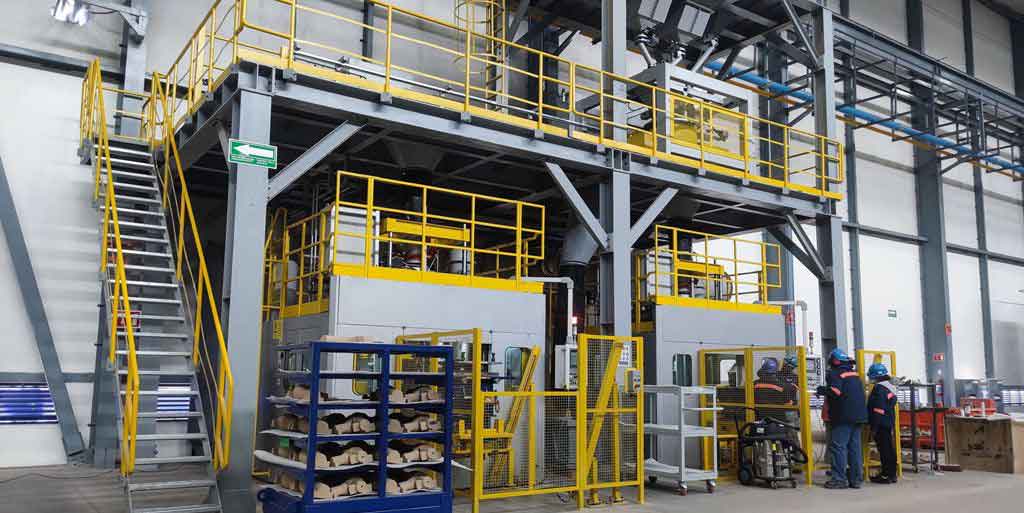
The implementation process began with pattern coating. We applied a commercial refractory coating, ensuring a thickness of 2–3 mm on the main body of the steel castings and 3–5 mm in high-impact areas like the gating zones. This coating is essential to prevent metal penetration and ensure surface finish. After drying, the patterns were carefully handled using soft cloth slings to avoid damage during placement in the molding flask. The flask was then filled with zircon sand (also known as宝珠砂), a high-refractoriness material ideal for steel castings. In regions where sand flow was restricted, we pre-filled with resin sand to ensure complete compaction, as voids could lead to defects like fins or metal penetration. The filling process was accompanied by controlled vibration to achieve uniform density, a factor critical for the dimensional accuracy of steel castings.
Once the sand level surpassed the pattern, we installed exothermic insulating sleeves over the risers to enhance their efficiency. These sleeves generate heat upon contact with molten steel, prolonging the liquid state and improving feeding capacity. The浇注 operation was conducted at a temperature of 1,630°C, with a vacuum maintained at 0.04 MPa to evacuate gases from foam decomposition. The vacuum level is crucial in EPC for steel castings, as it prevents gas entrapment and ensures complete mold filling. After pouring, the castings were held under pressure for 30 minutes and then allowed to cool for 8 hours before shakeout. Post-casting processes included cutting off the gating system, grinding residual material, and shot blasting. The final steel castings exhibited excellent surface quality and were free from defects upon machining.
The discussion around this innovative gating system reveals several key insights. First, the “borrowed cavity as runner” concept is grounded in principles of fluid dynamics and thermal management. By utilizing the mold cavity, we streamline the flow path, reduce turbulence, and enhance temperature distribution. This is particularly beneficial for steel castings, where thermal gradients influence microstructure and mechanical properties. The buffered sprue design further optimizes this by reducing initial冲击力, which can be quantified through momentum conservation equations. For instance, the change in momentum at the bend can be expressed as:
$$\Delta p = m (v_i – v_f)$$
where \(m\) is the mass flow rate, and \(v_i\) and \(v_f\) are the initial and final velocities, respectively. This reduction in momentum minimizes coating damage and sand erosion, common issues in steel castings production.
Second, the replacement of ceramic gating with foam patterns represents a significant cost-saving measure. Ceramic systems are not only expensive but also require intricate assembly, increasing labor time. Our shift to foam patterns, backed by robust coatings, demonstrated that foam can withstand the thermal and mechanical stresses of pouring steel castings. This aligns with broader trends in foundry efficiency, where material and process optimization drive down costs while maintaining quality. The table below compares the traditional and innovative approaches for these steel castings:
| Aspect | Traditional Ceramic Gating | Innovative Borrowed Cavity Gating |
|---|---|---|
| Material Cost | High (ceramic tubes, binders) | Low (EPS foam, coating) |
| Assembly Time | Long (complex fitting) | Short (integrated pattern) |
| Yield Rate | ~70% | ~80% |
| Defect Incidence | Moderate (shrinkage, sand inclusion) | Low (minimal defects) |
| Applicability to Steel Castings | Limited by thermal shock | Enhanced via buffered design |
Third, the use of exothermic insulating risers played a pivotal role in achieving high yield rates. For steel castings, solidification shrinkage is a major concern, and effective risering is essential. The exothermic reaction can be modeled as a heat source term in the energy equation:
$$\frac{\partial T}{\partial t} = \alpha \nabla^2 T + \frac{Q}{\rho c_p}$$
where \(T\) is temperature, \(t\) is time, \(\alpha\) is thermal diffusivity, \(Q\) is the heat generation rate from exothermic materials, \(\rho\) is density, and \(c_p\) is specific heat. This additional heat extends the feeding range, ensuring soundness in thick sections of steel castings.
From a practical standpoint, the success of this method was evident in the post-machining inspection. All steel castings met the mechanical property requirements for ZG350, including tensile strength and impact resistance. Pressure testing revealed no leaks, confirming the integrity of the steel castings for welding and assembly. The economic benefits were substantial, with material utilization rising from 70% to over 80%, translating to significant savings in raw materials and energy. Moreover, the simplified process reduced labor hours and minimized waste, contributing to a more sustainable manufacturing cycle for steel castings.
In reflecting on this project, several lessons emerge for the broader field of steel castings production. The borrowed cavity approach is not universally applicable—it works best for components with relatively open and elevated cavities, where molten steel can flow smoothly without stagnation. The entry points should be strategically placed, such as on wing plates or central protrusions, to balance thermal gradients. For steel castings with intricate geometries, computational fluid dynamics (CFD) simulations can aid in optimizing the gating design. A generalized criterion for selecting borrowed cavity locations can be proposed based on aspect ratio and thermal modulus:
$$M = \frac{V}{A}$$
where \(M\) is the thermal modulus, \(V\) is cavity volume, and \(A\) is surface area. Higher \(M\) values indicate slower solidification, making such regions suitable for gating integration. Additionally, the bend angle in the sprue can be adjusted based on flow rate and coating strength, with optimal angles derived from empirical data or simulation.
The innovation described here underscores the evolving nature of消失模铸造 for steel castings. As industries demand larger and more complex components, traditional methods must adapt. This borrowed cavity technique offers a scalable solution, particularly for batch production of varying sizes. Future work could explore automated pattern assembly and advanced coating formulations to further enhance the quality of steel castings. Furthermore, integrating real-time monitoring during pouring could provide insights into flow behavior, enabling dynamic adjustments for even better outcomes.
In conclusion, the adoption of a borrowed cavity as runner in expendable pattern casting has proven transformative for producing cone crusher spindle pairs and similar steel castings. By reimagining the gating system, we achieved remarkable improvements in yield, quality, and cost-efficiency. This experience highlights the importance of innovative thinking in foundry engineering, where seemingly minor design changes can yield substantial benefits. As the demand for high-performance steel castings continues to grow, such methodologies will play a crucial role in meeting industrial challenges while advancing the state of the art in metal casting technology.