
In the realm of advanced manufacturing, particularly for critical components in aerospace, gas turbines, and other high-performance sectors, the investment casting process stands out as a pivotal technique. Its ability to produce complex, near-net-shape parts with excellent surface finish and dimensional accuracy is unparalleled. However, achieving consistent high dimensional precision remains a significant challenge, primarily influenced by the linear shrinkage of the wax mold during pattern making. As an engineer deeply involved in refining casting methodologies, I have explored the potential of hollow wax mold structures to mitigate these shrinkage issues. This article delves into a comprehensive study on utilizing hollow wax mold designs for K648 superalloy castings, aiming to enhance dimensional accuracy by reducing linear shrinkage rates.
The investment casting process involves creating a wax pattern, coating it with ceramic slurry to form a shell, melting out the wax, and pouring molten metal into the cavity. Each step introduces variables that affect final part dimensions, but wax pattern shrinkage is often the most dominant factor, accounting for over 50% of dimensional variations. Traditional solid wax patterns, especially those with thick sections exceeding 13 mm, suffer from non-uniform cooling, leading to high internal stresses, warpage, and significant linear shrinkage. This results in castings that may only meet tolerance grades like CT7, which, while acceptable, fall short of the stringent CT4-CT5 levels demanded for premium applications. My research focuses on redesigning these thick sections into hollow structures to promote more uniform wall thickness, thereby stabilizing shrinkage and elevating precision.
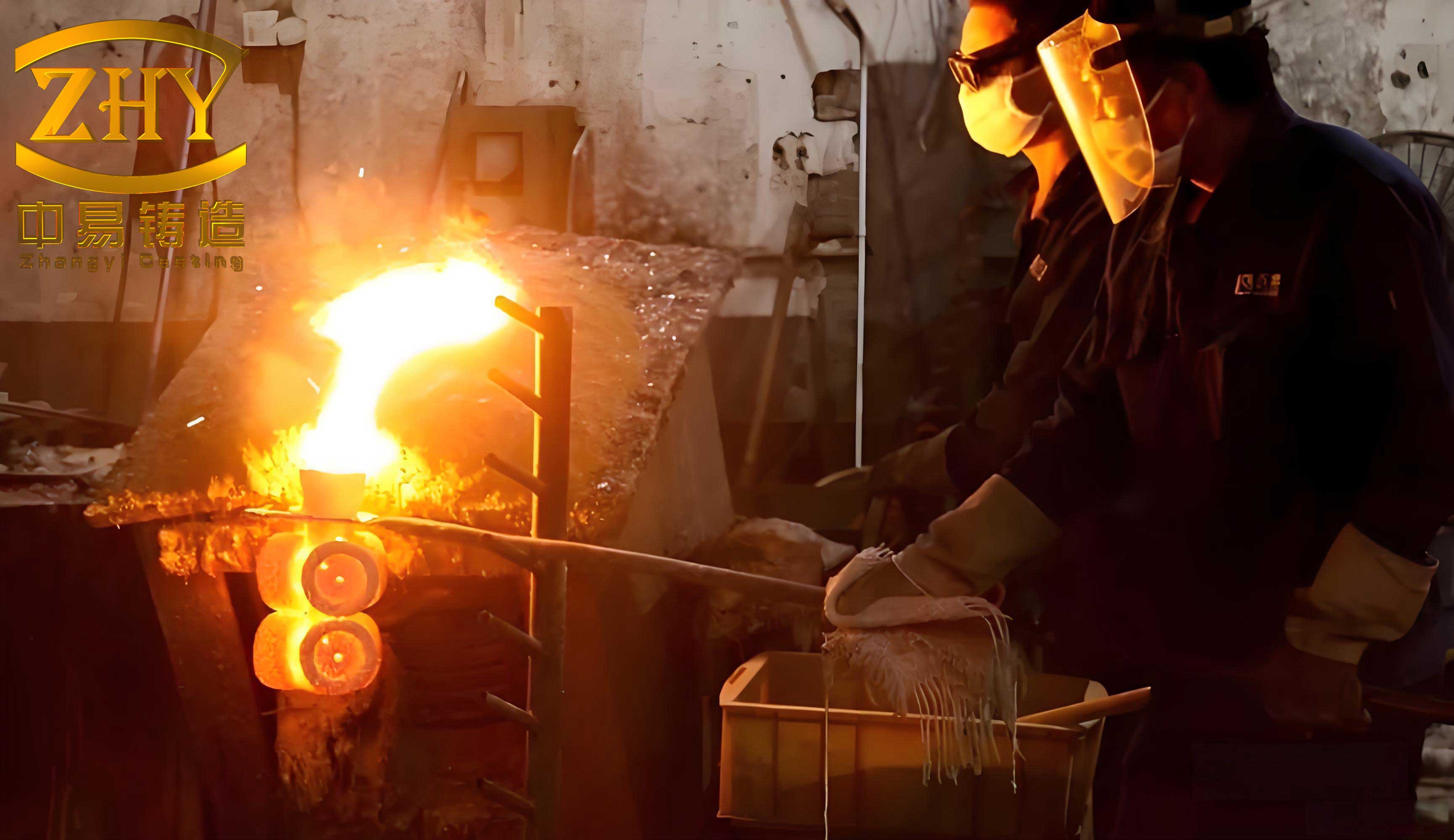
To understand the impact of hollow designs, it’s essential to first examine the key factors influencing wax pattern dimensional accuracy in the investment casting process. These factors include the type of wax material, molding parameters, mold fabrication precision, and pattern geometry. In standard practice, wax materials are categorized into non-filled and filled types, with linear shrinkage rates around 1.0% and 0.5%, respectively. For this study, a 162-grade non-filled wax was selected due to its excellent formability and stability, typical shrinkage of 0.9-1.0%, and suitability for thin to medium-sized patterns. However, even with advanced molding equipment that precisely controls injection pressure, temperature, and cooling times, inherent shrinkage persists. Moreover, while modern machining technologies have drastically improved mold precision, reducing its contribution to errors, pattern structure remains a critical adjustable variable. Thick, solid sections act as heat reservoirs, causing delayed cooling and uneven contraction. Thus, by hollowing these sections to a uniform 4.5-5.0 mm wall thickness, we can facilitate faster heat dissipation, minimize thermal gradients, and achieve more predictable shrinkage behavior throughout the investment casting process.
The experimental approach centered on a representative K648 superalloy casting, a structural component with key dimensions featuring wall thicknesses predominantly over 13 mm. The alloy composition, crucial for high-temperature performance, includes elements like chromium, molybdenum, and nickel. Two wax pattern designs were compared: a conventional solid structure and a novel hollow structure. The hollow design involved creating internal cavities via retractable metal cores in the mold, ensuring wall thicknesses of 4.5-5.0 mm, with tapered sections (5° draft) for easy core withdrawal. All hollow openings were positioned at the gating face, sealed during pattern assembly to form enclosed voids. This design not only reduces mass but also increases the surface area in contact with the mold, enhancing cooling uniformity. Patterns were fabricated using 100% fresh 162 wax to avoid variability from recycled material, with process parameters standardized as shown in Table 1.
| Injection Pressure (kg/cm²) | Flow Rate (%) | Injection Time (s) | Wax Cylinder Temperature (°C) | Cooling Cylinder Temperature (°C) | Cooling Time (s) | Nozzle Holding Time (s) | Cooling Method |
|---|---|---|---|---|---|---|---|
| 10-20 | 20 | 20-30 | 58 ± 5 | 58 ± 5 | 40-60 | 20-30 | Air Cooling |
After ejection, patterns were placed on alignment fixtures with weights for over 2 hours to correct any initial deformation—a critical step in maintaining geometry before shell building. The investment casting process then proceeded with a fully colloidal silica shell system, applying multiple coats with specific refractories and stucco sizes, as summarized in Table 2. Shells were dewaxed using high-pressure steam and preheated to 1050°C before pouring molten K648 alloy at 1450°C under vacuum conditions, ensuring minimal gas entrapment and clean fills.
| Layer | Slurry Type | Slurry Viscosity (s) | Refractory Material | Stucco Size (mesh) |
|---|---|---|---|---|
| 1 | Zircon flour-silica sol | 30-45 | Zircon sand | 80-120 |
| 2 | Shangdian flour-silica sol | 15-25 | Shangdian sand | 30-60 |
| 3-7 | Shangdian flour-silica sol | 8-15 | Shangdian sand | 16-30 |
| 8 | Shangdian flour-silica sol | 5-10 | – | – |
Dimensional analysis was conducted using blue light scanning to compare pattern contours against 3D CAD models. The linear shrinkage rates for both wax patterns and final castings were calculated using fundamental formulas. For the wax pattern, linear shrinkage (α) is defined as:
$$ \alpha = \frac{A_0 – A_1}{A_0} \times 100\% $$
where \( A_0 \) is the mold cavity dimension and \( A_1 \) is the measured wax pattern dimension. Similarly, the casting’s actual linear shrinkage (β) is:
$$ \beta = \frac{A_0 – A_2}{A_0} \times 100\% $$
where \( A_2 \) is the final casting dimension. These formulas are central to quantifying improvements in the investment casting process.
The results revealed dramatic differences between solid and hollow wax patterns. For the solid design, scanning showed surface deviations ranging from -0.695 mm to +0.735 mm, with noticeable bending at distal ends and pronounced sink marks at planar centers. In contrast, the hollow pattern exhibited a much tighter deviation range of -0.44 mm to +0.475 mm, with significantly reduced warpage and sinkage. This visual improvement underscores how hollow structures distribute cooling stresses more evenly. Quantitatively, key dimensions were measured, and linear shrinkage rates computed, as presented in Table 3. The average linear shrinkage for the solid wax pattern was 1.16%, whereas the hollow pattern achieved an average of 0.54%—a reduction of over 53%. This directly translates to enhanced pattern precision, a cornerstone for reliable investment casting process outcomes.
| Dimension No. | Mold Cavity Size, \( A_0 \) (mm) | Solid Wax Pattern Size, \( A_1 \) (mm) | Solid Shrinkage, \( \alpha \) (%) | Hollow Wax Pattern Size, \( A_1 \) (mm) | Hollow Shrinkage, \( \alpha \) (%) |
|---|---|---|---|---|---|
| 1 | 73.83 | 72.50 | 1.80 | 73.09 | 1.00 |
| 2 | 61.97 | 60.98 | 1.60 | 61.88 | 0.15 |
| 3 | 14.36 | 14.30 | 0.45 | 14.32 | 0.31 |
| 4 | 53.35 | 52.80 | 1.03 | 52.88 | 0.88 |
| 5 | 26.68 | 26.42 | 0.97 | 26.48 | 0.75 |
| 6 | 34.89 | 34.71 | 0.52 | 34.79 | 0.29 |
| 7 | 38.99 | 38.24 | 1.92 | 38.58 | 1.05 |
| 8 | 85.16 | 84.42 | 0.87 | 84.88 | 0.33 |
| 9 | 16.42 | 16.20 | 1.32 | 16.40 | 0.10 |
| Average Linear Shrinkage | 1.16% | 0.54% | |||
These pattern-level benefits cascaded to the final castings. Dimensional inspection per standard tolerance grading systems showed that castings from solid patterns met CT7 grade, while those from hollow patterns achieved CT5 grade—a two-level improvement in precision. The actual casting shrinkage rates also decreased, as detailed in Table 4. The average shrinkage for solid-pattern castings was 2.70%, but for hollow-pattern castings, it dropped to 2.41%. This reduction, though seemingly modest, is statistically significant in high-tolerance applications and reflects the compounded effect of lower wax pattern shrinkage. Notably, dimensions with originally thicker sections showed the most improvement, validating that hollowing effectively mitigates the high contraction stresses in bulky areas. This advancement is crucial for optimizing the investment casting process for thick-walled components.
| Dimension No. | Mold Cavity Size, \( A_0 \) (mm) | Casting from Solid Pattern, \( A_2 \) (mm) | Solid Casting Shrinkage, \( \beta \) (%) | Casting from Hollow Pattern, \( A_2 \) (mm) | Hollow Casting Shrinkage, \( \beta \) (%) |
|---|---|---|---|---|---|
| 1 | 73.83 | 72.45 | 1.87 | 72.17 | 2.25 |
| 2 | 61.97 | 59.97 | 3.23 | 60.24 | 2.79 |
| 3 | 14.36 | 14.07 | 2.07 | 14.04 | 2.26 |
| 4 | 53.35 | 52.33 | 1.91 | 52.19 | 2.17 |
| 5 | 26.68 | 25.71 | 3.62 | 26.15 | 1.97 |
| 6 | 34.89 | 34.15 | 2.11 | 34.08 | 2.31 |
| 7 | 38.99 | 37.98 | 2.60 | 37.98 | 2.58 |
| 8 | 85.16 | 82.47 | 3.15 | 82.69 | 2.89 |
| 9 | 16.42 | 15.80 | 3.73 | 16.01 | 2.49 |
| Average Casting Shrinkage | 2.70% | 2.41% | |||
The underlying mechanism for this improvement lies in thermal management during pattern solidification. In a solid wax pattern, thick sections cool slowly, creating a large temperature gradient between the surface and core. Upon ejection, the core’s residual heat causes re-softening and uneven contraction, leading to high linear shrinkage and distortion. The hollow design, by reducing wall thickness to 4.5-5.0 mm, ensures faster and more uniform cooling. Essentially, it transforms free contraction in thick zones into restrained contraction, as the metal cores provide internal support during cooling. This minimizes internal stresses and promotes dimensional stability. Moreover, the increased surface area enhances heat transfer to the mold, further stabilizing the process. Such principles are fundamental to advancing the investment casting process for complex geometries.
From a practical standpoint, implementing hollow wax molds offers several advantages over alternative methods like using cold wax inserts. Cold inserts require additional模具, increase production steps, and can lead to alignment issues or surface defects. In contrast, hollow structures integrate seamlessly into the mold design with retractable cores, avoiding extra patterns and reducing post-processing. This makes the approach highly suitable for high-volume production of precision castings. However, it does demand careful design of core geometries and draft angles to ensure easy withdrawal without compromising structural integrity. Computational simulations of mold filling and cooling could further optimize these parameters, but empirical results confirm the viability of this technique in real-world investment casting process applications.
To generalize the findings, the relationship between wall thickness and shrinkage can be modeled. For a given wax material, the linear shrinkage rate tends to increase with section thickness due to thermal mass effects. By designing hollow sections, we effectively reduce the equivalent thickness, thereby lowering shrinkage. This can be expressed as an empirical correlation for the investment casting process:
$$ \alpha_{effective} = k \cdot \left( \frac{T_{nominal}}{T_{hollow}} \right)^{-n} $$
where \( \alpha_{effective} \) is the reduced linear shrinkage, \( k \) is a material constant, \( T_{nominal} \) is the original thickness, \( T_{hollow} \) is the hollowed thickness (e.g., 5 mm), and \( n \) is an exponent derived from experimental data (approximately 0.5-1.0 for typical waxes). This formula helps in predicting improvements for various geometries.
Furthermore, the overall dimensional accuracy of a casting in the investment casting process depends on the cumulative effect of multiple factors. If we denote total dimensional error as \( E_{total} \), it can be approximated as:
$$ E_{total} = \sqrt{E_{wax}^2 + E_{shell}^2 + E_{metal}^2} $$
where \( E_{wax} \) is the error from wax pattern shrinkage, \( E_{shell} \) from shell expansion/contraction, and \( E_{metal} \) from solidification shrinkage. By reducing \( E_{wax} \) through hollow designs, we significantly lower \( E_{total} \), enabling higher tolerance grades. For instance, moving from CT7 to CT5 corresponds to a tolerance band reduction of about 30-40%, which aligns with the observed shrinkage reduction from 2.70% to 2.41%.
In conclusion, this study demonstrates that hollow wax mold structures are a highly effective strategy for enhancing dimensional accuracy in the investment casting process, particularly for thick-walled superalloy components like K648 castings. By redesigning sections thicker than 13 mm into hollow forms with 4.5-5.0 mm walls, we achieved a 53% reduction in wax pattern linear shrinkage (from 1.16% to 0.54%) and improved casting tolerance from CT7 to CT5, with actual shrinkage decreasing from 2.70% to 2.41%. These outcomes underscore the importance of thermal management during pattern making and provide a robust reference for optimizing the investment casting process for high-precision applications. Future work could explore hybrid materials, advanced cooling techniques, or digital twins to further refine this approach, but the hollow design principle stands as a practical and scalable solution for elevating quality in precision casting manufacturing.