
As an educator involved in practical engineering training, I have witnessed the transformative potential of integrating traditional craftsmanship with advanced manufacturing technologies. The investment casting process, a cornerstone of precision manufacturing, serves as a perfect vehicle for this integration. In this article, I will elaborate on how a novel educational framework combines hand-sculpting, reverse scanning, and 3D printing-enhanced investment casting to create a comprehensive, multidisciplinary learning experience. This approach not only demystifies the investment casting process but also fosters creativity and systematic thinking among students from diverse academic backgrounds.
The necessity for this curricular reform stems from the limitations of traditional, modularized teaching methods that often isolate specific skills or equipment. Previously, our practical courses on the investment casting process were offered as standalone modules across nine different undergraduate programs, leading to repetitive content and a lack of tailored learning objectives for students from varying disciplines such as humanities, engineering, and design. To address this, we shifted from a skill-centric training model to an integrated paradigm that emphasizes knowledge acquisition, capability development, and value cultivation—a “trinity” educational goal. This reform aims to build a cross-disciplinary, inquiry-based learning platform that merges subtractive manufacturing (like CNC engraving) with additive and formative processes like the investment casting process. By doing so, students engage in the entire product lifecycle, from design and modeling to production and post-processing, thereby gaining a holistic understanding of industrial workflows.
To achieve this, we developed a customized teaching model that synergizes hand-sculpting of clay or oil-based models, reverse engineering via 3D scanning, and 3D-printed investment casting. This fusion effectively bridges the gap for students, particularly those from non-engineering fields, who may struggle with complex CAD modeling. The hand-sculpting phase allows for intuitive, tactile creation of intricate forms; reverse scanning digitizes these physical models; and the investment casting process transforms them into durable metal artifacts. Throughout this journey, the investment casting process is repeatedly emphasized as a critical manufacturing technique, enabling students to appreciate its precision, versatility, and application in fields ranging from jewelry to aerospace.
Let me delve into the three core components of this integrated approach, using tables and formulas to summarize key aspects. Each component plays a vital role in demystifying the investment casting process and enhancing student engagement.
Hand-Sculpting: The Foundation of Creative Design
Hand-sculpting, particularly with clay or oil-based modeling materials, is an ancient yet flexible technique that serves as the initial step in our educational pipeline. This method allows students to physically manipulate materials to create complex, organic shapes that might be challenging to model digitally without prior expertise. In the context of the investment casting process, this phase produces the master pattern, which is later digitized and replicated. The plasticity of materials like pottery clay (with moisture content typically between 20% and 26%) enables detailed sculpting, fostering artistic expression and manual dexterity. For instance, in a project focused on cultural-creative figurines like “Festival Cats,” students sculpt representations of holidays—such as a cat holding a lucky character for Chinese New Year or peeking out from a rice dumpling for Dragon Boat Festival. This hands-on experience not only lowers the barrier to entry for design but also imbues the subsequent investment casting process with a personal, creative touch.
To quantify the material properties relevant to sculpting, we can consider the moisture content ( $w$ ) as a percentage, which affects workability. The optimal range for clay sculpting can be expressed as:
$$ 20\% \leq w \leq 26\% $$
where $w$ is defined as the ratio of water mass to dry clay mass. This ensures the material is malleable yet retains shape, crucial for creating patterns that will undergo the investment casting process. Additionally, the sculpting time ( $t_s$ ) often correlates with complexity, which we can model empirically. For a given volume $V$ of clay and a complexity factor $C$ (representing details like undercuts or fine features), the approximate sculpting time might follow:
$$ t_s = k \cdot V \cdot C $$
where $k$ is a constant dependent on the sculptor’s skill. This formula helps students plan their projects within course timelines, linking manual effort to the broader investment casting process workflow.
Reverse Scanning: Bridging Physical and Digital Realms
Once a physical sculpture is complete, we employ reverse scanning to digitize it. This step is pivotal for integrating traditional craftsmanship with modern manufacturing, as it converts tactile creations into digital assets compatible with 3D printing and the investment casting process. We use portable handheld laser scanners with high precision (up to 0.02 mm) and fast scanning speeds (e.g., 2,100,000 points per second). The scanner projects structured light or laser lines onto the object’s surface, and cameras capture the distortions to compute 3D coordinates. The fundamental principle involves triangulation, where a point $P$ in space is determined by intersecting lines from the projector and cameras.
Mathematically, for a point $P(x, y, z)$ on the sculpture’s surface, the scanner captures image coordinates $(u, v)$ in two cameras. Using calibration parameters, the 3D coordinates are reconstructed via:
$$ z = \frac{B \cdot f}{d} $$
where $B$ is the baseline distance between cameras, $f$ is the focal length, and $d$ is the disparity (difference in image coordinates). This process generates a point cloud, which is then meshed into an STL file—a standard format for 3D printing. The accuracy of scanning directly impacts the fidelity of the subsequent investment casting process, as any deviations can propagate to the final metal cast. To emphasize this, we often discuss error propagation: if the scanning error is $\Delta s$, and the investment casting process has an inherent error $\Delta c$, the total error $\Delta t$ in the final part might be approximated by:
$$ \Delta t = \sqrt{(\Delta s)^2 + (\Delta c)^2} $$
This highlights the importance of precision at every stage. The table below summarizes key parameters and considerations in reverse scanning for the investment casting process:
| Parameter | Typical Value/Range | Impact on Investment Casting Process |
|---|---|---|
| Scanning Precision | 0.02 mm to 0.1 mm | Determines surface finish and dimensional accuracy of wax patterns. |
| Scanning Speed | Up to 2.1 million points/s | Affects time efficiency in digitizing complex sculptures. |
| Point Cloud Density | Variable, based on resolution settings | Higher density improves detail but increases file size and processing time. |
| File Format Output | STL, OBJ, PLY | STL is preferred for 3D printing wax patterns in investment casting. |
| Calibration Requirements | Regular calibration needed | Ensures measurement consistency, critical for repeatable casting results. |
By mastering reverse scanning, students learn how digital twins are created, setting the stage for the next phase: 3D printing of wax patterns for the investment casting process.
3D Printing and the Investment Casting Process
With the digital model in hand, we proceed to 3D printing, which produces wax-like patterns essential for the investment casting process. This step replaces traditional manual wax modeling with additive manufacturing, offering speed and complexity unattainable by hand. We use material jetting printers that employ UV-curable plastics and soluble wax support materials (e.g., Visijet M2 SUP). The printer builds the pattern layer by layer based on the STL file, following the discrete/stacking principle. The printed pattern is then used in the investment casting process, which involves several stages: assembly into a wax tree, investment with refractory slurry (often gypsum-based), dewaxing via high-temperature baking, mold hardening, metal melting and pouring, and post-processing.
The investment casting process itself can be modeled through various physical and thermal equations. For example, during the dewaxing stage, the wax pattern must be removed completely without damaging the mold. The baking temperature $T$ and time $t$ are critical. An empirical relationship for dewaxing in a gypsum mold might be:
$$ T(t) = T_0 + \alpha \cdot t $$
where $T_0$ is the initial temperature and $\alpha$ is the heating rate. However, to ensure complete wax removal, we often use a stepped heating profile. The total heat input $Q$ required can be estimated as:
$$ Q = m_w \cdot c_w \cdot \Delta T + m_w \cdot L_f $$
where $m_w$ is the mass of wax, $c_w$ is its specific heat capacity, $\Delta T$ is the temperature change, and $L_f$ is the latent heat of fusion for wax melting. This thermal management is crucial to prevent mold cracking, which could compromise the investment casting process.
During metal pouring, fluid dynamics come into play. The flow of molten metal into the mold cavity can be described by Bernoulli’s principle for incompressible fluids, considering the pressure difference. The velocity $v$ of the metal at the gate might be approximated as:
$$ v = \sqrt{\frac{2(P_{\text{atm}} – P_{\text{vac}})}{\rho}} $$
where $P_{\text{atm}}$ is atmospheric pressure, $P_{\text{vac}}$ is the vacuum pressure applied in vacuum-assisted casting, and $\rho$ is the density of the molten metal. This ensures proper filling, reducing defects like misruns or air pockets—a key concern in the investment casting process.
The table below outlines the sequential stages of the investment casting process as taught in our course, highlighting how each stage integrates with the preceding hand-sculpting and scanning phases:
| Stage | Description | Key Parameters | Relation to Previous Phases |
|---|---|---|---|
| Wax Pattern 3D Printing | Additive manufacturing of pattern from scanned STL file. | Layer thickness (e.g., 0.025 mm), material type, support structure. | Direct use of digital model from reverse scanning. |
| Wax Tree Assembly | Multiple wax patterns attached to a central sprue for batch casting. | Tree geometry, gating system design. | Patterns derived from hand-sculpted originals. |
| Investment (Mold Making) | Coating the tree with refractory slurry (gypsum-based) to form mold. | Slurry viscosity, drying time, layer thickness. | Mold must capture fine details from sculpting and scanning. |
| Dewaxing and Baking | Heating to remove wax and harden mold. | Temperature ramp-up rate, final baking temperature (e.g., 700°C), hold time. | Critical for preserving mold integrity from scanned geometry. |
| Melting and Pouring | Melting metal (e.g., silver, bronze) and vacuum-assisted pouring into mold. | Melting temperature, pouring temperature, vacuum level. | Final step to realize hand-sculpted design in metal. |
| Post-Processing | Removing mold, cutting, polishing, electroplating. | Polishing grit, electroplating current density. | Enhances appearance of cast part, completing the investment casting process cycle. |
This structured approach ensures that students grasp the entirety of the investment casting process, from concept to finished product. To visualize the outcome of such a process, consider the following representation of precision castings, which exemplifies the high detail achievable through this integrated method:
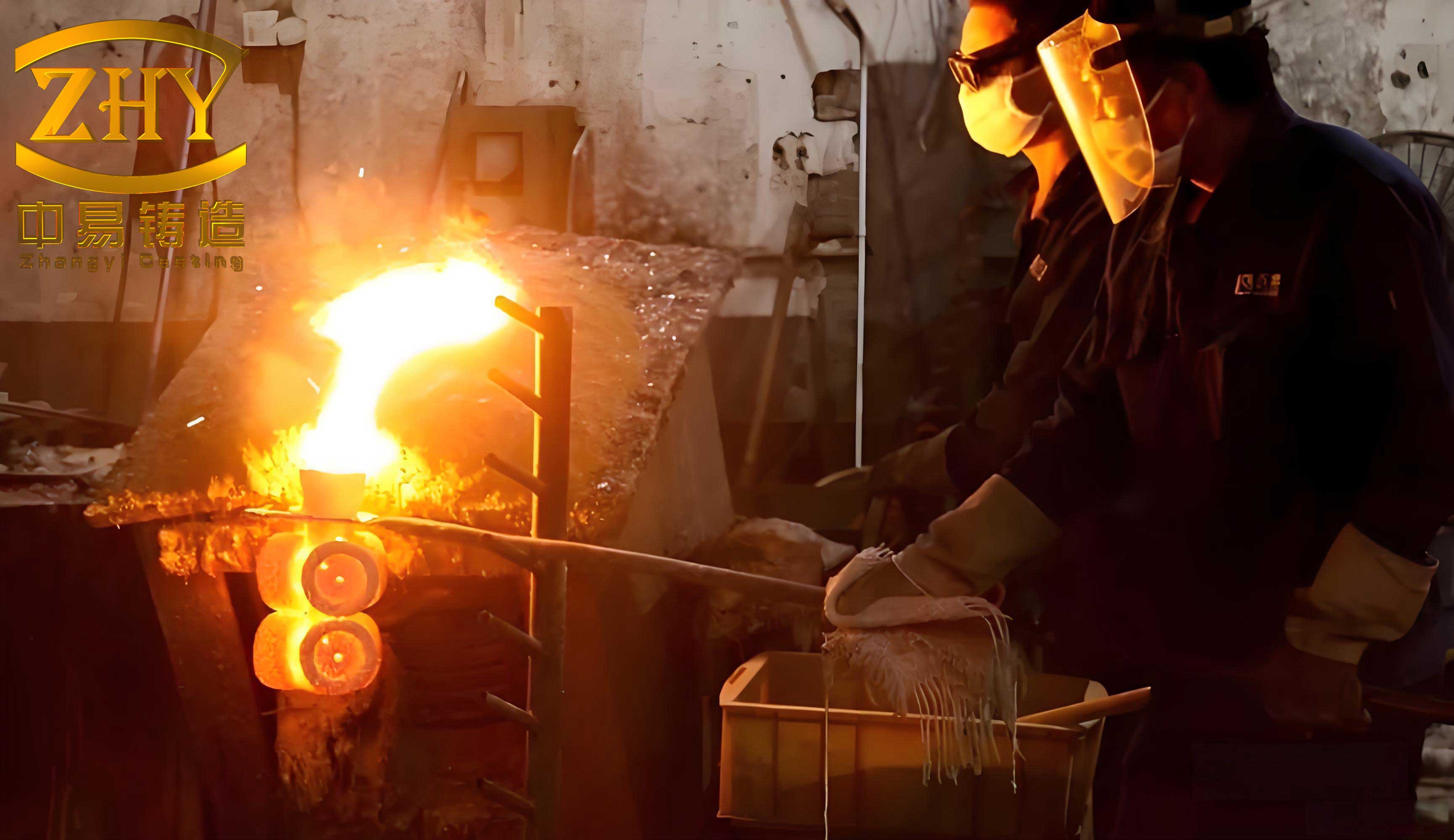
The image above showcases the precision and complexity possible with the investment casting process, especially when combined with digital technologies. In our courses, students produce similar metal artifacts, such as the Festival Cat series, through the fusion of hand-sculpting, scanning, and casting.
Curriculum Implementation and Pedagogical Impact
Implementing this integrated curriculum requires careful design to cater to diverse student groups. For example, in courses like “Manufacturing Engineering Experience” or “Personalized 3D Printing and Realization,” we tailor the depth of each component based on student majors. Humanities students might spend more time on hand-sculpting and design aesthetics, while engineering students delve into the technical parameters of the investment casting process. This customization addresses the earlier issue of repetitive modules and ensures that all students achieve clear learning outcomes: creativity and manual skills from sculpting, digital literacy from scanning, and engineering acumen from the investment casting process.
The fusion also promotes cross-disciplinary thinking. By engaging in the entire pipeline, students learn to connect artistic expression with manufacturing constraints. For instance, when sculpting, they must consider factors like draft angles or wall thicknesses that affect moldability in the investment casting process. We often use formulas to guide these considerations. The minimum wall thickness $t_{\text{min}}$ for a castable design can be estimated based on the metal’s fluidity and mold material:
$$ t_{\text{min}} = \frac{k \cdot \sigma}{\rho \cdot g \cdot H} $$
where $\sigma$ is the surface tension of the molten metal, $\rho$ is its density, $g$ is gravity, $H$ is the head height of metal during pouring, and $k$ is an empirical constant. Such equations help students make informed design decisions, bridging art and science.
Moreover, the investment casting process serves as a central theme throughout the course, reinforcing its importance in modern manufacturing. We discuss its applications beyond jewelry—such as in aerospace for turbine blades or in medical for implants—highlighting how precision and complexity are achieved. This broad perspective cultivates a “big engineering” worldview among students, aligning with the “four-levels, three-combinations” pedagogical system that integrates in-class and extra-curricular practice, university-industry collaboration, and humanistic craftsmanship spirit.
To quantify the educational benefits, we can assess student outcomes through metrics like project completion rates, creativity scores, and technical proficiency. However, qualitatively, the most significant impact is the empowerment of students to autonomously navigate from idea to tangible product. They not only learn the investment casting process but also appreciate the synergy between traditional techniques like hand-sculpting and advanced tools like 3D scanning and printing. This holistic experience is invaluable in fostering innovation, critical for the dual-innovation (mass entrepreneurship and innovation) era.
Conclusion
In summary, the innovative integration of hand-sculpting, reverse scanning, and 3D printing-enhanced investment casting process represents a paradigm shift in practical engineering education. By weaving together traditional craftsmanship and digital manufacturing, we create a dynamic learning environment that transcends disciplinary boundaries. This approach not only makes the investment casting process accessible to students of all backgrounds but also instills a deep understanding of the entire product development lifecycle. Through hands-on projects, theoretical insights, and practical applications, students gain the knowledge, skills, and mindset needed to thrive in today’s interconnected world. As educators, we continue to refine this model, exploring new technologies and methodologies to further enrich the investment casting process and its educational potential. The journey from clay to metal, mediated by scanning and printing, exemplifies the beautiful convergence of art, science, and engineering—a testament to the enduring relevance and adaptability of the investment casting process in shaping future innovators.