
The relentless pursuit of manufacturing components with intricate geometries and superior performance has driven significant advancements in foundry technologies. Among these, the investment casting process stands out for its exceptional ability to produce net-shape or near-net-shape parts with excellent surface finish and dimensional accuracy. Traditionally, this process relies on wax or polymer patterns created using hard tooling, which is expensive and time-consuming to design and fabricate, especially for complex parts like impellers with numerous thin, curved vanes. The advent of Additive Manufacturing (AM), particularly Selective Laser Sintering (SLS), presents a paradigm-shifting opportunity. This article details my comprehensive research and development work on synergistically integrating SLS-based 3D printing with the established investment casting process to manufacture high-integrity aluminum alloy impellers, overcoming traditional limitations and achieving remarkable results.
The core challenge addressed here is the fabrication of a high-performance fuel pump impeller characterized by a complex structure of 11 thin, curved vanes connecting a thicker hub and shroud. The minimum wall thickness is 1.5 mm, demanding a casting process capable of perfect mold filling and freedom from defects like shrinkage porosity. The traditional route of creating a metal injection mold for such a part is often economically unviable and technically fraught with challenges related to core pulling for the vanes. This is where the SLS-based investment casting process demonstrates its disruptive potential.
The SLS technology operates on a layer-by-layer principle. A laser beam selectively sinters polymer powder particles (in this case, Polystyrene or similar), fusing them together to form a solid cross-section. After one layer is completed, a new layer of powder is spread, and the process repeats, building the three-dimensional pattern directly from digital data. This digital-to-physical workflow eliminates the need for hard tooling, drastically reducing lead time from design to prototype and enabling the creation of geometries that are impossible to mold conventionally.
The journey begins with the creation of the sacrificial pattern. While SLS offers geometric freedom, the as-printed parts often exhibit inherent porosity and anisotropic mechanical properties due to the layer-wise bonding mechanism. For the investment casting process, the pattern must possess sufficient strength to withstand the handling, assembly, and the forces exerted during the ceramic shell or mold building stage. To optimize this, a systematic study on the effect of build orientation and post-processing was conducted.
Test specimens were printed in three primary orientations: flat (XY-plane major face down), on-edge, and upright. Their flexural and impact strengths were measured before and after a wax infiltration treatment. The wax impregnation involves immersing the porous SLS pattern in molten paraffin wax, allowing capillary action to fill the internal voids.
| Specimen Condition | Build Orientation | Avg. Flexural Strength (MPa) | Avg. Impact Strength (kJ/m²) |
|---|---|---|---|
| As-Printed | Flat | 3.9 | 0.79 |
| As-Printed | On-Edge | 2.7 | 1.23 |
| As-Printed | Upright | 1.6 | 0.54 |
| Wax-Infiltrated | Flat | 8.4 | 1.09 |
| Wax-Infiltrated | On-Edge | 5.2 | 1.61 |
| Wax-Infiltrated | Upright | 2.4 | 0.73 |
The data reveals clear anisotropy and the transformative effect of waxing. Strength is highest when the load-bearing surface is parallel to the print layers (flat orientation) because the force acts on the well-sintered plane of particles. It is weakest in the upright orientation where the force acts on the weaker inter-layer bonds. Crucially, wax infiltration increased the flexural strength by approximately 115%, 93%, and 50% for the flat, on-edge, and upright specimens, respectively. This is attributed to the wax filling the internal porosity, significantly increasing the pattern’s density and structural integrity. For the impeller pattern, the build orientation was strategically chosen to align the vulnerable vanes vertically, ensuring the stronger sintered planes resisted the primary direction of slurry flow during mold making, a critical consideration for the investment casting process.
With a robust, high-fidelity SLS pattern in hand, the focus shifted to the casting methodology. I opted for a plaster mold investment casting process, known for excellent surface replication, suitable for the thin sections of the impeller. A top-gating system with multiple ingates was designed to ensure smooth, controlled filling and promote directional solidification from the thin vanes towards the heavier hub and the feeder. The gating system dimensions were calculated using principles of fluid flow and solidification feeding. A key formula for estimating the required total ingate area \(A_g\) to achieve a desired fill time \(t\) is derived from Bernoulli’s principle and continuity:
$$A_g = \frac{W}{\rho \cdot t \cdot \sqrt{2gH}}$$
Where \(W\) is the weight of the casting, \(\rho\) is the metal density, \(g\) is gravity, and \(H\) is the effective metallostatic head. Furthermore, to manage solidification, Chvorinov’s Rule was considered to predict solidification times and sequence:
$$t = B \cdot \left(\frac{V}{A}\right)^n$$
Where \(t\) is solidification time, \(V\) is volume, \(A\) is surface area, and \(B\) and \(n\) are constants. To aid the solidification of the thick hub section, chill plates were incorporated into the mold design at strategic locations.
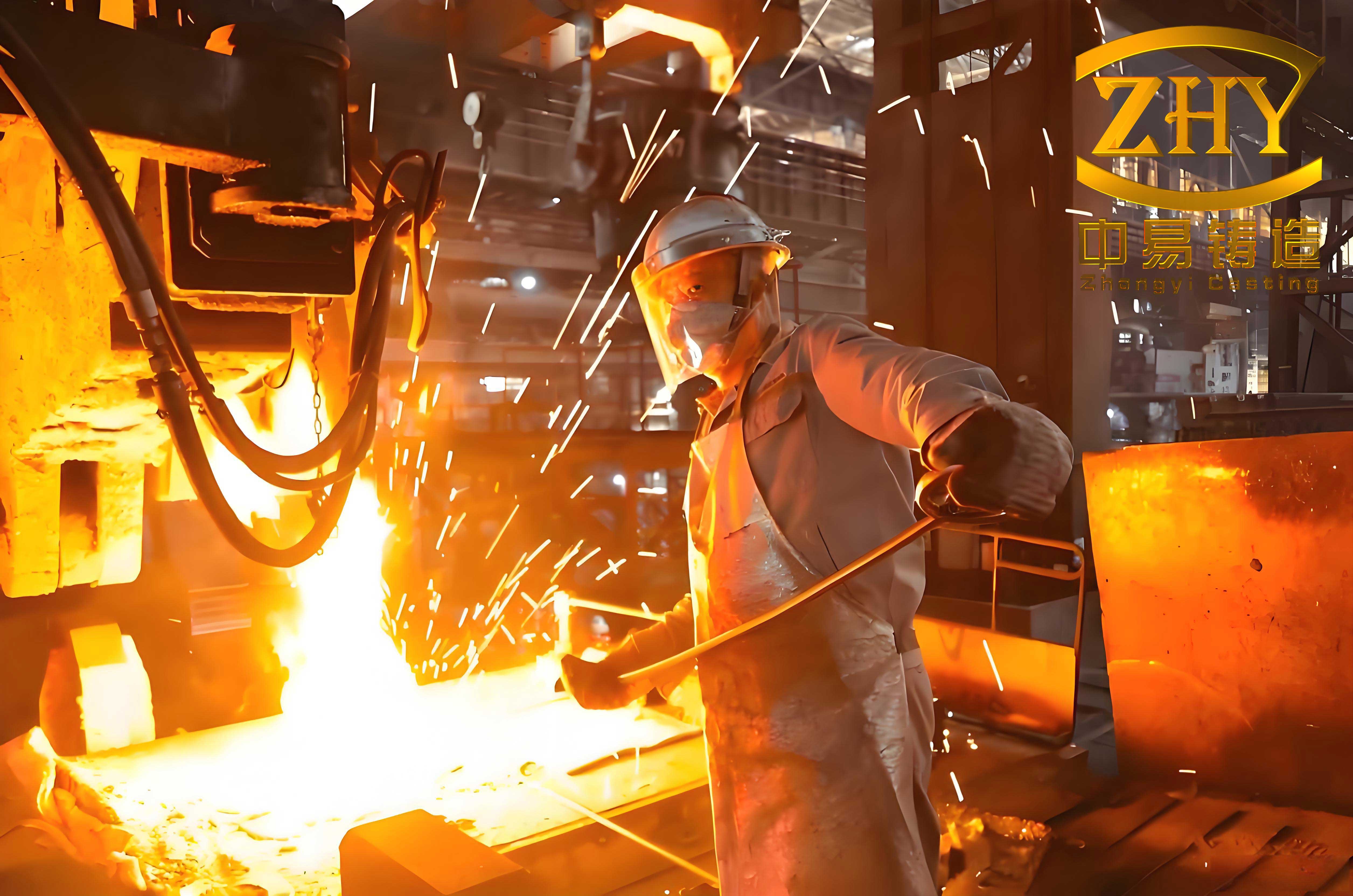
The designed investment casting process was rigorously validated through numerical simulation using ProCAST software. The simulation model, incorporating the exact 3D geometry, material properties of ZL105A aluminum alloy, and boundary conditions, predicted an optimal mold filling sequence. The metal entered calmly through the bottom gates first, followed by the top gates, minimizing turbulence and oxide formation. The solidification simulation confirmed the efficacy of the chills, showing a clear directional solidification front moving from the thin vanes and chilled hub sections towards the feeder. The simulation predicted that shrinkage porosity would be successfully isolated in the feeder, with no defects in the impeller body, validating the gating and chilling design for this specific investment casting process.
The physical investment casting process was then executed. The wax-infiltrated SLS pattern was assembled with the gating system and subjected to the standard investment casting shell-building procedure to create a robust plaster mold. After dewaxing and high-temperature baking, the mold was ready for pouring. To further enhance casting quality, a vacuum-assisted pressure casting technique was employed. The mold was placed in a chamber, evacuated to remove air, and then the molten ZL105A alloy was poured. Immediately after pouring, pressure was applied to the molten metal, forcing it into the finest details of the mold and suppressing gas porosity, resulting in a dense casting.
The as-cast impeller was inspected via X-ray radiography, confirming the simulation predictions: no internal shrinkage or gas porosity defects were detected in the casting proper. Test bars were extracted from the casting’s feeder system (same thermal history) to evaluate mechanical properties. The ZL105A alloy requires a T5 heat treatment (solution treatment followed by artificial aging) to achieve its optimum properties. The mechanical performance before and after T5 treatment was quantified.
| Condition | Ultimate Tensile Strength (MPa) | Brinell Hardness (HB) |
|---|---|---|
| As-Cast (F condition) | 184 | 57 |
| After T5 Heat Treatment | 330 | 109 |
The results are striking. The T5 treatment more than doubled the hardness and increased the tensile strength by nearly 80%. Microstructural analysis provides the explanation. The as-cast structure showed a typical eutectic morphology with coarse, acicular (needle-like) silicon particles in the aluminum matrix, along with some intermetallic phases. These sharp silicon particles act as stress concentrators, facilitating crack initiation and propagation, thereby limiting strength and ductility. The T5 heat treatment involves a solutionizing stage where the alloy is held at a high temperature. This allows for the dissolution of soluble intermetallics and, more importantly, initiates the fragmentation and spheroidization of the eutectic silicon. During the subsequent aging, these silicon particles become more rounded and evenly distributed. This microstructural transformation is the key driver behind the dramatic enhancement in mechanical properties, as the rounded particles impede dislocation motion more effectively without causing severe stress concentrations.
This research successfully demonstrates a complete and optimized digital workflow for manufacturing complex metal parts. By integrating SLS 3D printing for pattern fabrication with a scientifically designed and simulated investment casting process, I have overcome the traditional barriers associated with impeller production. The findings highlight that: 1) SLS is perfectly compatible with the investment casting process, provided pattern strength is optimized through strategic build orientation and post-process wax infiltration; 2) Virtual prototyping through solidification simulation is indispensable for designing a defect-free gating and feeding system in the investment casting process; 3) The final castings, after appropriate heat treatment, meet and exceed standard mechanical property requirements, with the enhancement directly linked to the beneficial microstructural evolution of the alloy. This hybrid SLS-Investment Casting methodology offers a rapid, flexible, and high-quality manufacturing route ideal for prototypes, low-volume production, and complex components that defy conventional manufacturing, firmly establishing a new best practice for advanced casting solutions.