
The production of high-integrity, thin-wall, plate-like castings from ductile cast iron presents a significant foundry challenge. These components, characterized by large planar dimensions relative to their minimal section thickness, are highly susceptible to internal shrinkage defects such as porosity and micro-shrinkage due to the unique solidification characteristics of ductile cast iron. The problem intensifies on high-volume production lines where cost-effectiveness and dimensional stability are paramount.
My extensive experience in a production foundry centered on a specific family of components that perfectly embodied this challenge. The castings in question were plates with envelope dimensions of approximately 500 mm x 400 mm, a uniform nominal wall thickness of only 13 mm, and a final weight ranging from 4 to 5 kg. The functional requirement for these parts was a dense, pressure-tight microstructure, completely free from internal shrinkage defects. However, during the initial production phase utilizing conventional foundry methods, the scrap rate due to internal shrinkage approached a staggering 80-90%. This was economically unsustainable and threatened project viability.
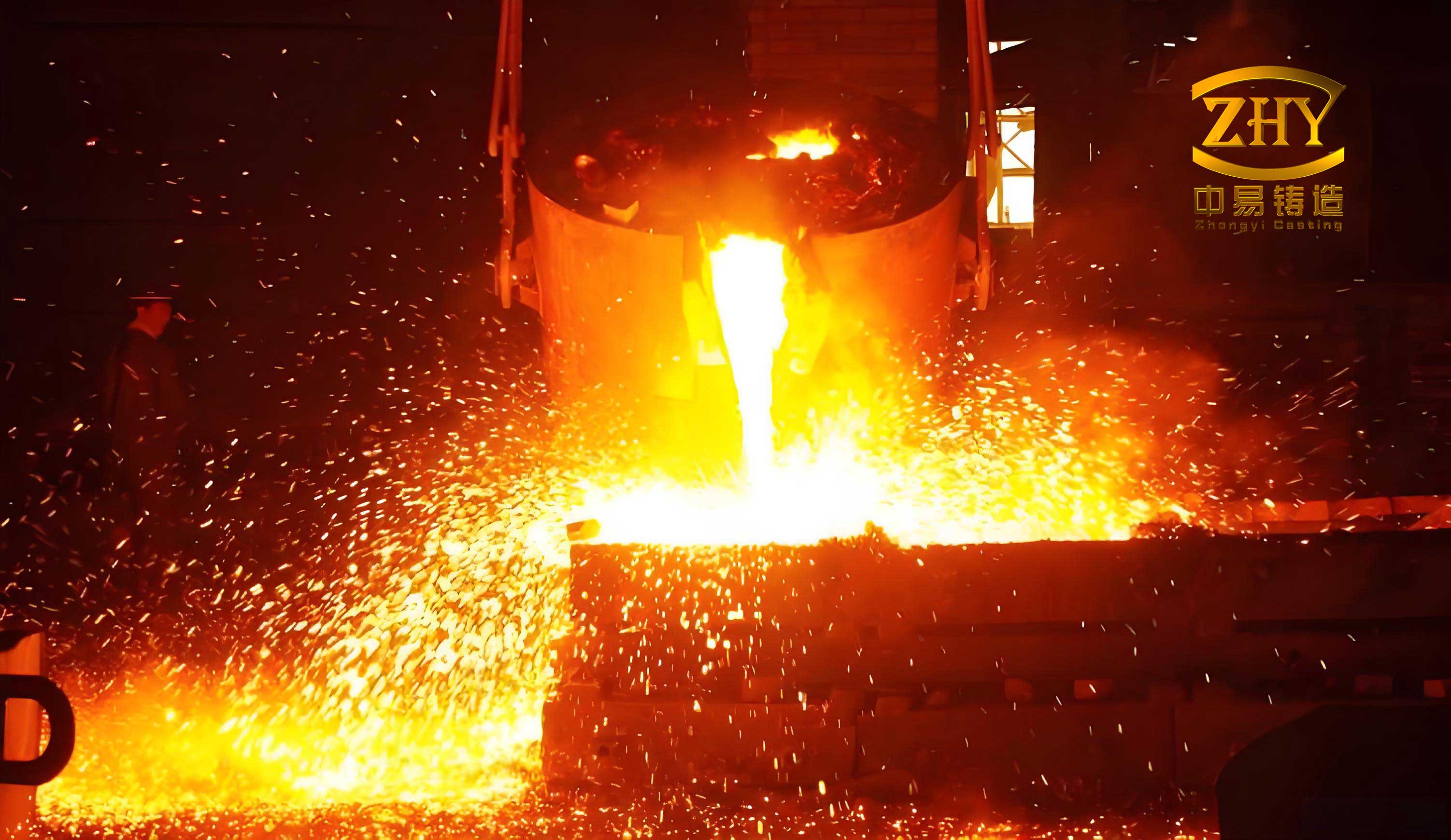
The root cause of this high defect rate lies in the solidification mechanics of ductile cast iron. Unlike grey iron, ductile cast iron exhibits a pasty or mushy zone mode of solidification. Graphite expansion during eutectic solidification can compensate for volumetric shrinkage, but this compensation is highly sensitive to cooling rates and section moduli. In thin sections, the rapid cooling and the early formation of a rigid austenitic shell can prematurely isolate liquid pockets, preventing efficient feeding from a riser and leading to internal micro-shrinkage. Traditional riser-based feeding systems, which are highly effective for heavier sections, fail catastrophically in this context for several reasons. The thin section acts as a very narrow feeding channel that freezes almost instantly, long before the riser can supply liquid metal to compensate for the solidification shrinkage occurring in the isolated thermal center. Consequently, the riser becomes a useless appendage, adding only to the cleaning cost and metal yield penalty.
Furthermore, the physical removal of these conventional risers from a thin, plate-like geometry introduced a secondary critical defect: dimensional distortion. The impact force required to knock off the riser would often cause permanent bending or warping of the casting, leading to downstream machining issues and dimensional non-conformance. Thus, the initial process created a dual problem of internal unsoundness and geometric inaccuracy. A paradigm shift in feeding methodology was imperative. This led to the development, refinement, and successful implementation of an “Internal Transferred Feeding” technique—a core innovation specifically tailored for thin-wall ductile cast iron castings.
Fundamental Limitations of Conventional Feeding for Thin-Wall Ductile Iron
To appreciate the innovation, one must first understand the quantitative failure of traditional methods. The effectiveness of a riser is governed by its ability to remain molten and feed liquid metal through an open channel to a solidifying region until that region is completely solid. This is encapsulated in Chvorinov’s Rule for solidification time, $t$, of a casting section:
$$ t = k \left( \frac{V}{A} \right)^2 = k \cdot M^2 $$
where $V$ is volume, $A$ is surface area, $M$ is the modulus ($V/A$), and $k$ is a mold constant. For effective feeding, the riser modulus, $M_r$, must be greater than the casting modulus, $M_c$, and the feeding path must remain open. For a thin plate of thickness $d$, the modulus is approximately $d/2$. For our 13 mm plate:
$$ M_{casting} \approx \frac{0.013}{2} = 0.0065 , \text{m} $$
A traditional side riser on such a casting would have a significantly larger modulus, perhaps 1.5-2 times greater. However, the decisive factor is the freeze time of the feeding channel—the thin wall itself. Its solidification time is exceedingly short. Meanwhile, the shrinkage porosity forms in the last region to solidify, typically at geometric or thermal “hot spots.” The required feeding distance for a sound casting in ductile iron can be estimated, but for thin sections, it is very limited. The traditional riser, separated from the hot spot by a long, thin channel, is rendered inert. The following table summarizes the inherent conflict.
| Aspect | Traditional Riser Practice | Reality in Thin-Wall Ductile Iron |
|---|---|---|
| Feeding Principle | Liquid metal reservoir feeds through open channel. | Feeding channel (thin wall) freezes almost instantly. |
| Modulus Rule | $M_{riser} > M_{casting}$ | Rule satisfied, but channel freezing invalidates it. |
| Solidification Sequence | Directional solidification towards riser. | Pasty, simultaneous solidification; no directional path. |
| Result | Theoretical soundness. | Practical failure (80-90% shrinkage). |
| Secondary Issue | Riser removal required. | Riser knockout causes plastic deformation/warping. |
Concept and Design of the Internal Transferred Feeding Process
The core philosophy of the Internal Transferred Feeding process abandons the idea of feeding from an external reservoir. Instead, it strategically relocates the shrinkage defect from the critical casting area to a non-critical, sacrificial appendage inside the mold cavity. This is achieved by integrating a specially designed “feeding block” or “transfer pad” within the core assembly. This block is positioned in the mold cavity, adjacent to the casting’s problematic hot spot, but is not part of the final product geometry. It acts as an internal thermal and volumetric sink.
The process mechanics can be described as follows: During pouring, both the casting and the internal feed block fill with liquid ductile cast iron. As solidification commences, the thin wall of the casting cools rapidly. The adjacent feed block, deliberately designed with a higher thermal mass (modulus), solidifies more slowly. This creates a controlled temperature gradient where the feed block becomes the hottest region. According to the laws of thermal dynamics, solidification will progress from the colder regions (the thin casting walls) towards this hotter internal feed block. Consequently, any shrinkage occurring in the last-to-freeze zone of the casting section is effectively “sucked” or transferred into the feed block via the still-liquid connection. The defect is thus intentionally created within the disposable feed block, leaving the actual casting sound.
The successful implementation of this technique hinges on three precise design parameters: location, thermal capacity (thickness), and connection geometry.
1. Optimal Location of the Internal Feed Block
The feed block must be placed immediately adjacent to the identified shrinkage-prone zone (the thermal hot spot) within the casting. It is typically positioned “above” the hot spot relative to the parting line or gravity feeding direction to utilize natural buoyancy and pressure head. The critical distance between the casting’s critical zone and the feed block is minimal. Empirical validation showed that a distance of 5 to 8 mm is optimal. This ensures a short, effective feeding channel that remains open long enough for the transfer to occur but is not so large as to become a hot spot itself.
2. Design of Thermal Capacity: The Thickness Ratio
The thermal mass of the feed block relative to the casting wall thickness is the most critical design variable. If the block is too thin, it will freeze concurrently with or even before the casting section, failing to act as a feeder. If it is too massive, it can create a new, severe hot spot, potentially drawing excessive heat and causing other issues like graphite degradation or even shrinkage in the opposite direction. Through systematic experimentation, the optimal relationship was established. The thickness of the internal feed block ($d_{block}$) should be 1.5 to 2.0 times the nominal wall thickness of the adjacent casting ($h_{wall}$).
$$ d_{block} = C \cdot h_{wall}, \quad \text{where } C = 1.5 \text{ to } 2.0 $$
For our standard 13 mm wall, this yields an optimal feed block thickness range of 19.5 mm to 26 mm. This ratio provides sufficient thermal inertia to delay solidification relative to the casting, creating the necessary temperature gradient for effective defect transfer.
3. Design of the Transfer Channel Geometry
The connection between the casting and the internal feed block—the transfer channel—must be designed to facilitate flow and minimize premature freezing. A key principle is that the cross-sectional area of the channel at the junction with the feed block should be larger than its cross-sectional area at the junction with the casting. This “trumpet” or flared design helps prevent the channel from pinching off at the block interface, maintaining the liquid connection. The channel itself is kept short (the 5-8 mm distance) and with a cross-section similar to or slightly greater than the wall thickness to avoid being the limiting thermal barrier.
| Design Parameter | Symbol / Relationship | Optimal Value / Rule | Rationale |
|---|---|---|---|
| Block Location | $L_{gap}$ | 5 – 8 mm from hot spot | Ensures short, effective feeding distance. |
| Block Thickness | $d_{block} = C \cdot h_{wall}$ | $C = 1.5$ to $2.0$ | Creates optimal thermal gradient (block solidifies last). |
| Channel Design | $A_{block} > A_{casting}$ | Flared connection towards block | Prevents premature freezing at block neck; maintains open channel. |
| Channel Length | $L_{channel}$ | Minimized, equal to $L_{gap}$ | Reduces flow resistance and heat loss in the channel. |
Mechanistic and Thermodynamic Analysis
The efficacy of the Internal Transferred Feeding process can be analyzed through the lens of heat transfer and solidification kinetics. The process aims to manipulate the local solidification sequence. Consider a simplified 1D model of a casting wall of thickness $h$ connected to a feed block of thickness $d$. The solidification times, per Chvorinov, are proportional to the square of their moduli.
$$ t_{wall} \propto \left( \frac{h}{2} \right)^2 = \frac{h^2}{4} $$
$$ t_{block} \propto \left( \frac{d}{2} \right)^2 = \frac{d^2}{4} $$
The ratio of their solidification times is therefore:
$$ \frac{t_{block}}{t_{wall}} \approx \frac{d^2}{h^2} $$
Applying our thickness ratio $d = C \cdot h$:
$$ \frac{t_{block}}{t_{wall}} \approx C^2 $$
For $C = 1.5$, the block solidifies $(1.5)^2 = 2.25$ times slower than the wall. For $C=2.0$, it solidifies 4 times slower. This delayed solidification is the fundamental driver. The feed block remains a liquid/semi-solid reservoir, compensating for the shrinkage in the casting wall through the open channel.
The required volumetric compensation can be linked to the shrinkage characteristics of ductile cast iron. The total volumetric change during solidification of ductile iron is a combination of liquid contraction, austenite contraction, and graphite expansion. The net effect typically results in a need for feeding. The volume of feed metal required from the block, $V_{feed}$, can be related to the volume of the controlled feeding zone in the casting, $V_{cz}$, and the net shrinkage factor, $\beta$ (often around 2-4% for ductile iron):
$$ V_{feed} \approx \beta \cdot V_{cz} $$
The internal feed block is designed with a volume sufficient to provide this $V_{feed}$ while also satisfying the thermal (modulus) requirement. Its design is therefore a simultaneous solution to thermal and volumetric constraints, which is far more efficient than a traditional riser for thin sections where thermal constraints dominate.
Validation Results and Comparative Advantages
The implementation of the Internal Transferred Feeding process yielded transformative results. Radiographic inspection and destructive sectioning of castings produced with the new method confirmed the complete elimination of shrinkage porosity in the critical sections of the ductile cast iron components. The shrinkage defects were consistently found within the sacrificial internal feed blocks, as intended.
The advantages over the conventional riser approach are substantial and multi-faceted:
1. Superior Soundness: The defect transfer mechanism directly addresses the root cause—the premature freezing of feeding paths. By creating a localized, high-modulus region inside the cavity, it ensures directional solidification towards the disposable feeder, guaranteeing soundness in the casting proper.
2. Eliminated Distortion: The internal feed block is connected to the casting via a small, thin bridge. Upon cooling, this connection develops a concentrated stress concentration. During the cleaning process, a simple, low-impact force is sufficient to fracture the connection. This eliminates the high-impact blows required to remove traditional risers, thereby preserving the dimensional accuracy of the thin, flexible ductile cast iron plate. Dimensional variation and post-casting straightening operations were drastically reduced.
3. Enhanced Economic Efficiency:
- Metal Yield (Pouring Yield): The internal feed block is extremely compact compared to a traditional riser. A typical side riser for such a plate might weigh 1-2 kg, doubling the poured weight per casting. The internal feed block typically weighs only 0.2-0.4 kg. This dramatically increases the process yield.
- Cleaning Cost: The easy removal of the small feed block reduces grinding time, consumable cost (cut-off wheels, grinding discs), and labor.
- Energy Savings: Melting less metal per good casting directly reduces energy consumption.
4. Process Robustness and Scalability: The process was successfully applied to three different but geometrically similar thin-wall ductile cast iron components on the high-pressure molding line, demonstrating its robustness and scalability. The design principles (thickness ratio, proximity, channel design) proved to be universally applicable within this product family.
| Performance Metric | Traditional Riser Process | Internal Transferred Feeding Process | Improvement / Advantage |
|---|---|---|---|
| Casting Soundness Rate | 10-20% | > 99% | Elimination of shrinkage defects in casting body. |
| Dimensional Distortion Issue | Severe (from riser knockout) | Negligible | Preserved dimensional accuracy of thin-wall ductile iron. |
| Process Yield (Weight Efficiency) | ~50-60% (Casting/Riser) | ~90-95% | Major reduction in melted metal per good part. |
| Cleaning/Finishing Effort | High (cutting, grinding) | Very Low (light breaking) | Reduced labor, time, and consumable cost. |
| Design Complexity | Low (standard riser) | Moderate (core integration) | Complexity moved to core design, enabling automation. |
Conclusion
The Internal Transferred Feeding process represents a targeted and highly effective solution to the persistent foundry problem of achieving soundness in thin-wall, plate-like ductile cast iron components. By fundamentally rethinking the feeding paradigm from one of external reservoir supply to one of internal defect relocation, it bypasses the inherent limitations imposed by the rapid solidification of thin sections. The key lies in the precise integration of a sacrificial, higher-modulus feed block within the core assembly, governed by the empirically derived rules of proximity (5-8 mm gap) and thermal ratio (1.5-2.0 times wall thickness).
This methodology delivers not only metallurgical integrity, transforming scrap rates from over 80% to near zero, but also delivers compelling economic and quality benefits. It dramatically increases metal yield, simplifies and reduces the cost of finishing operations, and—critically for thin geometries—prevents the dimensional distortion caused by traditional riser removal. The success across multiple similar components validates it as a reliable and scalable process for high-volume production of demanding thin-wall ductile iron castings. It stands as a testament to innovative foundry engineering that addresses material behavior, process physics, and production economics in a single, elegant solution.