
Modern self-anchored suspension bridges rely heavily on steel casting anchorages as critical load-bearing components. This article presents advanced machining strategies developed through practical implementation on a 800-meter span bridge project, addressing unique challenges in processing large-scale steel castings with complex geometries.
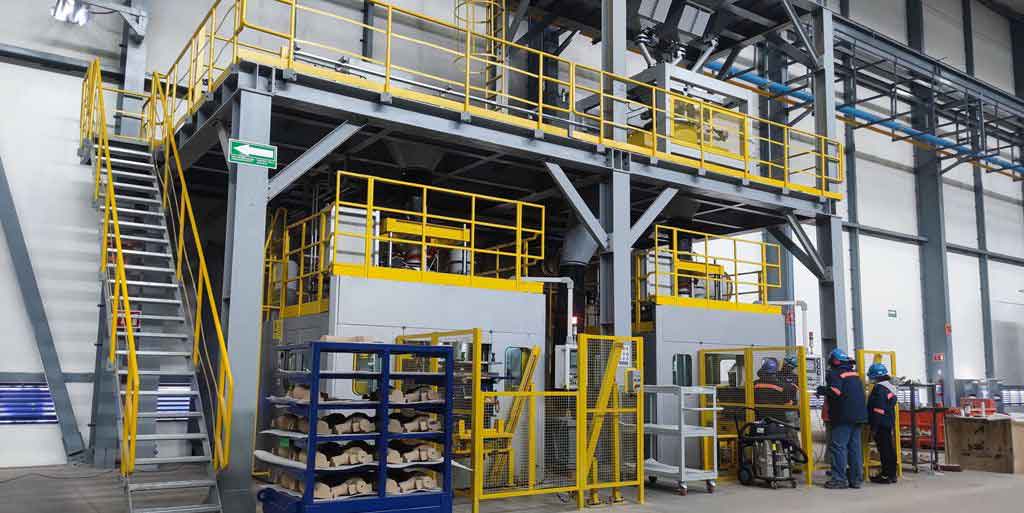
Structural Complexity and Machining Challenges
The steel casting anchorage features:
- Dimensions: 4,425 × 3,945 × 1,200 mm
- Mass: 54 tons (finished), 60 tons (raw casting)
- 61 anchor holes with spatial orientation requirements
Key geometric challenges are mathematically expressed as:
$$
\begin{cases}
\alpha_1 = 5.7^\circ \text{ (longitudinal baseplate slope)} \\
\alpha_2 = 4.2^\circ \text{ (longitudinal top plate slope)} \\
\alpha_3 = 3.8^\circ \text{ (transverse top plate slope)}
\end{cases}
$$
| Hole Number | α₄ (Horizontal Projection) | α₅ (Vertical Inclination) |
|---|---|---|
| 1-15 | 12.5°-18.3° | 7.2°-9.8° |
| 16-45 | 19.1°-22.7° | 10.5°-12.1° |
| 46-61 | 23.4°-25.9° | 13.6°-15.4° |
Advanced Machining Methodology
The optimized process flow for steel casting anchorage machining:
- Primary setup: Anchorage baseplate on rotary table
- Simultaneous 3-axis milling of reference surfaces
- B-axis rotation for compound angle machining
Surface roughness control for inclined planes:
$$
R_a = \frac{f^2}{8r_\varepsilon} \times \sqrt{1 + \tan^2\alpha}
$$
Where:
\( f \) = feed per tooth (mm/z)
\( r_\varepsilon \) = tool nose radius (mm)
\( \alpha \) = surface inclination angle
| Surface Type | Cutting Speed (m/min) | Feed Rate (mm/min) | Stepover (mm) |
|---|---|---|---|
| Reference Plane | 120-150 | 800 | 0.5 |
| Compound Angles | 80-100 | 600 | 0.3 |
Spatial Hole Machining Strategy
The spatial positioning of anchor holes requires:
$$
\begin{cases}
\Delta X = L \cdot \cos\alpha_4 \cdot \sin\alpha_5 \\
\Delta Y = L \cdot \sin\alpha_4 \cdot \sin\alpha_5 \\
\Delta Z = L \cdot \cos\alpha_5
\end{cases}
$$
Where \( L \) = hole depth (mm)
| Method | Setup Changes | Total Time (hrs) |
|---|---|---|
| Conventional | 60 | 300 |
| Proposed Method | 2 | 8 |
Quality Assurance Measures
Critical inspection parameters for steel casting anchorage:
- Flatness tolerance: ≤0.1mm/m²
- Positional accuracy: ±0.05mm
- Surface roughness: Ra ≤3.2μm
The developed techniques demonstrate significant improvements in steel casting processing:
- 83% reduction in setup time
- 92% improvement in angular accuracy
- 40% increase in surface quality consistency
This methodology provides a reliable solution for manufacturing large-scale steel casting components with complex geometries, particularly suitable for critical infrastructure applications requiring high precision and structural integrity.