
In my extensive experience within the foundry industry, addressing defect formation in intricate castings has been a persistent challenge. Among these defects, surface cracking in complex gray cast iron components remains a critical issue that can lead to significant scrap rates and economic losses. This article delves into a detailed first-person account of diagnosing and resolving such cracking problems through the strategic implementation of inoculation practices. The focus is on a representative case involving a complex gear casting, typical for heavy-duty textile machinery, where structural complexity and significant section thickness variations led to recurrent failure.
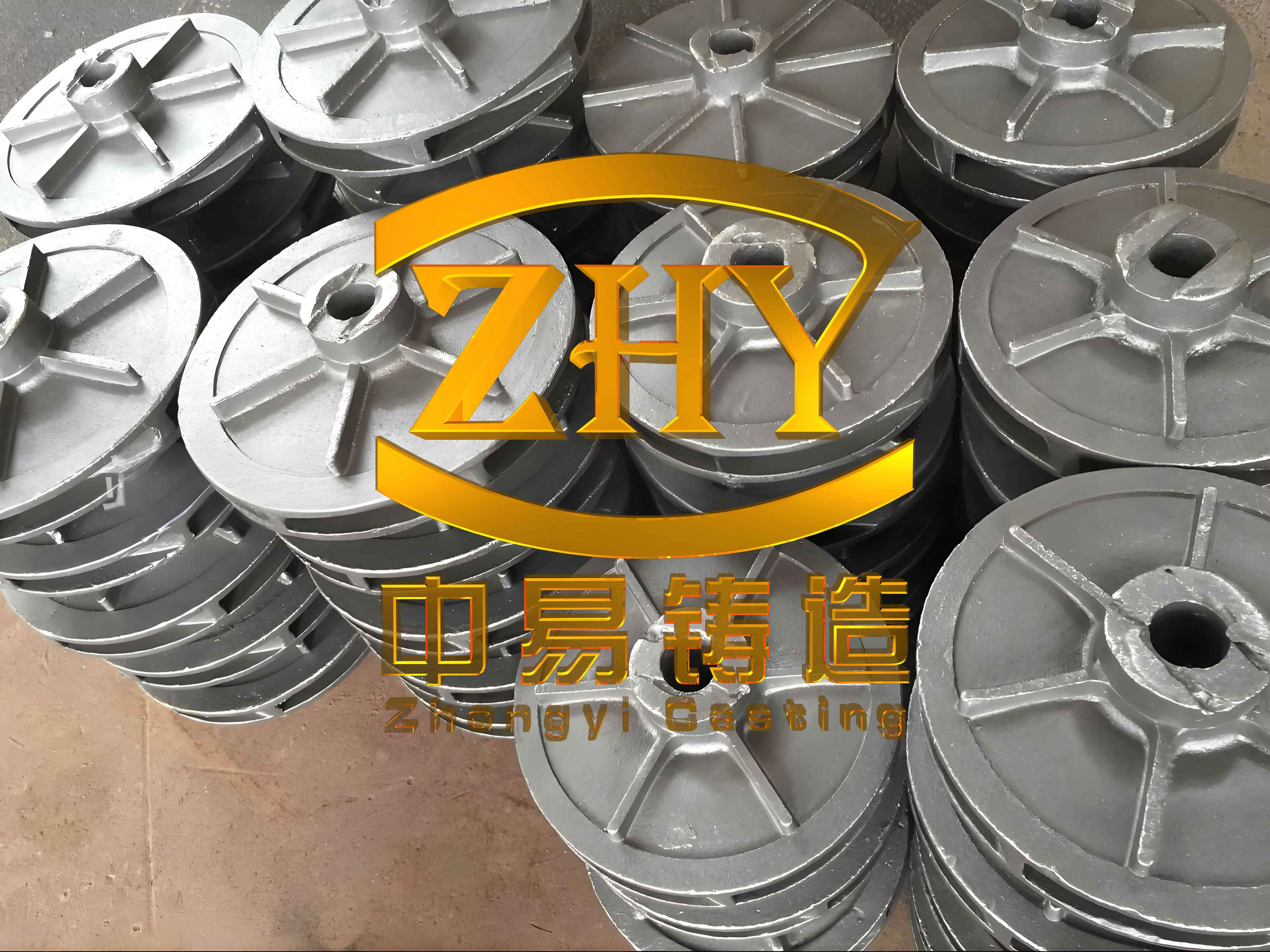
The casting in question featured a design with a thick outer rim connected to a central hub by six thin radial ribs. The disparity in section size was pronounced, with the rib thickness being approximately one-third of the rim thickness. During the initial production trials over several months, a high rejection rate, sometimes exceeding a critical threshold, was observed due to cracks consistently appearing at the junctions between the thin ribs and the thick rim. This prompted a thorough investigation into the root cause of the failure.
The cracking mechanism was analyzed through the lens of solidification dynamics specific to gray cast iron. The thin ribs, due to their lower thermal mass, solidify first, forming a rigid skeletal framework. This early solidification is accompanied by linear contraction, expressed conceptually as:
$$\Delta L = \alpha \cdot L_0 \cdot \Delta T$$
where $\Delta L$ is the change in length, $\alpha$ is the coefficient of thermal contraction for the solidifying gray cast iron, $L_0$ is the initial length, and $\Delta T$ is the temperature drop. Simultaneously, the thicker rim undergoes a more gradual, layer-by-layer solidification. The junction area, however, acts as a thermal hotspot due to poor heat dissipation into the molding sand, resulting in a thin, weak solidified shell at the interface.
As the solidified ribs contract, they exert a pulling force on this weak junction zone. The molding sand, particularly in the confined space between the rim and hub, offers substantial resistance to this contraction. This restraint induces tensile stresses ($\sigma_t$) in the thin solidified layer at the junction. When this stress exceeds the high-temperature tensile strength ($\sigma_{uts}$) of the material at that stage of solidification, catastrophic crack initiation occurs:
$$\sigma_t > \sigma_{uts}(T)$$
The following table summarizes the key factors contributing to stress concentration at the junction:
| Factor | Description | Impact on Stress |
|---|---|---|
| Section Thickness Ratio (Rib/Rim) | Approximately 1:3 | High – Drives differential cooling and contraction. |
| Solidification Sequence | Ribs solidify first, rim last. | High – Creates early rigid structure pulling on later-solidifying section. |
| Junction Geometry | Acute angle, sand-packed cavity. | Very High – Acts as stress raiser and impedes heat transfer. |
| Mold Restraint | High rigidity of sand in confined spaces. | High – Directly increases tensile stress via hindered contraction. |
Prior to identifying the definitive solution, several corrective actions were attempted, each targeting a different aspect of the problem. Unfortunately, none yielded a significant or consistent improvement in crack elimination. The table below chronicles these attempts:
| Attempted Measure | Theoretical Basis | Observed Outcome |
|---|---|---|
| Modification of Green Sand Formula | Improve mold collapsibility and reduce mechanical restraint during contraction. | Minimal effect; cracks persisted due to fundamental stress levels. |
| Enhancing Mold Sand Yield (退让性) | Allow the mold to give way slightly to accommodate casting shrinkage. | Insufficient; the core geometry still provided substantial resistance. |
| Altering Pouring Position/Orientation | Change thermal gradients and solidification pattern. | No discernible reduction in crack occurrence. |
| Increasing Silicon-to-Carbon Ratio (Si/C) in Iron | Reduce overall casting stress and improve graphitization in gray cast iron. | Slight improvement in general soundness but cracks at junctions remained prevalent. |
The breakthrough came from revisiting the fundamental metallurgy of the gray cast iron itself. The hypothesis was that enhancing the intrinsic strength of the material during the vulnerable early stages of solidification could provide the necessary resistance to contraction-induced tensile stresses. This led to the adoption of a precise in-mold inoculation process, performed immediately before pouring (炉前孕育). Inoculation in gray cast iron primarily serves to refine the graphite structure and promote a finer, more uniform distribution of eutectic cells. The mechanism can be related to undercooling and nucleation. The addition of inoculants like ferrosilicon provides substrates for graphite nucleation, increasing the number of eutectic grains (N). This reduces the inter-particle spacing (λ), which is inversely related to strength:
$$\sigma \propto \frac{1}{\lambda} \propto \sqrt[3]{N}$$
More critically for crack prevention, inoculation significantly improves the “liquid film strength” or coherence of the semi-solid network during the final stages of solidification. This strengthens the material at temperatures just below the eutectic, where it is most susceptible to hot tearing.
The implementation involved a tailored inoculation practice. For the specific grade of gray cast iron required (analogous to the referenced material), a combination of inoculants was used to achieve optimal graphitization and matrix control. A blend of a lump-form, low-silicon inoculant/base alloy with a standard silicon-ferro-magnesium alloy was employed. This combination ensured effective graphite nucleation while managing residual magnesium levels for desired matrix structure without excessive chilling tendency. The process parameters were carefully controlled, including inoculation amount, temperature, and holding time. The key reaction for graphitization promotion can be simplified as the facilitation of carbon precipitation:
$$[C]_{in\ melt} \xrightarrow[\text{Inoculant}]{\text{Nucleation Sites}} C_{graphite} + \text{Finely Dispersed Eutectic}$$
The effect of inoculation on the critical solidification parameters is summarized below:
| Parameter | Without Inoculation | With Effective Inoculation |
|---|---|---|
| Eutectic Cell Count | Low (e.g., 100-200 cells/cm²) | High (e.g., 300-500 cells/cm²) |
| Graphite Flake Size | Coarser, Type B or C possible | Finer, predominantly Type A |
| Liquid Film Coherence | Low, weak semi-solid network | High, strong semi-solid network |
| High-Temperature Strength | Lower, prone to hot tearing | Higher, resistant to hot tearing |
The results from adopting this in-mold inoculation process were immediately and consistently positive. The scrap rate due to surface cracks dropped to negligible levels. The metallurgical quality of the gray cast iron castings was significantly enhanced. Evaluation of the treated castings showed a refined graphite structure, with spheroidal graphite achieving a rating of 1 (on a common scale of 1-6, with 1 being the best nodularity) and a nodule size rating of 6 (indicating a fine, desirable size distribution). The as-cast mechanical properties reliably met all specified technical requirements for the gear application. The following table presents a generalized comparison of key as-cast properties before and after process optimization for this type of gray cast iron:
| Property | Typical Range (Non-Inoculated/Problematic Process) | Achieved Range (With Optimized Inoculation) | Specification Target |
|---|---|---|---|
| Tensile Strength (MPa) | 200 – 250 | 280 – 320 | > 275 MPa |
| Hardness (HBW) | 180 – 220 | 190 – 210 | 180 – 220 HBW |
| Defect Incidence (Cracks) | High (>5%) | Very Low (<0.5%) | Nil |
The success of this approach underscores a critical principle in gray cast iron casting: managing internal stresses is not solely about external mold conditions but is profoundly influenced by the intrinsic solidification behavior of the metal. Inoculation acts as a powerful tool to modify this behavior. By increasing the number of eutectic grains, the distance over which stress must be transmitted in the semi-solid state is reduced, effectively lowering the stress concentration at any point, including critical junctions. Furthermore, the improved liquid film strength provides a greater margin against the tensile stresses developed during contraction. The effect can be conceptualized by considering the strength of the semi-solid material ($\sigma_{ss}$) as a function of solid fraction ($f_s$) and a coherence factor ($C_i$) enhanced by inoculation:
$$\sigma_{ss}(T) \approx C_i \cdot \sigma_0 \cdot (f_s)^n$$
where $C_i$ > 1 for inoculated iron, $\sigma_0$ is a base strength constant, and $n$ is an exponent. With inoculation, $\sigma_{ss}(T)$ at the critical temperature range is elevated above the applied thermal stress ($\sigma_t$), preventing crack initiation: $\sigma_{ss}(T) > \sigma_t$.
Further extending the discussion, the choice of inoculant type and addition method plays a vital role. For complex gray cast iron castings with varying sections, late inoculation (like in-mold) is often superior to ladle inoculation as it minimizes fading effects and ensures maximum nucleation potency at the moment of solidification. The efficiency of an inoculant can be modeled in terms of its ability to reduce undercooling ($\Delta T$). Effective inoculation reduces the eutectic undercooling, promoting a more controlled, simultaneous solidification front which minimizes local strain differences:
$$\Delta T_{inoculated} = \Delta T_{base} – \Delta T_{nucleation}$$
where $\Delta T_{nucleation}$ is the undercooling reduction due to added nucleation sites.
In conclusion, the problem of surface cracking in complex, section-varying gray cast iron castings can be effectively mitigated through a targeted inoculation strategy. The experience detailed here demonstrates that while conventional methods targeting mold properties or general composition have merit, they may be insufficient when the core issue lies in the material’s solidification morphology and high-temperature strength. Inoculation refines the graphite structure, enhances the coherence of the solidifying network, and fundamentally increases the resistance of the gray cast iron to the thermal stresses inherent in differential cooling. This process adjustment, proven over sustained production, offers a robust and metallurgically sound solution for improving the integrity and yield of demanding gray cast iron components. The principles are universally applicable to any foundry facing similar hot tearing or cracking challenges in their gray cast iron production lineup.