
As a seasoned mechanical engineer with extensive experience in both internal combustion engine maintenance and foundry processes, I have often encountered the dual challenges of excessive engine oil consumption and casting defects such as slag inclusion. In this comprehensive article, I will delve into the root causes of engine lubricant over-consumption and share detailed methodologies for mitigating slag inclusion defects through optimized gating system design. My goal is to provide a thorough technical perspective that combines empirical observations with quantitative analysis, utilizing tables and mathematical models to summarize key points. The discussion will be structured to ensure clarity while maintaining a first-person narrative, reflecting my hands-on involvement in these fields.
Engine oil consumption is a critical parameter that directly impacts engine efficiency, longevity, and environmental compliance. Based on my observations and analysis, several factors contribute to excessive oil consumption. Firstly, increases in engine rotational speed enhance the splash lubrication mechanism, whereby oil is dispersed onto cylinder walls. The kinetic energy of splash lubrication can be modeled using the following relation for oil droplet formation: $$ E_k = \frac{1}{2} m v^2 $$ where \( E_k \) is the kinetic energy, \( m \) is the mass of oil droplets, and \( v \) is the tangential velocity of rotating components. As speed rises, \( v \) increases, leading to greater oil accumulation on cylinder walls. However, the scraping efficiency of oil control rings does not scale proportionally; this mismatch results in more oil entering the combustion chamber. Secondly, under increased load conditions, engine operating temperatures rise, which accelerates oil evaporation and thermal degradation. The Arrhenius equation approximates this temperature-dependent evaporation rate: $$ k = A e^{-\frac{E_a}{RT}} $$ where \( k \) is the rate constant, \( A \) is the pre-exponential factor, \( E_a \) is the activation energy, \( R \) is the gas constant, and \( T \) is the absolute temperature. Higher temperatures also increase blow-by gases, further elevating oil carry-over into combustion zones. Thirdly, an overfilled oil sump exacerbates oil splash and reduces the effectiveness of ring scraping. Proper oil level maintenance is essential; I recommend checking levels after engine shutdown on a flat surface, with optimal levels lying between the marks on the dipstick. Lastly, oil quality, particularly viscosity, plays a significant role. Lower viscosity oils evaporate more readily, increasing consumption, while higher viscosity oils may not flow adequately at low temperatures. The relationship between dynamic viscosity \( \eta \) and temperature can be expressed as: $$ \eta = \eta_0 e^{b/T} $$ where \( \eta_0 \) and \( b \) are material constants. To summarize these factors, I have compiled Table 1, which outlines primary causes, mechanisms, and mitigation strategies for excessive oil consumption.
| Factor | Mechanism | Impact on Oil Consumption | Recommended Mitigation |
|---|---|---|---|
| Increased Rotational Speed | Enhanced splash lubrication leads to more oil on cylinder walls; ring scraping efficiency lags. | Higher oil entry into combustion chamber. | Optimize ring design and monitor speed ranges. |
| Increased Load | Elevated temperatures raise evaporation rates and blow-by gases. | Increased oil evaporation and burn-off. | Use temperature-resistant oils and ensure cooling system efficiency. |
| Overfilled Oil Sump | Excess oil increases splash volume, overwhelming scraping mechanisms. | Oil migration past rings into combustion areas. | Maintain oil level between dipstick marks after proper shutdown. |
| Oil Quality (Viscosity) | Low viscosity oils evaporate faster; high viscosity oils may cause poor flow at cold starts. | Varied consumption based on viscosity-temperature profile. | Select oils per manufacturer specs: higher viscosity for summer, lower for winter. |
Transitioning to foundry processes, slag inclusion is a pervasive defect in cast components, particularly in critical parts like crankshafts. In my work, I have focused on reducing slag inclusion through gating system design. Slag inclusion refers to non-metallic impurities trapped within the metal matrix, often arising from oxidation, slag entrainment, or turbulence during pouring. These inclusions severely degrade mechanical properties, such as impact toughness and wear resistance, making their minimization paramount. The gating system—comprising sprue, runners, and ingates—directly influences fluid flow dynamics and slag formation. Based on experimental trials, I compare three gating system configurations: closed, semi-closed, and semi-closed with a slag trap and ceramic filter. The cross-sectional area ratios are defined as \( F_{\text{sprue}} : F_{\text{runner}} : F_{\text{ingate}} \). For the closed system, the ratio is 1.4:1.2:1.0; for both semi-closed systems, it is 4:8:3, with one variant including a slag trap. The effectiveness in reducing slag inclusion was evaluated through magnetic particle inspection and sulfur printing, with results summarized in Table 2.
| Gating System Type | Area Ratio (Sprue:Runner:Ingate) | Slag Trap/Filter | Observed Slag Inclusion Severity | Relative Effectiveness |
|---|---|---|---|---|
| Closed | 1.4:1.2:1.0 | None | Medium-thickness slag layer, moderate point-like slag | Poor |
| Semi-closed | 4:8:3 | None | Thin slag layer, minimal point-like slag | Good |
| Semi-closed with Trap | 4:8:3 | Ceramic filter in slag trap | Very thin slag layer, negligible point-like slag | Excellent |
The superior performance of semi-closed systems stems from reduced flow velocities and minimized turbulence. Using fluid dynamics principles, the Reynolds number \( Re \) indicates flow regime: $$ Re = \frac{\rho v D}{\mu} $$ where \( \rho \) is density, \( v \) is velocity, \( D \) is hydraulic diameter, and \( \mu \) is dynamic viscosity. Lower \( Re \) values (below 2000) promote laminar flow, reducing slag entrainment. In semi-closed systems, larger runner cross-sections decrease \( v \), thus lowering \( Re \) and turbulence. Additionally, the incorporation of a slag trap with a ceramic filter enhances slag capture by further slowing flow and providing physical filtration. The probability of slag inclusion formation \( P_{\text{slag}} \) can be modeled as: $$ P_{\text{slag}} = k_1 \cdot v^2 + k_2 \cdot \Delta T $$ where \( k_1 \) and \( k_2 \) are constants related to flow dynamics and temperature gradients, respectively. By optimizing gating design, \( P_{\text{slag}} \) is minimized. It is crucial to repeatedly address slag inclusion in casting discussions, as this defect directly compromises component integrity. For instance, in crankshaft production, even minor slag inclusion can lead to stress concentrations and premature failure, indirectly affecting engine performance and oil consumption through increased friction and wear.
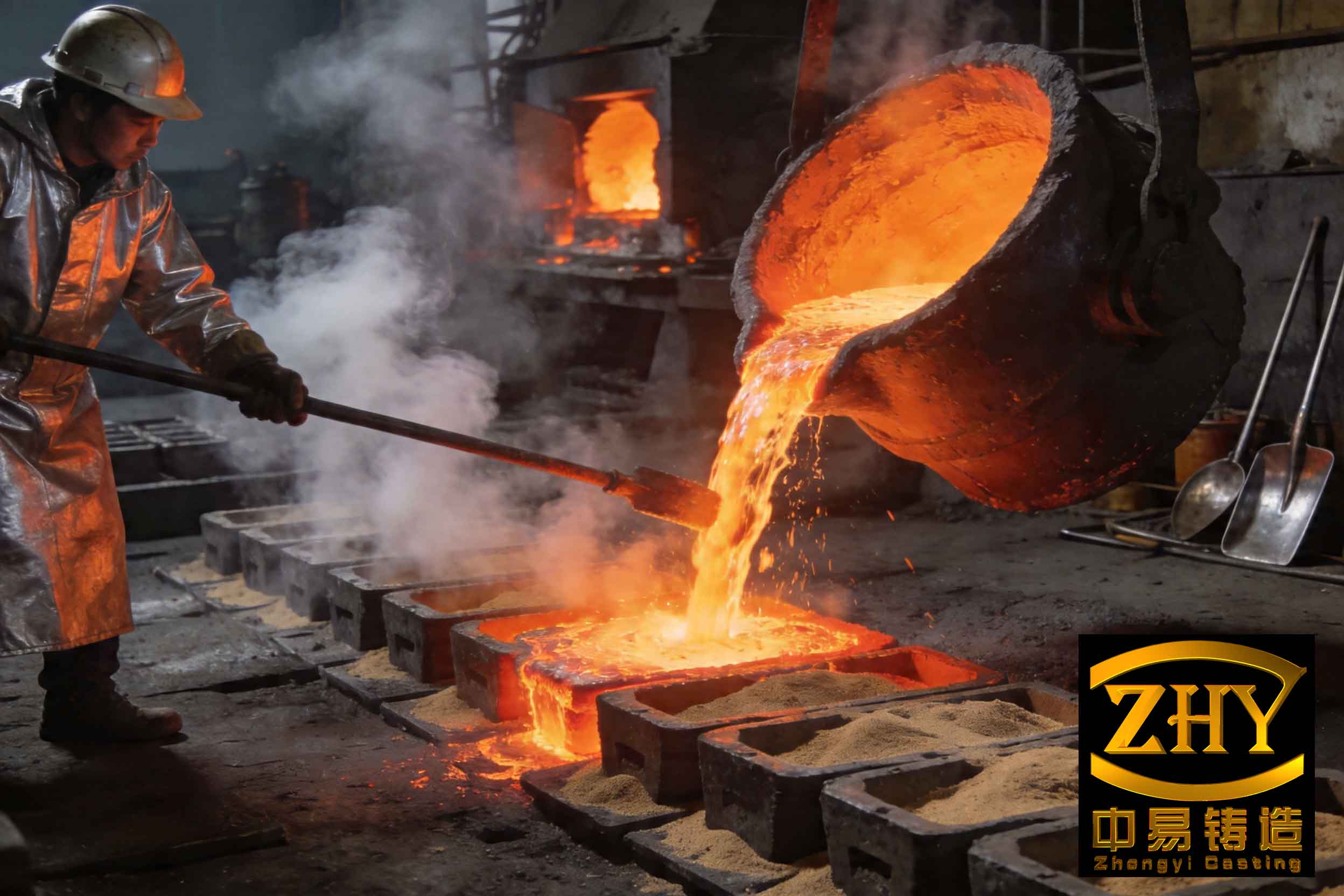
Building on the gating system analysis, I explore additional factors influencing slag inclusion. Pouring temperature, residual magnesium content, and slag removal practices are critical. Higher pouring temperatures reduce viscosity, improving slag floatation, but may increase oxidation. The balance can be expressed using the dimensionless number \( N_{\text{slag}} \): $$ N_{\text{slag}} = \frac{\eta \cdot g \cdot \rho_{\text{slag}}}{\sigma \cdot v_{\text{pour}}} $$ where \( \eta \) is metal viscosity, \( g \) is gravity, \( \rho_{\text{slag}} \) is slag density, \( \sigma \) is surface tension, and \( v_{\text{pour}} \) is pouring velocity. Lower \( N_{\text{slag}} \) values favor slag separation. Furthermore, I have developed empirical formulas to predict slag inclusion severity based on gating parameters. For example, the slag inclusion index \( I_{\text{slag}} \) for a semi-closed system is: $$ I_{\text{slag}} = \alpha \cdot \left( \frac{F_{\text{runner}}}{F_{\text{sprue}}} \right)^{-1} + \beta \cdot T_{\text{pour}}^{-1} $$ where \( \alpha \) and \( \beta \) are coefficients derived from regression analysis, and \( T_{\text{pour}} \) is pouring temperature. This index helps in designing systems that proactively reduce slag inclusion. In practice, I recommend iterative testing with these models to achieve optimal results. The interplay between gating design and slag inclusion is complex, but a systematic approach yields significant improvements in casting quality.
Connecting the two themes, engine components like crankshafts are often cast, and their quality directly impacts lubrication system performance. A crankshaft with slag inclusion may have reduced surface hardness and increased friction, leading to higher oil consumption over time. Thus, mitigating slag inclusion not only enhances mechanical properties but also contributes to efficient engine operation. From my perspective, engineers should adopt holistic approaches that consider both manufacturing quality and operational parameters. For instance, using high-integrity cast parts with minimal slag inclusion can lower wear rates, thereby reducing oil consumption. This synergy is often overlooked but is vital for long-term reliability. To quantify this, wear rate \( W \) can be related to slag inclusion density \( \rho_{\text{inclusion}} \) via: $$ W = c_1 \cdot \rho_{\text{inclusion}} + c_2 \cdot \mu_{\text{oil}}^{-1} $$ where \( c_1 \) and \( c_2 \) are constants, and \( \mu_{\text{oil}} \) is oil viscosity. By minimizing \( \rho_{\text{inclusion}} \) through better casting practices, \( W \) decreases, extending oil change intervals.
In summary, excessive engine oil consumption arises from multifactorial causes including speed, load, oil level, and oil quality, each amenable to mitigation through proper design and maintenance. Concurrently, slag inclusion defects in casting can be substantially reduced by optimizing gating systems, with semi-closed designs incorporating slag traps offering the best performance. My first-hand experiences reinforce the importance of integrating quantitative analysis—through formulas and tables—into practical engineering decisions. Future work could explore advanced materials and real-time monitoring to further address these challenges. Ultimately, a proactive stance on both fronts ensures enhanced performance and durability in mechanical systems.