
The pursuit of excellence in manufacturing, particularly for critical components, demands relentless innovation in process control and material science. In the domain of heavy-duty railway infrastructure, the high manganese steel casting stands as a quintessential example of a component where performance, safety, and longevity are non-negotiable. As the pivotal “throat” of railway switches, the high manganese steel frog (or crossing) endures extreme impact and abrasive wear. Its quality is directly dictated by the stability and precision of the foundry processes used in its creation. This article chronicles a first-person perspective on the development and industrial integration of two synergistic technological advancements: an online sand property monitoring and control system, and the Vacuum Replacement Hardening (VRH) process. Together, these systems form a comprehensive framework aimed at elevating the consistency, quality, and reliability of high manganese steel casting production.
The foundational element in any green sand molding process is the molding sand itself. Its properties, primarily compactability and green compressive strength, are critical determinants of mold integrity, dimensional accuracy, and final casting surface quality. Traditional methods relied on offline laboratory testing, which introduced significant lag time between sampling, analysis, and corrective action. This delay inevitably led to wide fluctuations in sand properties, causing inconsistencies in the high manganese steel casting quality. To address this, we developed and deployed an online, closed-loop control system.
The core principle of the system is based on establishing empirical relationships between measurable physical forces and the target sand properties. A probe is integrated directly into the sand mixer. During the mulling cycle, the system measures parameters such as resistance to penetration and shear. These measurements are correlated to compactability (C) and wet tensile/green compressive strength (P) through derived algorithms. The fundamental relationship can be conceptualized as:
$$P = f(C, M, \rho)$$
where \(M\) represents moisture content and \(\rho\) represents the density of the sand mixture. The system’s industrial programmable logic controller (PLC) continuously processes these sensor inputs, comparing them to pre-set target ranges. If a deviation is detected, the PLC automatically calculates and initiates corrective actions, such as adjusting water or binder addition rates, in real-time.
The hardware architecture is built for industrial robustness. A ruggedized sensor suite feeds data to a central PLC, which executes the control algorithms. An upper-level computer (HMI/SCADA) provides the interface for operators to set parameters, monitor real-time trends, and view historical data. The system’s logic is designed for minimal interference with production. For instance, in our initial full-scale validation at a foundry with four sand mixers, the system was installed on only one mixer to ensure production continuity during the trial phase. The results were unequivocal. The system operated reliably, providing accurate and consistent readings that matched laboratory verification tests. Most importantly, it successfully regulated the sand compactability within a tight specification.
The table below contrasts the control performance before and after the system’s implementation for a critical parameter like compactability:
| Parameter | Control Target | Performance Before System | Performance After System |
|---|---|---|---|
| Compactability | 40% ±5% | Wide, uncontrolled fluctuations, mostly outside target. | Stably controlled within 40% ±3%. |
This marked improvement in process stability directly translates to more consistent mold hardness, reduced scrap due to sand-related defects like blows or cuts, and ultimately, a more reliable high manganese steel casting. The role of the PLC in facilitating this real-time, automated feedback loop is indispensable, transforming a previously manual and reactive process into a proactive, precision-controlled operation.
While sand preparation control addresses one variable, the molding and core-making process itself presented another set of historical challenges for our high manganese steel casting production. For decades, we used the CO2-sodium silicate process with limestone sand (“70-sand”). While it prevented chemical burn-on on high manganese steel, it harbored several drawbacks: high gas generation leading to porosity, poor surface finish due to coarse sand grains, low reclamation rates, poor collapsibility leading to hot tearing, and environmental issues from effluent discharge.
The quest for a superior process led us to the Vacuum Replacement Hardening (VRH) method. This innovation significantly improves upon traditional sodium silicate bonding. The process sequence is as follows: 1) A mold or core is rammed using sand mixed with a minimal amount of sodium silicate binder. 2) The mold is enclosed in a vacuum chamber. 3) The air is evacuated, removing most of the moisture and air from the sand pores. 4) CO2 gas is introduced into the vacuum. The drastic pressure difference drives the CO2 deep into the sand mass, where it reacts rapidly and uniformly with the sodium silicate, forming a silica gel bond. The chemical reaction is:
$$Na_2O \cdot mSiO_2 \cdot nH_2O + CO_2 \rightarrow Na_2CO_3 + mSiO_2 \cdot (n-1)H_2O + H_2O$$
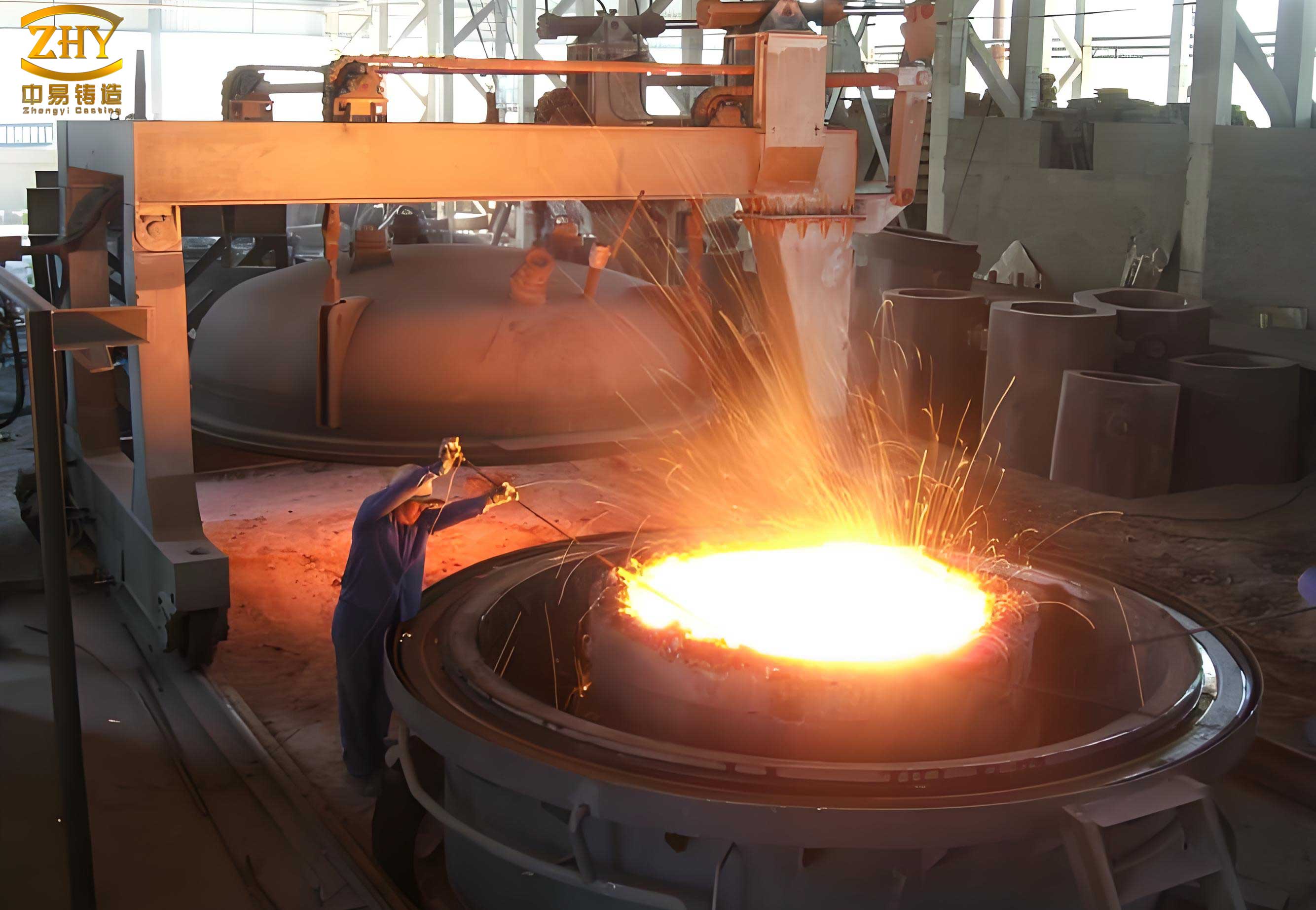
The advantages for high manganese steel casting are profound. The lower moisture content and more efficient reaction allow for a drastic reduction in binder usage (from 6-8% in traditional methods to 3.5-3.7%). This directly translates to excellent collapsibility, resolving the hot tearing issue prevalent with the old sand. The hardened mold has high immediate strength, allowing for quick pattern removal and handling. Furthermore, the process uses environmentally benign materials.
Our feasibility studies and subsequent process development were meticulous. We selected magnesia olivine sand for its superior thermal stability and resistance to basic slag reactions, crucial for high manganese steel casting. A dedicated VRH production line was established. The key to success lay in optimizing a matrix of interdependent parameters. We conducted extensive trials to establish the optimal windows for each variable, understanding that they form a cohesive system.
The table below summarizes the critical VRH process parameters and their optimized ranges developed for our high manganese steel frog production:
| Process Parameter | Target Range / Value | Significance |
|---|---|---|
| Base Sand | Magnesia Olivine (50/100 mesh) | High refractoriness, low thermal expansion, resistant to chemical attack. |
| Sodium Silicate Modulus | 2.1 – 2.3 | Balances hardening speed and final strength. |
| Sodium Silicate Addition | 3.5 – 3.7 wt% | Minimized for collapsibility while ensuring adequate strength. |
| Mold Hardness (Rammer) | > 85 | Ensures uniform density and “bridging” for effective gas reaction. |
| Vacuum Degree | > 90% (approx. -0.09 MPa) | Removes moisture and air, creating a pressure differential for CO2 penetration. |
| CO2 Gassing Time | 10 – 20 seconds | Sufficient for complete reaction without over-gassing. |
| Target Mold Strength | > 1.5 MPa | Adequate for handling and resisting metal static pressure. |
The transition was not without challenges, demanding practical problem-solving. For example, hot external chills (at ~700°C) from shaken-out castings were damaging the magnetic separator’s heat-resistant belt (rated for 600°C). The solution was installing protective, non-magnetic steel angles on the belt to prevent direct contact with the hot chills, extending belt life from days to years. Another issue was the lack of a waste-sand discharge in the closed-loop sand reclamation system. Although the dry reclamation efficiency was over 95%, the accumulated residual alkali in the recycled sand required a purge stream. We ingeniously added a bypass chute at the top of a bucket elevator, solving this “blockage” without additional energy consumption.
Despite the success of the VRH line, continuous improvement is imperative. We observed that under certain conditions—variations in raw material quality or ambient temperature—mold surface stability could be compromised, leading to potential scabbing or erosion in complex sections of the high manganese steel casting. To push the boundaries further, we are now pioneering a hybrid hardening process: VRH combined with organic ester pre-hardening. This approach leverages the rapid, surface-setting characteristic of esters with the deep, strong, and uniform hardening of VRH. The ester initiates the gelation process immediately upon mixing, providing high early strength and superb surface stability for the mold. The subsequent VRH treatment then completes the hardening through the entire section. This synergy allows for even lower sodium silicate addition (potentially below 3.0%), further enhancing collapsibility while achieving superior mold integrity. The strength development can be modeled as a composite function:
$$S_{total}(t) = S_{ester}(t) + S_{VRH}(t)$$
where \(S_{ester}(t)\) increases rapidly to a plateau, and \(S_{VRH}(t)\) increases more slowly but to a higher final value, ensuring both immediate handling strength and long-term thermal resilience.
The true power of modern foundry control is realized when unit processes are integrated into a cohesive, data-driven system. The online sand control system and the VRH process are not isolated islands of technology. Imagine a fully integrated workflow: The sand plant, governed by the PLC-based control system, delivers sand with perfectly consistent properties to the VRH molding stations. This consistency ensures that the rammed molds have uniform density and hardness, which is a critical pre-condition for the repeatability of the VRH cycle’s vacuum and gassing parameters. In essence, the output of the first controlled process (sand mixing) becomes a stabilized input for the second controlled process (mold hardening).
Data from both systems can be fed into a central manufacturing execution system (MES). This allows for sophisticated analysis and correlation. For instance, one could analyze if subtle, permissible drifts in sand compactability (within the ±3% band) have any statistically significant effect on the optimal CO2 gassing time in the VRH chamber for a specific high manganese steel casting pattern. This level of analysis enables predictive adjustments and fine-tuning that transcend the capability of standalone systems. The control logic for the entire sand-to-mold chain can be visualized as an adaptive network, where the setpoints for the muller are dynamically adjusted not just based on sand property feedback, but also on the historical performance data of molds produced from that sand batch.
The ultimate testament to this integrated approach is the quality of the final high manganese steel casting. The improvements are measurable and significant:
- Dimensional Consistency: Reduced mold wall movement from stable, high-strength VRH molds leads to castings closer to nominal dimensions, minimizing cleaning and machining costs for the hard, work-hardening high manganese steel.
- Internal Soundness: The low-gas VRH process, combined with sand of controlled and minimal moisture, drastically reduces the incidence of subsurface porosity and gas-related defects.
- Surface Quality: The use of finer, stable olivine sand and molds with high surface stability produces castings with superior surface finish, reducing cleaning time and improving fatigue resistance.
- Reduced Scrap and Rework: The combined effect of stabilized sand and a robust molding process significantly lowers variability, leading to a steep drop in scrap rates for defects like sand inclusions, cuts, washes, and hot tears.
- Environmental and Economic Benefits: Higher sand reclamation rates (>85%), lower binder consumption, and the elimination of water-blast cleaning contribute to a cleaner, more sustainable, and cost-effective operation.
The journey from a manual, variable-prone process to a digitally monitored and controlled one represents the future of heavy casting manufacture. The implementation of the online sand control system and the VRH process for high manganese steel casting production has been transformative. It has moved quality assurance from a reactive, inspection-based model to a proactive, process-embedded one. The PLC and computer-based controls are the nervous system of this new paradigm, enabling precision, repeatability, and traceability that were previously unattainable.
The path forward involves deepening this integration through Industry 4.0 principles. The next evolutionary step includes embedding IoT sensors in patterns and molds to monitor temperature gradients during pouring and solidification of the high manganese steel casting. This data, correlated with the sand property logs and VRH cycle parameters, can feed machine learning algorithms. The goal is to develop predictive models that not only control the process but also forecast the resulting microstructure and mechanical properties of the high manganese steel, such as its ultimate toughness and wear resistance. The equation for quality is becoming a complex, multivariable function that we are now equipped to solve:
$$Q_{casting} = F(P_{sand}, T_{VRH}, t_{cycle}, \Delta T_{solid}, …)$$
where each input variable is measured, controlled, and optimized. This holistic control strategy, pioneered on critical components like railway frogs, sets a new standard for reliability and excellence in the demanding field of high manganese steel casting.