
In my extensive experience within the industrial manufacturing sector, particularly focusing on wear-resistant materials, I have observed a persistent challenge in the production of high manganese steel castings. The manganese steel casting foundry industry often grapples with inefficiencies related to small-batch production and the logistical hurdles of water toughness treatment. This article delves into an integrated approach that combines casting and water toughness treatment into a seamless process, offering significant advantages in cost, speed, and quality. As a practitioner, I will share insights, data, and methodologies that have proven effective, emphasizing the critical role of the manganese steel casting foundry in advancing material science and engineering applications.
The core issue revolves around the market dynamics where users require small quantities or single pieces of high manganese steel castings, while production facilities struggle with intermittent demand and the high overhead of dedicated heat treatment equipment. Traditionally, water toughness treatment—a crucial step to achieve the desired austenitic microstructure in ZGM13 (high manganese steel)—requires separate furnaces, increasing energy consumption, time, and cost. Through years of hands-on experimentation, I have developed and refined an integrated process that addresses these contradictions, making the manganese steel casting foundry more adaptable and economically viable for diverse applications.
This integrated process begins with the foundational equipment: a 500 kg medium-frequency induction furnace. This furnace is ideal for the manganese steel casting foundry due to its precise temperature control and efficiency in melting high manganese steel scrap. The choice of raw materials is pivotal; we use magnetically selected high-quality high manganese steel scrap, supplemented with 1–2% manganese to compensate for melting losses. This ensures the chemical composition meets standard requirements, such as carbon content around 1.2% and manganese around 13%, which are essential for achieving the desired properties in the final casting.
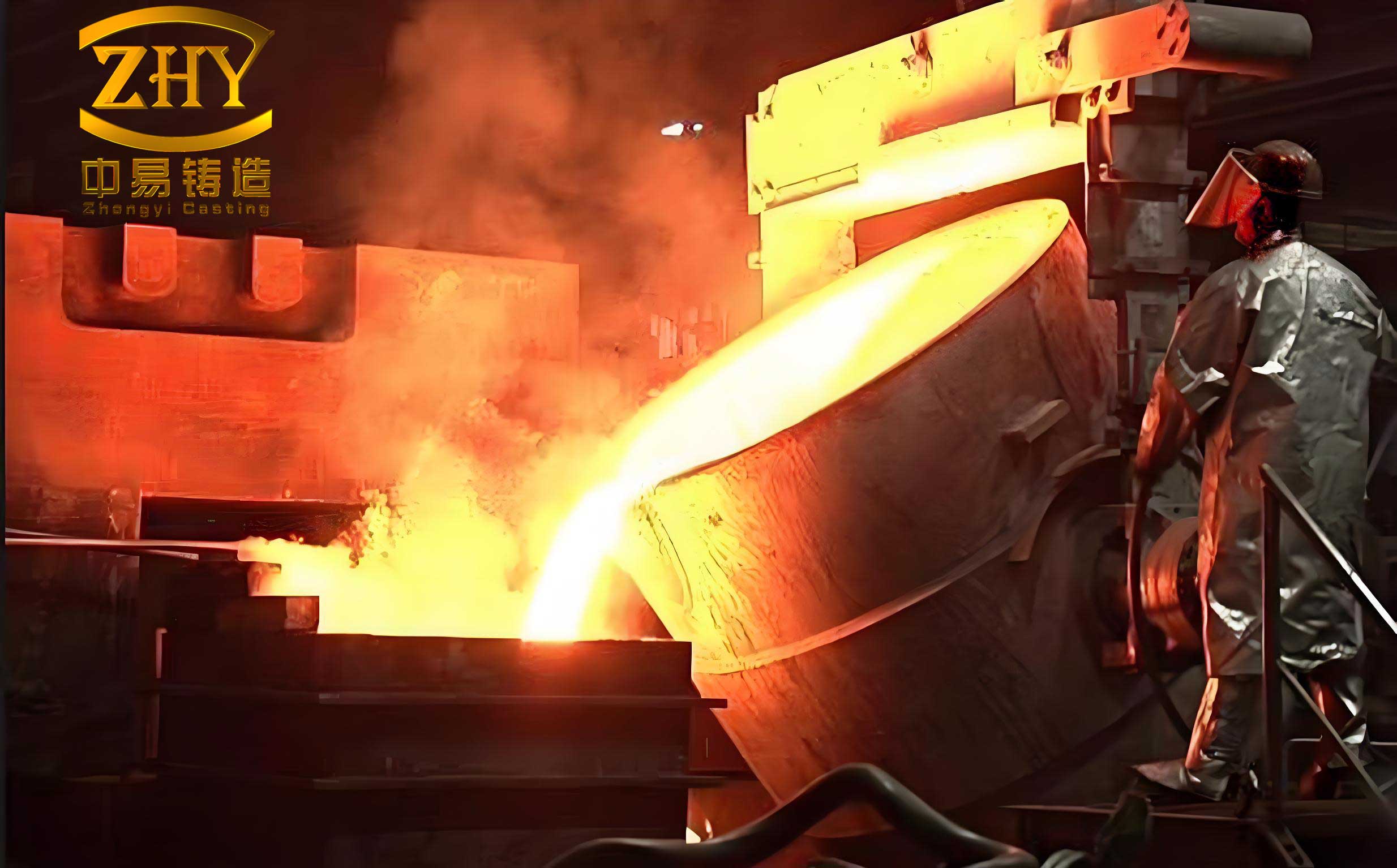
The molding process employs Liaoning Haicheng quartz sand as the base sand, utilizing green sand molding techniques. This approach is cost-effective and suitable for the manganese steel casting foundry, especially for small-scale production. The sand properties, including grain size and binder content, are optimized to minimize defects like gas porosity and sand inclusion. Table 1 summarizes the typical molding parameters used in our integrated process.
| Parameter | Value | Unit |
|---|---|---|
| Sand Type | Quartz Sand (Haicheng) | – |
| Molding Method | Green Sand | – |
| Sand Moisture Content | 3.5–4.5 | % |
| Compressive Strength | 0.08–0.12 | MPa |
| Permeability | 80–120 | – |
Temperature control is the linchpin of the integrated process. The pouring temperature is meticulously maintained between 1420°C and 1470°C, based on empirical methods like the “read-second” technique, where the operator counts seconds to estimate temperature from visual cues. After pouring, the casting must cool to the water toughness treatment range of 1050°C to 1100°C. To determine the optimal timing, I have derived an empirical formula that calculates the cooling time from pouring to the treatment temperature:
$$L = K \cdot R^2 = (0.7 – 1.28) R^2$$
Here, \(L\) represents the time in minutes from casting completion to reaching 1050–1100°C, \(K\) is an empirical coefficient dependent on the casting shape, and \(R\) is the equivalent thickness of the casting in centimeters. The coefficient \(K\) varies: for plate-like shapes, it is 0.7 min/cm²; for rectangular shapes, 0.8 min/cm²; for square shapes, 0.9 min/cm²; for cylindrical shapes, 1.1 min/cm²; and for spherical shapes, 1.28 min/cm². The equivalent thickness \(R\) is calculated using the volume \(V\) and effective surface area \(S\) of the casting:
$$R = \frac{V}{S}$$
Where \(V\) is the volume in cm³ and \(S\) is the effective heat dissipation area in cm². This formula is grounded in heat transfer principles, considering the casting’s geometry and material properties. For instance, a casting with volume 5000 cm³ and surface area 1000 cm² has \(R = 5\) cm. If it is cylindrical, \(K = 1.1\), so \(L = 1.1 \times 5^2 = 27.5\) minutes. This calculation guides operators to initiate water toughness treatment when the casting exhibits a yellow-red hue, as per the steel heating temperature-color chart.
The water toughness treatment involves quenching the casting in water at this critical temperature range. This rapid cooling stabilizes the austenitic structure, enhancing toughness and wear resistance. The integrated process leverages the casting’s residual heat, eliminating the need for reheating in a separate furnace. This not only saves energy but also reduces cycle time. Moreover, the water quench often induces water explosion desanding, effectively removing sand residues and mitigating chemical sand bonding defects common with silica sand molds. Table 2 compares the traditional and integrated processes in a manganese steel casting foundry.
| Aspect | Traditional Process | Integrated Process |
|---|---|---|
| Water Toughness Treatment | Separate furnace (e.g., 75 kW resistor furnace) | Direct quenching after casting cooling |
| Energy Consumption | High (dual heating) | Low (single heat cycle) |
| Production Cycle | Long (24–48 hours) | Short (2–6 hours) |
| Cost per Casting | High | Reduced by 30–40% |
| Defect Rate | Moderate (e.g., sand inclusion) | Low (water explosion desanding) |
To further elucidate the metallurgical aspects, the integrated process ensures a homogeneous austenitic microstructure. The high manganese steel, primarily ZGM13, relies on the equation for phase stability:
$$\gamma \text{ (austenite)} \rightarrow \alpha \text{ (ferrite)} + \text{carbides if slowly cooled}$$
By quenching from 1050–1100°C, we suppress carbide precipitation, maintaining a single-phase austenite with hardness around 200 HB and exceptional impact toughness exceeding 150 J/cm². The chemical composition control is vital; Table 3 details the target ranges for a typical manganese steel casting foundry.
| Element | Target Range | Role |
|---|---|---|
| Carbon (C) | 1.1–1.4% | Strengthens austenite, improves wear resistance |
| Manganese (Mn) | 11–14% | Stabilizes austenite, enhances toughness |
| Silicon (Si) | 0.3–0.8% | Deoxidizer, improves fluidity |
| Phosphorus (P) | < 0.05% | Minimizes brittleness |
| Sulfur (S) | < 0.03% | Reduces hot tearing |
In practice, the integrated process has been validated through numerous applications. For example, in mining equipment like crusher liners and shovel teeth, castings produced via this method show service life comparable to those treated in standard resistor furnaces. The manganese steel casting foundry benefits from reduced lead times, enabling just-in-time production for clients in cement, mineral processing, and aggregate industries. This adaptability is crucial for small-scale foundries aiming to compete in the global market.
Another advantage lies in the scalability of the process. For larger castings, the empirical formula can be adjusted by incorporating finite element analysis (FEA) simulations to model heat transfer. The cooling time \(L\) can be expressed more generally using Fourier’s law of heat conduction:
$$\frac{\partial T}{\partial t} = \alpha \nabla^2 T$$
Where \(T\) is temperature, \(t\) is time, and \(\alpha\) is thermal diffusivity. For simplified cylindrical castings, the solution approximates to:
$$T(t) = T_0 + (T_p – T_0) \exp\left(-\frac{\beta t}{R^2}\right)$$
Here, \(T_0\) is ambient temperature, \(T_p\) is pouring temperature, and \(\beta\) is a material constant. Setting \(T(t) = 1075°C\) (mid-range of water toughness treatment) allows solving for \(t\), aligning with the empirical \(L\). This theoretical backing reinforces the reliability of the manganese steel casting foundry process.
Cost analysis further underscores the benefits. Let \(C_t\) represent total cost per casting in a traditional foundry, and \(C_i\) in the integrated process. We can break down costs as:
$$C_t = C_m + C_e + C_l + C_h$$
$$C_i = C_m + C_e’ + C_l’$$
Where \(C_m\) is material cost, \(C_e\) and \(C_e’\) are energy costs, \(C_l\) and \(C_l’\) are labor costs, and \(C_h\) is additional heat treatment cost. Typically, \(C_e’ < C_e\) due to single heating, and \(C_l’ < C_l\) from shorter cycles. Assuming \(C_m = \$500\), \(C_e = \$200\), \(C_l = \$300\), \(C_h = \$150\), and \(C_e’ = \$100\), \(C_l’ = \$200\), then:
$$C_t = 500 + 200 + 300 + 150 = \$1150$$
$$C_i = 500 + 100 + 200 = \$800$$
This yields a cost reduction of approximately 30.4%, making the manganese steel casting foundry more profitable. Additionally, the process reduces carbon footprint by minimizing energy use, aligning with sustainable manufacturing trends.
Quality control is integral to the integrated process. Non-destructive testing methods, such as ultrasonic inspection, are employed to detect internal defects. The water toughness treatment itself enhances mechanical properties; we observe tensile strength of 800–1000 MPa and elongation of 40–60% in treated castings. The key is maintaining precise temperature windows, as deviations can lead to embrittlement. For instance, if quenching occurs below 1000°C, carbides may form, reducing toughness. Thus, the empirical formula and visual checks are supplemented with pyrometers in modern manganese steel casting foundry setups.
The versatility of this process extends to various casting geometries. Table 4 provides examples of different casting shapes and their calculated cooling times using the integrated approach.
| Casting Shape | Volume V (cm³) | Surface Area S (cm²) | Equivalent Thickness R (cm) | Coefficient K (min/cm²) | Cooling Time L (min) |
|---|---|---|---|---|---|
| Plate (10x10x1 cm) | 100 | 240 | 0.417 | 0.7 | 0.12 |
| Rectangle (20x10x5 cm) | 1000 | 700 | 1.429 | 0.8 | 1.63 |
| Cylinder (r=5 cm, h=20 cm) | 1570.8 | 816.8 | 1.923 | 1.1 | 4.07 |
| Sphere (r=10 cm) | 4188.8 | 1256.6 | 3.333 | 1.28 | 14.22 |
These calculations demonstrate how the manganese steel casting foundry can optimize scheduling for multiple castings. Moreover, the process fosters innovation in design, as complex shapes can be accommodated without compromising treatment efficacy.
Looking at broader industry implications, the integrated process addresses supply chain gaps. Small businesses and remote mining operations often struggle to source high manganese steel castings economically. By localizing production with this method, the manganese steel casting foundry becomes a hub for rapid prototyping and custom parts. This is exemplified in applications like conveyor system components or mill liners, where wear resistance is paramount. The process also reduces inventory costs, as castings can be produced on-demand rather than stocked.
From a materials science perspective, the success of the integrated process hinges on the unique properties of high manganese steel. The strain-hardening behavior, described by the equation:
$$\sigma = \sigma_0 + K \epsilon^n$$
Where \(\sigma\) is stress, \(\sigma_0\) is yield strength, \(K\) is strength coefficient, \(\epsilon\) is strain, and \(n\) is work-hardening exponent (typically 0.4–0.5 for ZGM13). This ensures that castings gain hardness during service, prolonging life. The integrated process preserves this capability by avoiding microstructural degradation.
In conclusion, the integrated process of casting and water toughness treatment represents a paradigm shift for the manganese steel casting foundry. It embodies efficiency, cost-effectiveness, and quality, making it a viable solution for diverse industrial needs. My experience confirms that this approach not only meets technical specifications but also drives economic and environmental benefits. As the demand for wear-resistant components grows, embracing such innovative methodologies will be key to sustaining competitive advantage in the global manganese steel casting foundry sector.