
In modern manufacturing, the fusion of additive manufacturing (AM) with traditional foundry processes has revolutionized prototype development, particularly in prototype investment casting. This study delves into the application of fused deposition modeling (FDM) 3D printing and computational fluid dynamics (CFD) simulation to optimize the prototype investment casting process for a complex aluminum alloy impeller. By leveraging AM for pattern creation and numerical analysis for process validation, we aim to streamline production, reduce defects, and enhance precision in prototype investment casting. The impeller, characterized by intricate blade geometry and thin walls, presents challenges in mold filling and solidification, making it an ideal candidate for this integrated approach. Throughout this article, the term prototype investment casting will be emphasized to underscore its role in rapid prototyping and low-volume production, where traditional methods may be time-consuming or costly.
The impeller under investigation features a disc-like structure with curved blades, critical for fluid dynamics applications. Key dimensions include a base diameter of 104 mm, top diameter of 25 mm, and a width of 49 mm, as illustrated in the 3D model. The blade thickness is set at 2.5 mm, adhering to standard prototype investment casting guidelines for aluminum alloys to ensure structural integrity while minimizing weight. Such geometries necessitate careful gating system design to control metal flow and mitigate defects like shrinkage porosity or turbulence. In prototype investment casting, pattern accuracy directly influences final part quality; hence, AM offers a viable solution by producing high-fidelity patterns without the need for complex tooling. The material selected for the 3D-printed pattern is polylactic acid (PLA), chosen for its ease of printing and compatibility with investment shell burnout processes. For casting, ZL104 aluminum alloy is used due to its excellent castability and mechanical properties, with a pouring temperature of 750°C and a shell preheat temperature of 650°C to reduce thermal shock. The mold shell is fabricated from high-temperature-resistant gypsum, known for its low thermal conductivity and superior replication fidelity in prototype investment casting.
To address the impeller’s complexity, three distinct gating systems were conceptualized: top-gating, side-gating, and bottom-gating. Each design follows principles of prototype investment casting to facilitate smooth metal entry, directional solidification, and defect minimization. The top-gating system introduces molten metal from the upper section, potentially causing turbulence due to gravity-driven flow. Side-gating aims for a more balanced fill by injecting metal along the impeller’s periphery, while bottom-gating promotes upward filling, reducing air entrapment and optimizing thermal gradients. These systems were modeled in CAD software and exported as STL files for subsequent analysis. The table below summarizes the key parameters for the numerical simulation, which are critical in prototype investment casting to predict outcomes before physical trials.
| Parameter | Value | Description |
|---|---|---|
| Pouring Material | ZL104 Aluminum Alloy | Selected for its fluidity and strength in casting |
| Pouring Temperature | 750°C | Optimal to maintain liquidity while reducing oxidation |
| Shell Preheat Temperature | 650°C | Minimizes thermal shock and ensures proper filling |
| Pouring Velocity | 25 cm/s | Controlled to prevent turbulence based on simulation inputs |
| Pattern Material | PLA (3D-printed) | Used in AM for the investment pattern in prototype investment casting |
| Shell Material | High-Temperature Gypsum | Provides accurate mold cavity and thermal resistance |
Numerical simulation was conducted using AnyCasting software, a powerful tool for analyzing prototype investment casting processes. The STL files were imported into the preprocessor for mesh generation, resulting in a grid of approximately 977,976 elements to ensure computational accuracy. The solver module calculated fluid flow, heat transfer, and solidification phenomena, while the post-processor visualized results such as filling patterns, temperature gradients, and defect predictions. For the top-gating system, simulation revealed turbulent flow during filling, with metal accelerating downward and causing instability. This led to potential gas entrapment and shrinkage defects at the impeller base, as indicated by high values in the combination defect parameter (a product of temperature gradient and inverse interface velocity). The mathematical representation of this defect criterion is often expressed as: $$ D_c = G \cdot \frac{1}{V} $$ where \( D_c \) is the combination defect, \( G \) is the temperature gradient (°C/cm), and \( V \) is the interface velocity (cm/s). Higher \( D_c \) values correlate with increased risk of shrinkage porosity, a common concern in prototype investment casting.
In the side-gating simulation, filling was more stable, but rapid metal entry prevented complete air evacuation from the mold cavity. Defects were predicted near the gating junctions and blade roots, highlighting the need for optimized venting in prototype investment casting. The solidification sequence proceeded upward, which is desirable, but localized hot spots contributed to shrinkage. The bottom-gating system demonstrated the most favorable outcomes: filling occurred smoothly from the base upward, promoting sequential solidification and minimizing turbulence. Combination defect maps showed negligible issues on the impeller surfaces, with defects confined to gating channel corners. The shrinkage porosity fraction, computed using the Niyama criterion (often applied in prototype investment casting simulations), was low across the blades. The Niyama criterion is defined as: $$ N_y = \frac{G}{\sqrt{T}} $$ where \( N_y \) is the Niyama value, \( G \) is the temperature gradient, and \( T \) is the local solidification time. Lower \( N_y \) values indicate higher propensity for microporosity; in our simulation, values exceeded thresholds in critical areas only in non-structural regions.
Based on the simulation results, the bottom-gating system was selected as optimal for this prototype investment casting application. Its design ensures controlled metal flow, reduced defect formation, and better dimensional accuracy. The 3D-printed pattern for this system was fabricated using an FDM printer with PLA filament, achieving a high-resolution replica of the impeller and gating assembly. This pattern served as the sacrificial model in the investment process, showcasing the synergy between AM and prototype investment casting. The following table compares the simulation outcomes for the three gating systems, emphasizing key metrics relevant to prototype investment casting quality assurance.
| Gating System | Filling Stability | Defect Concentration | Solidification Sequence | Suitability for Prototype Investment Casting |
|---|---|---|---|---|
| Top-Gating | Low (turbulent flow) | High at base | Top-down | Not recommended due to high defect risk |
| Side-Gating | Medium (moderate turbulence) | Medium at gates and blades | Bottom-up with hotspots | Moderate, requires venting improvements |
| Bottom-Gating | High (laminar flow) | Low on blades, high at gate corners | Ideal bottom-up | Highly recommended for defect minimization |
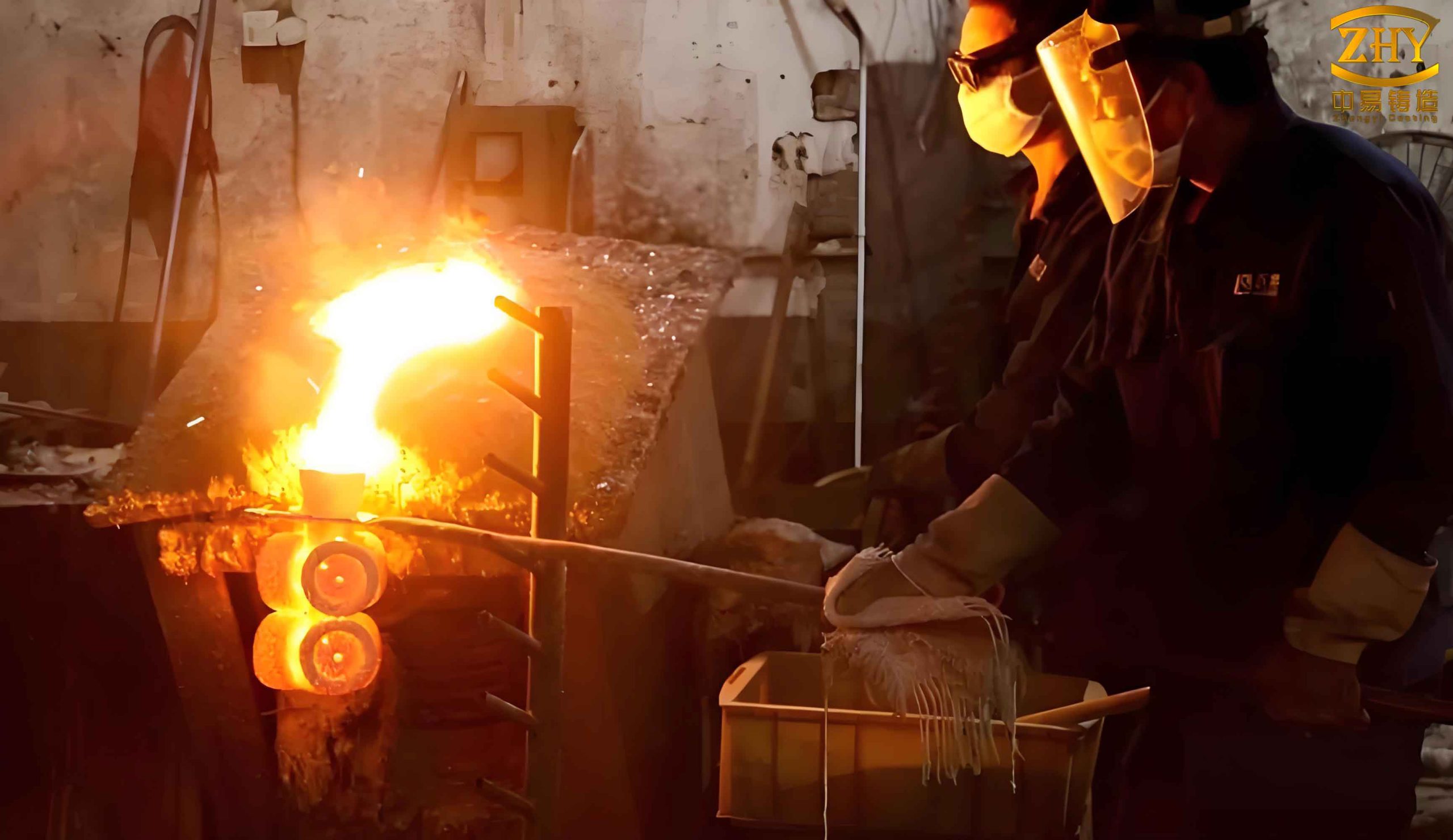
The experimental phase commenced with shell building, a cornerstone of prototype investment casting. A slurry was prepared by mixing high-temperature gypsum with water in a ratio of 100:45 by weight, stirred thoroughly to eliminate air bubbles. The 3D-printed PLA pattern was coated uniformly with this slurry, ensuring penetration into blade cavities to capture fine details. After bubble release, the pattern was placed in a steel flask on a gypsum base, and more slurry was poured to envelop it completely. The assembly was allowed to harden, forming a precise mold cavity. For burnout, the flask was heated in a resistance furnace using a stepped temperature profile: 400°C for 15 minutes, 600°C for 30 minutes, and 750°C for 2 hours. This regimen vaporized the PLA pattern without residue, leaving a clean cavity for casting—a critical step in prototype investment casting to avoid surface imperfections. Simultaneously, ZL104 aluminum alloy was melted in a crucible at 750°C, and the preheated shell was retrieved at 600°C for pouring. Metal was poured steadily into the gating system, maintaining the simulated velocity of 25 cm/s, until overflow at the riser indicated complete filling.
After solidification, the flask was cooled and broken apart to extract the casting. The gypsum shell was carefully removed to avoid damaging the delicate blades. The gating system was cut off, and the impeller surface was ground with sandpaper to remove oxide layers and minor irregularities. The final casting exhibited excellent dimensional accuracy, with no visible defects such as cold shuts, porosity, or misruns on the blades. This outcome validates the simulation predictions and underscores the efficacy of integrating AM with prototype investment casting. The process from design to finished part was significantly accelerated compared to conventional methods, highlighting the value of this approach for rapid prototyping in industries like aerospace and turbomachinery. In prototype investment casting, such integrations reduce lead times from weeks to days while maintaining high fidelity.
To further quantify the benefits, we can analyze thermal dynamics during solidification using Fourier’s law of heat conduction, which governs heat transfer in the mold: $$ q = -k \cdot \nabla T $$ where \( q \) is the heat flux (W/m²), \( k \) is the thermal conductivity of the gypsum shell (approximately 0.5 W/m·K for high-temperature grades), and \( \nabla T \) is the temperature gradient. In prototype investment casting, lower \( k \) values help maintain steep gradients for directional solidification, reducing shrinkage defects. The solidification time \( t_s \) for a section can be estimated by Chvorinov’s rule: $$ t_s = C \cdot \left( \frac{V}{A} \right)^n $$ where \( V \) is volume, \( A \) is surface area, \( C \) is a mold constant, and \( n \) is an exponent (typically 2 for sand molds). For our impeller blades with thin sections, \( V/A \) is small, leading to rapid solidification that minimizes grain growth but requires careful gating to ensure proper feeding. The bottom-gating system optimized these parameters by providing continuous metal supply during solidification.
In conclusion, this study demonstrates a robust methodology for prototype investment casting of complex geometries like impellers. By combining FDM 3D printing for pattern fabrication and AnyCasting software for process simulation, we achieved a defect-free aluminum alloy casting with high precision. The bottom-gating design proved superior in minimizing turbulence and promoting sequential solidification, as predicted by numerical models. This integrated approach not only streamlines prototype investment casting but also reduces material waste and iteration cycles. Future work could explore other AM materials for patterns, such as wax-like polymers, or advanced simulations incorporating multiphase flows for even greater accuracy. As industries demand faster turnaround for prototypes, the synergy between additive manufacturing and prototype investment casting will continue to evolve, offering sustainable solutions for customized, high-performance components. The success of this impeller project reaffirms that prototype investment casting, when enhanced with modern technologies, remains a vital process for innovation in manufacturing.