
The landscape of engineering education is undergoing a significant transformation. As an instructor deeply involved in practical and foundational training, I have observed a persistent gap between theoretical knowledge and tangible, creative application. Traditional foundry practice modules, while fundamental, often limit student agency to predefined, simple shapes, failing to capture the potential of modern manufacturing. This essay details my firsthand experience and rationale for integrating a comprehensive digital workflow centered on the investment casting process into the core of practical teaching. This fusion of 3D modeling, additive manufacturing, and precision casting is not merely an equipment upgrade; it represents a pedagogical shift towards a student-centered, outcome-based learning model that cultivates innovation, design thinking, and a profound understanding of advanced manufacturing principles.
The core educational challenge was to move beyond rote skill execution. We aimed to create a learning environment where students could conceive an idea, navigate its digital creation, and shepherd it through a sophisticated physical transformation into a functional metal object. The investment casting process, renowned for its ability to produce complex, high-fidelity metal parts, became the perfect vehicle for this journey. By prefacing it with digital tools, we empower students to explore geometries impossible with traditional pattern-making, thereby directly linking computational design freedom with advanced manufacturing capability.
The Integrated Digital-Physical Process Chain
The implemented teaching system is a seamless pipeline integrating several discrete technologies into a coherent investment casting process. The table below summarizes this integrated chain and its pedagogical objectives:
| Process Stage | Technology/Method | Key Student Learning Outcome | Connection to Core Investment Casting Process |
|---|---|---|---|
| Ideation & Digital Design | 3D CAD Software (e.g., 3D One Plus, Fusion 360) | Spatial reasoning, design-for-manufacturability (DFM) considerations, creative expression. | Creation of the digital master model, which is the absolute origin of the final metal part in the investment casting process. |
| Pattern Fabrication | Additive Manufacturing (SLA, DLP, or Material Jetting) | Understanding AM principles, material limitations (e.g., burnout characteristics), and the role of patterns. | Direct production of a high-resolution, expendable pattern. This replaces traditional wax injection tooling, a revolutionary step in prototyping via the investment casting process. |
| Mold Assembly & Investment | Gating System Design, Tree Assembly, Ceramic Slurry Investment | Principles of fluid flow, thermal management, and ceramic mold science. | The heart of the investment casting process. Students learn to assemble patterns into a “tree,” apply ceramic slurries, and build a robust shell mold. |
| Pattern Removal & Firing | Autoclave/Flash Fire Dewaxing, High-Temperature Furnace Firing | Understanding thermal cycles, phase changes, and the preparation of a mold cavity. | Critical step to remove the AM pattern and sinter the ceramic mold, creating a negative cavity for metal pouring in the investment casting process. |
| Metal Pouring & Solidification | Vacuum or Centrifugal Casting, Alloy Selection | Principles of metallurgy, solidification dynamics, and process control. | The transformational step where molten metal fills the ceramic mold, replicating the original digital design through the investment casting process. |
| Post-Processing | Cut-off, Grinding, Polishing, Heat Treatment | Appreciation of finishing operations, quality assessment, and final product realization. | Final steps to reveal and finish the metal part produced by the investment casting process, connecting the digital design to a tangible artifact. |
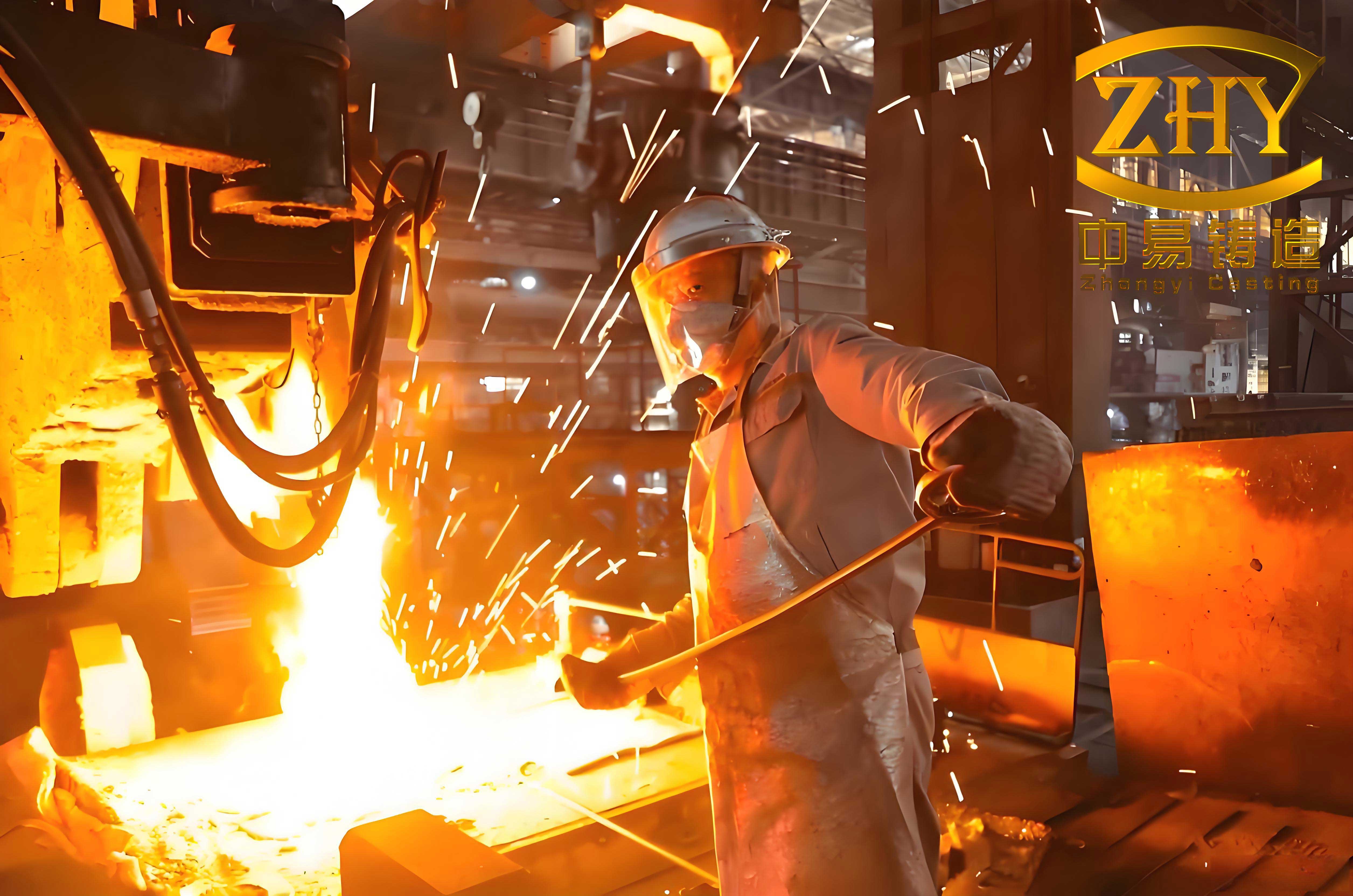
This integrated chain demystifies advanced manufacturing. Students no longer see design, prototyping, and production as isolated silos but as interconnected nodes in a digital-physical continuum. The ability to iterate rapidly—modifying a CAD model and printing a new pattern within hours—fundamentally changes their approach to problem-solving and optimization within the investment casting process.
Curricular Design: Modularity and Scalable Depth
A one-size-fits-all approach is ineffective. To cater to diverse student backgrounds and course durations, we developed a modular curriculum centered on the digital investment casting process. Each module adds layers of complexity and hands-on involvement, as outlined below:
| Module Duration | Primary Focus | Student Hands-On Activities | Depth in Investment Casting Process |
|---|---|---|---|
| 4-Hour (Demo/Introduction) | Process Overview & Key Principles | Observe demos, assist in post-processing, understand workflow. | Conceptual understanding of the complete investment casting process chain. |
| 8-Hour (Standard Project) | Digital Design & Full Process Flow | CAD design of a ring/pendant, operate 3D printer, participate in mold investment, finishing. | Direct involvement in core steps: pattern creation (via AM) and realization through the investment casting process. |
| 12-16 Hour (Advanced Project) | Complex Design & Process Parameterization | Design functional/assembled parts, experiment with gating designs, control slurry parameters. | Deeper engineering analysis of the investment casting process, including fluid flow and solidification simulation. |
| 24+ Hour (Capstone/Research) | Innovation, Optimization & Material Science | Original research, parameter optimization, use of alternative pattern/binder materials, mechanical testing. | Mastery and potential contribution to advancing aspects of the investment casting process. |
The 8-hour module, often titled “Personalized 3D Design and Realization,” serves as the cornerstone experience. It efficiently encapsulates the entire value proposition. Students begin with mastering a CAD tool to design a personalized ring. This immediately engages creative and spatial thinking. They then translate this digital asset into a physical pattern using a stereolithography (SLA) 3D printer, learning about layer-by-layer fabrication and support structures. The subsequent immersion into the investment casting process—building the ceramic mold around their pattern, burning it out, and finally casting it in bronze or aluminum—provides an unforgettable lesson in material transformation. The moment they retrieve, cut, polish, and wear their own designed ring represents a powerful synthesis of art, engineering, and personal achievement.
Technical Foundations and Quantitative Analysis
Moving beyond the workflow, it is crucial to anchor the experience in analytical principles. We introduce simplified models that govern the investment casting process, allowing students to appreciate the science behind the art.
1. Pattern Expansion and Mold Dimensional Accuracy: A critical concern is compensating for the thermal expansion of the pattern material and the contraction of the metal during solidification. The final cast part dimension (\(D_{cast}\)) can be related to the original CAD dimension (\(D_{CAD}\)) through a combined compensation factor. For a process using a wax or photopolymer pattern and a silica-based ceramic mold, the relationship can be approximated by considering pattern expansion and metal shrinkage:
$$D_{cast} \approx D_{CAD} \times (1 + \alpha_p \Delta T_p) \times (1 – \beta_m)$$
Where:
\(\alpha_p\) is the coefficient of thermal expansion of the pattern material,
\(\Delta T_p\) is the temperature change during the dewaxing/burnout stage,
\(\beta_m\) is the linear shrinkage factor of the metal alloy from pouring temperature to room temperature.
In practice, the ceramic shell mold itself also undergoes sintering. Therefore, a single, empirically derived “linear compensation factor” (\(C_f\)) is often applied directly in the CAD stage:
$$D_{CAD, compensated} = \frac{D_{desired}}{C_f}$$
For typical jewelry bronze in a plaster-silica investment, \(C_f\) might range from 1.018 to 1.022 (i.e., 1.8-2.2% expansion). Students can measure their final parts and back-calculate this factor, linking design to empirical outcome.
2. Gating System Design – Chvorinov’s Rule: To prevent casting defects like shrinkage porosity, the gating system must ensure directional solidification towards a feeder (riser). We introduce Chvorinov’s rule, which states that the local solidification time (\(t_s\)) is proportional to the square of the volume-to-surface area ratio \(\left(\frac{V}{A}\right)^2\):
$$t_s = B \left( \frac{V}{A} \right)^2$$
where \(B\) is the mold constant. Students learn to design their “wax tree” so that the feeder section has a higher \(V/A\) ratio than the casting itself (\((V/A)_{feeder} > (V/A)_{casting}\)), ensuring it remains molten longest and feeds liquid metal to compensate for shrinkage. This is a fundamental principle in the investment casting process.
3. Investment Slurry Rheology – A Simplified Viscosity Model: The ceramic slurry’s viscosity (\(\eta\)) is critical for building a uniform shell. While non-Newtonian, we discuss it in terms of affecting the thickness (\(h\)) of a layer drained from a pattern, which can be simplified from the force balance between viscosity and gravity:
$$h \propto \sqrt{\frac{\gamma t}{\eta}}$$
where \(\gamma\) is the slurry’s surface tension and \(t\) is the drainage time. Students experiment with dip-coating times and observe how slurry viscosity (which changes with binder concentration and age) affects shell thickness and quality, directly impacting the success of the investment casting process.
Pedagogical Outcomes and Assessment
The impact of this integrated module is measured not just by the quality of the cast ring, but by the development of higher-order cognitive skills. The following table contrasts traditional vs. the integrated digital investment casting process approach:
| Learning Dimension | Traditional Foundry Exercise | Integrated Digital Investment Casting Process Module |
|---|---|---|
| Design Agency | Minimal to none; uses pre-made patterns. | High; students are the originators of the design, fostering ownership and creativity. |
| Process Understanding | Segmented; often focuses only on sand molding and pouring. | Holistic; connects digital design, pattern fabrication, mold science, metallurgy, and finishing. |
| Iteration & Failure Analysis | Slow, costly, and often discouraged. | Rapid and educational; a design flaw can be corrected in CAD and a new pattern printed for another attempt at the investment casting process. |
| Technical Skill Set | Manual dexterity, process following. | Digital literacy (CAD/CAM), additive manufacturing, precision process control, analytical thinking. |
| Innovation Mindset | Limited, focused on replication. | Cultivated; students are challenged to create something novel and feasible within the constraints of the investment casting process. |
Assessment is multi-faceted: the completion and quality of the final metal artifact; the creativity and manufacturability of the original CAD design; the student’s ability to articulate the steps and reasoning behind the investment casting process; and their performance in troubleshooting during lab sessions (e.g., identifying a poor shell coating or a misdesigned gate). The most significant indicator, however, is the observable increase in student engagement, curiosity, and the sophisticated questions they begin to ask about materials and processes.
Conclusion and Future Directions
The integration of digital design tools and additive manufacturing with the classic investment casting process has proven to be a transformative strategy in practical engineering education. It successfully bridges the digital and physical worlds, providing a compelling, hands-on context for teaching advanced manufacturing principles. Students transition from passive learners to active creators and problem-solvers. They gain not only practical skills but also a systems-thinking perspective essential for modern engineers.
The future development of this pedagogical model lies in further deepening the analytical layer. This includes incorporating simulation software for predicting fluid flow and solidification in the investment casting process, allowing students to virtually test and optimize their gating designs before committing to physical production. Exploring a wider range of engineering alloys, and introducing non-destructive testing methods for their cast parts, will add another dimension of professional practice. Furthermore, scaling this model to facilitate small-batch production of student-designed functional components for robotics or aerospace projects can elevate the learning experience to true interdisciplinary engineering practice.
In essence, this approach uses the investment casting process as a powerful educational platform. It demonstrates that foundational industrial training need not be static but can dynamically evolve to embody innovation, creativity, and technological synthesis, thereby preparing students not just for the industry of today, but for shaping the manufacturing paradigms of tomorrow.