
The development of high-integrity components through prototype investment casting is a cornerstone of modern manufacturing, particularly for industries such as aerospace and automotive that demand complex geometries, high dimensional accuracy, and superior surface finish. Traditional process development relies heavily on costly and time-consuming iterative trial-and-error methods. The advent of sophisticated finite element analysis (FEA) software has initiated a paradigm shift, enabling a “proof-of-concept” approach where digital simulations predict casting defects and validate gating system designs prior to physical production, thereby significantly reducing development cost and time. This article details a comprehensive methodology that synergizes initial experimental trials with advanced numerical simulation to systematically design and optimize the gating system for a critical support bracket component, ultimately achieving a defect-free prototype investment casting.
The component in question is a thin-walled nickel-based superalloy (K444) support bracket with a hollow structure. Its maximum envelope dimensions are 318 mm x 308 mm x 186 mm, featuring a nominal wall thickness of approximately 4.5 mm. The inherent challenge in casting such a geometry lies in ensuring directional solidification to prevent internal shrinkage defects, which are common in large, thin-section areas where thermal gradients are difficult to control.
Initial Prototype Investment Casting Trial and Defect Analysis
An initial gating system was designed and a prototype was cast under standard parameters: a pouring temperature of 1420°C and a shell preheat temperature of 980°C. To promote bottom-up solidification, the main body of the bracket was left to cool in air, while the top feeder and horizontal runners were insulated with 12mm thick ceramic fiber blanket. Post-casting inspection revealed a visually sound component. However, non-destructive testing (NDT) via X-ray radiography and fluorescent penetrant inspection identified severe shrinkage porosity concentrated in the upper and middle regions of the bracket’s side walls, as illustrated in the reference study. This indicated that the intended solidification sequence was not achieved. The side walls solidified almost simultaneously, creating a mushy zone of interconnected dendrites that isolated small liquid pools, preventing effective feeding from the risers and resulting in micro-shrinkage.
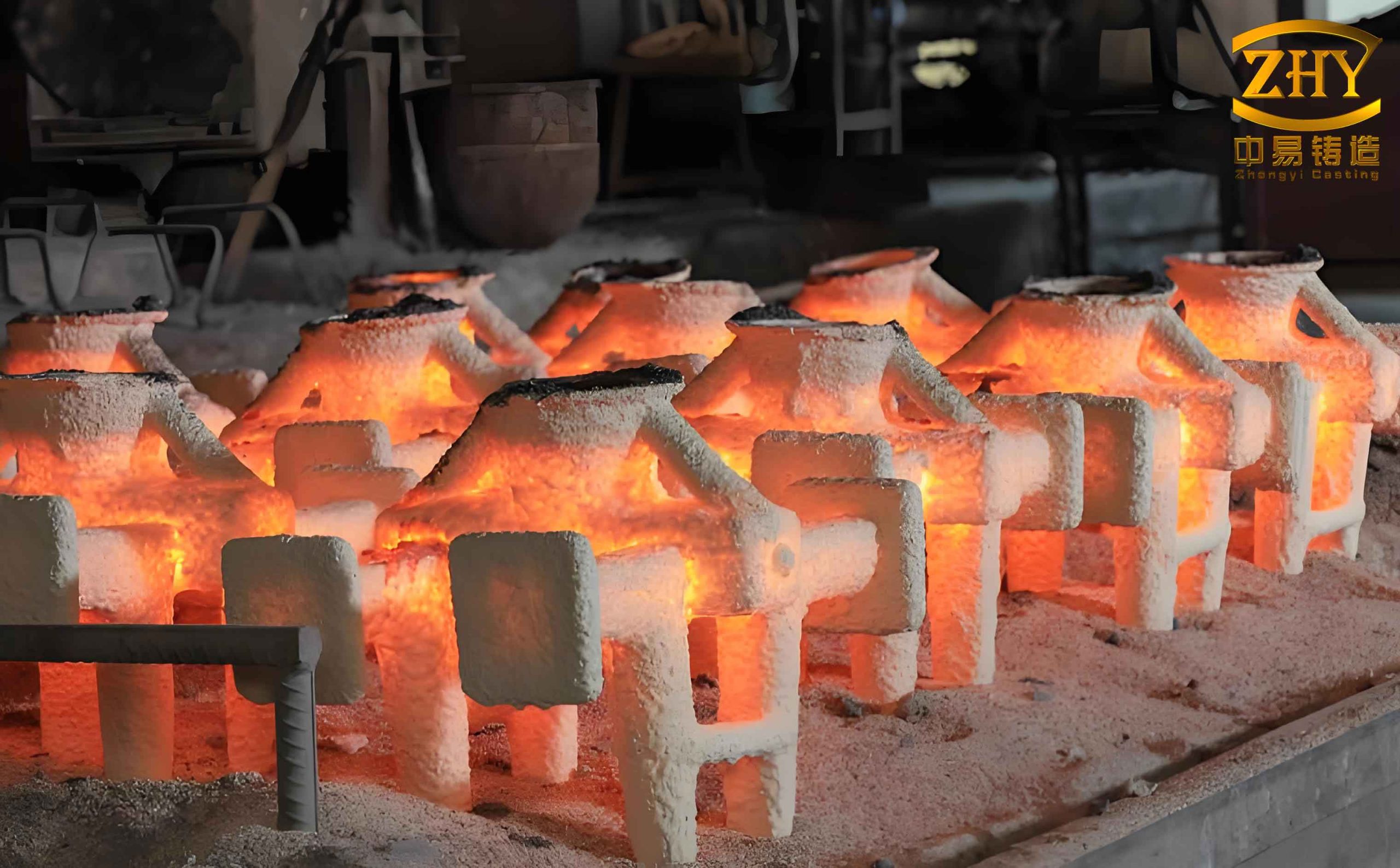
Methodology: Coupling Experiment with Numerical Simulation
Based on the findings from the initial prototype investment casting trial, three distinct optimized gating system concepts were proposed. The primary tool for evaluating these concepts was the finite element analysis software ProCAST, which replaced physical iterations for rapid virtual prototyping. The simulation inputs were derived from the actual process parameters, as summarized in Table 1.
| Parameter | Value / Specification |
|---|---|
| Alloy | Nickel-based Superalloy K444 |
| Pouring Temperature | 1420 °C |
| Shell Preheat Temperature | 980 °C |
| Pouring Time | 4 s |
| Interface Heat Transfer Coefficient (Metal-Shell) | 300 W/(m²·K) |
| Heat Transfer Coefficient, Insulated Shell (12mm blanket) to Air | 0.2 W/(m²·K) |
| Heat Transfer Coefficient, Insulated Shell (6mm blanket) to Air | 1.0 W/(m²·K) |
| Heat Transfer Coefficient, Uninsulated Shell to Air (Air Cooling) | 10 W/(m²·K) |
| Ambient Temperature | 20 °C |
The thermal history and defect formation were governed by the fundamental heat transfer equation during solidification:
$$ \rho c_p \frac{\partial T}{\partial t} = \nabla \cdot (k \nabla T) + \rho L \frac{\partial f_s}{\partial t} $$
where \( \rho \) is density, \( c_p \) is specific heat, \( T \) is temperature, \( t \) is time, \( k \) is thermal conductivity, \( L \) is latent heat, and \( f_s \) is the solid fraction. The evolution of \( f_s \) is critical and was modeled using appropriate microsegregation models for the nickel-based alloy.
Proposed Gating System Designs for Prototype Investment Casting
Three gating system designs were conceived, each with a different strategy to control thermal gradients and feeding.
1. “Perimeter” Gating System: This design aimed for a balance between feeding area and thermal control. It featured multiple ingates (9 per side) along the lower perimeter of the bracket. The top feeder and horizontal runners were insulated with 12mm blanket, while the vertical ingate sections were insulated with only 6mm blanket to encourage faster cooling in the casting relative to the feeder.
2. “V-Shaped” Gating System: This design prioritized establishing a strong thermal gradient for directional solidification. The number of ingates was reduced to 4 per side, and the bottom runner was eliminated. The ingate cross-sectional area was increased to compensate for reduced feeding points, and all gating channels (feeders and ingates) were heavily insulated with 12mm blanket to maintain them liquid longer.
3. “Staggered” Gating System: This was a further refinement of the V-shaped concept to optimize the thermal gradient. Ingates (5 total) were placed in a staggered pattern on opposite sides of the bracket. All gating was insulated with 12mm blanket to maximize feeding capability. Table 2 summarizes the key design parameters.
| Gating System Design | Number of Ingates (per side) | Ingate Insulation | Feeder/Runner Insulation | Primary Design Focus |
|---|---|---|---|---|
| Perimeter | 9 | 6 mm blanket | 12 mm blanket | Maximize feeding area |
| V-Shaped | 4 | 12 mm blanket | 12 mm blanket | Enhance thermal gradient |
| Staggered | 2 or 3 (staggered) | 12 mm blanket | 12 mm blanket | Optimize gradient & feeding path |
Numerical Simulation Analysis and Results
The performance of each prototype investment casting design was evaluated using two key simulation outputs: the evolution of solid fraction (\(f_s\)) and the prediction of shrinkage porosity using the Niyama criterion.
Solid Fraction and Solidification Sequence Analysis:
The solid fraction over time for critical points in the casting and gating system was tracked. The Perimeter system showed the most rapid overall increase in solid fraction. Crucially, by the end of casting solidification, the solid fraction in its ingates reached 60-67%, indicating a high risk of premature feeding channel closure. In contrast, both the V-Shaped and Staggered systems maintained a much lower solid fraction in the gating (33-40%) until the casting was mostly solid, suggesting sustained feeding capability. However, the Staggered system showed evidence of isolated liquid pockets forming within the casting body before the gating solidified, which could also interrupt feeding.
The total solidification time contour plots provided a clear visualization of the solidification sequence. The V-Shaped design demonstrated the most desirable pattern: solidification initiated at the bottom of the bracket and progressed uniformly upwards towards the insulated feeders, indicating a strong, controlled thermal gradient essential for sound prototype investment casting.
Shrinkage Porosity Prediction:
The Niyama criterion (\(NY\)), a widely used indicator for shrinkage porosity, was calculated. It is a function of thermal gradient (\(G\)), cooling rate (\(\dot{T}\)), and is expressed as:
$$ NY = \frac{G}{\sqrt{\dot{T}}} $$
Areas with a Niyama value below a critical threshold (set at 0.01 (℃/s)^{1/2} based on empirical correlation for this alloy) are predicted to contain shrinkage porosity. The simulation results were starkly different for each design, as qualitatively summarized in Table 3.
| Gating System Design | Simulated Shrinkage Location | Predicted Severity | Interpreted Root Cause |
|---|---|---|---|
| Perimeter | Within casting side walls (upper/mid sections) | High | Premature freezing of ingates (high \(f_s\)) cuts off feed metal supply. |
| V-Shaped | Primarily within the gating system; negligible in casting. | Low (in casting) | Effective directional solidification; shrinkage directed to feeder. |
| Staggered | Within casting, particularly at thermal “hot spots”. | Medium-High | Isolation of liquid pools due to improper thermal gradient, despite liquid feeders. |
The underlying metallurgical principle is that shrinkage porosity forms when the feeding path is interrupted. The pressure drop (\(\Delta P\)) required for interdendritic feeding is given by the Darcy-Forchheimer equation for flow in a porous mushy zone:
$$ \nabla P = – \frac{\mu}{K} v – \beta \rho v^2 $$
where \( \mu \) is dynamic viscosity, \( K \) is permeability (a strong function of \( f_s \), often modeled as \( K = K_0 (1 – f_s)^n \)), \( v \) is flow velocity, and \( \beta \) is a inertial coefficient. When the solid fraction becomes high enough, the permeability \( K \) drops dramatically, making feeding impossible and leading to pore formation. This occurred in the Perimeter design due to early ingate freezing and in the Staggered design due to internal channel blockage.
Production Validation of the Optimal Prototype Investment Casting Process
Based on the simulation results, the V-Shaped gating system was identified as the optimal design for this prototype investment casting. It successfully established a thermal gradient conducive to directional solidification and maintained open feeding channels until the casting solidified. A validation production run was conducted using this optimized design. The resultant castings were fully dense, with excellent surface quality. Comprehensive X-ray inspection confirmed the complete absence of internal shrinkage porosity or other defects, validating the simulation-guided optimization approach. The component met all quality specifications.
Conclusion
This study successfully demonstrates a robust framework for optimizing prototype investment casting processes. Key conclusions are:
- Numerical simulation software like ProCAST is a powerful and accurate tool for modeling the filling, solidification, and defect formation in prototype investment casting, enabling a shift from physical trial-and-error to virtual design iteration.
- Large, thin-walled sections in castings are highly susceptible to shrinkage defects due to the formation of isolated liquid pools within a coherent dendritic network, which blocks interdendritic feeding paths.
- Strategic design of the gating system—specifically controlling insulation to manipulate thermal gradients and ensuring the feeding channels remain liquid—is paramount to achieving directional solidification. The optimal design for this bracket was the V-Shaped system, which created a bottom-up solidification sequence.
- The synergy of a limited initial experimental trial for defect identification, followed by systematic virtual prototyping and simulation-based root-cause analysis, provides a highly effective and economical methodology for developing robust prototype investment casting processes, ensuring high-quality, defect-free components.
The integration of simulation into the prototype investment casting development cycle not only reduces cost and lead time but also provides deep insight into the physical phenomena governing casting quality, facilitating first-right design and manufacturing.