
As a materials scientist deeply involved in the development of critical aerospace components, we constantly face the challenge of manufacturing complex, thin-walled, and high-performance parts. Among these, fuel tank frames represent a quintessential example, serving dual roles as load-bearing structures and fuel containers. These components must withstand prolonged exposure to high temperatures and significant mechanical stresses during supersonic flight. While titanium alloys, particularly TA15, have been the traditional choice, the push for longer-duration, higher-speed aerospace vehicles demands materials with superior elevated temperature capabilities, such as the ZTi55 (or Ti55 derivative) high-temperature titanium alloy.
The complex geometry of these frames, characterized by significant variations in wall thickness, makes traditional forging and machining routes highly inefficient, leading to excessive material waste, long lead times, and high costs. In contrast, the investment casting process offers a compelling near-net-shape alternative. This mature technology is renowned for its ability to produce components with high dimensional accuracy and complex internal features. However, its application to advanced high-temperature titanium alloys like ZTi55 is fraught with challenges. These alloys, with their complex multi-element compositions, exhibit notoriously poor castability, manifesting in issues like incomplete mold filling, gross porosity, and most critically, excessive grain coarsening which severely undermines mechanical properties.
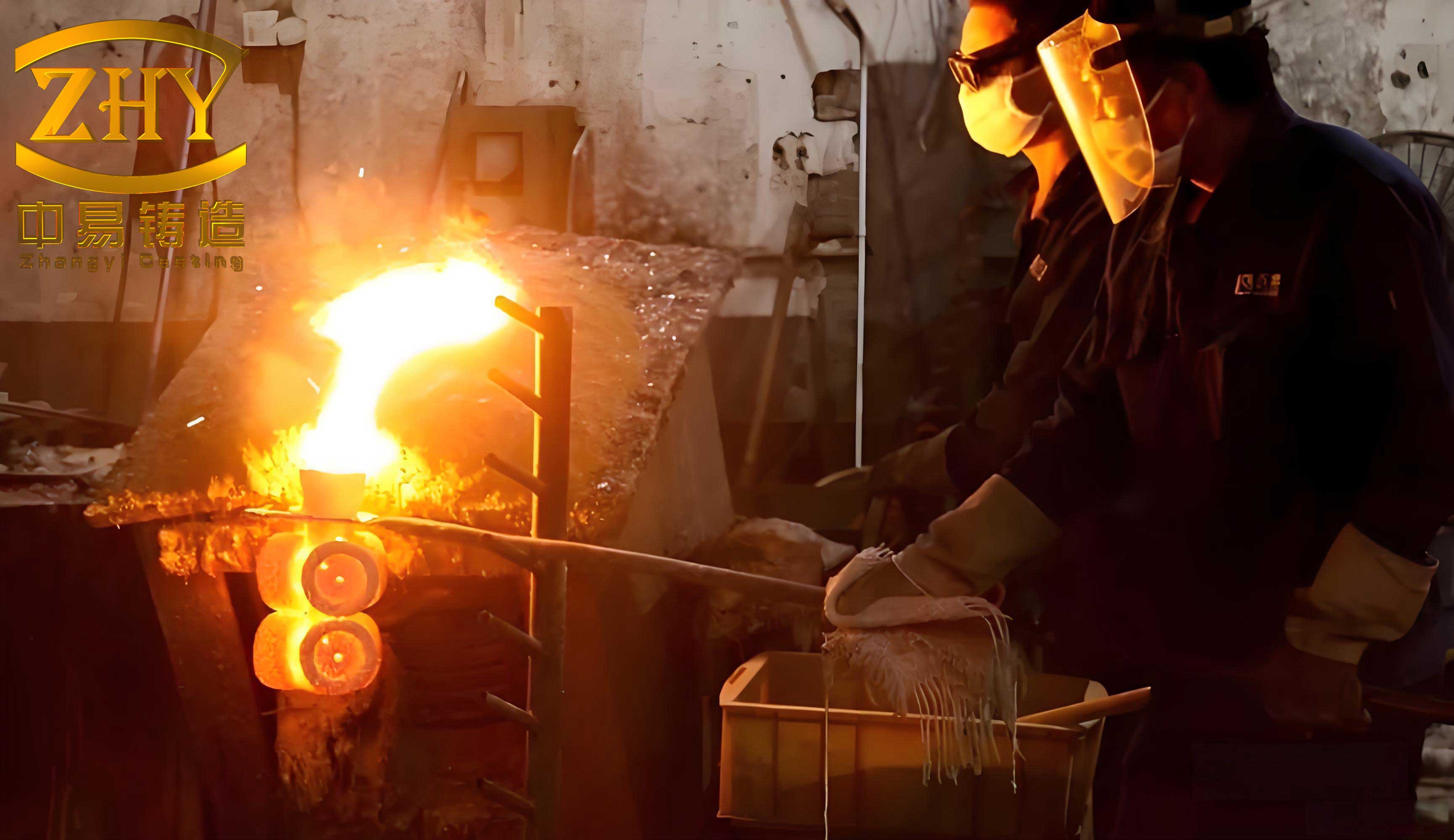
Traditionally, optimizing the investment casting process relies heavily on empirical trial-and-error, an approach that is both costly and time-consuming, especially for large, expensive components. This is where numerical simulation emerges as a transformative tool. By virtually replicating the mold filling and solidification stages, simulation allows us to predict and mitigate potential defects before any metal is poured. This study focuses on employing numerical simulation to design a robust process for a representative cylindrical section of a ZTi55 fuel tank frame. We then validate the simulation through actual casting and meticulous metallurgical analysis, establishing a definitive correlation between simulated thermal history and the resulting as-cast grain structure. Our goal is to move beyond mere defect prediction towards a fundamental understanding of microstructure evolution within the investment casting process for these challenging alloys.
1. Methodology: Integrating Simulation and Experiment
1.1 Target Geometry and Material
The object of this study is a cylindrical structure representative of a larger fuel tank skeleton. Its dimensions are substantial, with a maximum outer diameter of 410 mm and a height of 315 mm. The key challenge lies in its variable wall thickness, ranging from a minimum of approximately 3 mm to a maximum exceeding 23 mm, with complex features like curved surfaces and a bottom flange. For systematic analysis, the cylinder is divided into three distinct zones (see geometry schematic): Zone A (Bottom), featuring thin curved walls (~5 mm) and a thicker outer flange (~8 mm); Zone B (Cylinder Wall), a relatively uniform section with an average wall thickness of ~8 mm; and Zone C (Top Rim), a thick-walled section with a maximum local thickness of ~23 mm.
The alloy selected is ZTi55, a high-temperature titanium alloy derived from Ti55, with a complex composition designed for service at elevated temperatures. Its critical thermal properties, determined via CALPHAD-based thermodynamic calculations, are as follows:
- Liquidus Temperature, $T_L$: 1680.5 °C
- Solidus Temperature, $T_S$: 1641.4 °C
- Beta Transus Temperature, $T_{\beta}$: ~1030 °C
The nominal chemical composition (in wt.%) is provided in Table 1.
| Al | Mo | Nb | Si | Sn | Ta | Zr | C | O |
|---|---|---|---|---|---|---|---|---|
| 5.7 | 0.7 | 0.72 | 0.16 | 2.0 | 0.5 | 3.0 | 0.05 | 0.06 |
1.2 Numerical Simulation of the Investment Casting Process
A bottom-gated gravity pouring system was designed to ensure uniform filling of the complex geometry. A key feature is a bottom ring gate that allows simultaneous metal entry at multiple points around the cylinder base. The sprue height is set 220 mm above the top of the casting to maintain sufficient metallostatic pressure during the final stages of filling, crucial for preventing mistruns in thin sections.
The simulation was conducted using ProCAST software. The mold was modeled as a ceramic shell system. The boundary conditions and process parameters, summarized in Table 2, were defined based on standard industrial practice for titanium investment casting process.
| Parameter | Value / Specification |
|---|---|
| Alloy | ZTi55 |
| Pouring Temperature, $T_{pour}$ | 1730 °C |
| Shell Preheat Temperature, $T_{shell}$ | 700 °C |
| Filling Time, $t_{fill}$ | 6.5 s |
| Heat Transfer Coefficient (Metal-Shell) | Standard Ti-Ceramic database values |
| Gravity | 9.81 m/s² |
The simulation solves the fundamental equations of fluid flow, heat transfer, and solidification. The energy conservation equation is central to predicting the temperature field:
$$ \rho c_p \frac{\partial T}{\partial t} = \nabla \cdot (k \nabla T) + \rho L \frac{\partial f_s}{\partial t} $$
where $\rho$ is density, $c_p$ is specific heat, $T$ is temperature, $t$ is time, $k$ is thermal conductivity, $L$ is latent heat of fusion, and $f_s$ is the solid fraction.
1.3 Experimental Casting and Analysis
The simulated process was validated through physical casting. The steps included: 1) 3D printing of wax patterns using PMMA, 2) Building a multi-layer ceramic shell (Yttria-based face coat, alumina-based backup coats), 3) Dewaxing and high-temperature firing, 4) Melting and gravity pouring in a 150 kg vacuum skull furnace using the parameters from the simulation, and 5) Standard post-casting processes like shell removal, cutoff, and finishing.
Metallographic samples were extracted from the three predefined zones (A, B, C) of the sound casting. Multiple samples were taken from each zone with sufficient spacing (>100 mm) to ensure statistical relevance. The samples were prepared using standard grinding, polishing, and etching techniques (HF:HNO3:H2O = 2:3:16). The resulting Widmanstätten microstructure was examined using optical microscopy (Leica DMI8C), and the prior-beta grain size was measured using the linear intercept method.
2. Results & Discussion: From Virtual Prediction to Physical Reality
2.1 Simulation Insights: Filling and Solidification Dynamics
The simulation of the investment casting process provided a detailed virtual window into the filling sequence and thermal history.
Filling Pattern: The metal entered smoothly from the bottom ring gate. The filling was sequential and stable, progressing upwards along the cylindrical wall without significant turbulence or vortex formation. The entire cavity was filled in approximately 1.5 seconds. This smooth filling minimizes air entrapment and oxide film folding, which are primary sources of gas porosity and bifilms in titanium castings.
Solidification Sequence & Thermal Gradients: The solidification fraction plots revealed a clear sequence dictated by geometry and thermal mass. Solidification initiated first in Zone A, specifically in the thin curved sections that were filled last. This is because these thin sections lose heat fastest to the preheated mold. Subsequently, Zone B (the main cylinder wall) began to solidify. The last region to solidify was Zone C, the thick top rim. This area not only has a large cross-section but is also thermally linked to the massive sprue, acting as a significant heat source and dramatically slowing down its cooling.
The temperature field evolution (see isothermal plots at different times) quantified these observations. The cooling curves extracted from nodes in each zone show dramatic differences, summarized in Table 3.
| Casting Zone | Key Feature | Time from $T_L$ to $T_{\beta}$ (s) | Relative Cooling Rate |
|---|---|---|---|
| Zone A (Thin Curved Wall) | Last-filled, thinnest section | ~120 | Fastest |
| Zone B (Cylinder Wall) | Moderate, uniform thickness | ~254 | Intermediate |
| Zone C (Thick Rim) | First-filled, massive, connected to sprue | >1160 | Slowest |
The cooling rate, $ \dot{T} = dT/dt $, is a critical factor controlling solidification microstructure. A higher cooling rate generally promotes a finer grain structure by increasing nucleation undercooling and limiting grain growth. The time spent above the beta transus temperature ($T_{\beta}$) is particularly crucial for titanium alloys, as it dictates the extent of grain growth in the single-phase beta field before the transformation to alpha. The simulation predicted that Zone C would experience an extremely prolonged period above $T_{\beta}$, creating ideal conditions for beta grain coarsening.
2.2 Experimental Validation: Grain Structure Analysis
The actual casting produced was fully sound, with no mistruns or major surface defects, confirming the effectiveness of the gating system designed via simulation. Metallographic analysis revealed a classical Widmanstätten microstructure in all areas, but with striking variations in prior-beta grain size that aligned remarkably well with the simulation predictions.
- Zone A (Bottom): The grain size was the finest observed. In the thinnest part of the curved wall, the average grain size was approximately 305 µm. In the slightly thicker flange areas of the same zone, the grain size increased to about 534-560 µm.
- Zone B (Cylinder Wall): This zone exhibited a relatively uniform and intermediate grain size of about 486 µm.
- Zone C (Top Rim): This zone displayed the coarsest microstructure. The grain size was consistently large, measuring approximately 890 µm in areas away from the direct gate connection and up to 961 µm near the gate attachment point.
The correlation is unmistakable: areas predicted by the simulation to cool the fastest (Zone A thin wall) developed the finest grains, while the area predicted to cool the slowest (Zone C) developed the coarsest grains. The direct link between thermal history during the investment casting process and final microstructure is thus empirically validated. The data is consolidated in Table 4.
| Casting Zone & Location | Avg. Wall Thickness (mm) | Simulated Cooling Time $T_L$ to $T_{\beta}$ (s) | Measured Avg. Prior-Beta Grain Size (µm) |
|---|---|---|---|
| Zone A: Thin Curved Wall | ~5 | ~120 | 305 |
| Zone A: Thicker Flange | ~8 | ~120-150* | 534 – 560 |
| Zone B: Cylinder Wall | ~8 | ~254 | 486 |
| Zone C: Rim (away from gate) | ~23 | >1160 | 890 |
| Zone C: Rim (near gate) | ~23 | >1160 | 961 |
*Estimated based on position between thin wall and Zone B.
3. In-Depth Analysis: Governing Principles of Microstructure Formation
The excellent agreement between simulation and experiment allows us to delve deeper into the metallurgical principles governing grain size evolution in the investment casting process. The primary factors are local solidification time and cooling rate, both intrinsically linked to section thickness.
3.1 The Role of Local Solidification Time and Cooling Rate
For a given alloy and mold condition, the local solidification time, $ \theta $, is primarily a function of the modulus, $ M $, of the casting section, where $ M = V/A $ (Volume / Cooling Surface Area). For simple shapes like plates, $ M $ is proportional to the thickness, $ d $. The famous Chvorinov’s rule illustrates this:
$$ t_f = B \cdot M^n = B’ \cdot d^{n} $$
where $ t_f $ is the local solidification time, and $ B, B’, n $ are constants. A larger $d$ leads to a longer $ t_f $.
The average cooling rate through the solidification interval is inversely related to the solidification time:
$$ \dot{T}_{avg} \approx \frac{T_L – T_S}{t_f} $$
Thus, thicker sections solidify slower. In titanium alloys, solidification concludes with the formation of beta grains. A longer $ t_f $ allows for fewer nucleation events and more time for grain growth within the mushy zone and the subsequent fully beta phase.
3.2 Beta Grain Growth Above the Transus
The more critical factor for the final prior-beta grain size in many titanium castings is the growth that occurs after solidification is complete but while the metal is still above the $ T_{\beta} $. Grain growth in this single-phase region is typically governed by a parabolic growth law:
$$ D^2 – D_0^2 = K t $$
where $ D $ is the grain diameter at time $ t $, $ D_0 $ is the initial (as-solidified) grain diameter, and $ K $ is a temperature-dependent rate constant that follows an Arrhenius relationship, $ K = K_0 \exp(-Q/RT) $. The time $ t $ here is effectively the cooling time from the solidus to the beta transus predicted by the simulation.
Zone C, with its cooling time of over 1160 seconds above $ T_{\beta} $, had orders of magnitude more time for grain growth compared to Zone A (~120 seconds). Even if the initial as-solidified grain size ($D_0$) in Zone C was larger due to slower solidification, the prolonged exposure at high temperature would have resulted in massive coarsening, as observed. The near-identical grain size in Zone C both near and far from the gate suggests that the entire thermal mass of that region remained in the beta field for a similarly long duration, and the system reached a near-equilibrium grain size dictated by the local thermal profile.
3.3 Implications for Process Design and Modeling
This study demonstrates that numerical simulation is not just a tool for predicting gross defects like shrinkage or mistruns, but can be quantitatively linked to microstructure-scale outcomes. The key is the accurate prediction of the local thermal history. For future work, this allows for the implementation of more advanced microstructure models directly coupled with thermal simulation. A simplified grain size prediction could take the form:
$$ D_{final} = f(D_0(\dot{T}_{solid}), t_{above-\beta}, T_{avg}) $$
Where $D_0$ is a function of the solidification cooling rate, and the growth term is a function of time above the transus and average temperature. Our data provides a clear calibration for such a model for ZTi55 under investment casting process conditions.
The strong, quantifiable correlation between wall thickness, cooling rate, and grain size provides a powerful design rule. For components requiring uniform or specific mechanical properties, the geometry must be designed with uniform moduli where possible. When thick sections are unavoidable, the simulation-predicted thermal history can be used to proactively specify local process modifications.
4. Conclusions and Forward Outlook
Through the integrated application of numerical simulation and experimental metallurgy, this work has successfully deciphered the key relationships governing the microstructure of a complex ZTi55 high-temperature titanium alloy casting produced via the investment casting process. The principal conclusions are:
- Numerical simulation accurately predicted the filling behavior and, more importantly, the starkly heterogeneous solidification and cooling sequence within the cylindrical casting. The last-filled thin-walled sections (Zone A) were predicted and confirmed to cool fastest, while the first-filled thick sections thermally connected to the feeding system (Zone C) cooled slowest.
- A direct, quantitative correlation was established between the simulated thermal history (specifically the cooling time from liquidus to beta transus) and the measured prior-beta grain size. The thin-wall region solidified with a cooling time of ~120 s and developed a fine grain size of ~305 µm. The thick-wall region, with a cooling time exceeding 1160 s, developed a coarse grain size exceeding 900 µm.
- The casting’s wall thickness is the dominant geometric factor controlling its thermal history and final grain structure. The relationship follows fundamental solidification and grain growth principles: thicker sections lead to longer local solidification times and exponentially longer periods in the high-temperature beta phase field, resulting in significantly coarsened grains.
This understanding provides immediate practical guidance for optimizing the investment casting process. For components like this where coarse grains in thick sections are detrimental to mechanical properties, the simulation can be used to design targeted cooling enhancements. The most straightforward solution, as suggested by this work, is the strategic placement of chill materials at locations like Zone C. Chills would locally increase the heat extraction rate, shortening the critical cooling time above the beta transus and thereby refining the grain structure.
Future work will focus on implementing such chill designs in simulation, validating their effectiveness, and extending this methodology to predict not just grain size but also the morphology and scale of the Widmanstätten alpha laths, which are equally critical for mechanical performance. This integrated simulation-metallurgy approach represents a significant step towards achieving microstructure-aware design and optimization of the investment casting process for next-generation high-temperature titanium alloys.