
In the field of metal casting, the production of high-integrity shell castings presents significant challenges due to complex geometries, varying wall thicknesses, and stringent quality requirements. As an engineer specializing in casting process design, I have extensively utilized Cast Designer software to address these challenges through advanced simulation and optimization techniques. This article details my approach to designing and optimizing the casting process for a marine gas turbine shell casting, focusing on defect minimization and cost efficiency. The methodology integrates Design for Manufacturability (DFM) analysis, experimental design (DOE), and genetic algorithm (GA)-based optimization to achieve an optimal balance between quality and material yield for shell castings.
The shell castings under consideration are fabricated from ZG10Cr14Ni5Mo2 steel, with a mass of 104 kg and a structure comprising one-sixth circular segments. The wall thickness ranges from 8 mm to 30 mm, creating substantial disparities that predispose the shell castings to defects like shrinkage cavities. Traditional trial-and-error methods are time-consuming and costly, prompting the adoption of Cast Designer, which embeds DOE and GA technologies to enable intelligent process optimization. By simulating various scenarios, I aimed to derive a robust casting process that ensures minimal defects and maximal material utilization for these critical shell castings.
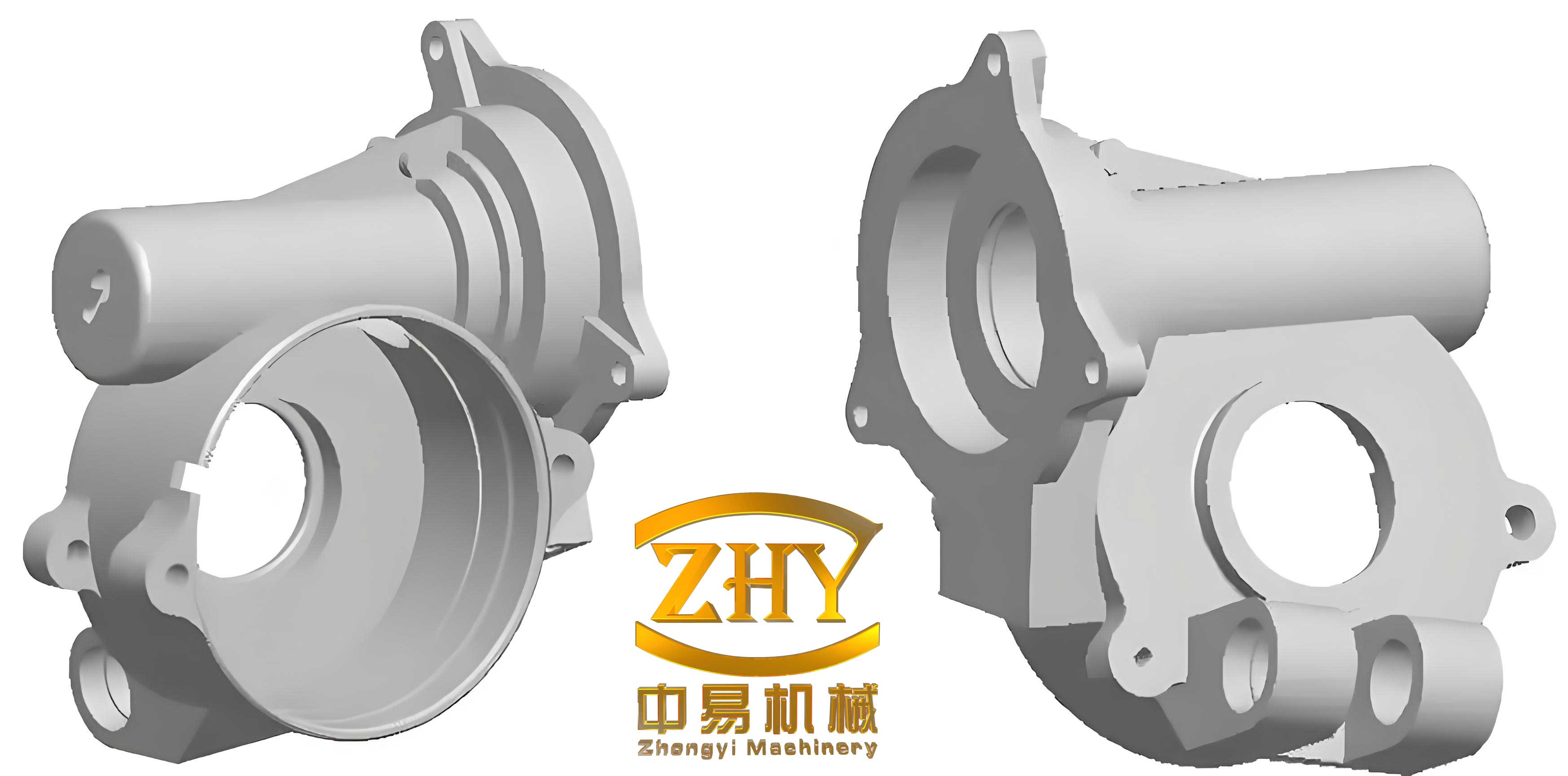
To commence the process, I conducted a DFM analysis using Cast Designer to assess the manufacturability of the shell castings. DFM evaluates key indices such as the Mass Distribution Index (MDI) and Heat Distribution Index (HDI), which predict potential defect zones without full-scale simulation. The MDI quantifies mass concentration areas, while the HDI identifies thermal hotspots that could lead to shrinkage in shell castings. The HDI analysis for these shell castings revealed significant heat accumulation in upper and lower regions, aligning with areas of thick sections. This is mathematically represented by the HDI formula, which considers geometric and environmental thermal effects:
$$ \text{HDI} = \frac{\int_V T(\mathbf{x}) \, dV}{\int_V \, dV} \times f(\text{geometry}, \text{boundary conditions}) $$
where \( T(\mathbf{x}) \) is the temperature distribution within the shell castings volume \( V \), and \( f \) accounts for factors like mold material and cooling rates. The HDI results, visualized through color gradients, indicated high values (e.g., above 30 in critical zones), necessitating strategic riser placement for these shell castings. Additionally, draft angle checks and ejection force assessments ensured that the shell castings could be demolded without damage, further refining the design for manufacturability.
Based on the DFM insights, I designed the initial gating and risering system for the shell castings. The goal was to provide adequate feeding to shrinkage-prone areas while minimizing excess material. Initially, I proposed two top risers and two side risers, but HDI evaluation showed insufficient feeding in central and lower regions of the shell castings. This led to a revised design with one top riser and four side risers, as illustrated in the optimized layout. The gating system was automated using Cast Designer’s runner design wizard, which calculates key parameters like filling time and ingate area based on casting mass and material properties. For shell castings, the filling time \( t_f \) is derived from:
$$ t_f = \frac{V_{\text{casting}}}{\dot{Q}} $$
where \( V_{\text{casting}} \) is the volume of the shell castings and \( \dot{Q} \) is the volumetric flow rate, determined by the ingate area \( A_{\text{ingate}} \) and flow velocity \( v \):
$$ \dot{Q} = A_{\text{ingate}} \times v $$
To balance quality and cost for shell castings, I established two primary response variables: shrinkage cavity volume (indicative of quality) and yield rate (indicative of cost). The yield rate \( Y \) is defined as:
$$ Y = \frac{\text{Mass of shell castings}}{\text{Total mass poured}} \times 100\% $$
while shrinkage volume \( S \) is measured from simulation results. A higher yield reduces material cost but may increase defects in shell castings if risers are undersized, creating a trade-off that requires systematic exploration.
I employed DOE within Cast Designer to analyze the effects of various process factors on the shell castings’ responses. Five factors were selected, each at multiple levels, as summarized in Table 1. The full factorial design involved 162 runs, with simulations conducted for each combination to extract shrinkage volume and yield rate data for the shell castings.
| Factor | Level 1 | Level 2 | Level 3 | Notes |
|---|---|---|---|---|
| Top Riser Size | Small (Volume V1) | Medium (Volume V2) | Large (Volume V3) | Varied in height and diameter |
| Side Riser 1 Size | Small (Diameter D1) | Medium (Diameter D2) | Large (Diameter D3) | Independent of Side Riser 2 |
| Side Riser 2 Size | Small (Diameter D4) | Medium (Diameter D5) | Large (Diameter D6) | Affects feeding in lower zones |
| Chill Placement | No Chill | One Chill | Two Chills | Positioned at bottom of shell castings |
| Pouring Temperature | 1540°C | 1560°C | 1580°C | Limited to two levels for simplicity |
The DOE results for shell castings were analyzed to identify key influencers. Figure 4 (referenced from simulations) plots yield rate against shrinkage volume, showing a Pareto frontier where optimal solutions lie. Points in the lower-right region represent high yield and low shrinkage for shell castings, while upper-left points indicate poor performance. Parallel coordinate analysis revealed that side riser dimensions (Side Riser 1 and Side Riser 2) are critical factors, as their volumes directly impact feeding efficiency in thick sections of the shell castings. Pouring temperature and chills had negligible effects, likely due to the material’s solidification characteristics. The top riser, while not a primary driver, influenced both responses; its volume \( V_{\text{top}} \) correlates with yield \( Y \) and shrinkage \( S \) through:
$$ S \propto \frac{1}{V_{\text{top}}^a}, \quad Y \propto \frac{1}{V_{\text{top}}^b} $$
where \( a \) and \( b \) are exponents derived from regression analysis of shell castings data. This underscores the need for fine-tuning riser sizes to achieve optimal outcomes for shell castings.
To transcend the limitations of predefined DOE levels, I implemented a GA-based optimization in Cast Designer for the shell castings. GA mimics natural selection to evolve solutions toward a global optimum, using parameters like mutation rate and crossover probability. I defined continuous ranges for key variables, as shown in Table 2, allowing the algorithm to explore unseen combinations and refine the shell castings process.
| Parameter | Lower Bound | Upper Bound | Step Size | Description |
|---|---|---|---|---|
| Top Riser Height (mm) | 120 | 160 | 10 | Height of the central riser |
| Top Riser Angle (°) | 60 | 64 | 2 | Angle affecting feeding range |
| Side Riser Diameter (mm) | 90 | 110 | 5 | Diameter of side risers for shell castings |
| Riser Coefficient (H/D) | 1.0 | 1.5 | 0.1 | Height-to-diameter ratio for efficiency |
The GA optimization for shell castings involved 50 generations with a population size of 20, evaluating objectives to minimize shrinkage and maximize yield. The fitness function \( F \) was formulated as:
$$ F = w_1 \cdot S + w_2 \cdot (1 – Y) $$
where \( w_1 \) and \( w_2 \) are weights prioritizing quality and cost for shell castings. Over iterations, the algorithm converged to a Pareto-optimal front, depicted in Figure 6, where point A signifies the best compromise: high yield with minimal shrinkage for the shell castings. The optimal parameters, detailed in Table 3, were derived from this analysis and implemented in the final casting process for the shell castings.
| Parameter | Optimal Value | Effect on Shell Castings |
|---|---|---|
| Top Riser Height (mm) | 130 | Enhances feeding pressure in upper zones |
| Top Riser Angle (°) | 62 | Improves metal flow to critical areas |
| Side Riser Diameter (mm) | 90 | Adequately feeds lower sections of shell castings |
| Riser Coefficient (H/D) | 1.0 | Balances volume and efficiency for shell castings |
| Yield Rate (%) | 65.1 | Maximizes material utilization in shell castings |
| Shrinkage Volume (mm³) | 254.64 | Minimized defects in shell castings |
The optimized process for shell castings resulted in a significant improvement: the yield rate increased to 65.1%, reducing material waste, while shrinkage volume was maintained below 255 mm³, ensuring high integrity. This outcome demonstrates the efficacy of integrating DFM, DOE, and GA for shell castings. The DFM analysis provided a foundational design, DOE identified critical factors like side riser sizes for shell castings, and GA fine-tuned parameters beyond human intuition. Such an approach not only accelerates process development but also enhances reproducibility for complex shell castings.
In practice, the implementation of these optimized parameters for shell castings led to successful casting trials, with radiographic inspections confirming the absence of major shrinkage defects. The Cast Designer software proved invaluable in predicting outcomes and guiding decisions for shell castings. Future work could extend this methodology to other alloys or larger shell castings, incorporating additional factors like mold material properties or cooling rate controls. Moreover, the use of machine learning models alongside GA could further refine predictions for shell castings, reducing simulation overhead.
In conclusion, the intelligent optimization of casting processes for shell castings using Cast Designer offers a robust framework to achieve quality-cost equilibrium. By leveraging DFM for initial design, DOE for factor screening, and GA for precise optimization, I have demonstrated a systematic path to enhance the manufacturability of shell castings. This methodology underscores the transformative potential of simulation-driven design in foundries, paving the way for more efficient and reliable production of shell castings across industries.