
In modern foundry engineering, the integration of computer simulation and optimization techniques has revolutionized the design and development of casting processes. As technology advances, simulation tools not only evaluate pre-designed schemes but also enable intelligent optimization to achieve the best balance between quality and cost. In this work, we focus on the application of Cast Designer software for the casting process design and optimization of complex shell castings. These shell castings, typically made from materials like ZG10Cr14Ni5Mo2, present challenges due to their intricate geometry, varying wall thicknesses (8–30 mm), and stringent quality requirements. Our goal is to leverage Cast Designer’s capabilities, including Design for Manufacturability (DFM) analysis, Design of Experiments (DOE), and Genetic Algorithm (GA)-based optimization, to minimize defects such as shrinkage cavities while maximizing yield rate, thereby reducing material costs for shell castings.
The shell castings under consideration are used in marine gas turbine applications, with a mass of 104 kg and a segmented structure comprising one-sixth circular components. The inherent complexity and thickness disparities necessitate a meticulous工艺 approach to ensure soundness. Traditional trial-and-error methods are time-consuming and costly, prompting the adoption of simulation-driven design. Cast Designer embeds DOE optimization techniques, allowing for iterative improvements in output responses within a virtual environment, which facilitates intelligent optimization of casting processes for shell castings. This article details our first-person perspective on utilizing this software to achieve optimal results.
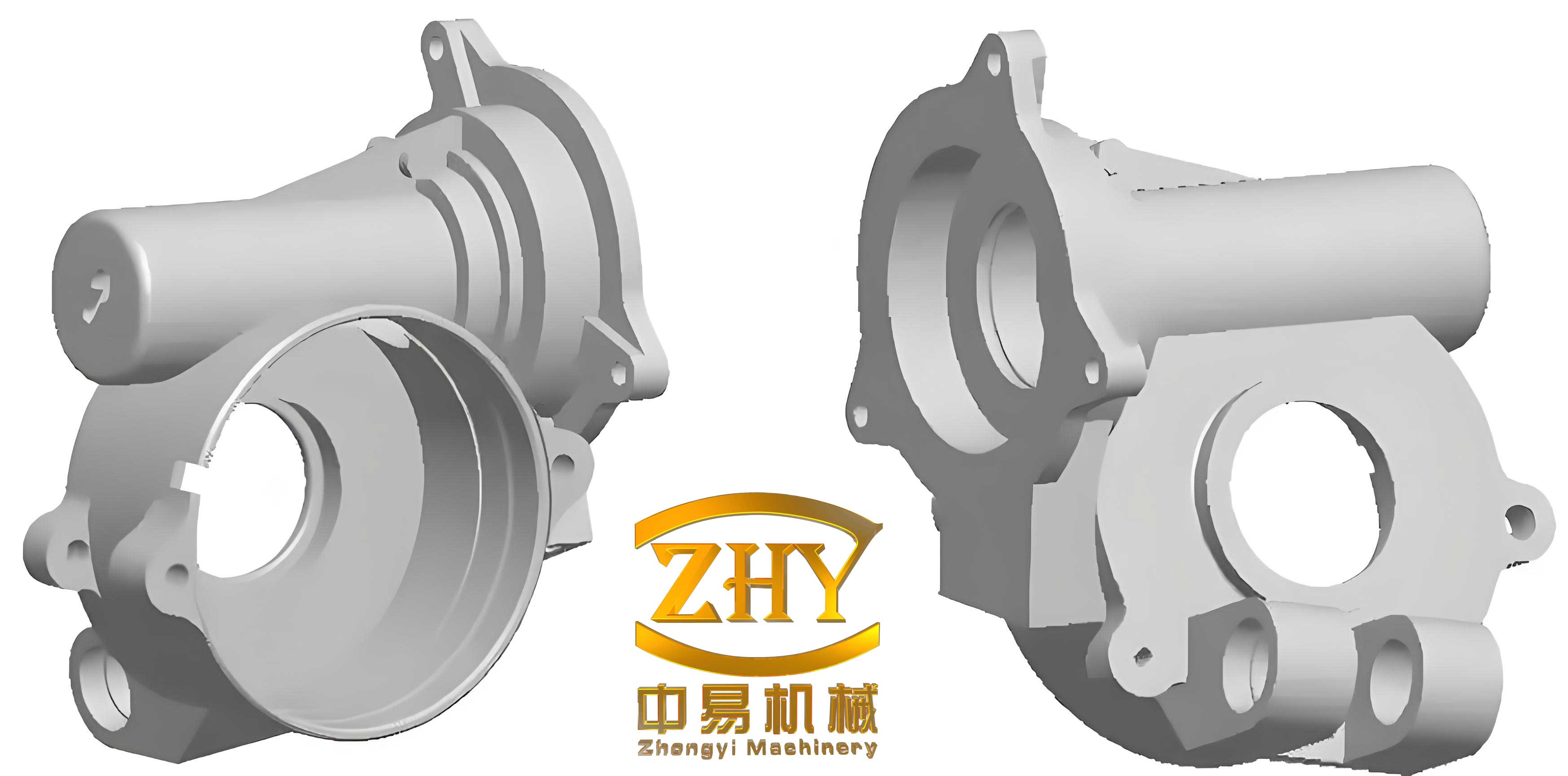
We began with a comprehensive DFM analysis using Cast Designer. DFM assesses manufacturability by evaluating indices such as the Mass Distribution Index (MDI) and Heat Distribution Index (HDI). For shell castings, HDI is particularly crucial as it predicts thermal hot spots during solidification without requiring full simulation, offering rapid and flexible insights. The HDI analysis revealed significant wall thickness variations in upper and lower regions of the shell castings, indicating potential shrinkage zones. This analysis considers three-dimensional geometry and environmental thermal effects, providing a foundation for subsequent design steps. The HDI results closely align with solidification simulation outcomes, validating its reliability for initial assessments of shell castings.
Based on the DFM insights, we proceeded to design the gating and risering system. Initially, two top risers and two side risers were proposed to feed the thick sections of the shell castings. However, HDI evaluation highlighted inadequate feeding in central and bottom lateral areas. To address this, we optimized the riser configuration to one top riser and four side risers, connected to the gating system to save space. This adjustment aimed to enhance feeding efficiency while considering yield rate implications. The gating system was designed using Cast Designer’s runner design wizard, which automatically calculates key parameters such as filling time, velocity, and ingate area based on casting mass, dimensions, and material properties. The real-time linkage between工艺 parameters and geometric models allowed for flexible adjustments. The final design for the shell castings is depicted in the figure above, showcasing the integrated gating and risering layout.
To quantitatively assess the impact of various factors on casting quality, we employed DOE within Cast Designer. The primary responses were shrinkage cavity volume (indicative of quality) and yield rate (related to cost). These are conflicting objectives; increasing riser size reduces shrinkage but lowers yield, so finding an optimal balance is essential for shell castings. We selected five factors with multiple levels, as summarized in Table 1.
| Factor | Level 1 | Level 2 | Level 3 |
|---|---|---|---|
| Top Riser Size (Small/Medium/Large) | Small | Medium | Large |
| Side Riser 1 Size (Small/Medium/Large) | Small | Medium | Large |
| Side Riser 2 Size (Small/Medium/Large) | Small | Medium | Large |
| Chill Placement (None/One/Two) | None | One | Two |
| Pouring Temperature (°C) | 1540 | 1560 | 1580 |
A full factorial design resulted in 162 simulations (3×3×3×3×2). Each simulation evaluated shrinkage volume and yield rate for the shell castings. The shrinkage volume, denoted as \( V_s \), can be modeled based on thermal parameters, while yield rate \( Y \) is calculated as the ratio of casting weight to total poured weight. Empirical relationships suggest that shrinkage in shell castings correlates with cooling rates and riser efficacy. For instance, Chvorinov’s rule estimates solidification time \( t \) as:
$$ t = B \left( \frac{V}{A} \right)^2 $$
where \( V \) is volume, \( A \) is surface area, and \( B \) is a mold constant. Shrinkage tendency increases with longer local solidification times, often in thick sections of shell castings. The yield rate is given by:
$$ Y = \frac{W_c}{W_c + W_r + W_g} \times 100\% $$
where \( W_c \) is casting weight, \( W_r \) is riser weight, and \( W_g \) is gating weight. DOE results were analyzed to identify key factors. Figure 1 (represented by the embedded image) illustrates the relationship between yield rate and shrinkage volume across all trials. Points in the lower-right region indicate optimal combinations with high yield and low shrinkage for shell castings. Parallel coordinate plots revealed that side riser 1 and side riser 2 sizes were critical factors, whereas pouring temperature and chills had minor effects. Although top riser size was not a primary driver, it directly influenced both responses, necessitating further optimization.
Based on DOE findings, we implemented a GA-based intelligent optimization to search for the best parameter set beyond the predefined levels. GA mimics natural selection to evolve solutions toward an optimum. We defined the optimization problem as minimizing shrinkage volume \( V_s \) and maximizing yield rate \( Y \) for shell castings, a multi-objective scenario. The design variables and their ranges are listed in Table 2.
| Variable | Start | End | Step |
|---|---|---|---|
| Top Riser Height (mm) | 120 | 160 | 10 |
| Top Riser Angle (degrees) | 60 | 64 | 2 |
| Side Riser Diameter (mm) | 90 | 110 | 5 |
| Riser Coefficient (Height/Diameter) | 1.0 | 1.5 | 0.1 |
The objective functions were formulated as:
$$ \text{Minimize } f_1 = V_s $$
$$ \text{Maximize } f_2 = Y $$
These constitute a Pareto optimization problem. The GA used a population size of 50 over 100 generations, with crossover and mutation rates set at 0.8 and 0.05, respectively. Fitness was evaluated using a weighted sum approach, though the Pareto front was ultimately analyzed. The optimization process generated numerous solutions, with the Pareto curve depicting trade-offs between shrinkage and yield for shell castings. The optimal point, labeled A in the results, offered the best compromise: minimal shrinkage and high yield. Specific optimized parameters are shown in Table 3.
| Parameter | Value |
|---|---|
| Top Riser Height (mm) | 130 |
| Top Riser Angle (degrees) | 62 |
| Side Riser Diameter (mm) | 90 |
| Riser Coefficient (H/D) | 1.0 |
| Yield Rate (%) | 65.1 |
| Shrinkage Volume (mm³) | 254.64 |
The optimization demonstrates that for shell castings, a top riser height of 130 mm, angle of 62°, side riser diameter of 90 mm, and a riser coefficient of 1.0 yield a high yield rate of 65.1% with minimal shrinkage of 254.64 mm³. This represents a significant improvement over initial designs, achieving the desired balance. The effectiveness of this approach stems from Cast Designer’s integrated environment, which combines DFM, DOE, and GA seamlessly. The software’s ability to rapidly simulate and iterate allows for data-driven decisions, reducing reliance on empirical rules for shell castings.
Further analysis involved mathematical modeling of shrinkage formation in shell castings. Shrinkage volume \( V_s \) can be approximated using thermal gradient-based equations. For a given region, the volumetric shrinkage \( \Delta V \) relates to the temperature drop \( \Delta T \) and coefficient of thermal contraction \( \alpha \):
$$ \Delta V = V_0 \cdot \alpha \cdot \Delta T $$
where \( V_0 \) is initial volume. In casting, shrinkage cavities form due to inadequate feeding during solidification. The Niyama criterion, often used in simulation, predicts shrinkage propensity based on local temperature gradient \( G \) and cooling rate \( \dot{T} \):
$$ N_y = \frac{G}{\sqrt{\dot{T}}} $$
Lower Niyama values indicate higher shrinkage risk in shell castings. Our DOE and GA results align with such principles, as riser design directly affects \( G \) and \( \dot{T} \). Additionally, yield rate optimization involves geometric calculations. For cylindrical risers commonly used in shell castings, volume \( V_r \) is:
$$ V_r = \pi \left( \frac{D}{2} \right)^2 H $$
where \( D \) is diameter and \( H \) is height. Total poured weight includes casting, risers, and gating, so optimizing riser dimensions minimizes waste while ensuring feeding.
In practice, the optimized process for shell castings was validated through virtual simulations in Cast Designer. Solidification analysis confirmed reduced shrinkage in critical areas, and filling simulations ensured no defects like mistruns. The software’s predictive capabilities enhance reliability for complex shell castings. Moreover, the integration of DOE and GA provides a robust framework for handling multiple variables and objectives. This is particularly beneficial for shell castings, where small changes in riser design can significantly impact quality and cost.
To summarize, our work underscores the value of Cast Designer in advancing casting工艺 for shell castings. The DFM analysis provided a solid starting point, identifying thermal hotspots and guiding initial designs. DOE revealed key factors like side riser sizes, while GA enabled fine-tuning beyond manual limits. The final optimized方案 achieves a yield rate of 65.1% with minimal shrinkage, exemplifying the intelligent optimization potential. Future directions may include incorporating more material-specific models or extending to other casting types. Nonetheless, the methodology presented here offers a replicable approach for enhancing the manufacturing of shell castings through simulation-driven innovation.
In conclusion, the combination of DFM, DOE, and GA within Cast Designer facilitates a comprehensive optimization strategy for shell castings. By balancing shrinkage reduction and yield maximization, we can achieve cost-effective production without compromising quality. This approach not only saves time and resources but also pushes the boundaries of what is possible in casting design for intricate components like shell castings. As foundries continue to embrace digital tools, such intelligent optimization will become standard practice, driving efficiency and excellence in the production of shell castings across industries.