
In my research, I have focused on understanding the wear resistance mechanisms of high chromium white cast iron, a material renowned for its exceptional performance in abrasive environments. The motivation for this study stems from the need to optimize the composition and processing of white cast iron to enhance its durability in applications such as mining, cement production, and mineral processing. This article presents a comprehensive analysis based on experiments conducted using a self-designed testing apparatus, aiming to elucidate the effects of alloying elements and modification treatments on the abrasion resistance of high chromium white cast iron.
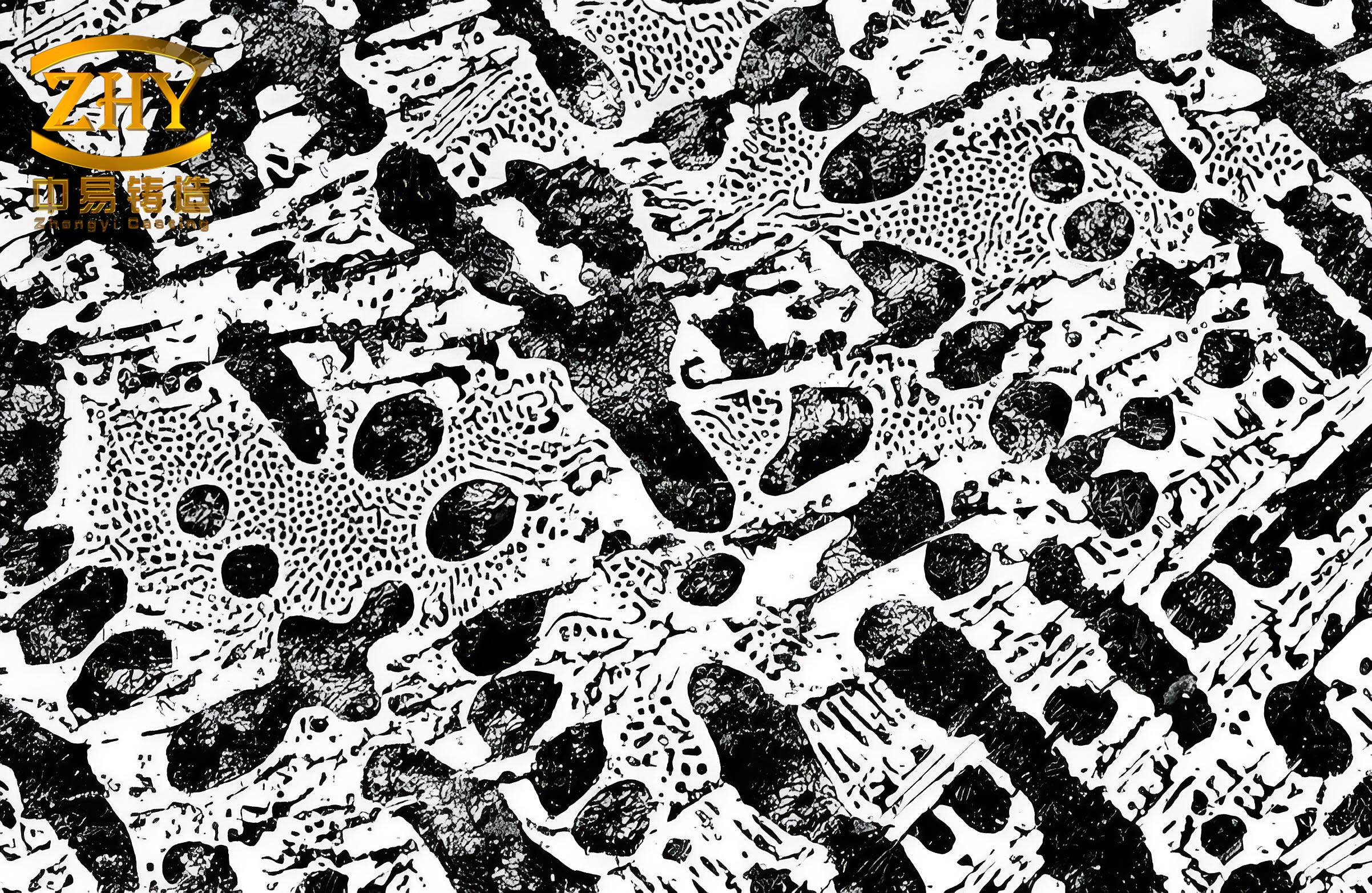
White cast iron, particularly the high chromium variant, derives its wear resistance from a unique microstructure characterized by hard carbides embedded in a tough matrix. The primary carbide in high chromium white cast iron is of the M7C3 type, which exhibits a hardness ranging from 1500 to 1900 HV, significantly surpassing that of common abrasives like silica sand. This carbide typically forms as discontinuous networks, rods, or plates, contributing to improved toughness compared to continuous carbide networks. The matrix, often comprising martensite or austenite, plays a crucial role in supporting these carbides. However, the performance of white cast iron in practice can be inconsistent, prompting investigations into compositional adjustments and treatment methods.
To systematically evaluate the abrasion resistance, I developed a rotary disc rubber wheel abrasion wear testing machine. The design principles are illustrated in the following schematic, which demonstrates the arrangement for subjecting specimens to controlled abrasive conditions.
The machine operates by feeding abrasive particles between a rotating rubber wheel and a fixed specimen. The abrasive flow rate is regulated via a valve, ensuring consistent testing conditions. The rubber layer minimizes rolling tendencies of the abrasives, promoting sliding wear that simulates real-world scenarios. All tests were conducted under a constant load to facilitate comparative analysis. The parameters for the abrasion tests are summarized in Table 1.
| Parameter | Value |
|---|---|
| Rubber Wheel Speed | 100 rpm |
| Abrasive Type | 50-mesh silica sand |
| Abrasive Flow Rate | 7.5 kg/h |
| Applied Load | 650 g (≈6.37 N) |
| Test Duration | 4 hours |
| Specimen Dimensions | 20 mm × 20 mm × 110 mm |
The specimens were prepared by melting high chromium white cast iron in a medium-frequency induction furnace, followed by casting into standard impact test bars. After cleaning, the hardness and impact toughness were measured prior to abrasion testing. The chemical compositions of the various white cast iron samples investigated are detailed in Table 2. These compositions range from a baseline high chromium white cast iron to alloyed versions with additions of molybdenum, vanadium, titanium, copper, and others, as well as a modified variant treated with a composite modifier containing rare earth elements, potassium, and zinc.
| Specimen ID | C | Si | Mn | P | S | Cr | Mo | V | Ti | Cu | Other | Microstructure (As-Cast) |
|---|---|---|---|---|---|---|---|---|---|---|---|---|
| OA | 2.6 | 0.4 | 0.05 | ≤0.05 | ≤0.05 | 16 | 1.0 | 0.2 | 0.1 | 0.5 | – | Pearlite + Austenite + M7C3 |
| A1 | 2.8 | 0.7 | 0.05 | ≤0.05 | ≤0.05 | 18 | 1.0 | 0.2 | 0.1 | 1.0 | – | Austenite + Ferrite + M7C3 |
| A2 | 3.0 | 1.5 | 0.25 | 0.15 | – | 18 | 1.5 | – | – | – | – | Austenite + Ferrite + M7C3 |
| A3 | 3.2 | 2.0 | 0.3 | 0.2 | – | 18 | 1.5 | – | – | – | – | Austenite + Ferrite + M7C3 |
| A4 | 3.5 | 2.5 | 0.3 | 0.2 | – | 18 | – | – | – | – | – | Austenite + Ferrite + M7C3 + M23C6 |
| A5 | 3.8 | 2.8 | 0.35 | 0.25 | – | 18 | 2.0 | 0.5 | 0.3 | 1.5 | Al 0.1 | Austenite + Ferrite + M7C3 + M23C6 |
| Modified A4 | 3.5 | 2.5 | 0.3 | 0.2 | – | 18 | – | – | – | – | 0.5% RE, 2% K, 0.08% Zn | Refined Austenite + Ferrite + Carbides |
The abrasion resistance was quantified using the relative wear resistance coefficient, denoted by ε. This coefficient is defined as the ratio of the weight loss of a standard reference material to the weight loss of the test specimen. The standard material employed was normalized 45 carbon steel. The formula for ε is given by:
$$ \epsilon = \frac{\Delta W_{\text{standard}}}{\Delta W_{\text{test}}} $$
where ΔWstandard is the weight loss of the 45 steel standard and ΔWtest is the weight loss of the white cast iron specimen. A higher ε value indicates superior abrasion resistance. The weight loss data from the tests, along with the calculated ε values, are presented in Table 3.
| Specimen ID | Weight Loss 1 (g) | Weight Loss 2 (g) | Weight Loss 3 (g) | Average Weight Loss, ΔWtest (g) | Relative Wear Resistance, ε |
|---|---|---|---|---|---|
| OA | 0.12382 | 0.13680 | 0.12563 | 0.12875 | 2.91 |
| A1 | 0.05891 | 0.05945 | 0.05901 | 0.05912 | 6.33 |
| A2 | 0.05968 | 0.05943 | 0.05879 | 0.05930 | 6.28 |
| A3 | 0.05390 | 0.05854 | 0.05638 | 0.05628 | 6.60 |
| A4 | 0.05605 | 0.05018 | 0.05230 | 0.05218 | 6.03 |
| A5 | 0.05793 | 0.05304 | 0.05453 | 0.05510 | 5.75 |
| Modified A4 | 0.04983 | 0.05005 | 0.05164 | 0.05014 | 7.28 |
| 45 Steel (Standard) | 0.37085 | 0.37553 | 0.38456 | 0.37698 | 1.00 (by definition) |
The data reveals significant variations in the wear resistance of high chromium white cast iron based on composition and treatment. The baseline white cast iron (OA) exhibits the lowest ε value of 2.91, while alloyed and modified versions show substantial improvements, with ε values exceeding 6.0. The modified white cast iron specimen achieves the highest ε of 7.28, underscoring the efficacy of combined alloying and modification.
To delve deeper into the influence of alloying elements, I analyzed the microstructure-property relationships. The hardness of the matrix and the morphology of carbides are critical factors. The hardness of M7C3 carbides can be approximated by:
$$ H_{M_7C_3} \approx 1500 + 200 \cdot \left(\frac{Cr}{C}\right) \text{ HV} $$
where Cr/C represents the chromium-to-carbon ratio. A higher ratio promotes the formation of M7C3 over other carbides like M3C, enhancing wear resistance. The matrix hardness, particularly after heat treatment, contributes to the overall performance. For white cast iron, the effective wear resistance can be modeled as a function of carbide volume fraction (Vc), carbide hardness (Hc), and matrix hardness (Hm). A simplified empirical relation is:
$$ \epsilon \propto \frac{V_c \cdot H_c + (1 – V_c) \cdot H_m}{\sigma_f} $$
where σf is a stress factor related to the interfacial bonding between carbides and matrix. Alloying elements such as molybdenum and vanadium increase hardenability, promoting martensite formation in the matrix upon cooling, which raises Hm. Copper and nickel stabilize austenite, affecting toughness and work-hardening capacity. However, excessive alloying, as seen in specimen A5, can lead to complex carbide formations like M23C6, which may be less effective against abrasion than M7C3, potentially explaining its slightly lower ε value.
The modification treatment applied to the A4 composition involved a composite modifier of 0.5% RE, 2% K, and 0.08% Zn. This treatment refines the microstructure by promoting heterogeneous nucleation and suppressing carbide network continuity. The refinement mechanism can be described by the growth restriction factor Q, which influences grain size:
$$ d = \frac{k}{Q^n} $$
where d is the grain or carbide size, k and n are constants, and Q is a function of modifier concentration. The modified white cast iron exhibits finer carbides and a more uniform matrix, leading to improved load distribution and reduced crack initiation during abrasion. This microstructural refinement directly enhances the abrasion resistance, as evidenced by the higher ε value.
Furthermore, the role of chromium in white cast iron extends beyond carbide formation. Chromium increases the electrode potential of the iron matrix, improving corrosion resistance. In corrosive-abrasive environments, the wear loss is a synergistic effect of mechanical removal and electrochemical dissolution. The corrosion-wear rate R can be expressed as:
$$ R = R_m + R_c – \Delta R_{syn} $$
where Rm is the mechanical wear rate, Rc is the corrosion rate, and ΔRsyn represents synergistic interactions. For high chromium white cast iron, the high chromium content mitigates Rc, thereby reducing overall material loss. Elements like boron, though not extensively studied here, are known to enhance corrosion resistance by refining structure and reducing microgalvanic cells, which could be beneficial for white cast iron in slurry applications.
The relationship between hardness and abrasion resistance in white cast iron is nonlinear. As hardness increases, wear resistance generally improves, but the effect diminishes at higher hardness levels due to embrittlement. This trend can be approximated by a power-law equation:
$$ \epsilon = a \cdot H^b $$
where H is the hardness (e.g., in HRC), and a and b are material-specific constants with b typically less than 1. For the white cast iron specimens, hardness measurements correlated with ε values, but the modified specimen showed superior performance despite similar hardness, highlighting the importance of microstructure over mere hardness.
To consolidate the effects of various elements, I developed a multi-parameter model for predicting the relative wear resistance of high chromium white cast iron. The model incorporates compositional factors and treatment indices:
$$ \epsilon = \alpha_0 + \alpha_1 \cdot [Cr] + \alpha_2 \cdot [Mo] + \alpha_3 \cdot [V] + \alpha_4 \cdot I_m + \alpha_5 \cdot \left(\frac{[Cr]}{[C]}\right) + \alpha_6 \cdot H_{matrix} $$
where [X] denotes the concentration of element X in weight percent, Im is a modification index (0 for unmodified, 1 for modified), Hmatrix is the matrix hardness, and αi are regression coefficients derived from experimental data. This model emphasizes that optimal performance in white cast iron requires balancing alloy content to avoid excessive carbide complexity while ensuring matrix toughening.
In practical terms, the selection of white cast iron for abrasive applications should consider both composition and post-casting treatments. The data suggests that moderate alloying with elements like molybdenum and vanadium, coupled with composite modification, yields the best abrasion resistance. Over-alloying, as in specimen A5, may not provide proportional benefits and could increase cost unnecessarily. The modified white cast iron represents a cost-effective solution for enhancing wear life in components like pump impellers, liner plates, and grinding media.
Future research directions for white cast iron could explore the effects of nano-sized carbide precipitates via heat treatment, the integration of computational materials design to optimize compositions, and the behavior under combined impact and abrasion. Additionally, the environmental sustainability of white cast iron production, such as recycling of scrap and reduced energy consumption during melting, warrants attention.
In conclusion, my investigation demonstrates that the abrasion resistance of high chromium white cast iron is profoundly influenced by its chemical composition and microstructural characteristics. Alloying improves performance, but excessive additions can be detrimental. Modification treatments, particularly with composite modifiers, significantly enhance wear resistance by refining microstructure. The relative wear resistance coefficient ε serves as a reliable metric for evaluating these materials. This study provides a framework for developing advanced white cast iron alloys tailored for demanding industrial environments, ensuring longevity and efficiency in abrasive applications.