
In recent years, the hot workability of white cast iron has gradually gained attention within the materials science community. Research indicates that low-carbon, low-alloy white cast iron can not only undergo hot working but may also exhibit superplastic behavior. Through hot deformation processes, the eutectic carbides, which typically exist in a network or coarse rod-like morphology in the as-cast state, undergo deformation, bending, or fragmentation, leading to refinement. Concurrently, casting defects such as shrinkage cavities, porosity, and microcracks are healed under pressure, resulting in a significant enhancement of the strength and toughness of white cast iron. Although some foundational studies have been conducted in this area, the specific conditions under which white cast iron, particularly high-carbon and high-alloy varieties, can achieve optimal hot working outcomes are not fully resolved. Therefore, further investigation is essential to advance our understanding and industrial application of these materials.
This study focuses on the hot plasticity of chromium-containing white cast iron, a critical property for hot forming processes like forging or rolling. I employed hot torsion testing to evaluate the hot workability across a range of compositions and temperatures. The goal is to elucidate the effects of chemical composition, particularly chromium and carbon content, as well as deformation temperature, on the hot plasticity of white cast iron. The insights gained are intended to guide the design of white cast iron alloys with improved hot deformation characteristics.
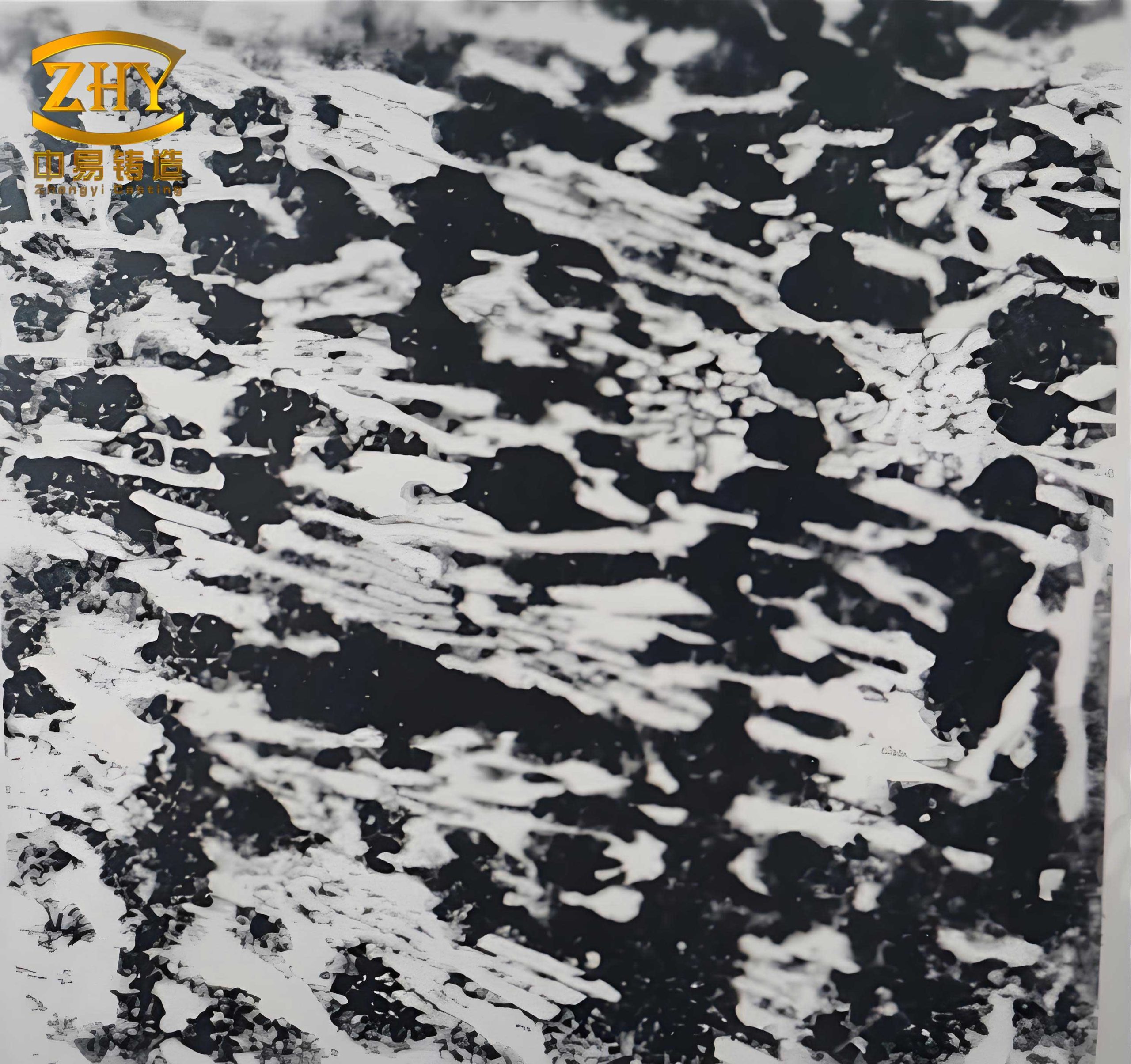
The materials for this investigation were prepared using scrap steel and pig iron as raw materials, melted in medium-frequency induction furnaces. The pouring temperature was controlled between 1350°C and 1400°C. Various heats were produced to achieve a spectrum of chromium and carbon contents. The chemical compositions of the white cast iron specimens used in the hot torsion tests are summarized in Table 1.
| Specimen Group | C | Cr | Si | Mn | Cr/C Ratio |
|---|---|---|---|---|---|
| High-C, Low-Cr | ~2.8 | 0-5 | ~0.6 | ~0.5 | 0 – ~1.8 |
| High-C, Med-Cr | ~2.8 | 5-15 | ~0.6 | ~0.5 | ~1.8 – ~5.4 |
| High-C, High-Cr | ~2.8 | 15-30 | ~0.6 | ~0.5 | ~5.4 – ~10.7 |
| Medium-C, Low-Cr | ~2.0 | 0-5 | ~0.6 | ~0.5 | 0 – ~2.5 |
| Medium-C, Med/High-Cr | ~2.0 | 5-30 | ~0.6 | ~0.5 | ~2.5 – ~15 |
| Low-C, Varied-Cr | ~1.2 | 0-30 | ~0.6 | ~0.5 | 0 – ~25 |
The hot torsion test is a widely accepted method for assessing hot workability. The specimen geometry is cylindrical, with a gauge length of 30 mm and a diameter of 6 mm. Testing was conducted on a machine operating at a constant rotational speed of 30 rpm. Specimens were heated to the desired deformation temperature, held for 10 minutes to ensure uniform temperature distribution, and then subjected to torsion until fracture. The number of twists to failure (N_f) and the torque were continuously recorded. The hot plasticity of the white cast iron is primarily evaluated by the N_f value, with the average of two tests reported for each condition. The relationship between shear strain and twists can be expressed as:
$$ \gamma = \frac{2 \pi R N}{L} $$
where \(\gamma\) is the shear strain, \(R\) is the specimen radius, \(N\) is the number of twists, and \(L\) is the gauge length. The hot workability is often correlated with the peak torque and the total strain to fracture.
The as-cast microstructure of the chromium white cast iron evolves significantly with the chromium-to-carbon ratio (Cr/C). As the Cr/C ratio increases, the morphology of the eutectic carbides transitions from a coarse continuous network to a finer network, then to a chrysanthemum-like pattern, and finally to isolated rods or blocks. This progression reduces the continuity of the carbide phase. For Cr/C ratios exceeding approximately 5, the carbides are predominantly in a discontinuous rod-like form. Furthermore, X-ray diffraction analysis reveals that the crystal structure of the carbides changes with increasing Cr content: from cementite (Fe$_3$C) to (Fe,Cr)$_3$C, and then to complex carbides like (Cr,Fe)$_7$C$_3$ and (Cr,Fe)$_{23}$C$_6$ at higher chromium levels. The matrix structure is also affected; in low-carbon, high-chromium white cast iron, the austenite can retain a significant amount of chromium in solid solution, suppressing the transformation to pearlite or martensite upon cooling, resulting in a retained austenite matrix at room temperature.
The influence of chromium on the hot plasticity of white cast iron is multifaceted and varies with carbon content. For high-carbon white cast iron (C ~2.8%), the hot plasticity, represented by N_f, generally increases with chromium addition up to a point. This improvement is most pronounced in the medium-chromium range (Cr ~5-15%), where a maximum in hot plasticity is observed. The underlying mechanism involves two competing factors: the beneficial modification of carbide morphology and distribution, and the detrimental solid solution strengthening of the austenite matrix by chromium. At low chromium levels, the refinement of the as-cast ledeburite structure and the reduction in carbide network continuity begin to enhance hot plasticity. In the medium-chromium range, carbides become discontinuous rods or blocks, minimizing their cutting effect on the plastic austenite phase during hot deformation, leading to a sharp rise in hot plasticity. However, in the high-chromium region (Cr >15%), despite further improvement in carbide morphology, the increasing chromium content in solid solution and the presence of hard, complex carbides like (Cr,Fe)$_7$C$_3$ degrade the deformation capacity of both phases, causing hot plasticity to decline. This relationship can be qualitatively modeled as:
$$ N_f \approx f_1(\text{Cr/C}) – f_2([\text{Cr}]_{ss}) $$
where \(f_1\) represents the positive contribution from carbide morphology improvement (a function of Cr/C ratio), and \(f_2\) represents the negative contribution from solid solution strengthening (a function of dissolved chromium concentration, \([\text{Cr}]_{ss}\)).
For medium-carbon white cast iron (C ~2.0%), the effect of chromium is similar but with some nuances. The absolute hot plasticity values in the low and high chromium regions are slightly lower or comparable to those of ordinary medium-carbon white cast iron without chromium. This is because, compared to high-carbon white cast iron, the lower carbide volume fraction in medium-carbon grades means ordinary white cast iron already has relatively good hot plasticity. Initial chromium additions primarily strengthen the austenite, outweighing the morphological benefits and causing a slight decrease in hot plasticity. The trend in the medium to high chromium range broadly mirrors that of high-carbon white cast iron.
The impact of chromium on low-carbon white cast iron (C ~1.2%) is markedly different. Hot plasticity decreases sharply with increasing chromium content. In low-chromium variants, hot plasticity is higher than in high- and medium-carbon white cast iron due to the inherently lower carbide content. However, as chromium increases, the solid solution strengthening effect dominates severely, as the matrix constitutes a larger fraction of the microstructure. Additionally, during heating for deformation, the sparse carbides partially dissolve and spheroidize, but the high dissolved chromium content in the austenite significantly impairs its hot workability. Homogenization annealing (e.g., at 1100°C for 4 hours) prior to testing improves the hot plasticity of both as-cast and alloyed white cast iron, particularly for low-carbon grades, by promoting carbide spheroidization and compositional homogeneity.
The effect of carbon content on the hot plasticity of white cast iron is more straightforward. As shown in Table 2, which compares data extracted from the study, increasing carbon content consistently reduces hot plasticity for both ordinary and chromium-alloyed white cast iron. This is primarily attributed to the increasing volume fraction of hard, brittle carbides, which hinder plastic flow. The relationship can be expressed by a simple linear approximation for a given chromium level and temperature:
$$ N_f \approx N_{f,0} – k \cdot [\%C] $$
where \(N_{f,0}\) is a baseline hot plasticity value and \(k\) is a positive constant dependent on other alloying elements and temperature.
| Carbon Level | Chromium Level | Relative Hot Plasticity (N_f) | Dominant Factor |
|---|---|---|---|
| Low (~1.2%C) | Low (0-5%Cr) | High | Low carbide volume, matrix plasticity |
| Low (~1.2%C) | High (15-30%Cr) | Low to Medium | Strong matrix solid solution strengthening |
| Medium (~2.0%C) | Low (0-5%Cr) | Medium | Moderate carbide volume |
| Medium (~2.0%C) | Medium (5-15%Cr) | High (Peak) | Optimized carbide morphology |
| High (~2.8%C) | Low (0-5%Cr) | Low | High carbide volume, continuous network |
| High (~2.8%C) | Medium (5-15%Cr) | Very High (Maximum) | Discontinuous carbide rods/blocks |
| High (~2.8%C) | High (15-30%Cr) | Medium | Complex hard carbides, strengthened matrix |
Deformation temperature exerts a profound influence on the hot plasticity of chromium white cast iron. Within the range of 900°C to 1100°C, hot plasticity generally increases with temperature. This enhancement is due to several synergistic factors: increased dissolution of carbides into the austenite, spheroidization and softening of remaining carbides, a decrease in the critical shear stress of the austenite, and the activation of dynamic recovery and recrystallization processes. The softening of carbides reduces the hardness difference between the carbide and austenite phases, facilitating more cooperative deformation. The temperature dependence can be described by an Arrhenius-type relationship for the strain to fracture or flow stress, but a simplified phenomenological model for N_f in a specific temperature window is:
$$ N_f(T) = A \exp\left(-\frac{Q}{RT}\right) $$
where \(A\) is a pre-exponential factor, \(Q\) is an apparent activation energy for hot deformation, \(R\) is the gas constant, and \(T\) is the absolute temperature. However, beyond approximately 1100°C, hot plasticity tends to decrease, likely due to grain boundary weakening, incipient melting of low-melting-point phases, or excessive grain growth.
The interplay between chromium, carbon, and temperature defines a complex processing window for hot working white cast iron. To optimize hot workability, the composition should be tailored based on the intended deformation temperature. For instance, for hot forging at around 1050°C, a high-carbon white cast iron with a medium chromium content (Cr/C ratio between 2 and 5) would be advantageous. The superior hot plasticity in this regime stems from the optimal carbide morphology. In contrast, for low-temperature warm working, a low-carbon, low-chromium white cast iron might be preferable to avoid excessive flow stresses. The data suggests that the hot plasticity of white cast iron is not an intrinsic property but a system response highly sensitive to microstructure, which is controlled by composition and thermal history.
Further analysis involves the role of carbide type. The transition from M$_3$C-type carbides to M$_7$C$_3$ and M$_{23}$C$_6$ types with increasing chromium alters the deformation behavior. M$_7$C$_3$ carbides, while harder, often exhibit a more favorable rod-like morphology compared to the networked M$_3$C. Their higher thermal stability may also be beneficial at elevated temperatures. The volume fraction of carbides (\(V_c\)) can be estimated using the lever rule for the Fe-C-Cr system, and its correlation with hot plasticity is generally inverse. A comprehensive model considering multiple variables could take the form:
$$ \text{Hot Plasticity Index} \propto \frac{\alpha \cdot (1 – V_c) \cdot \mu_m + \beta \cdot \Psi(Cr/C)}{\sigma_{0,m} + K[\%Cr]_{ss} + \gamma \cdot V_c \cdot H_c} $$
Here, the numerator represents positive contributions: \((1-V_c)\) is the matrix fraction, \(\mu_m\) is the matrix shear modulus (temperature-dependent), and \(\Psi(Cr/C)\) is a function describing the carbide morphology improvement. The denominator represents resistance to deformation: \(\sigma_{0,m}\) is the base strength of the matrix, \(K[\%Cr]_{ss}\) is solid solution strengthening, and \(V_c \cdot H_c\) represents the hardening from carbides of hardness \(H_c\). The coefficients \(\alpha, \beta, \gamma\) are fitting parameters.
In practical terms, for engineers seeking to hot work white cast iron components, these findings imply that careful control of both chromium and carbon is necessary. Pre-heating treatments like homogenization annealing can significantly improve the hot workability of alloyed white cast iron, especially for compositions prone to forming continuous carbide networks. The hot torsion test serves as a valuable tool for screening compositions and determining suitable hot working temperatures for various grades of white cast iron.
In conclusion, the hot plasticity of chromium-containing white cast iron is a critical property that determines its suitability for thermomechanical processing. Through systematic hot torsion testing, I have characterized how chromium and carbon content, as well as deformation temperature, interact to influence this property. The key findings are that an optimal chromium-to-carbon ratio exists to maximize hot plasticity by favorably modifying carbide morphology, while excessive chromium can be detrimental due to solid solution strengthening. Carbon content inversely affects hot plasticity, and higher deformation temperatures generally enhance it within a practical range. This research provides a foundational framework for designing white cast iron alloys with tailored hot workability, expanding the potential applications of this versatile but often brittle material. Future work could focus on developing more precise constitutive equations and exploring the effects of other alloying elements like molybdenum or vanadium on the hot deformation behavior of white cast iron.