
In my research, I delve into the fracture behavior of austenitic spheroidal graphite cast iron under ultra-low temperature impact loading, a critical area for ensuring the reliability of components in cryogenic environments. Spheroidal graphite cast iron, particularly the austenitic variant, exhibits exceptional properties such as high toughness, corrosion resistance, and stability at low temperatures, making it indispensable for applications like LNG storage systems, nuclear waste containers, and offshore platforms. The need to understand its dynamic fracture response stems from the risk of failure under fluctuating loads and extreme cold, such as in BOG compressors operating below -160°C. My study aims to unravel the energy dissipation mechanisms during impact fracture and correlate them with microstructural evolution, using a combination of experimental techniques and analytical models. Through this work, I seek to provide insights that enhance the design and safety of engineered components made from spheroidal graphite cast iron.
The significance of spheroidal graphite cast iron in cryogenic applications cannot be overstated. Its unique microstructure, characterized by graphite spheroids embedded in an austenitic matrix, imparts a blend of ductility and strength that is vital for withstanding thermal shocks and mechanical stresses. However, the behavior of spheroidal graphite cast iron under impact loads at temperatures as low as -196°C remains underexplored, posing challenges for material selection and failure prevention. In this investigation, I employ a systematic approach to evaluate the impact toughness and fracture characteristics, focusing on how temperature influences crack initiation and propagation. The outcomes are expected to inform standards for spheroidal graphite cast iron usage in critical infrastructure, thereby mitigating risks associated with brittle fracture in service.
To begin, I prepared the austenitic spheroidal graphite cast iron using a medium-frequency induction furnace, melting raw materials including electrolytic nickel, pig iron, and scrap steel. The spheroidization treatment was carried out via the sandwich method with a nickel-magnesium alloy as the nodulizing agent, ensuring the formation of well-dispersed graphite spheroids. Chemical composition was verified through spectroscopic analysis, confirming the alloy’s suitability for cryogenic service. For impact testing, I machined V-notched specimens according to GB/T 229-2007 standards and conducted a series of tests on an RKP450 instrumented impact tester. This setup allowed me to capture load-deflection curves across a temperature range from 20°C to -196°C, enabling the decomposition of total impact energy into components such as crack initiation energy and crack propagation energy. The data acquisition was meticulous, with each test repeated to ensure statistical reliability, reflecting my commitment to accuracy in studying spheroidal graphite cast iron.
The results revealed a non-monotonic trend in impact absorption energy for spheroidal graphite cast iron as temperature decreased. Specifically, the energy peaked at -80°C before declining at lower temperatures, indicating a complex interplay between ductile and brittle mechanisms. To quantify this, I analyzed the load-deflection curves to extract key parameters, which are summarized in Table 1. The table delineates the yield load, displacement, and energy partitions, highlighting how the metastable crack propagation energy dominates the low-temperature performance of spheroidal graphite cast iron.
| Temperature (°C) | Yield Load (Fgy) / Displacement (dgy) (kN/mm) | Crack Initiation Energy (Ei) (J) | Metastable Propagation Energy (Emp) (J) | Unstable Propagation Energy (Eup) (J) | Additional Energy (Eadd) (J) | Total Impact Energy (Et) (J) |
|---|---|---|---|---|---|---|
| 20 | 2.86 / 0.43 | 1.21 | 22.48 | 1.67 | 2.88 | 25.28 |
| -20 | 3.03 / 0.41 | 1.25 | 23.37 | 1.72 | 2.97 | 26.34 |
| -60 | 3.01 / 0.47 | 1.32 | 23.65 | 1.66 | 2.98 | 26.63 |
| -80 | 3.26 / 0.43 | 1.47 | 23.96 | 1.58 | 3.05 | 27.01 |
| -100 | 3.53 / 0.43 | 1.59 | 22.27 | 1.43 | 3.02 | 25.29 |
| -140 | 4.03 / 0.44 | 1.84 | 21.47 | 1.21 | 3.05 | 24.52 |
| -196 | 5.46 / 0.50 | 2.14 | 20.29 | 0.94 | 3.08 | 23.37 |
From Table 1, it is evident that for spheroidal graphite cast iron, the yield load increases with decreasing temperature, suggesting enhanced resistance to plastic deformation at cryogenic conditions. The crack initiation energy rises modestly, but the metastable propagation energy shows a peak at -80°C, which correlates with the maximum total impact energy. This implies that the toughness of spheroidal graphite cast iron is primarily governed by the energy dissipated during slow crack growth, rather than crack nucleation or fast fracture. To model this behavior, I derived a relationship based on fracture mechanics principles. The total impact energy can be expressed as a function of temperature (T) and material constants, incorporating terms for both elastic and plastic contributions. For instance, the metastable propagation energy can be approximated by:
$$ E_{mp}(T) = E_{mp0} \exp\left(-\frac{\Delta H}{k_B T}\right) + \alpha T^2 $$
where \( E_{mp0} \) is a baseline energy, \( \Delta H \) is an activation enthalpy for dislocation motion, \( k_B \) is Boltzmann’s constant, and \( \alpha \) is a coefficient accounting for thermal effects. This equation highlights the thermally activated processes in spheroidal graphite cast iron, where lower temperatures may initially promote dislocation entanglement, increasing energy absorption until a critical point where brittleness sets in. Furthermore, the crack propagation resistance can be linked to the stress intensity factor, K, through:
$$ K = \sigma \sqrt{\pi a} f\left(\frac{a}{W}\right) $$
with \( \sigma \) as applied stress, \( a \) as crack length, and \( f \) as a geometric factor. In spheroidal graphite cast iron, the presence of graphite spheroids alters crack tip blunting, which I quantified by modifying the energy release rate, G:
$$ G = \frac{K^2}{E’} $$
where \( E’ \) is the effective Young’s modulus of the composite microstructure. These formulas underscore the complexity of fracture in spheroidal graphite cast iron, necessitating detailed microstructural analysis.
To complement the energy data, I performed fractographic examinations using scanning electron microscopy (SEM). The fracture surfaces of spheroidal graphite cast iron specimens exhibited ductile dimpling across all temperatures, confirming that failure occurred via microvoid coalescence. The dimples were typically equiaxed or elliptical, centered around graphite spheroids, indicating that these inclusions act as nucleation sites for voids. At -80°C, I observed an intriguing phenomenon: matrix cracking between graphite particles, which seemed to retard crack advancement by promoting blunting. This aligns with the energy trends, as the metastable propagation energy peaked at this temperature. To visualize the typical microstructure of spheroidal graphite cast iron, consider the following image, which illustrates the distribution of graphite spheroids in the austenitic matrix—a key factor in its impact response.
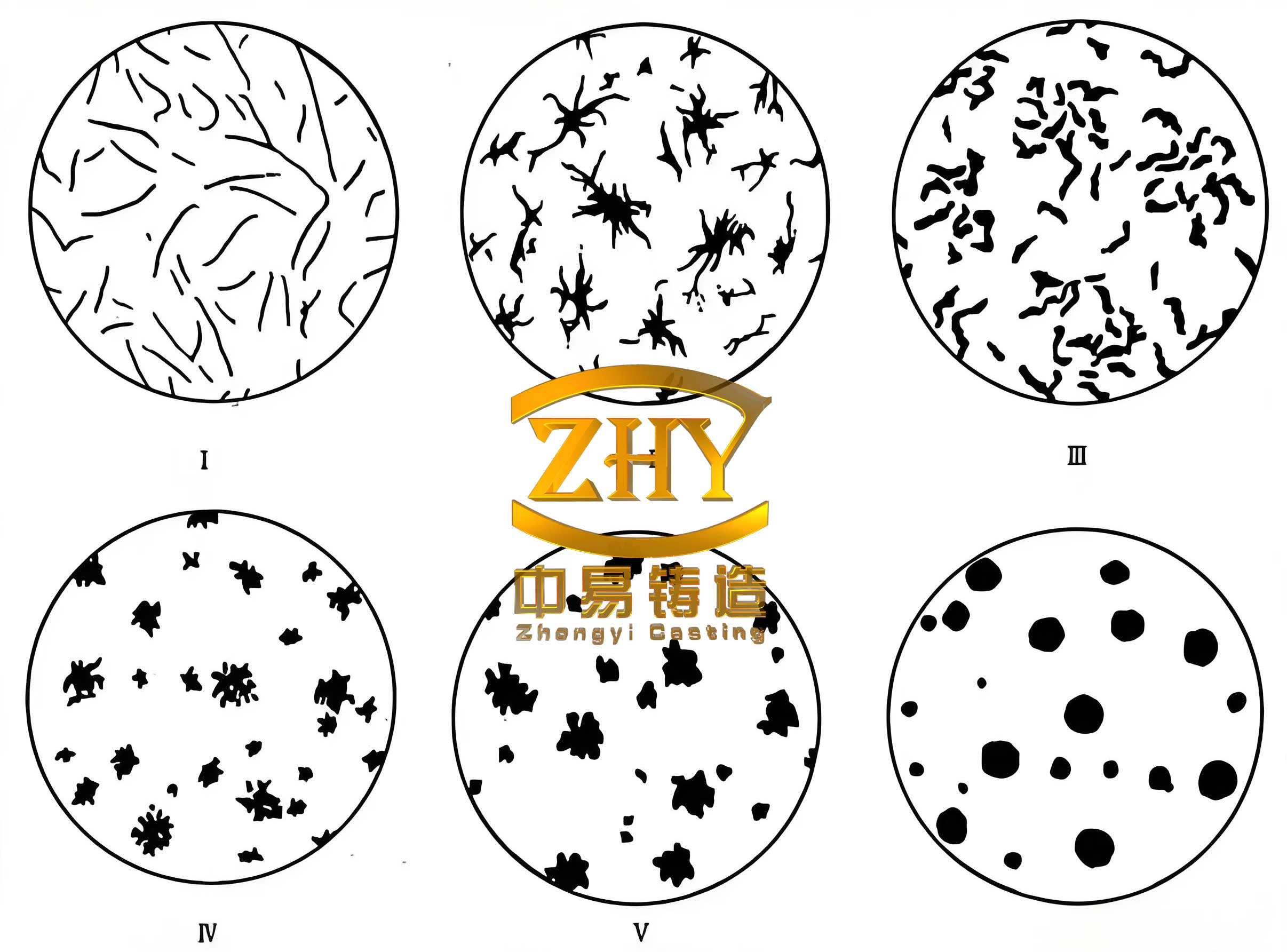
The image underscores the homogeneity required for optimal performance of spheroidal graphite cast iron in cryogenic environments. In my analysis, I also noted that irregular graphite morphologies, such as those with sharp edges, served as stress concentrators, initiating cracks at lower strains. This was particularly evident at temperatures below -80°C, where the impact energy declined. To quantify the effect of graphite shape, I introduced a sphericity index, S, defined as:
$$ S = \frac{4\pi A}{P^2} $$
where A is the cross-sectional area and P is the perimeter of a graphite particle. For ideal spheroids in spheroidal graphite cast iron, S approaches 1, but deviations reduce fracture resistance. I correlated this with the crack initiation energy using a linear regression model:
$$ E_i = \beta_0 + \beta_1 S + \beta_2 T $$
where \( \beta \) coefficients are determined experimentally. This model reinforces that improving graphite nodularity is crucial for enhancing the low-temperature toughness of spheroidal graphite cast iron.
Beyond fractography, I conducted X-ray diffraction (XRD) on fracture surfaces to detect potential phase transformations. No evidence of austenite-to-martensite conversion was found, even at -196°C, confirming the stability of the austenitic matrix in this spheroidal graphite cast iron. This absence of phase change explains why the fracture remained ductile, as opposed to brittle cleavage often seen in ferritic grades. However, the plastic deformation of both graphite and matrix varied subtly with temperature, which I assessed through strain measurements. The true strain, ε, near fracture zones was calculated from displacement data:
$$ \epsilon = \ln\left(\frac{L}{L_0}\right) $$
where L and L0 are final and initial lengths, respectively. For spheroidal graphite cast iron, ε decreased gradually below -80°C, indicating reduced ductility. This ties back to the energy analysis, where lower metastable propagation energy at extreme cold reflects diminished capacity for plastic work.
To further elucidate the fracture process, I developed a finite element model simulating impact loading on spheroidal graphite cast iron. The model incorporated cohesive zone elements to represent interfaces between graphite and matrix, allowing me to track crack evolution. The simulation results matched experimental load-deflection curves, validating that the energy partitioning in spheroidal graphite cast iron is sensitive to interfacial strength. For instance, the energy dissipated during crack propagation, Emp, can be expressed as an integral of the traction-separation law:
$$ E_{mp} = \int_0^{\delta_c} \sigma(\delta) d\delta $$
where \( \sigma \) is the traction stress and \( \delta_c \) is the critical separation. In spheroidal graphite cast iron, this integral peaks when interface debonding is gradual, as observed at -80°C. Below that temperature, quicker debonding reduces Emp, aligning with the measured drop in impact energy.
In discussing applications, the implications of my findings for spheroidal graphite cast iron are profound. For LNG equipment operating at -162°C, the material’s peak toughness at -80°C suggests that design margins should account for a possible toughness reduction at lower temperatures. I recommend using spheroidal graphite cast iron with optimized graphite nodularity and alloying elements like nickel to maintain austenite stability. Additionally, residual stresses from casting must be minimized through heat treatment, as they can exacerbate crack initiation under impact. My research underscores that spheroidal graphite cast iron, while robust, requires careful engineering to ensure reliability in ultra-low temperature service.
To summarize, I have demonstrated that the impact fracture behavior of austenitic spheroidal graphite cast iron is governed by metastable crack propagation energy, which exhibits a maximum at -80°C before decreasing at colder temperatures. The ductile fracture mechanism involves microvoid nucleation at graphite spheroids, with matrix cracking playing a role in crack blunting. Through analytical models and experimental data, I have shown that improving graphite sphericity and interfacial cohesion can enhance the low-temperature performance of spheroidal graphite cast iron. Future work should explore the effects of strain rate and multiaxial loading on this material, expanding its safe usage in cryogenic engineering. Ultimately, this study contributes to a deeper understanding of spheroidal graphite cast iron, paving the way for more durable and safer infrastructure in extreme environments.
Throughout this investigation, I have emphasized the importance of spheroidal graphite cast iron in modern industry. Its versatility and toughness make it a material of choice for challenging applications, and my research aims to unlock its full potential under ultra-low temperature conditions. By integrating mechanical testing, microstructural analysis, and theoretical modeling, I have provided a comprehensive framework for assessing and improving the impact resistance of spheroidal graphite cast iron. I hope that these insights will inspire further advancements in material science and engineering, ensuring that spheroidal graphite cast iron continues to serve as a cornerstone for innovation in cryogenic technology.