
In the field of materials science, white cast iron is widely recognized for its excellent wear resistance, particularly in abrasive environments. As a researcher focused on developing cost-effective and high-performance alloys, I embarked on a study to explore the effects of titanium on manganese-based white cast iron. This work aims to enhance the mechanical properties and abrasion resistance of white cast iron by alloying with titanium, leveraging its grain-refining capabilities and the formation of hard titanium carbides. The motivation stems from the need to overcome limitations in traditional manganese white cast iron, such as coarse microstructure and susceptibility to cracking, which can degrade performance. Through systematic experimentation, I investigated how varying titanium content influences the microstructure, hardness, impact toughness, and wear behavior of white cast iron, with a focus on optimizing composition and heat treatment for industrial applications.
The foundation of this study lies in understanding the role of carbon and alloying elements in white cast iron. Carbon is a primary element that determines the volume fraction of carbides; to ensure adequate impact toughness, the carbide content should be kept below 30%, corresponding to a carbon content of approximately 3.2% or less. Manganese, at a fixed level of 2.0%, is added to stabilize austenite and form (Fe, Mn)₃C carbides, but excessive manganese can lead to coarse austenite dendrites and increased shrinkage. Titanium, with its strong affinity for carbon and nitrogen, promotes the formation of TiC and TiN compounds, which are known to refine grains and improve wear resistance. In this work, I varied titanium content from 0% to 2.5% to assess its effects, while maintaining other elements constant. The chemical composition of the white cast iron samples is summarized in Table 1, highlighting the key alloying components.
| Element | Content Range (%) | Fixed Value (%) |
|---|---|---|
| Carbon (C) | 3.1 | 3.1 |
| Silicon (Si) | 0.8 | 0.8 |
| Manganese (Mn) | 2.0 | 2.0 |
| Phosphorus (P) | ≤ 0.07 | ≤ 0.07 |
| Sulfur (S) | ≤ 0.10 | ≤ 0.10 |
| Titanium (Ti) | 0 – 2.5 | Varied |
The preparation of white cast iron samples involved melting in a 10 kg medium-frequency induction furnace, using raw materials such as pig iron, carbon steel, ferromanganese, and ferrotitanium. The molten metal was poured at 1420°C into resin-bonded sand molds to produce cast specimens. Some of these white cast iron samples were subsequently subjected to normalizing heat treatment at 920°C for 1.5 hours, followed by air cooling, to evaluate the effects of thermal processing. Mechanical testing included impact toughness measurements using Charpy-type specimens (110 mm × 20 mm × 20 mm) with a 70 mm span, and hardness testing on Rockwell C scale. Microstructural analysis was performed on etched sections using optical and scanning electron microscopy, complemented by energy-dispersive spectroscopy (EDS) to identify phases. Abrasion resistance was assessed via dry sand rubber wheel tests, with quartz sand of 0.425–0.212 mm particle size as the abrasive medium; wear loss was measured using a high-precision balance, and abrasion resistance ε was calculated as the ratio of weight loss for titanium-containing samples to that of a titanium-free white cast iron reference. This comprehensive approach allowed me to correlate titanium content with performance metrics in white cast iron.
My investigation revealed that titanium primarily exists in the form of TiC within the microstructure of white cast iron. EDS analysis indicated minimal solid solubility of titanium in austenite and cementite, with values around 0.008% and 0.003%, respectively. Due to the high carbon content in white cast iron, titanium preferentially reacts with carbon to form TiC, which can incorporate nitrogen as Ti(C, N) compounds. As titanium content increased from 0.16% to 2.43%, the quantity, size, and morphology of TiC particles evolved significantly. Initially, TiC appeared as simple polygonal shapes, but with higher titanium levels, they transformed into irregular polygons and chain-like structures, often surrounded by dark inclusions rich in titanium oxides or complex compounds. This is illustrated in the microstructural observations, where TiC distribution shifted from within austenite dendrites to more frequent locations at dendrite boundaries and inter-dendritic regions. The presence of these hard phases is crucial for enhancing the wear resistance of white cast iron.
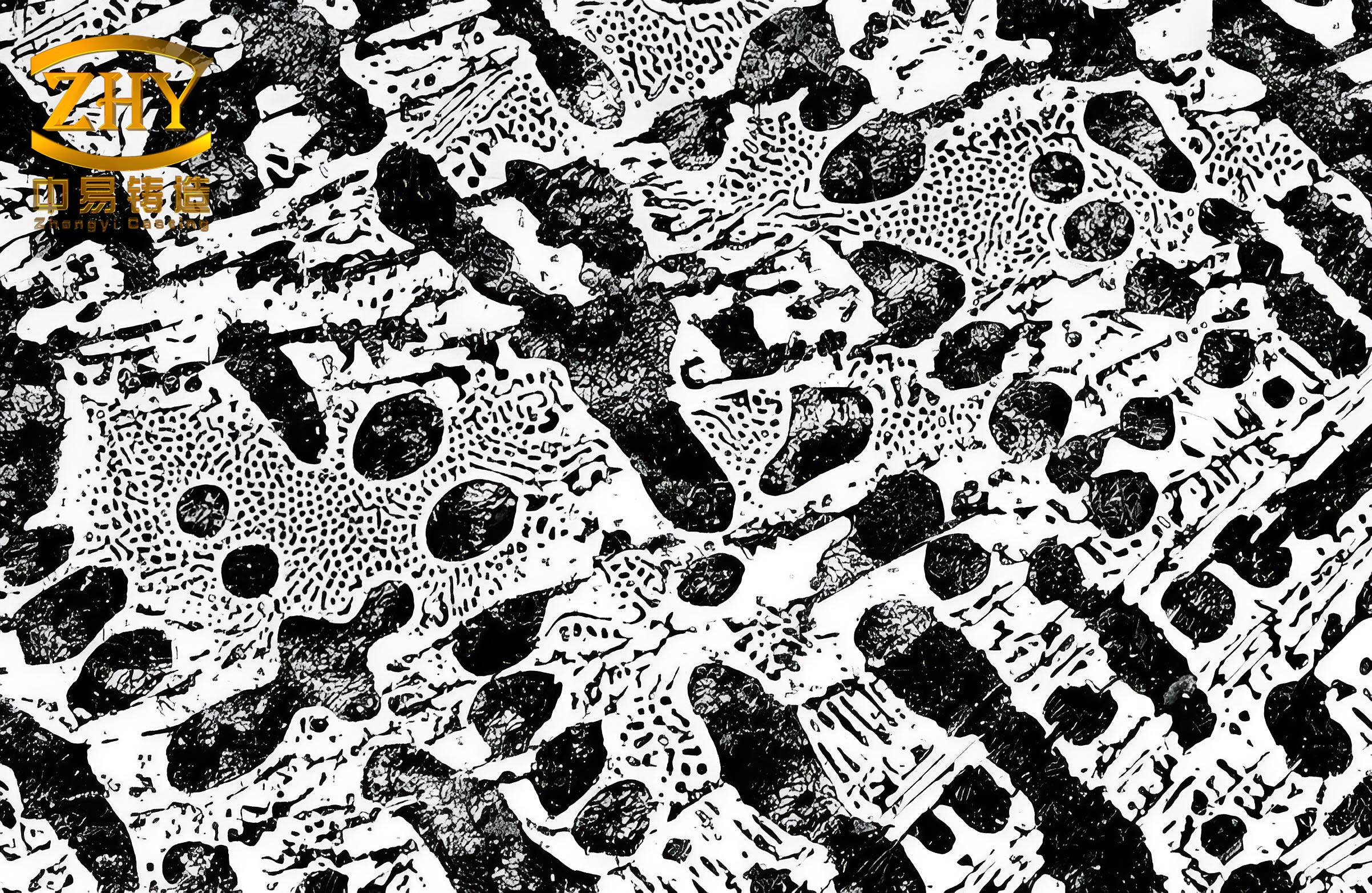
Titanium exerted a profound influence on the austenite dendrites and cementite network in white cast iron. In the base composition without titanium, the microstructure exhibited coarse austenite dendrites with a directional growth pattern, accompanied by a continuous network of cementite in the ledeburite eutectic. With titanium addition, I observed a refinement of austenite dendrites, as quantified by the secondary dendrite arm spacing (DAS). For instance, at 1.33% titanium, the DAS decreased by approximately 12%, indicating effective grain refinement. This can be modeled using a relationship for grain size reduction: $$ DAS = D_0 – k \cdot [Ti] $$ where \( D_0 \) is the initial DAS, \( k \) is a constant, and [Ti] is the titanium content. Concurrently, the cementite morphology changed from a continuous network to a broken or isolated configuration, characterized by an increased shape factor Q. The shape factor Q, defined as the ratio of perimeter to area for cementite particles, rose with titanium content, suggesting greater fragmentation and spheroidization. Table 2 summarizes these microstructural changes, demonstrating how titanium promotes a more favorable microstructure in white cast iron.
| Titanium Content (%) | Austenite DAS (μm) | Cementite Shape Factor Q | TiC Morphology |
|---|---|---|---|
| 0.00 | 24.0 | 1.821 | None |
| 0.16 | 23.5 | 1.890 | Simple polygons |
| 0.28 | 22.8 | 1.940 | Polygons, dispersed |
| 0.61 | 22.0 | 1.960 | Irregular shapes |
| 1.33 | 21.3 | 1.967 | Chain-like, coarse |
| 2.43 | 20.5 | 1.980 | Complex, with inclusions |
The refinement mechanism in white cast iron can be attributed to the high melting point of TiC (3180°C) and its low standard free energy of formation, allowing it to precipitate early in the melt. TiC particles act as nucleation sites for austenite due to crystallographic matching: the lattice constants are 4.32 × 10⁻⁸ cm for TiC and 3.63 × 10⁻⁸ cm for γ-Fe (austenite), with an atomic spacing mismatch of only 1.83% for specific orientations. This promotes heterogeneous nucleation, leading to finer austenite grains and more equiaxed structures. Additionally, the increased volume of primary austenite isolates the eutectic melt, resulting in divorced eutectic formation and broken cementite networks. These microstructural modifications are essential for improving the mechanical properties of white cast iron.
In terms of mechanical properties, titanium addition significantly affected the hardness and impact toughness of white cast iron. As shown in Table 3, the hardness decreased monotonically with increasing titanium content in the as-cast condition, from 46.9 HRC at 0% titanium to 43.1 HRC at 1.60% titanium. This decline is primarily due to the reduction in carbon available for carbide formation and the increased proportion of softer austenite, despite the presence of hard TiC particles. The impact toughness, however, exhibited a peak at 0.28% titanium, with a value of 3.5 J/cm², representing a 40–50% improvement over titanium-free white cast iron. This enhancement stems from grain refinement and cementite fragmentation, which reduce stress concentrations and crack propagation. Beyond 0.28% titanium, toughness decreased due to the embrittling effect of coarse TiC particles and inclusions at phase boundaries. After normalizing heat treatment, both hardness and impact toughness improved across all compositions, as the treatment transformed austenite to martensite and further spheroidized cementite. For example, at 0.28% titanium, normalized white cast iron achieved 49.1 HRC and 4.1 J/cm² impact toughness, highlighting the synergistic effect of titanium and heat treatment.
| Titanium Content (%) | As-Cast Hardness (HRC) | Normalized Hardness (HRC) | As-Cast Impact Toughness (J/cm²) | Normalized Impact Toughness (J/cm²) |
|---|---|---|---|---|
| 0.00 | 46.9 | 50.0 | 2.4 | 3.2 |
| 0.16 | 45.1 | 49.5 | 2.8 | 3.7 |
| 0.28 | 44.2 | 49.1 | 3.5 | 4.1 |
| 0.61 | 44.2 | 49.2 | 3.3 | 3.9 |
| 0.99 | 44.0 | 48.5 | 3.1 | 3.8 |
| 1.33 | 43.2 | 47.2 | 2.9 | 3.8 |
| 1.60 | 43.1 | 46.7 | 2.3 | 2.7 |
The relationship between hardness and titanium content can be expressed using a linear approximation: $$ HRC = H_0 – \alpha \cdot [Ti] $$ where \( H_0 \) is the base hardness, \( \alpha \) is a coefficient, and [Ti] is the titanium concentration. For impact toughness, a parabolic model fits the data: $$ A_k = A_0 + \beta \cdot [Ti] – \gamma \cdot [Ti]^2 $$ with \( A_0 \), \( \beta \), and \( \gamma \) as constants. These equations help predict property trends in titanium-modified white cast iron.
Abrasion resistance is a critical performance metric for white cast iron, especially in mining and machinery applications. My wear tests revealed that titanium addition generally improved the abrasion resistance of white cast iron, but the effect depended on titanium content and heat treatment. In the as-cast condition, abrasion resistance ε (where lower ε indicates better resistance) showed a parabolic trend, with an optimal range at 0.28–0.61% titanium, where ε decreased by up to 30% compared to titanium-free white cast iron. After normalizing, abrasion resistance improved further and increased monotonically with titanium content, as shown in Table 4. This behavior can be explained by the interplay between TiC particles and the matrix. TiC has a hardness of HV 2600–3100, much higher than quartz abrasive (HV 900–1280) and cementite (HV 920–1100), providing effective resistance to micro-cutting. However, in as-cast white cast iron, the softer pearlitic matrix wears preferentially, exposing TiC particles that may detach under stress, creating pits that accelerate wear. Normalizing transforms the matrix to a harder mixture of martensite, retained austenite, and sorbitte, with retained austenite undergoing work-hardening to HV 623 during wear, thereby protecting TiC particles and enhancing overall abrasion resistance.
| Titanium Content (%) | As-Cast Abrasion Resistance ε | Normalized Abrasion Resistance ε | Improvement Over Base (%) |
|---|---|---|---|
| 0.00 | 1.00 | 1.00 | 0 |
| 0.16 | 0.85 | 0.78 | 22 |
| 0.28 | 0.70 | 0.65 | 35 |
| 0.61 | 0.72 | 0.68 | 32 |
| 0.99 | 0.80 | 0.72 | 28 |
| 1.33 | 0.85 | 0.75 | 25 |
| 1.60 | 0.90 | 0.80 | 20 |
The wear mechanism in white cast iron involves abrasive particles plowing the surface, forming grooves as observed in SEM images. The effectiveness of TiC in resisting this process can be modeled using a wear rate equation: $$ W = K \cdot \frac{H_m^{-1} \cdot f_c}{H_c} $$ where \( W \) is the wear rate, \( K \) is a constant, \( H_m \) is the matrix hardness, \( f_c \) is the volume fraction of carbides, and \( H_c \) is the carbide hardness. For titanium-containing white cast iron, the high \( H_c \) of TiC reduces \( W \), but only if the matrix is sufficiently hard to retain the particles. Normalizing optimizes this balance, making white cast iron more durable.
Further analysis of the microstructure-property relationships in white cast iron reveals the importance of phase distribution. I used quantitative microscopy to estimate the volume fraction of TiC, which increases with titanium content according to: $$ V_{TiC} = \rho \cdot [Ti] \cdot \frac{M_{C}}{M_{Ti}} $$ where \( \rho \) is a factor accounting for reaction efficiency, \( M_C \) and \( M_{Ti} \) are the atomic weights of carbon and titanium. At 0.28% titanium, \( V_{TiC} \) is approximately 1.2%, sufficient for grain refinement without excessive embrittlement. The aspect ratio of cementite, another key parameter, decreases with titanium addition, promoting toughness. These insights are vital for designing white cast iron alloys for specific applications.
In discussing the broader implications, titanium-modified white cast iron offers a promising alternative to conventional high-chromium white cast irons, especially in cost-sensitive industries. The addition of titanium not only refines the microstructure but also introduces hard phases that enhance wear resistance. However, excessive titanium (above 1.6%) leads to detrimental inclusions and property degradation, underscoring the need for precise control. Normalizing heat treatment is a practical method to further improve performance, making this white cast iron suitable for components like grinding balls, liners, and crusher parts. Future work could explore synergistic effects with other elements like boron or vanadium to optimize white cast iron for extreme conditions.
To conclude, my investigation demonstrates that titanium significantly influences the microstructure and properties of manganese-based white cast iron. At an optimal titanium content of 0.28%, white cast iron achieves the best combination of mechanical properties and abrasion resistance, with impact toughness improved by 40–50% and wear resistance enhanced by up to 35% in the normalized condition. The refinement of austenite dendrites, fragmentation of cementite, and formation of TiC contribute to these benefits. Normalizing further boosts hardness and toughness through phase transformations. This study provides a foundation for developing advanced white cast iron alloys, emphasizing the role of titanium as a versatile alloying element. For industrial applications, white cast iron with 0.28% titanium and normalizing treatment is recommended to balance performance and cost, offering a durable solution for abrasive environments.
In summary, the key findings on white cast iron are: titanium promotes TiC formation, refines grains, and improves toughness and wear resistance, with 0.28% titanium being optimal. These results highlight the potential of titanium-alloyed white cast iron in extending service life and reducing maintenance costs. As research progresses, continuous optimization of composition and processing will unlock new possibilities for white cast iron in demanding engineering contexts.