
In my recent project, I was tasked with developing a successful production process for a large flange casting with a mass of 15.5 kg. This component had initially been developed by another foundry, but was transferred to us due to persistent issues with shrinkage porosity and surface quality. The challenges presented by this part provided a comprehensive test of our ability to apply and refine the investment casting process for substantial steel components.
The intrinsic advantages of the investment casting process, including its high dimensional accuracy, excellent surface finish, design flexibility for complex geometries, and applicability to virtually any alloy, made it the ideal choice for this part. However, these advantages can only be fully realized through meticulous process design and control, especially for parts with significant thermal mass.
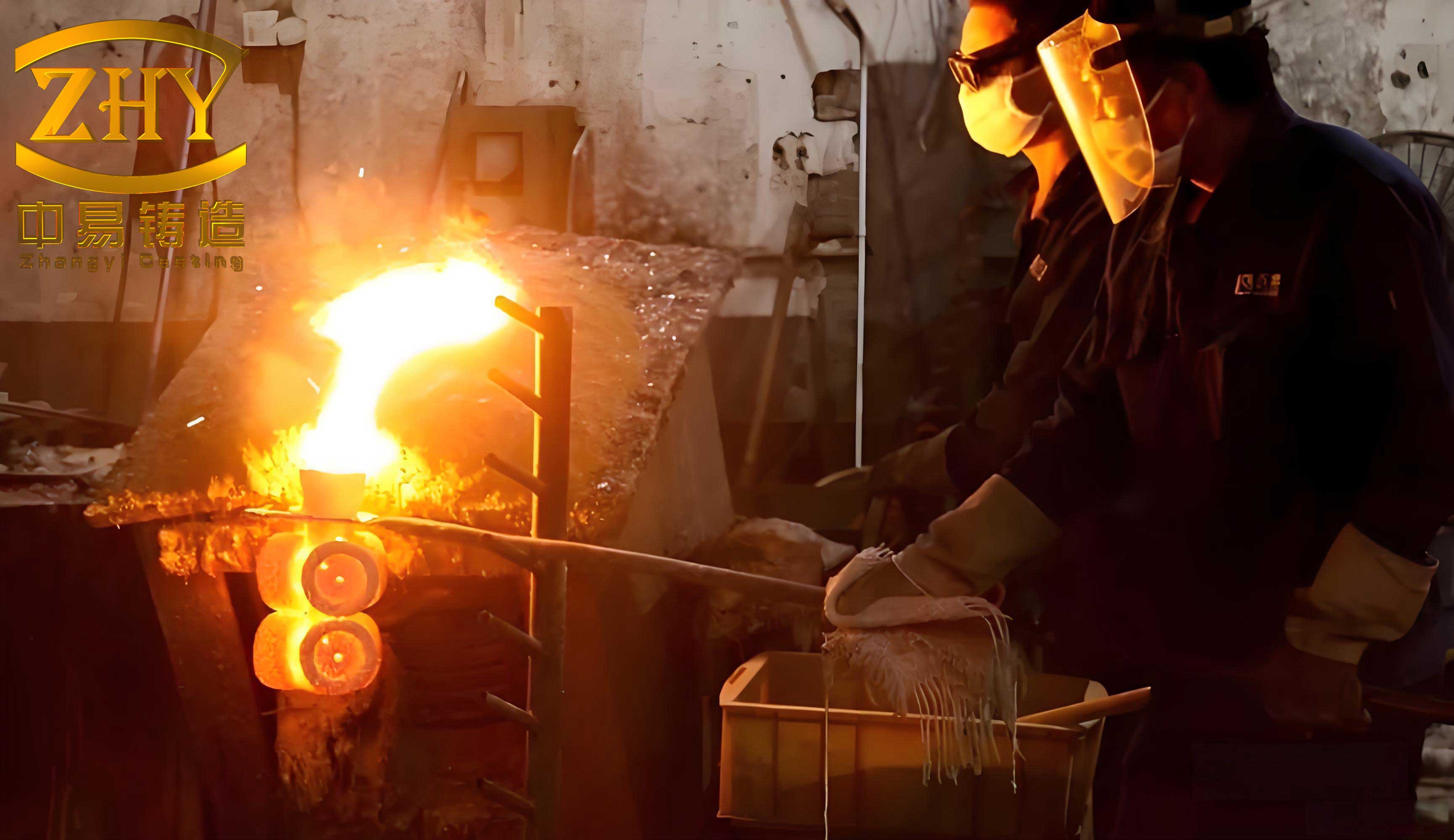
Challenge 1: Eliminating Shrinkage Porosity
The primary and most critical defect in the initial castings was shrinkage porosity. A detailed analysis of the rejected parts pinpointed the location exclusively to the interior walls of a side hole feature. The root cause was a classic thermal issue inherent to the geometry and the investment casting process.
Root Cause Analysis
During shell building, the intricate side hole becomes completely blocked by ceramic material. This creates an insulated thermal mass, or “hot spot,” within the mold. When molten steel is poured, the thick side wall combined with this insulated ceramic core leads to delayed solidification in that zone. According to the fundamental principle of solidification shrinkage, this area is the last to freeze and, without adequate liquid metal supply, will develop shrinkage porosity or cavities. The governing relationship for solidification time is given by Chvorinov’s rule:
$$ t = B \left( \frac{V}{A} \right)^n $$
Where \( t \) is the solidification time, \( V \) is the volume of the casting section, \( A \) is its surface area, \( n \) is an exponent (typically ~2), and \( B \) is a mold constant. A high \( V/A \) ratio (modulus) indicates a slower cooling rate. The blocked side hole drastically reduces the effective cooling area \( A \), increasing the local modulus and solidification time \( t \), thereby creating a severe hot spot.
| Feature | Problem | Thermal Consequence |
|---|---|---|
| Side Hole Wall Thickness | Substantial metal volume | High \( V \) |
| Blocked Hole after Shelling | Ceramic insulation | Dramatically reduced effective \( A \) |
| Combined Effect | Large, isolated hot spot | Very high local \( V/A \) ratio, leading to last-point solidification and shrinkage risk. |
Gating System Design Strategy
The strategy to overcome this was to enforce directional solidification, starting from the hot spot (side hole) back towards the feeder (riser). This requires placing the gate and riser as close as possible to the problematic area to establish an efficient thermal gradient. The flange had two potential gating faces, A and B. Face A, with its larger cross-section, was selected. A larger connection area facilitates better heat transfer from the riser and provides a more robust feeding channel. The gating system was designed with a central down sprue feeding a horizontal runner connected to a single, large top riser placed directly over the gate on Face A.
| Design Element | Purpose in Investment Casting Process |
|---|---|
| Gate Location on Face A | Proximity to hot spot for efficient thermal gradient. |
| Large Top Riser | Acts as a liquid metal reservoir to feed shrinkage. |
| Direct Riser-to-Gate Connection | Creates a short, open path for feeding. |
Integrated Solutions for Sequential Solidification
Merely placing a riser nearby is often insufficient. A multi-faceted approach was implemented to actively slow the cooling of the feeding system relative to the casting hot spot, thereby extending its feeding range and efficiency.
1. Increasing Feed Metal Flow Area: The connection between the gate and the riser was modified by adding a generous fillet using patching wax during wax assembly. This increases the cross-sectional area at this critical junction, reducing fluid flow resistance and effectively allowing more liquid metal to pass from the riser to the casting per unit time during the critical feeding stage. The flow rate \( Q \) can be approximated by:
$$ Q \propto \frac{A_c \cdot \Delta P}{\mu \cdot L} $$
Where \( A_c \) is the cross-sectional area of the feeding channel, \( \Delta P \) is the pressure differential (e.g., metallostatic pressure), \( \mu \) is the viscosity, and \( L \) is the channel length. Increasing \( A_c \) directly increases \( Q \), improving feeding capability.
2. Insulating the Feeding Channel: To prevent the connecting channel between the riser and the hot spot from freezing prematurely, ceramic fiber insulation was wrapped around the corresponding section of the ceramic shell just before pouring. This practice in the investment casting process is crucial for maintaining the “feeding path” open. The heat loss \( \dot{q} \) through the shell wall can be modeled as:
$$ \dot{q} = \frac{k \cdot A \cdot (T_m – T_a)}{d} $$
Where \( k \) is the thermal conductivity of the shell, \( A \) is the surface area, \( T_m \) is the metal temperature, \( T_a \) is ambient temperature, and \( d \) is the shell thickness. Adding insulation significantly increases the effective thermal resistance (increases effective \( d \) for the insulation layer), thereby reducing \( \dot{q} \) and preserving liquid metal in the channel.
3. Enhancing Riser Efficiency: The entire riser and pour cup were wrapped in ceramic fiber blankets. This drastically reduces radiative and convective heat loss to the environment, causing the riser to solidify last. The efficiency \( \eta \) of a riser is defined as the percentage of its volume available to feed the casting:
$$ \eta = \frac{V_{feed}}{V_{riser}} \times 100\% $$
Insulation increases \( \eta \) by minimizing the volume of riser metal used to create its own shrinkage cavity, leaving more for the casting. Furthermore, exothermic compound was sprinkled on top of the metal in the pour cup immediately after pouring. This reaction generates heat, counteracting heat loss from the exposed metal surface and further prolonging the liquid state of the metal in the riser.
4. Optimizing Pouring Temperature: For a heavy casting like this flange, a lower pouring temperature within the acceptable range for CF8M stainless steel (1580°C ± 10°C) was selected. A lower superheat reduces the total heat content that must be extracted, shrinks the size of the thermal field around the hot spot, and can accelerate the overall solidification rate, making the thermal gradient easier to control. The relationship for total heat content \( H \) is:
$$ H = m \left[ C_s (T_p – T_l) + L_f + C_l (T_l – T_s) \right] $$
Where \( m \) is mass, \( C_s \) and \( C_l \) are specific heats of solid and liquid, \( T_p \) is pour temperature, \( T_l \) is liquidus, \( T_s \) is solidus, and \( L_f \) is latent heat of fusion. Lowering \( T_p \) directly reduces \( H \).
| Solution | Mechanism of Action | Key Parameter Affected |
|---|---|---|
| Gate/Riser Fillet | Increases feed metal flow rate | Increases cross-sectional area \( A_c \) |
| Channel Insulation | Preserves liquid in feeding path | Reduces heat loss rate \( \dot{q} \) |
| Riser Insulation & Exothermics | Maximizes liquid reservoir duration | Increases riser efficiency \( \eta \) |
| Lower Pour Temperature | Reduces total thermal load | Lowers total heat content \( H \) |
Challenge 2: Ensuring Superior Surface Quality
With numerous non-machined surfaces, achieving excellent as-cast finish was paramount. Control over surface quality in the investment casting process must be exercised at every stage, from pattern to final cleaning.
Wax Pattern Quality Control
The surface of the wax pattern is a direct replica of the final casting surface. Therefore, its quality is foundational.
- Minimizing Repair: Common wax defects like flow lines, short shots, or bubbles were addressed primarily by optimizing injection parameters (pressure, temperature, time) rather than extensive surface repair with soft wax, which can increase local roughness.
- Preventing Dents: Sink marks or dents occur in thick sections of wax as it cools and shrinks. For sections thicker than 5 mm, conformal cooling wax blocks (chills) were inserted into the die cavity during wax injection. These blocks absorb heat rapidly, promoting uniform cooling and solidification of the thick wax section, thus preventing depression. The cooling rate is governed by Fourier’s law, and the chill acts as a heat sink.
- Edge Preparation: Sharp corners on the wax pattern are vulnerable to becoming rolled edges during shell handling, knockout, or shot blasting. All such sharp external edges were deliberately rounded during wax finishing.
Shell Building and Dewaxing Control
The ceramic shell must reproduce the wax pattern’s detail without introducing new defects.
- Managing Surface Details: Areas with fine lettering or sharp recesses can trap air during slurry dipping. To prevent resulting “metal fins” on the casting, these areas were dipped slowly and at an angle, and compressed air was used during slurry drainage to ensure complete coating.
- Preventing Fins (Flash): Fins are caused by metal penetrating cracks in the shell. Prevention requires a robust shell and controlled dewaxing.
- Shell Thickness: The shell was built to 7.5 layers of ceramic, compared to a standard 4.5 layers for smaller castings, significantly increasing its mechanical strength to withstand metallostatic pressure and thermal stress. The hoop stress \( \sigma \) in a cylindrical shell under pressure is: $$ \sigma = \frac{P \cdot r}{t} $$ where \( P \) is pressure, \( r \) is radius, and \( t \) is thickness. Increasing \( t \) reduces \( \sigma \).
- Dewaxing: Controlled autoclave dewaxing per strict parameters was followed. Crucially, additional wax vents (sprues) were attached to the main riser (not the casting) to provide extra escape paths for molten wax, preventing shell crack-inducing pressure build-up.
Melting, Pouring, and Finishing Control
The final stages of the investment casting process have a direct impact on surface integrity.
| Process Stage | Control Action | Benefit for Surface Quality |
|---|---|---|
| Melting (CF8M Steel) | Multiple slag removals and extended high-temperature holding time. | Promotes flotation and removal of non-metallic inclusions that can cause surface pits. |
| Pouring | Controlled, moderate pour rate to achieve laminar fill. | Minimizes turbulence, which can entrap mold gases or oxides, leading to surface defects. |
| Shell Removal & Finishing | Combination of mechanical vibration (for bulk removal) and targeted shot blasting (for residual ceramic). Careful handling throughout. | Prevents mechanical damage (nicks, dents) to the delicate as-cast surface, reducing repair work. |
Conclusion and Results
By systematically addressing the root causes of shrinkage through a thermally engineered gating and feeding strategy, and by enforcing stringent quality controls across the entire investment casting process chain, the development of the 15.5 kg flange was successfully completed. The integrated approach of enhancing feeding efficiency and controlling solidification dynamics resolved the porosity issue. Concurrently, the focus on precision at every step—from pattern making to final cleaning—delivered the required high surface finish on the non-machined areas.
This project underscores that the successful application of the investment casting process for large, sound-critical components is not merely about replicating a shape, but about actively managing the solidification event and the production ecosystem. The process was validated through a pilot run of 100 castings, achieving a final product yield of 96%, which signified full approval from the customer and marked a successful resolution of the challenges that had halted initial production elsewhere.