
In the pursuit of enhanced engine power, reduced size, and controlled emissions, turbocharging technology has become indispensable in the automotive industry. At the heart of this technology lies the turbocharger turbine wheel, a critical component subjected to extreme thermal and mechanical stresses. To improve efficiency and reduce turbo lag, these turbines are designed with intricate geometries—featuring thin, highly curved blades and a substantially thicker central hub. This significant variation in cross-section presents a formidable challenge during manufacturing, particularly making them highly susceptible to the formation of hot tears, a catastrophic solidification cracking defect. The investment casting process is the preferred method for producing these complex superalloy components, but controlling hot tearing requires a deep understanding of the thermal and mechanical events during solidification. This article presents a comprehensive numerical analysis of the investment casting process for an IN713C nickel-based superalloy automotive turbine, focusing on predicting and mitigating hot tearing through simulation.
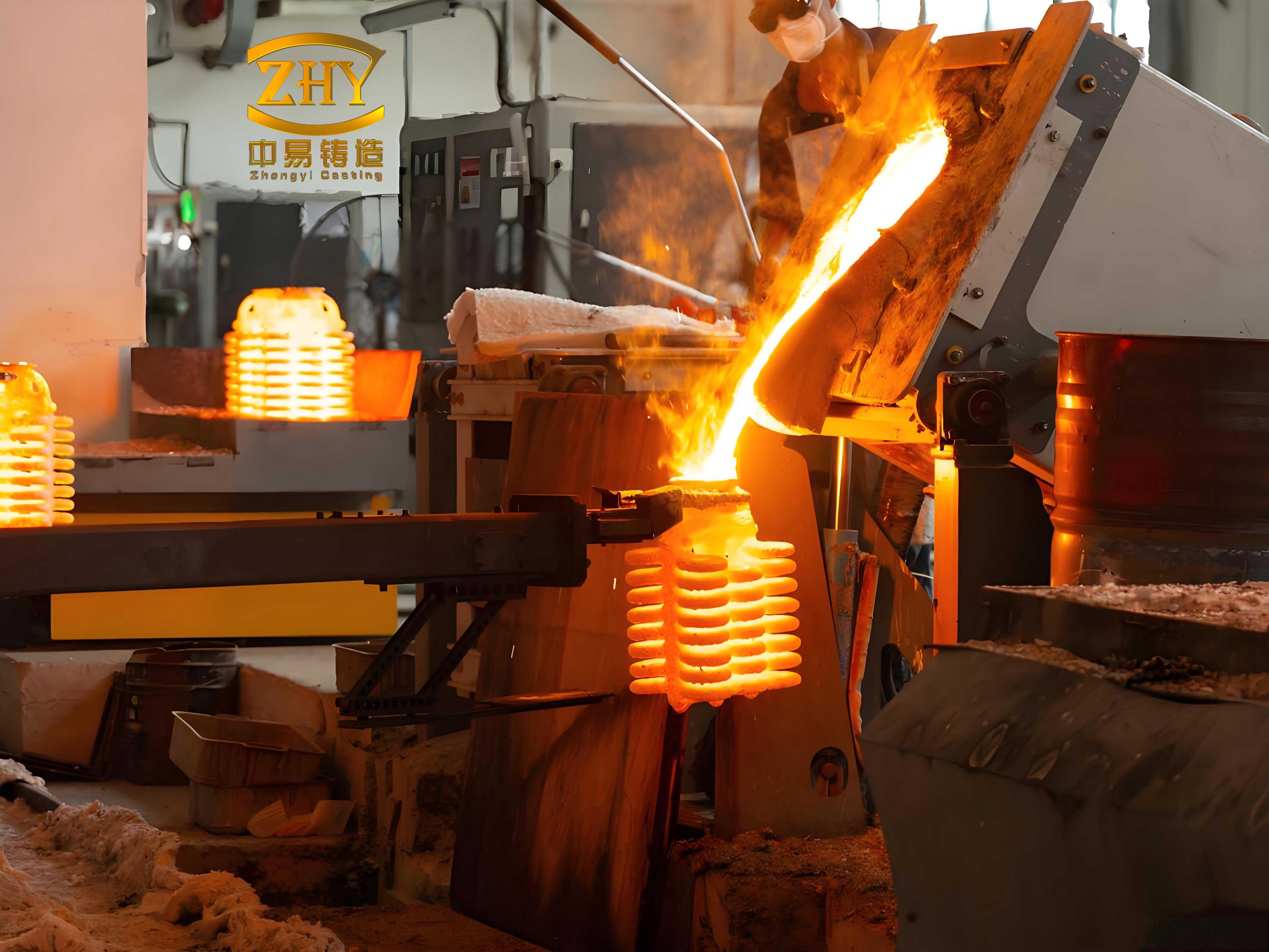
The investment casting process, also known as the lost-wax process, is ideal for producing net-shape components with excellent surface finish and complex geometries. It involves creating a wax pattern of the desired part, assembling it onto a wax gating system, repeatedly dipping the assembly in ceramic slurry to build a shell, dewaxing, firing the ceramic mold, and finally pouring molten metal. For high-performance components like turbocharger wheels, the process parameters within this sequence—such as pouring temperature, mold preheat temperature, and gating design—are critical in determining the final quality of the casting.
To analyze the complex interplay of fluid flow, heat transfer, and stress development, numerical simulation has become an essential tool. In this study, the commercial finite element software ProCAST was employed to simulate the entire investment casting process for a typical automotive turbine. The turbine geometry consists of a central hub and ten aerodynamically curved blades, with a height of approximately 60 mm, a maximum diameter of 86 mm, and a blade thickness of only about 0.7 mm, contrasting sharply with the ~28 mm thick shaft. A gating system with one sprue, a pour cup, and three ingates was designed to cast three turbines simultaneously, with the turbine axis angled at 130° to the sprue centerline.
Constitutive and Hot Tearing Models for Simulation
Accurate stress simulation is paramount for predicting hot tearing. This analysis utilizes a thermo-elastoplastic material model. In this model, the material behaves elastically until the stress reaches the yield point, after which plastic deformation occurs. The relationship between stress and elastic strain is governed by Hooke’s Law:
$$ \{ d\sigma \} = [ D_e ] \{ d\varepsilon^e \} $$
where $\{ d\sigma \}$ is the increment of stress, $[ D_e ]$ is the elastic modulus matrix, and $\{ d\varepsilon^e \}$ is the increment of elastic strain. The total strain increment is the sum of elastic, plastic, and thermal components:
$$ \{ d\varepsilon \} = \{ d\varepsilon^e \} + \{ d\varepsilon^p \} + \{ d\varepsilon^T \} $$
where the superscripts $p$ and $T$ denote plastic and thermal, respectively. The stress increment in the elastoplastic regime is then calculated as:
$$ \{ d\sigma \} = [ D_{ep} ] ( \{ d\varepsilon \} – \{ d\varepsilon^p \} – \{ d\varepsilon^T \} ) $$
where $[ D_{ep} ]$ is the elastoplastic modulus matrix. For the simulation, material properties such as temperature-dependent Young’s modulus, Poisson’s ratio, thermal expansion coefficient, yield strength, and a linear hardening rule defined by $\sigma = \sigma_0 + H\varepsilon_{pl}$ (where $\sigma_0$ is yield stress and $H$ is the plastic modulus) are required inputs.
Hot tearing occurs in the late stages of solidification when the semi-solid material has limited strength and ductility. To quantitatively predict its likelihood, the Hot Tearing Indicator (HTI) model is used. This model calculates the accumulated plastic strain rate within the vulnerable temperature range (often between coherency and solidus):
$$ HTI = \int_{t_{coh}}^{t_s} \sqrt{ \frac{2}{3} \dot{\boldsymbol{\varepsilon}}^p : \dot{\boldsymbol{\varepsilon}}^p } \, d\tau $$
where $\dot{\boldsymbol{\varepsilon}}^p$ is the plastic strain rate tensor, $t_{coh}$ is the time at coherency (when grains begin to touch), and $t_s$ is the time at the solidus temperature. A higher HTI value at a location indicates a greater susceptibility to hot tearing.
Material Properties and Simulation Parameters for IN713C
The material under investigation is IN713C, a precipitation-strengthened nickel-based superalloy widely used for turbocharger wheels due to its excellent high-temperature strength, oxidation resistance, and fatigue performance. Its microstructure in the as-cast state consists of a γ matrix reinforced by γ’ precipitates (Ni3(Al, Ti)), with minor amounts of carbides and borides. The chemical composition is provided in the table below.
| Element | Weight % |
|---|---|
| Ni | Balance |
| Cr | 13.0 |
| Al | 6.0 |
| Mo | 4.2 |
| Nb+Ta | 2.3 |
| Ti | 0.6 |
| C | 0.12 |
| Fe | ≤1.8 |
| Si | 0.4 |
| Mn | 0.23 |
| Co | ≤1.0 |
| B | 0.01 |
| Zr | 0.1 |
The thermophysical properties of IN713C, including enthalpy, solid fraction, thermal conductivity, and density as functions of temperature, were calculated using the Scheil-Gulliver model and integrated into the simulation. Key solidification parameters are a liquidus temperature of 1345°C and a solidus temperature of 1196°C. The alloy was modeled as an elastoplastic material, while the ceramic shell was treated as a rigid body. The heat transfer coefficient at the metal-mold interface was set to 900 W/(m²·K).
A parametric study was designed to evaluate the influence of key investment casting process parameters on hot tearing. The baseline and varied parameters are summarized below.
| Process Parameter | Values Investigated |
|---|---|
| Pouring Temperature | 1400°C, 1450°C, 1500°C, 1550°C |
| Mold (Shell) Preheat Temperature | 800°C, 850°C, 900°C |
| Alloy Material Model | Thermo-Elastoplastic |
| Shell Material Model | Rigid |
Simulation Results: Filling, Solidification, and Stress Evolution
The simulation of the filling phase for the baseline case (1450°C pour, 850°C mold) showed a rapid and complete filling sequence within approximately 1 second, driven by the relatively large cross-section of the gating system and the small size of the castings. The analysis then focused on the more critical solidification and cooling phases. The temperature field at an intermediate time revealed a steep thermal gradient, with the thin blade tips cooling significantly faster than the massive hub. Consequently, solidification initiated and completed at the blade edges long before the hub center began to solidify. This differential cooling and the associated constrained contraction are the primary drivers for the development of thermal stress.
The stress distribution and HTI map at a time when the blades are nearly solidified clearly identified the regions of highest risk. Maximum tensile stress and elevated HTI values were concentrated precisely at the thin, curved edges of the turbine blades. This is a direct consequence of the geometry: the blades, constrained by the much hotter and still-molten or mushy hub, cannot contract freely. The stress builds up in these thin sections while their mechanical strength in the semi-solid state is minimal. This simulation prediction was validated against an actual casting, which exhibited hot tear cracks in the exact locations highlighted by the model—the periphery of the blades.
Parametric Analysis of Hot Tearing Susceptibility
To quantify the effect of investment casting process parameters, a specific point ‘A’ at a critical blade edge location was monitored for thermal stress and HTI under all simulated conditions.
Effect of Pouring Temperature
With the mold preheat temperature held constant at 800°C, the influence of pouring temperature was investigated. The results revealed a non-monotonic relationship between pouring temperature and hot tearing tendency.
- Thermal Stress: Increasing the pouring temperature from 1400°C to 1550°C led to a consistent decrease in the peak thermal stress at point A. Higher superheat reduces the thermal gradient between the casting and the mold initially, leading to slower initial cooling and lower thermally induced strains.
- Hot Tearing Indicator (HTI): Contrary to the stress trend, the HTI initially increased with pouring temperature, reaching a maximum at 1450°C, before decreasing at 1500°C and 1550°C. This behavior can be explained by two competing factors:
- Vulnerable Time Window: At lower pouring temperatures (e.g., 1400°C), solidification is rapid, shortening the time the alloy spends in the brittle temperature range (solid fraction between ~0.9 and 1.0). This reduces the time available for strain accumulation, resulting in a lower HTI despite higher stress.
- Strain Accumulation Rate: At higher pouring temperatures, the longer solidification time extends the vulnerable window. However, the associated thermal stress is significantly lower. The HTI, being an integral of strain rate over time, therefore peaks at an intermediate temperature where the product of moderate stress and a sufficiently long vulnerable time is maximized.
Effect of Mold Preheat Temperature
With the pouring temperature held constant at 1500°C, the effect of mold preheat was studied. The influence here was more straightforward.
- Thermal Stress: Increasing the mold temperature from 800°C to 900°C substantially reduced the thermal stress at point A. A hotter mold decreases the cooling rate, minimizing thermal gradients and contraction mismatch between different sections of the casting.
- Hot Tearing Indicator (HTI): The HTI decreased monotonically with increasing mold temperature. Unlike pouring temperature, a higher mold preheat simultaneously reduces stress *and* can slightly alter the solidification pattern in a beneficial way, without dramatically extending the brittle range in a harmful manner for this geometry. The dominant effect is stress reduction, leading to a lower accumulated plastic strain.
Comprehensive Process Optimization
The interplay between pouring temperature (T_pour) and mold temperature (T_mold) on the key outputs at the critical point A is synthesized in the table below. This provides a direct guide for process optimization in the investment casting process for IN713C turbines.
| T_pour [°C] / T_mold [°C] | 800°C | 850°C | 900°C | Trend & Recommendation |
|---|---|---|---|---|
| 1400°C | High Stress, Low-Mod HTI | Moderate Stress, Mod HTI | Lower Stress, Low HTI | Low T_pour requires high T_mold to control stress. |
| 1450°C | High Stress, Max HTI | Mod-High Stress, High HTI | Moderate Stress, Mod HTI | This combination should be avoided as it maximizes hot tear risk. |
| 1500°C | Moderate Stress, Mod HTI | Lower Stress, Low-Mod HTI | Low Stress, Low HTI | Optimal Zone. High T_mold (900°C) with 1500°C gives excellent results. |
| 1550°C | Low-Mod Stress, Low HTI | Low Stress, Low HTI | Low Stress, Low HTI | Very robust to T_mold variation, but excessive superheat may promote coarse grains and shrinkage. |
The following conclusions and optimized process guidelines can be drawn from this numerical analysis of the investment casting process:
- Hot Tearing Location: Numerical simulation accurately predicts that hot tearing defects in IN713C turbocharger turbines are most likely to occur at the thin, constrained edges of the blades, which was confirmed by actual casting defects.
- Parameter Influence Mechanism:
- Hot tearing susceptibility (HTI) shows a non-linear relationship with pouring temperature, initially increasing due to a longer brittle range before decreasing as thermal stresses fall.
- Increasing mold preheat temperature consistently reduces both thermal stress and HTI by slowing the cooling rate and improving thermal uniformity.
- Process Optimization: For the studied turbine geometry, an optimized investment casting process window is recommended. A combination of a pouring temperature of 1500°C and a mold preheat temperature of 900°C provides the best compromise, minimizing hot tearing tendency while avoiding the potential for excessive grain growth or shrinkage porosity associated with overly high superheat. This setting effectively leverages the beneficial stress-reducing effects of both parameters.
This study demonstrates the power of integrated numerical simulation in de-risking and optimizing the investment casting process for complex, high-integrity components. By understanding the fundamental thermo-mechanical interactions during solidification, foundry engineers can proactively design gating systems and select process parameters to mitigate defects like hot tearing, thereby improving yield, reliability, and performance of critical components like automotive turbocharger turbines.