
In the realm of advanced manufacturing, titanium alloys stand out as critical materials due to their exceptional strength-to-weight ratio, corrosion resistance, and biocompatibility. Among these, Ti-6Al-4V alloy is widely utilized in aerospace, biomedical, and automotive industries for its balanced mechanical properties. However, producing large, complex, thin-wall components from this alloy presents significant challenges, particularly in achieving near-net shape with high dimensional accuracy and structural integrity. This study focuses on the investment casting process, a precision manufacturing technique that enables the fabrication of intricate geometries with minimal machining. The investment casting process involves creating a ceramic shell mold around a wax pattern, which is then melted out, followed by pouring molten metal into the cavity. For reactive metals like titanium, this process demands specialized materials and parameters to prevent contamination and ensure quality. Herein, we explore the comprehensive development of an investment casting process tailored for a large thin-wall Ti-6Al-4V slide rail component, addressing key aspects such as shell mold construction, alloy melting, pouring techniques, and post-processing. Our goal is to establish a robust methodology that can be applied to similar complex castings, leveraging extensive experimentation and analysis.
The component under investigation is a slide rail with dimensions of 700 mm × 190 mm × 80 mm, a volume of 0.001 m³, a minimum wall thickness of 6 mm, and a mass of approximately 6 kg. Its geometry features an arc-shaped profile with a narrow internal cavity, which complicates mold preparation, coating application, shell removal, and dimensional control. These challenges necessitate a meticulous approach to the investment casting process, as any deviation can lead to defects like cold shuts, porosity, or incomplete filling. We began by analyzing the component’s structure using CAD models to identify stress concentrations and flow paths for molten metal. This analysis informed our process design, emphasizing the need for high-strength shell molds, precise temperature control, and optimized pouring dynamics. The investment casting process must accommodate the alloy’s high reactivity and the component’s thin sections, requiring innovations in material selection and parameter optimization.
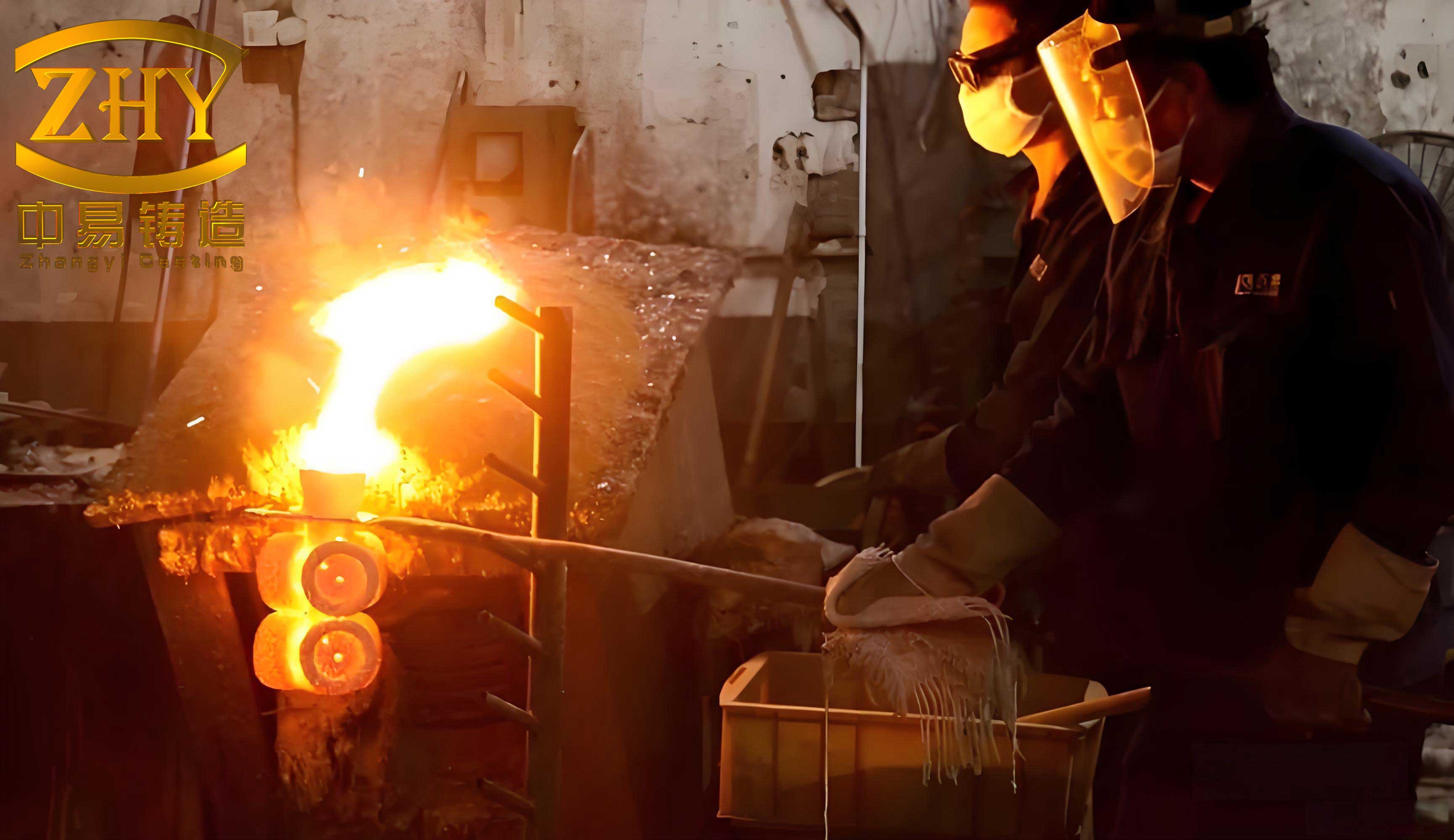
The shell mold is a critical element in the investment casting process, as it directly interacts with the molten titanium. Given Ti-6Al-4V’s propensity to react with most refractories at high temperatures, we selected yttrium oxide (Y₂O₃) as the facecoat material due to its high stability and low thermal conductivity. This choice minimizes alpha case formation—a surface contamination layer—to 0.02–0.05 mm, ensuring superior metallurgical quality. The binder for the facecoat was zirconium acetate, which offers good wettability and coating adherence. The slurry formulation involved a powder-to-liquid ratio of 2–4:1, with coarse powder content maintained at 20–30% to enhance permeability and strength. For the backup layers, we used silica sol and bauxite, applying multiple coats to build a shell thickness of about 20 mm. To reinforce the shell for centrifugal pouring—a necessity for thin-wall sections—we incorporated steel wire mesh after the fifth layer. The shell was then dried and subjected to a controlled dewaxing process using trichloroethylene vapor at 200°C, followed by sintering in a vacuum furnace at 950–1020°C to remove residual organics and achieve densification. This tailored shell manufacturing approach is fundamental to the success of the investment casting process, as it provides the necessary thermal and mechanical stability during pouring.
Melting and pouring are pivotal stages in the investment casting process, dictating the alloy’s fluidity and final properties. We employed a vacuum skull melting furnace, which utilizes a water-cooled copper crucible to form a solid titanium skull that prevents contamination. The melting was conducted under high vacuum (below 10⁻² Pa) to minimize gas pickup, with parameters optimized for Ti-6Al-4V’s liquidus temperature of approximately 1650°C. The molten alloy was then poured using a centrifugal casting system, which enhances fillability and densification for thin-wall structures. The centrifugal speed was calculated based on the component’s geometry and shell strength, using the formula:
$$ n = 299 \sqrt{\frac{G}{R_0}} $$
where \( n \) is the rotational speed in rpm, \( G \) is the gravitational factor (typically 40–60 for titanium), and \( R_0 \) is the distance from the rotation axis to the component’s farthest point in cm. Through iterative trials, we determined that a speed range of 200–300 rpm yielded optimal results, ensuring complete cavity fill without turbulence or defect formation. This aspect of the investment casting process leverages centrifugal force to overcome the alloy’s rapid solidification and improve metallurgical soundness.
Post-casting treatment is essential to rectify inherent defects like porosity and shrinkage, common in titanium investment casting processes. We applied hot isostatic pressing (HIP) at 920 ± 10°C under an argon atmosphere at 110–140 MPa for 2–2.5 hours. This process collapses internal voids through plastic deformation and diffusion bonding, significantly enhancing mechanical properties. The HIP treatment also promotes microstructural refinement, transforming lamellar alpha phases into more equiaxed grains in healed regions. The efficacy of HIP in the investment casting process is quantified by density measurements and non-destructive testing, which show near-theoretical density and defect-free structures.
To summarize the key parameters of our investment casting process, we present the following tables and formulas. Table 1 outlines the shell mold composition and processing steps, while Table 2 details the melting and pouring parameters. These tables encapsulate the iterative optimization we conducted to achieve high-quality castings.
| Layer | Material | Binder | Drying Time (h) | Function |
|---|---|---|---|---|
| Facecoat (1-2) | Y₂O₃ powder | Zirconium acetate | 8 | Provide reactivity barrier |
| Backup (3-5) | Bauxite | Silica sol | 8 | Build thickness and strength |
| Reinforcement (6+) | Steel wire mesh | Silica sol | 8 | Enhance mechanical integrity |
| Dewaxing | Trichloroethylene vapor | N/A | 3 cycles, 1 h each | Remove wax pattern |
| Sintering | Vacuum furnace | N/A | 2–3 h at 950–1020°C | Densify shell and remove gases |
| Parameter | Value | Rationale |
|---|---|---|
| Melting furnace | Vacuum skull melter | Prevent contamination via solid skull |
| Vacuum level | <10⁻² Pa | Minimize gas absorption (O₂, N₂, H₂) |
| Pouring method | Centrifugal casting | Enhance fillability for thin walls |
| Centrifugal speed | 200–300 rpm | Balance fill and shell strength |
| Mold preheat temperature | 200–300°C | Reduce thermal shock and improve flow |
| HIP treatment | 920°C, 110–140 MPa, 2–2.5 h | Eliminate porosity and improve density |
The investment casting process we developed involved extensive experimentation to validate each stage. We produced multiple prototypes, varying parameters such as slurry viscosity, sintering time, and centrifugal speed. The castings were evaluated using X-ray radiography, computed tomography (CT) scanning, and metallographic analysis. Results indicated that the optimized investment casting process achieved a casting yield of 75%, with components meeting dimensional tolerances of ±0.5 mm and surface roughness below 6.3 µm. Mechanical testing revealed tensile strengths of 930–950 MPa and elongation of 10–12%, consistent with ASTM standards for Ti-6Al-4V castings. The success of this investment casting process underscores its applicability to large, complex geometries, reducing material waste and machining costs compared to traditional methods.
Further analysis of the investment casting process includes microstructural evolution during solidification. The cooling rate in thin sections can be described by the Fourier heat conduction equation:
$$ \frac{\partial T}{\partial t} = \alpha \nabla^2 T $$
where \( T \) is temperature, \( t \) is time, and \( \alpha \) is thermal diffusivity. For Ti-6Al-4V, rapid cooling promotes fine alpha-beta microstructures, enhancing strength. However, in thicker regions, slower cooling may lead to coarse grains, necessitating thermal management in the investment casting process. We modeled temperature gradients using finite element analysis (FEA) to optimize pouring temperatures and shell preheating, ensuring uniform solidification. This modeling is integral to refining the investment casting process for diverse component geometries.
The economic and environmental impacts of the investment casting process are also noteworthy. By enabling near-net shape production, it reduces titanium scrap by up to 40% compared to machining from billet. Additionally, the use of yttrium oxide—though costly—can be recycled, lowering long-term expenses. We conducted life-cycle assessments to compare this investment casting process with alternative methods like forging or additive manufacturing, highlighting advantages in energy efficiency and material utilization for high-volume aerospace applications.
In conclusion, this study delineates a comprehensive investment casting process for large thin-wall Ti-6Al-4V alloy components. Through systematic design of shell molds, controlled melting and centrifugal pouring, and effective HIP treatment, we achieved high-quality castings with complex geometries. The investment casting process demonstrated here is reproducible and scalable, offering a blueprint for manufacturing similar parts in industries demanding precision and performance. Future work will focus on automating slurry application and integrating real-time monitoring to further enhance the reliability and efficiency of the investment casting process. Ultimately, the advancements in this investment casting process contribute to the broader adoption of titanium alloys in critical applications, leveraging their unique properties through innovative manufacturing techniques.
To encapsulate the mathematical relationships governing key aspects of the investment casting process, we present additional formulas. The stress on the shell during centrifugal pouring can be approximated by:
$$ \sigma = \rho \omega^2 r^2 $$
where \( \sigma \) is the hoop stress, \( \rho \) is the shell density, \( \omega \) is the angular velocity, and \( r \) is the radius. This informs the reinforcement design. Moreover, the kinetics of alpha case formation during the investment casting process follow an Arrhenius-type equation:
$$ \delta = A \exp\left(-\frac{E_a}{RT}\right) t^{1/2} $$
where \( \delta \) is the alpha case thickness, \( A \) is a pre-exponential factor, \( E_a \) is activation energy, \( R \) is the gas constant, \( T \) is temperature, and \( t \) is time. By minimizing \( \delta \) through material selection, we ensure surface integrity. These equations exemplify the scientific rigor embedded in optimizing the investment casting process.
Throughout this investigation, the term “investment casting process” has been emphasized to highlight its centrality in overcoming the challenges of titanium component fabrication. Each iteration of the investment casting process yielded insights into parameter interactions, such as the effect of slurry rheology on shell permeability or the impact of centrifugal force on grain orientation. By documenting these details, we aim to provide a valuable resource for engineers and researchers engaged in advanced casting technologies. The investment casting process, when tailored with precision, unlocks new possibilities for lightweight, high-strength structures in demanding environments.