
Introduction
V process casting, a vacuum-sealed molding technique, has gained prominence in producing high-precision gray iron castings due to its advantages in dimensional accuracy, surface finish, and environmental sustainability. This method eliminates the need for binders, simplifies sand handling, and reduces production costs. However, challenges arise when applying V process casting to complex large flat gray iron castings, such as structural distortion, shrinkage control, and film integrity. This article explores the critical process parameters and adjustments required to optimize V process casting for such components, focusing on a case study of a dual-head planer machine casting (HT200).
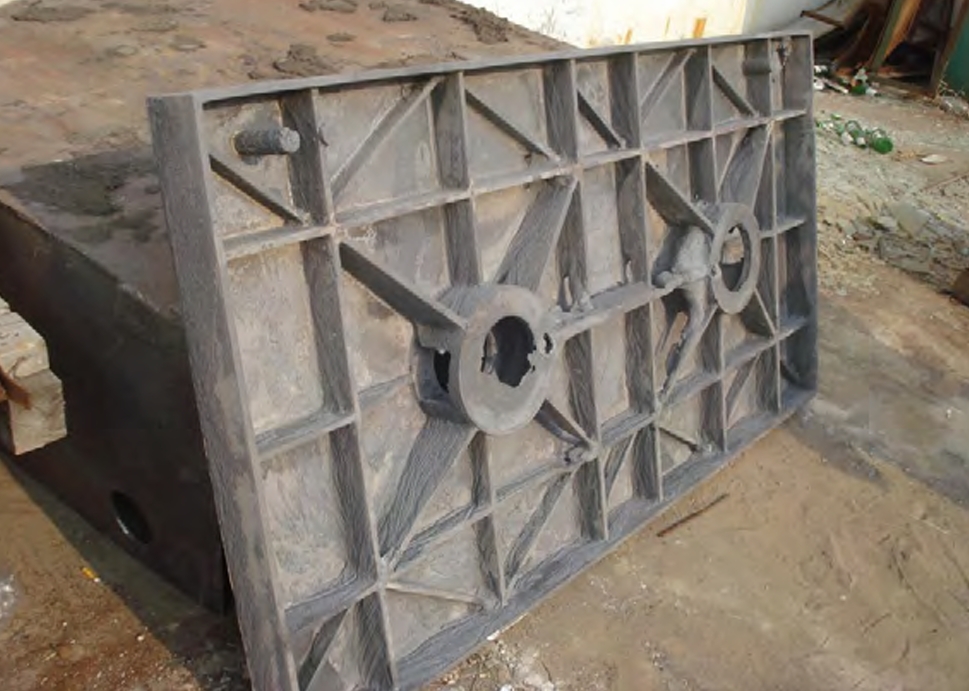
Analysis of the Casting
The dual-head planer casting (dimensions: 1800 mm × 960 mm × 110 mm, mass: 370 kg) exemplifies the challenges of large flat gray iron castings:
- Structural Complexity: Numerous intersecting ribs and thin walls complicate mold coating and film application.
- Dimensional Stability: Precise control of flatness, wall thickness, and assembly hole spacing is critical.
- Shrinkage and Distortion: Free contraction in V process casting leads to unpredictable shrinkage rates and warping.
Casting Process Design
1. Mold Configuration
- Single Cavity Layout: The casting was placed in the lower mold with the large flat surface as the parting plane.
- Gating System:
- Sprue: Diameter = 50 mm.
- Runner: Inverted trapezoidal cross-section (50 mm × 40 mm).
- Gates: Six gates distributed to ensure uniform temperature fields (Figure 1).
- Formula for gate area distribution:Atotal gates=∑i=1nAgatei=4×(5×60)+2×(5×40)=1600 mm2Atotal gates=i=1∑nAgatei=4×(5×60)+2×(5×40)=1600mm2
2. Venting System
- Primary Vents: Two vents (Ø45 mm) at the highest points.
- Structural Vents: Added at critical locations to prevent gas entrapment. Vent-to-sprue area ratio:AventsAsprue=2×π×(22.5)2π×(25)2≈1.62AsprueAvents=π×(25)22×π×(22.5)2≈1.62
3. Core Design
Small cores for assembly holes were made using resin-bonded sand.
Challenges and Adjustments
1. Film Integrity Issues
- Problem: EVA film ruptured at rib intersections during vacuum forming (Figure 2).
- Solution:
- Adjusted rib geometry (rounded edges, reduced height).
- Optimized film thickness (0.06 mm Japanese EVA film outperformed domestic 0.15 mm films).
2. Shrinkage and Distortion
- Observed Shrinkage Rates:DimensionDesign Shrinkage (%)Actual Shrinkage (%)Length0.61.1Width0.61.3Height0.61.2
- Distortion Mitigation:
- Anti-Deformation Design: Added 7–8 mm reverse curvature at the center and 3 mm at edges.
- Extended Vacuum Hold: Prolonged vacuum pressure post-pouring to stabilize the mold.
3. Sand Adhesion
- Cause: Non-uniform coating due to manual brushing.
- Solution: Switched to spray coating for consistent thickness.
Results and Comparison
1. Dimensional Accuracy
Post-adjustment casting dimensions met specifications (Table 1):
| Parameter | Target (mm) | Initial Result (mm) | Adjusted Result (mm) |
|---|---|---|---|
| Length | 1800 | 1792 | 1801 |
| Width | 960 | 955 | 962 |
| Height | 90 | 89.6 | 93 |
2. Surface Quality
- Roughness: Ra 10–50 µm (vs. 40+ µm in resin/clay sand).
- Machining Allowance: Reduced from 3 mm to 1 mm.
3. Process Comparison
V process casting outperformed traditional methods (Table 2):
| Parameter | Resin/Clay Sand | V Process Casting |
|---|---|---|
| Draft Angle | 2.5° | None |
| Surface Roughness | Ra ≥ 40 µm | Ra ≤ 50 µm |
| Weight Stability | ±16 kg | ±2 kg |
| Labor Intensity | High | Low |
Critical Control Points in V Process Casting
- Shrinkage Compensation:
- Use empirical formulas tailored for V process casting:Shrinkage Rate=(Lmold−LcastingLmold)×100%Shrinkage Rate=(LmoldLmold−Lcasting)×100%
- Adjust mold dimensions based on component geometry (e.g., 1.1–1.3% for flat castings).
- Vacuum Management:
- Maintain vacuum pressure ≥ 0.04 MPa during pouring and hold for ≥ 15 minutes post-solidification.
- Gating and Venting:
- Ensure vent-to-sprue area ratio > 1.5 for stable mold pressure.
- Distribute gates to minimize thermal gradients.
- Film and Coating Optimization:
- Select films with high elongation (e.g., 0.06 mm EVA).
- Apply coatings via spraying (thickness: 0.3–0.5 mm).
Conclusion
V process casting offers unparalleled advantages for producing complex large flat gray iron castings, but success hinges on meticulous control of shrinkage, vacuum stability, gating design, and film integrity. By integrating empirical adjustments, such as anti-deformation molds and optimized venting, manufacturers can achieve high-quality castings with minimal post-processing. This case study underscores the need for iterative experimentation and collaboration between design and production teams to harness the full potential of V process casting.