
The global demand for precision machinery has surged, driven by rapid industrialization and technological advancements. As a foundational element in manufacturing, machine tool castings play a critical role in determining the performance, accuracy, and durability of machine tools. In this article, I will explore the essential techniques and challenges involved in producing high-quality machine tool castings, drawing from extensive industry experience and research. The focus will be on achieving optimal material properties, such as high strength and dimensional stability, while addressing common production issues. Through detailed discussions on melting control, inoculation, and stress relief, I aim to provide a comprehensive guide for enhancing the quality of machine tool castings.
Machine tool castings form the backbone of various industries, including automotive, energy, shipbuilding, aviation, and rail transport. The increasing need for efficient and precise machining has elevated the importance of these castings. For instance, the automotive sector alone requires machine tool castings for engine components, transmission systems, and other critical parts, highlighting their widespread application. Similarly, the energy and aviation industries demand castings with exceptional rigidity and fatigue resistance to withstand high-stress environments. As such, the production of machine tool castings must adhere to stringent standards to meet these diverse requirements.
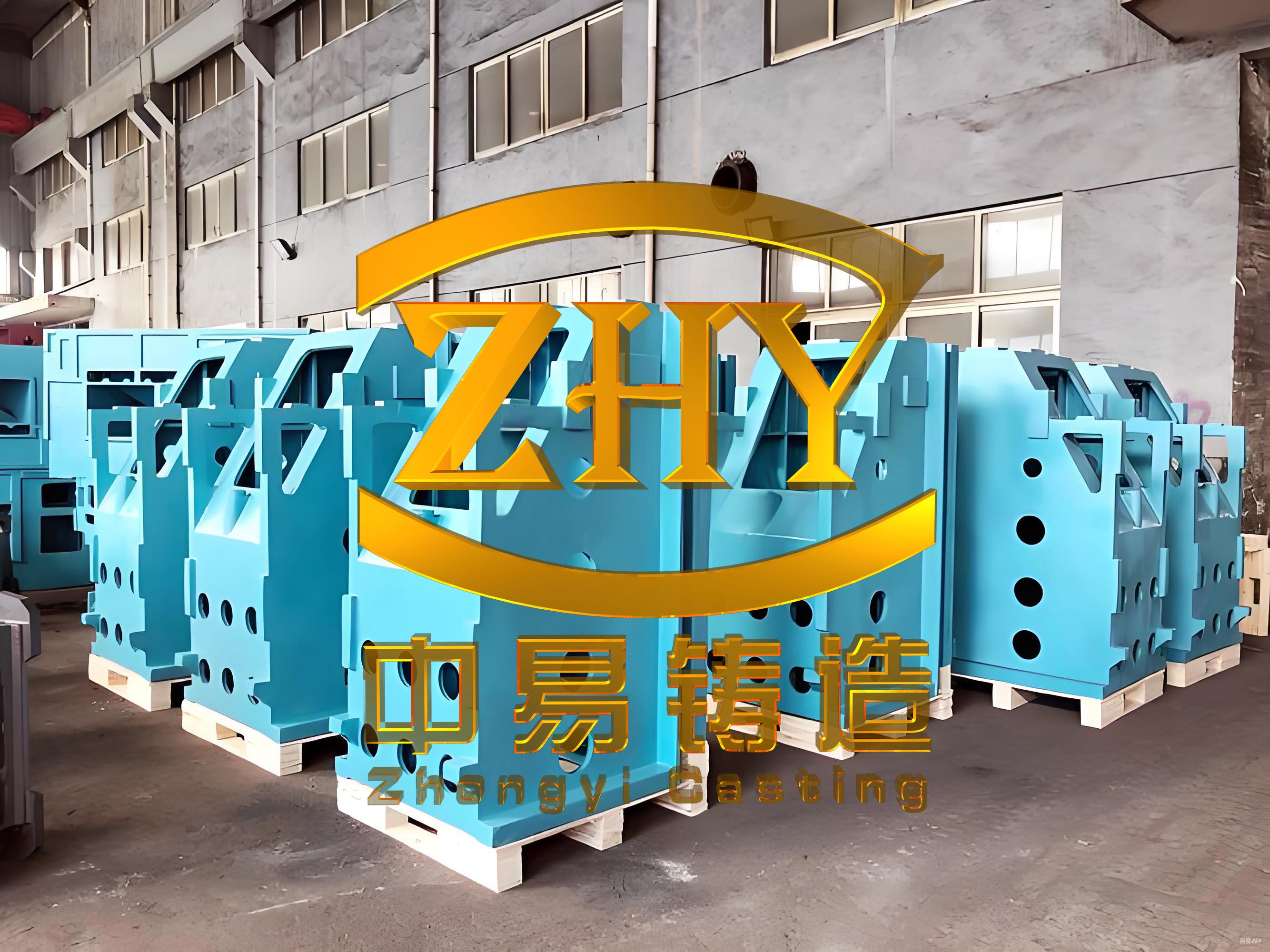
The evolution of machine tool castings has been marked by significant material advancements. Initially, gray iron grades like HT200 and HT250 were predominant, but modern applications necessitate higher strength materials such as HT300 and HT350. The shift towards ductile iron for specific components has further expanded the capabilities of machine tool castings, offering improved stiffness and weight reduction. This progression is summarized in Table 1, which outlines the historical development of material grades used in machine tool castings.
| Time Period | Primary Material Grades | Key Characteristics |
|---|---|---|
| Pre-1980s | HT200, HT250 | Basic gray iron with moderate strength |
| 1990s | HT300 | Introduction of higher strength gray iron |
| 2000s Onwards | HT350, Ductile Iron | Adoption of high-strength and alloyed iron for enhanced performance |
In recent years, the trend towards thin-walled and large-scale machine tool castings has gained momentum. This shift aims to reduce weight while maintaining structural integrity, which is crucial for high-speed machining operations. However, achieving thin-walled designs requires precise control over casting parameters to prevent defects like shrinkage and distortion. The following equation illustrates the relationship between wall thickness (t) and casting stress (σ), emphasizing the need for careful design:
$$ \sigma = k \cdot \frac{1}{t} $$
where k is a material constant. This inverse relationship highlights the challenges in producing thin-walled machine tool castings without compromising quality.
Despite these advancements, several issues persist in the production of machine tool castings. One major challenge is the trade-off between strength and other properties. For example, achieving high strength often involves reducing carbon equivalent, which can lead to increased casting stresses and poor machinability. This dilemma is particularly evident in high-grade machine tool castings like HT350, where low carbon equivalent values exacerbate shrinkage and deformation. Comparative data between domestic and international practices reveal significant gaps, as shown in Table 2, which contrasts carbon equivalent values for various grades of machine tool castings.
| Material Grade | Domestic Carbon Equivalent (%) | Foreign Carbon Equivalent (%) |
|---|---|---|
| HT250 | 3.75 | 3.95 |
| HT300 | 3.55 | 3.82 |
| HT350 | 3.45 | 3.76 |
The silicon-to-carbon ratio (Si/C) is another critical factor influencing the quality of machine tool castings. A lower Si/C ratio, commonly observed in domestic production, contributes to higher internal stresses and reduced dimensional stability. The ideal Si/C ratio for machine tool castings should range between 0.55 and 0.62 to minimize stress-related issues. The relationship between Si/C ratio and casting stress can be expressed as:
$$ \sigma \propto \frac{1}{\text{Si/C}} $$
This underscores the importance of maintaining an optimal Si/C ratio during the melting process. Table 3 provides a comparison of Si/C ratios in machine tool castings, highlighting areas for improvement.
| Material Grade | Domestic Si/C Ratio | Foreign Si/C Ratio |
|---|---|---|
| HT250 | 0.51 | 0.59 |
| HT300 | 0.50 | 0.59 |
| HT350 | 0.49 | 0.59 |
To address these challenges, mastering key technologies in the production process is essential. The melting stage serves as the foundation for high-quality machine tool castings. Controlling carbon equivalent and alloying elements is crucial for achieving high strength without sacrificing other properties. The carbon equivalent (CE) is calculated using the formula:
$$ CE = C + \frac{1}{3}Si + \frac{1}{3}P $$
where C, Si, and P represent the weight percentages of carbon, silicon, and phosphorus, respectively. For machine tool castings, a high CE is desirable to enhance fluidity and reduce casting stresses. However, this must be balanced with the addition of alloying elements like copper and chromium to stabilize pearlite and improve strength. Recommended chemical compositions for various grades of machine tool castings are provided in Table 4.
| Grade | C | Si | Mn | P | S |
|---|---|---|---|---|---|
| HT250 | 3.25-3.35 | 1.85-2.10 | 0.8-1.2 | <0.12 | 0.06-0.10 |
| HT300 | 3.15-3.25 | 1.80-2.00 | 0.8-1.2 | <0.12 | 0.06-0.10 |
| HT350 | 3.10-3.20 | 1.75-1.95 | 0.8-1.2 | <0.12 | 0.06-0.10 |
Alloying plays a pivotal role in enhancing the properties of machine tool castings. Elements such as copper, chromium, antimony, and tin are commonly used in combinations to improve strength and reduce section sensitivity. For instance, a blend of 0.4-0.6% copper and 0.2-0.4% chromium can significantly increase the hardness and tensile strength of machine tool castings. The effect of alloying on strength can be modeled using the following equation:
$$ R_m = R_0 + k_a \cdot C_a $$
where R_m is the tensile strength, R_0 is the base strength, k_a is a constant, and C_a is the concentration of the alloying element. This linear relationship highlights the importance of precise alloy addition in producing high-performance machine tool castings.
Charge composition is another critical aspect of producing quality machine tool castings. The use of high scrap steel ratios in the charge, coupled with effective carburization, promotes better graphite formation and higher strength. Comparative data on scrap steel ratios between domestic and international practices are presented in Table 5, demonstrating the need for increased scrap usage in domestic production.
| Material Grade | Domestic Scrap Ratio | Foreign Scrap Ratio |
|---|---|---|
| HT250 | 20-30 | 30-40 |
| HT300 | 35-45 | 50-60 |
| HT350 | 45-55 | 60-75 |
Molten iron temperature is a key parameter influencing the quality of machine tool castings. Higher temperatures, typically in the range of 1500-1550°C, refine graphite structure and improve mechanical properties. The relationship between molten iron temperature and tensile strength can be expressed as:
$$ R_m = A \cdot e^{-B/T} $$
where A and B are constants, and T is the temperature in Kelvin. This exponential relationship underscores the importance of maintaining high temperatures during melting. Table 6 shows the impact of temperature on the tensile strength of different grades of machine tool castings.
| Material Grade | Tensile Strength at 1450°C (MPa) | Tensile Strength at 1510°C (MPa) |
|---|---|---|
| HT250 | 283 | 291 |
| HT300 | 330 | 337 |
| HT350 | 376 | 389 |
Inoculation is a vital process for achieving the desired microstructure in machine tool castings. Proper inoculation reduces undercooling, promotes uniform graphite distribution, and minimizes casting defects. However, inoculation decay remains a common issue, leading to inconsistent results. Instantaneous inoculation methods, such as stream inoculation or mold inoculation, are recommended to ensure effectiveness. The inoculation effect can be quantified using the chill reduction ratio (CRR), defined as:
$$ CRR = \frac{\text{Chill depth before inoculation} – \text{Chill depth after inoculation}}{\text{Chill depth before inoculation}} $$
A higher CRR indicates better inoculation efficiency, which is crucial for producing high-quality machine tool castings.
Performance testing is essential for verifying the quality of machine tool castings. Beyond standard tensile tests, evaluations of elastic modulus, casting stress, and machinability should be conducted. The maturity degree (M), defined as the ratio of actual tensile strength to expected tensile strength based on carbon equivalent, should exceed 1 for optimal performance. Similarly, the hardening degree (H), representing the ratio of actual hardness to expected hardness, should be less than 1 to ensure good machinability. These metrics provide a comprehensive assessment of machine tool castings, guiding improvements in production processes.
Stress relief through aging treatments is critical for maintaining dimensional stability in machine tool castings. Thermal aging is the most common method, but it requires precise control over heating and cooling rates. Inadequate stress relief can lead to distortion and cracking, compromising the integrity of machine tool castings. The effect of cooling rate on stress relief is summarized in Table 7, emphasizing the need for slow cooling to achieve optimal results.
| Cooling Rate (°C/h) | Stress Relief Amplitude (%) |
|---|---|
| 130 | 6-27 |
| 50 | 42 |
| 30 | 85 |
The aging process should be conducted after rough machining to eliminate residual stresses from processing. The stress evolution during aging can be described by the equation:
$$ \sigma(t) = \sigma_0 \cdot e^{-t/\tau} $$
where σ(t) is the stress at time t, σ_0 is the initial stress, and τ is the relaxation time constant. This exponential decay model highlights the importance of sufficient aging time for machine tool castings.
In addition to thermal aging, vibration aging and natural aging are alternative methods for stress relief. However, natural aging requires extended periods, often exceeding six months, and must be conducted outdoors to leverage temperature variations. The effectiveness of natural aging can be modeled as:
$$ \sigma_r = \sigma_0 \cdot (1 – e^{-k t}) $$
where σ_r is the relieved stress, k is a constant, and t is time. This equation illustrates the gradual stress reduction in machine tool castings during natural aging.
The production of large-scale machine tool castings presents unique challenges, such as ensuring uniform microstructure and minimizing section sensitivity. For heavy-duty applications, ductile iron is increasingly used due to its high stiffness and strength. However, issues like shrinkage and graphite degeneration are common in large castings. Advanced techniques, including controlled pouring and optimized gating systems, are necessary to address these problems. The quality of large machine tool castings can be evaluated using the quality coefficient (Q), defined as:
$$ Q = \frac{R_m}{HB} $$
where R_m is the tensile strength and HB is the Brinell hardness. A higher Q value indicates better overall performance, which is essential for demanding applications.
In summary, the production of high-quality machine tool castings requires a holistic approach, integrating precise control over composition, melting, inoculation, and aging. By adopting high carbon equivalent strategies and advanced processing techniques, manufacturers can overcome common defects and meet the evolving demands of the industry. Continuous innovation and adherence to best practices will ensure that machine tool castings remain a cornerstone of modern manufacturing, supporting advancements across various sectors. The journey towards excellence in machine tool castings is ongoing, and embracing these key technologies will pave the way for future success.