
In my extensive experience with advanced casting processes, I have focused on developing reliable methods for producing high-integrity shell castings, particularly using challenging alloys like ZL205A. This aluminum-copper alloy is renowned for its exceptional strength-to-weight ratio and dimensional stability, making it ideal for critical applications such as aerospace components. However, its poor casting characteristics, including a wide freezing range and high susceptibility to shrinkage and hot tearing, demand meticulous工艺 design. Here, I will share insights and practical approaches for successfully manufacturing complex shell castings with ZL205A, emphasizing the工艺要点 that ensure defect-free, high-performance parts. The term “shell castings” will be central to our discussion, as these components often serve as structural enclosures requiring utmost reliability.
The foundation of any successful casting project lies in understanding the material’s inherent behavior. ZL205A is a high-purity, high-strength Al-Cu system alloy developed domestically, capable of achieving remarkable mechanical properties after heat treatment. Its chemical composition and typical mechanical properties are summarized in Table 1. The alloy’s strength is derived from multiple strengthening elements like Cu, Mn, Ti, Zr, and V, which refine the grain structure and enable precipitation hardening. However, this very complexity leads to a pasty, mushy mode of solidification, which hinders directional solidification and promotes microporosity and thermal stresses. For shell castings, which often feature varying wall thicknesses and complex geometries, this poses a significant challenge. To counteract these issues, I advocate for a工艺 philosophy centered on enforcing a strong temperature gradient and sequential solidification from the bottom to the top of the casting.
| Element | Composition Range | Element | Composition Range |
|---|---|---|---|
| Cu | 4.6–5.3 | Fe | ≤0.15 |
| Mn | 0.3–0.5 | Si | ≤0.06 |
| Ti | 0.15–0.35 | Mg | ≤0.05 |
| Zr | 0.05–0.20 | Zn | ≤0.1 |
| B | 0.005–0.06 | Al | Balance |
| Cd | 0.15–0.25 | ||
| V | 0.05–0.30 |
| Casting Method | Condition | Tensile Strength σb (MPa) | Elongation δ5 (%) | Brinell Hardness (HBS) |
|---|---|---|---|---|
| S (Sand) | T5 | 440 | 7 | 120 |
| S (Sand) | T6 | 490 | 3 | 140 |
| S (Sand) | T7 | 470 | 2 | 130 |
The solidification dynamics of ZL205A can be modeled to understand the need for directional cooling. The basic heat transfer during solidification can be described by Fourier’s law, but for practical purposes, we often use Chvorinov’s rule to estimate solidification time. For a shell casting with a modulus (volume-to-surface area ratio) of $M$, the solidification time $t_f$ is approximately:
$$ t_f = k \cdot M^n $$
where $k$ is the mold constant and $n$ is an exponent typically around 2. For ZL205A, due to its wide freezing range, ensuring a progressive solidification front requires manipulating $M$ through chills and risers. The thermal gradient $G$ and solidification rate $R$ are critical; we aim for a high $G/R$ ratio to minimize porosity. In shell castings, this is achieved by placing chills at thick sections and using risers to feed shrinkage. The effectiveness of a chill can be related to its thermal diffusivity $\alpha$:
$$ \alpha = \frac{k}{\rho c_p} $$
where $k$ is thermal conductivity, $\rho$ is density, and $c_p$ is specific heat. Materials like iron or copper have high $\alpha$, making them excellent for chills.
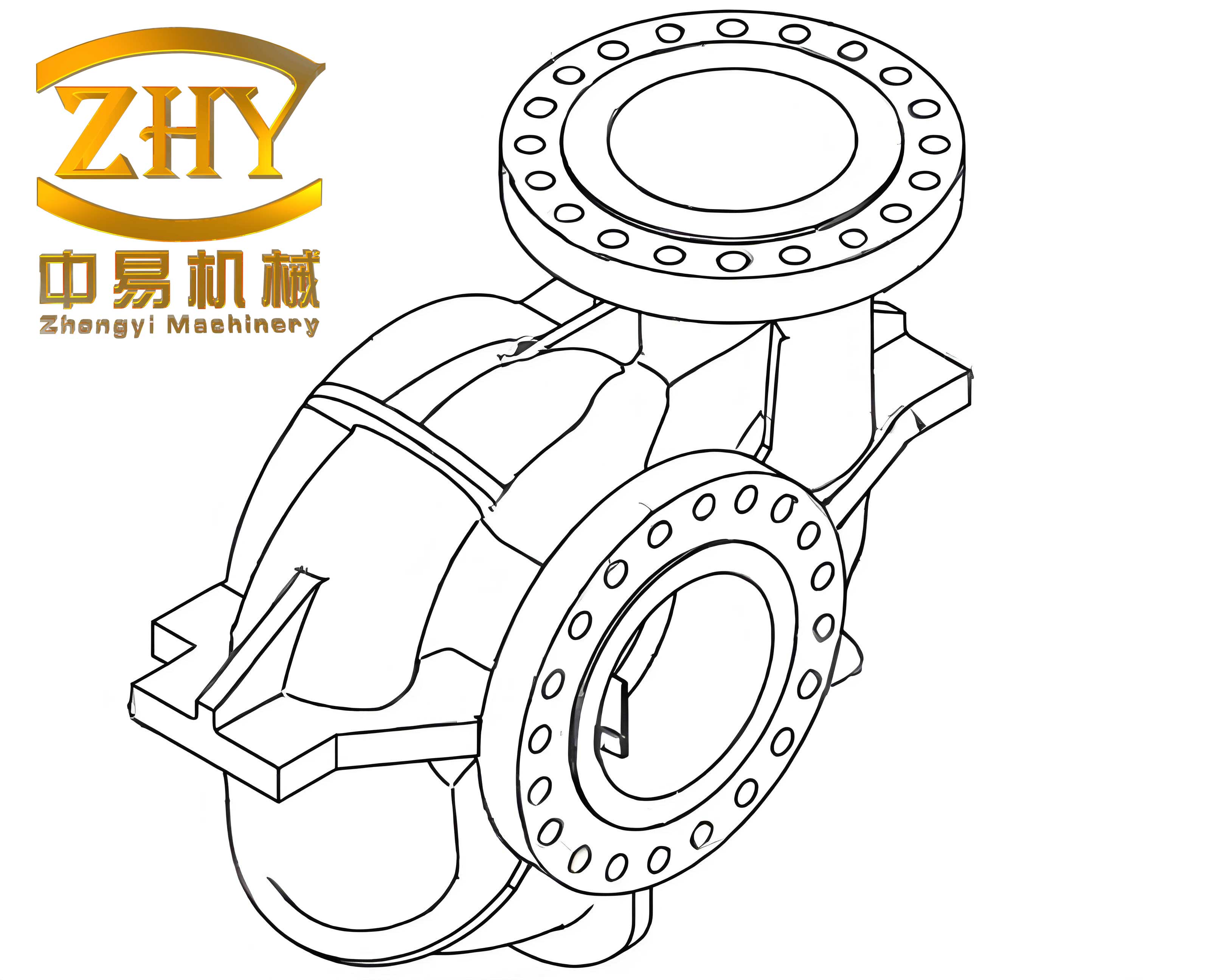
Analyzing the specific shell casting structure is paramount. The component discussed here is a conical回转体 with significant dimensions: large end diameter of 578 mm, small end diameter of 252 mm, and height of 238 mm. The wall thickness is non-uniform, with a nominal thickness of 30 mm and a maximum of 70 mm at the top port. Such disparities create hot spots that are prone to shrinkage defects. Therefore, for these shell castings, I recommend a vertical pouring orientation with the larger end facing upward. This arrangement leverages gravity to promote bottom-up solidification and allows for effective placement of risers at the top. The entire mold is constructed using cores, primarily made from chromite sand for its chilling properties, which helps mitigate the alloy’s thickness sensitivity and ensures dimensional stability of the internal cavity. The design of a hollow core also enhances venting and simplifies assembly.
The gating system is a cornerstone of quality for ZL205A shell castings. Given the alloy’s tendency to oxidize and its pasty solidification, an open gating system with a combination of bottom and slot gates is essential. This ensures smooth, rapid filling and supports the desired temperature gradient. The cross-sectional areas of the gating channels are calculated based on the poured weight. For a shell casting with a gross weight $G$ (in kg), the choke area, typically the sprue base $F_{sprue}$ in cm², is determined by:
$$ F_{sprue} = C \cdot G $$
where $C$ is an empirical coefficient. For ZL205A, I use $C = 0.11$, derived from experience. Thus, for a casting weighing 40 kg:
$$ F_{sprue} = 0.11 \times 40 = 4.4 \, \text{cm}^2 $$
In practice, I employ custom-made片状 dry sprue with dimensions, and the actual area is adjusted for flow balance. The gating ratio is set as $F_{sprue} : F_{runner} : F_{ingate} = 1 : 4 : 5$. The runner is designed with a dual configuration for better flow stabilization and slag trapping, and ceramic filters with a porosity exceeding 75% are installed at the sprue-runner junction to reduce inclusions. The ingates include both conventional gates and vertical slot gates attached to risers. The slot gate dimensions are critical: thickness $a$ is 0.8 to 1.5 times the local casting wall thickness $\delta$, width $b$ ranges from 15 to 35 mm, and the attached riser diameter $D$ is 4 to 6 times $a$. This design ensures the slot gate feeds the riser directly, enhancing its thermal efficiency and补缩 capability. The riser height is set at 170 mm to provide adequate metallostatic pressure.
To quantify the feeding requirements, the modulus method is useful. The riser modulus $M_r$ must be greater than the casting modulus $M_c$ at the hot spot. For a cylindrical riser:
$$ M_r = \frac{V_r}{A_r} = \frac{\pi D_r^2 H_r / 4}{\pi D_r H_r + \pi D_r^2 / 4} = \frac{D_r H_r}{4H_r + D_r} $$
For effective feeding, $M_r > 1.2 \, M_c$. In our shell casting, the top port with 70 mm thickness has a high $M_c$, necessitating a sizable riser. Additionally, the use of chills reduces the local modulus, aiding solidification control. The placement of chills follows the rule of covering hot spots; conformal chills are used at the bottom and thick sections to extract heat rapidly.
Heat treatment is the final step in unlocking the alloy’s potential. For ZL205A shell castings requiring T5 condition, a precise multi-stage solution treatment followed by aging is mandatory. The process parameters are tightly controlled: preheat below 300°C, then step-wise heating to 530±5°C (hold 0.5 h), 535±5°C (hold 1 h), and 538±5°C (hold 18 h), followed by quenching in water at 40–60°C. Aging is done at 155±5°C for 9 hours, then air cooling. The narrow temperature windows demand accurate furnace control to avoid overheating, which can cause incipient melting and scrap the entire batch of shell castings. The effectiveness of heat treatment can be related to the kinetics of precipitate formation, often described by the Avrami equation for phase transformation:
$$ f = 1 – \exp(-k t^n) $$
where $f$ is the fraction transformed, $k$ is a rate constant, $t$ is time, and $n$ is an exponent. Proper parameters ensure optimal precipitation of strengthening phases like θ’ (Al2Cu).
The试制 phase validated our工艺 approach. Two prototype shell castings were produced using the described methodology. Visual inspection revealed no external defects like cracks or misruns. Non-destructive testing, including X-ray radiography, confirmed the absence of internal flaws such as porosity, shrinkage, or segregation. Mechanical testing samples extracted from the castings met all specified requirements, with tensile strength exceeding 440 MPa and elongation around 7% in T5 condition. Dimensional checks showed conformity to the stringent tolerances. This success underscores the importance of a holistic工艺 design tailored to ZL205A’s characteristics for producing reliable shell castings.
Expanding further on the challenges, the design of the mold core system is critical for shell castings. Using chromite sand cores not only provides chilling but also improves erosion resistance against the high-temperature aluminum melt. The core assembly must ensure proper alignment and venting to prevent gas defects. Venting channels can be sized based on the gas generation rate during pouring, which can be estimated from the mold material’s moisture and binder content. The pressure buildup $P_g$ in the mold cavity should be below a critical threshold to avoid gas entrapment:
$$ P_g = \frac{R_g T}{V} \sum m_i $$
where $R_g$ is the gas constant, $T$ is temperature, $V$ is cavity volume, and $m_i$ is the mass of gas generated from different sources.
Another aspect is the control of residual stresses in shell castings. Due to the uneven cooling, thermal stresses can lead to distortion or cracking. Finite element analysis (FEA) simulations can predict stress fields, but a simplified analytical model considers the thermal strain $\epsilon_{th}$:
$$ \epsilon_{th} = \alpha_T \Delta T $$
where $\alpha_T$ is the coefficient of thermal expansion and $\Delta T$ is the temperature difference. Stress $\sigma$ develops if strain is constrained:
$$ \sigma = E \epsilon_{th} $$
where $E$ is Young’s modulus. By ensuring gradual cooling through proper mold design and controlled shakeout, we minimize these stresses in ZL205A shell castings.
To enhance the quality of shell castings, statistical process control (SPC) can be applied. Key parameters like pouring temperature, mold temperature, and alloy composition are monitored. For instance, the pouring temperature for ZL205A is typically held between 700–720°C. A regression model can correlate these inputs with output quality metrics like tensile strength. Suppose we have data from multiple pours; a multiple linear regression might take the form:
$$ \sigma_b = \beta_0 + \beta_1 T_{pour} + \beta_2 [Cu] + \beta_3 t_{quench} + \epsilon $$
where $\beta_i$ are coefficients and $\epsilon$ is error. This helps in optimizing the process for consistent shell castings.
In summary, producing high-strength ZL205A aluminum alloy shell castings demands a deep integration of material science, thermal management, and precise engineering. The工艺要点 revolve around enforcing directional solidification via strategic use of chills and risers, designing a gating system that ensures clean, tranquil filling, and executing a meticulous heat treatment. Every step, from mold core制作 to final aging, must be calibrated to the alloy’s sensitive nature. The successful试制 of these conical shell castings demonstrates that with the right approach, even challenging alloys can be harnessed to produce components that meet the highest standards of performance and reliability. Future work may explore additive manufacturing of molds or advanced simulation tools to further refine the process for complex shell castings.
| Process Stage | Parameter | Typical Value/Range | Remarks |
|---|---|---|---|
| Melting & Pouring | Pouring Temperature | 710 ± 10°C | To avoid oxidation and ensure fluidity |
| Mold Design | Core Material | Chromite Sand | High chilling power, improves surface finish |
| Chill Material | Cast Iron/Copper | Placed at thick sections (≥30 mm difference) | |
| Gating System | Gating Ratio (Sprue:Runner:Ingate) | 1 : 4 : 5 | Open system for ZL205A |
| Filter Porosity | >75% | Ceramic foam at sprue base | |
| Slot Gate Thickness (a) | a = (0.8–1.5)δ | δ is local casting wall thickness | |
| Riser Design | Riser Height | 170 mm (for 40 kg casting) | Height-to-diameter ratio ~1.5 |
| Heat Treatment | Solution Treatment | 538°C for 18 h (step-wise) | Prevents overheating |
| Aging (T5) | 155°C for 9 h | Air cool after |
Finally, it is worth noting that the principles discussed here for ZL205A shell castings can be adapted to other high-performance aluminum alloys with similar casting challenges. The core idea is to always prioritize thermal control and feeding mechanisms tailored to the component’s geometry. As demand for lightweight, strong shell castings grows in aerospace and defense sectors, mastering these工艺 details becomes ever more critical. Continuous improvement through data analysis and technological innovation will drive the future of manufacturing these essential components.