
The landscape of foundry technology is perpetually evolving, driven by the relentless pursuit of performance, cost-efficiency, and material sustainability. In the specialized domain of steel castings, which demand exceptional high-temperature resistance and dimensional accuracy, the choice of molding and core-making materials is paramount. Coated sand, a precision aggregate bound by a thermosetting resin film, stands as a critical enabler for producing complex, high-integrity steel castings for automotive, marine, valve, and heavy machinery components. For decades, high-purity natural sea sand, prized for its spherical grain shape and high silica content, has been the benchmark aggregate. However, its diminishing availability and escalating cost, particularly in regions like Northeast China, impose significant financial strain on the industry. This economic and supply-chain pressure catalyzes the exploration of viable alternatives. This article presents a first-person, in-depth investigation into the application of manufactured sand as a full or partial replacement for natural sea sand in the production of coated sand for steel castings.
The fundamental challenge lies in replicating or adapting to the key properties of natural sand. The liquid steel in steel castings is poured at extreme temperatures, typically ranging from 1,540 °C to 1,600 °C. Consequently, the aggregate must possess superior refractoriness, primarily dictated by a high SiO₂ content (>98% minimum), to prevent chemical burn-on and penetration. Beyond chemistry, grain morphology is crucial. Rounded grains have a lower surface-area-to-volume ratio, meaning a given amount of resin can form a thicker, more effective bonding bridge between grains, leading to higher strength. Furthermore, spherical grains pack more densely and exhibit superior flowability, ensuring complete and uniform filling of intricate core boxes. The parameter quantifying this is the Angularity Factor (AF), where a lower value indicates a more rounded grain. The performance metrics of any alternative aggregate must therefore be scrutinized through these lenses: chemical purity, grain size distribution, and morphology.
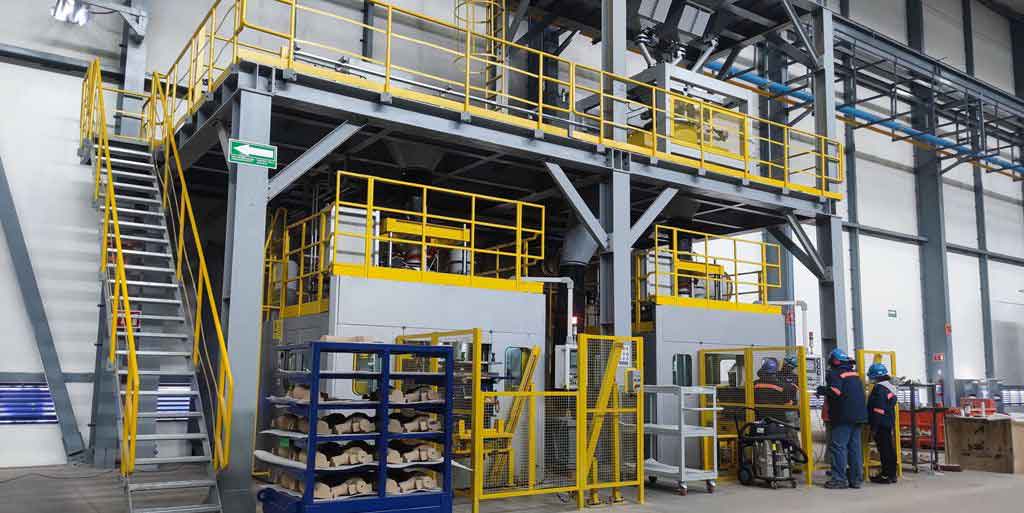
Manufactured sand, produced by mechanically crushing and processing high-purity quartzite or silica sandstone, emerges as a compelling candidate. Through a controlled process involving crushing, grinding, classification, hydraulic sizing, magnetic separation, and drying, a consistent aggregate with SiO₂ content often exceeding 99% can be achieved. This satisfies the basic chemical requirement for steel castings. The initial step in our evaluation involved a direct, head-to-head comparison of the fundamental properties of a sourced manufactured sand against a benchmark natural sea sand, as summarized in Table 1.
| Property | Unit | Manufactured Sand | Natural Sea Sand |
|---|---|---|---|
| Ignition Loss | % | 0.12 | 0.17 |
| Clay Content | % | 0.17 | 0.13 |
| Acid Demand Value | mL/50g | 1.197 | 0.992 |
| Moisture Content | % | 0.06 | 0.04 |
| Linear Expansion (1000°C) | % | 1.9566 | 2.2134 |
| Electrical Conductivity (25°C) | µS/cm | 156.8 | 174.3 |
| Bulk Density | g/cm³ | 1.34 | 1.41 |
| AFS Grain Fineness Number | – | 68.99 | 69.96 |
The data reveals a nuanced picture. The manufactured sand demonstrates advantages in key high-temperature behavior indicators: lower ignition loss and significantly reduced thermal expansion. Lower expansion minimizes stress within the sand core during the heating phase of casting, reducing the risk of veining or cracking defects in the final steel castings. Its lower electrical conductivity may also suggest a lower ionic content. However, it shows a slightly higher clay content and acid demand value, which can influence resin demand and binder efficiency. The lower bulk density is a direct consequence of grain morphology, which we will examine next.
Grain size distribution is equally critical. A well-distributed, “three-screen” sand with a central peak (e.g., 70/140 mesh) promotes dense packing. The selected sands for this study had nearly identical AFS numbers and very similar distributions, as shown in Table 2, ensuring a fair comparison of the effect of grain shape alone.
| Sieve Mesh | Manufactured Sand (%) | Natural Sea Sand (%) |
|---|---|---|
| 20 | – | – |
| 30 | 0.01 | – |
| 40 | 0.76 | 0.82 |
| 50 | 6.80 | 3.59 |
| 70 | 28.41 | 31.12 |
| 100 | 45.04 | 44.65 |
| 140 | 16.25 | 16.51 |
| 200 | 2.52 | 2.86 |
| 270 | 0.29 | 0.42 |
| Pan | – | 0.04 |
Microscopic analysis confirms the expected morphological difference: the manufactured sand consists predominantly of sub-angular grains with few spheres, while the sea sand is largely sub-rounded. This angularity directly impacts the interfacial bonding mechanics. For a constant resin addition (wr), the effective resin film thickness (tf) on a grain is inversely related to its specific surface area (SA). Angular grains have a higher SA, leading to a thinner film. The tensile strength (σt) of the bonded assembly can be conceptually related to the bond cross-section and packing density. A simple model for comparative strength potential can be expressed as being proportional to the resin film thickness and the coordination number (Z, average contact points per grain), which is higher for rounded grains:
$$ \sigma_{t} \propto t_{f} \cdot Z \approx \frac{w_{r}}{\rho_{r} \cdot S_{A}} \cdot Z $$
where ρr is the resin density. This explains the inherent strength challenge with angular aggregates.
The core of our practical investigation was to produce coated sand under identical, tightly controlled industrial conditions. Using a fully automated coater with precise thermal and metering control, both sands were processed with the same formulation: 2.5 wt% phenolic resin (based on sand weight), 12-15 wt% hexamine-based hardener (based on resin weight), and 6-8 wt% calcium stearate lubricant. The process involved heating the sand to 150°C ±10°C, sequential addition and coating of additives, and final cooling. The properties of the resulting coated sands, detailed in Table 3 and Table 4, quantify the performance gap and highlight specific characteristics.
| Sieve Mesh | Manufactured Sand Coated Sand (%) | Natural Sea Sand Coated Sand (%) |
|---|---|---|
| 40 | 0.60 | 0.96 |
| 50 | 10.26 | 7.63 |
| 70 | 29.30 | 30.15 |
| 100 | 39.06 | 40.59 |
| 140 | 18.44 | 18.03 |
| 200 | 2.00 | 2.23 |
| Property | Unit | Manufactured Sand | Natural Sea Sand | Difference (%) |
|---|---|---|---|---|
| Tensile Strength (Cold) | MPa | 3.4 | 4.0 | -15.0 |
| Bending Strength (Cold) | MPa | 6.6 | 7.5 | -12.0 |
| Tensile Strength (Hot, 232°C) | MPa | 1.7 | 2.0 | -15.0 |
| Bending Strength (Hot) | MPa | 3.3 | 3.9 | -15.4 |
| Gas Evolution (850°C) | mL | 16.39 | 16.58 | ≈ |
| Hot Distortion (1000°C) | min | 12.8 | 13.7 | -6.6 |
| Permeability Number | – | 121 | 82 | +47.6 |
| Flowability | sec | 65.43 | 61.89 | -5.7 |
| Melting Point | °C | 104 | 103 | ≈ |
The results are systematic. The manufactured sand coated sand exhibited approximately a 15% deficit in all strength metrics (cold/hot, tensile/bending), aligning perfectly with the theoretical prediction based on grain angularity. However, a significant and advantageous divergence was observed in permeability, which was nearly 48% higher. This can be modeled using a simplified Carmen-Kozeny relation, where permeability (k) is inversely proportional to the square of the specific surface area and a tortuosity factor (τ), which is higher for angular grains:
$$ k \propto \frac{\phi^3}{(1-\phi)^2 \cdot S_A^2 \cdot \tau} $$
While angular grains increase SA and τ, the dominant effect in this case appears to be a lower packing density (φ, porosity), leading to markedly higher permeability—a beneficial trait for venting gases from large or thick-section steel castings. Flowability and high-temperature endurance were slightly inferior but remained within functional limits.
The true test for any core material is its behavior in the actual production of steel castings. Cores for two distinct steel casting families—a “Upper Bracket” series and a more complex “Hook” series—were produced on a standard hot-box core shooter using identical parameters (265°C mold temperature, 0.35 MPa shooting pressure). Both sand types produced cores with good surface finish, adequate “finger-nail” hardness, and no visible pyrolysis. They were deemed fit for pouring.
The casting trials were conducted using a medium-frequency furnace, pouring 35# carbon steel at approximately 1590°C. Multiple castings from each series were produced. The evaluation of the final steel castings revealed the practical outcome:
– For the Upper Bracket steel castings, surfaces produced with manufactured sand coated sand were sound, clean, and free from defects, fully meeting acceptance standards and matching the quality of sea sand cores.
– For the more geometrically complex Hook steel castings, the surfaces were largely excellent. However, isolated areas, particularly on lower faces, exhibited minor “orange peel” texture. This is attributed to localized resin degradation or metal penetration, potentially exacerbated by the lower hot strength and angular grain profile of the manufactured sand base. Crucially, non-defect areas were smooth and dimensionally accurate. The overall casting quality was acceptable for many commercial applications.
This investigation leads to several definitive conclusions and strategic pathways for adopting manufactured sand in the production of coated sand for steel castings:
1. Manufactured sand is a chemically viable aggregate (SiO₂ >99%) but introduces a trade-off: inferior grain roundness versus superior permeability compared to natural sea sand.
2. Under fixed resin addition, this morphology results in a predictable ~15% reduction in coated sand strength but a ~48% increase in gas permeability.
3. For a vast range of steel castings with standard surface finish requirements, manufactured sand can serve as a direct, drop-in replacement for natural sea sand, providing immediate cost savings estimated at up to 40%.
4. For premium steel castings demanding flawless surface finish, especially in complex geometries, strategies must be employed to mitigate the angularity effect. These include:
– **Sand Conditioning:** Implementing additional mechanical attrition or aerodynamic processes to round the grain edges post-crushing.
– **Resin System Optimization:** Tailoring resin formulation (e.g., higher flow, lower viscosity) or slightly increasing resin addition to build a thicker bond bridge.
– **Application of Refractory Coatings:** The use of zircon- or graphite-based core washes can create a protective barrier, effectively decoupling the casting surface from the core sand’s angularity, making it an excellent solution for critical steel castings.
The transition to manufactured sand is not merely a cost-saving exercise but a step toward sustainable and secure sourcing in the foundry industry. By understanding the property shifts and implementing targeted process adaptations, foundries can reliably produce high-quality steel castings while achieving significant economic benefits and reducing dependence on scarce natural resources. The future of core making for steel castings will increasingly rely on such engineered, consistent, and sustainable material solutions.