
In my extensive work with high-strength aluminum alloys for critical aerospace applications, the Al-Cu based system, particularly the ZL205A alloy, has been a focal point. This alloy is pivotal for manufacturing large-scale structural components that must withstand significant loads. While its excellent room and high-temperature mechanical properties are well-documented, its application is often constrained by a pronounced tendency for hot tearing due to a wide solidification range. The intimate relationship between a material’s microstructure and its final properties is undeniable. By strategically altering the quantity, size, morphology, and distribution of constituent phases through heat treatment, we can directly engineer the desired performance profile. This detailed study documents my systematic investigation into optimizing the heat treatment of large ZL205A castings, with a particular emphasis on understanding the evolution of microstructure during solution and aging, and crucially, on identifying and mitigating potential heat treatment defects.
The component under investigation is a large, thin-walled cylindrical casing. Its complex geometry and substantial size inherently pose significant manufacturing challenges. To meet the stringent in-service requirements, the casting must achieve mechanical properties that surpass those of many wrought aluminum alloys: an ultimate tensile strength (σ_b) ≥ 390 MPa, a yield strength (σ_{0.2}) ≥ 315 MPa, and an elongation (δ_5) between 3% and 13%. This stringent demand underscores the necessity for a precisely controlled and deeply understood heat treatment protocol to ensure consistent performance and avoid heat treatment defects such as insufficient strength, over-aging, or distortion.
Materials and Experimental Methodology
The ZL205A alloy used in this study was melted and processed according to the stringent QJ3185-2003 standard. Its nominal chemical composition and the strict limits on impurity elements, which are critical to prevent embrittlement and other heat treatment defects, are summarized in Table 1.
| Element | Cu | Mn | Ti | Zr | Cd | B | V | Al |
|---|---|---|---|---|---|---|---|---|
| Content | 4.6-5.3 | 0.3-0.5 | 0.15-0.35 | 0.05-0.20 | 0.15-0.25 | 0.005-0.060 | 0.05-0.30 | Bal. |
| Impurity | Fe | Si | Mg | Zn | Others (Total) |
|---|---|---|---|---|---|
| Max. Limit | ≤ 0.15 | ≤ 0.06 | ≤ 0.05 | ≤ 0.10 | ≤ 0.15 |
To account for the substantial variation in wall thickness inherent to the large casting, three different geometries of attached test bars were cast simultaneously. After processing, these were machined into standard tensile specimens according to GB6397. The primary experimental variable was the aging time. All specimens first underwent a standardized solution treatment: holding at 538 ± 5°C for 15-18 hours, followed by quenching. This temperature is critically close to the alloy’s incipient melting point, making precise furnace control paramount to avoid gross heat treatment defects like overburning. Subsequently, a series of isothermal aging treatments were conducted at 175°C. A sequential “build-up” aging approach was employed: a batch of specimens was aged for an initial period (e.g., 0.25h), one specimen was removed for mechanical testing, and the remaining batch was returned to the furnace for an additional aging increment. This process was repeated through cumulative aging times up to 20 hours, allowing for the detailed mapping of property evolution.
Theoretical Framework of Precipitation Strengthening
The core mechanism governing the property changes in ZL205A during heat treatment is precipitation hardening. In the as-cast state, the microstructure consists of α-Al dendrites and a network of intermetallic phases, predominantly CuAl₂ (θ-phase), at the grain boundaries. The solution treatment aims to dissolve these soluble phases back into the aluminum matrix, creating a supersaturated solid solution (SSSS) upon rapid quenching.
The subsequent aging process is a controlled decomposition of this metastable SSSS. The sequence of precipitation, which directly dictates strength and is a common source of heat treatment defects if mismanaged, can be summarized as follows:
$$ \text{SSSS } (\alpha) \rightarrow \text{GP Zones} \rightarrow \theta” \rightarrow \theta’ \rightarrow \text{Stable } \theta (\text{CuAl}_2) $$
Each stage has distinct characteristics:
GP Zones: Coherent, solute-rich clusters, providing the initial strength increase.
θ” phase: A semi-coherent, metastable transitional phase. Its formation and fine dispersion create significant coherency strain fields, offering peak strengthening.
θ’ phase: A larger, semi-coherent transitional phase. Its appearance marks the beginning of over-aging, where strength plateaus or declines.
θ phase: The stable, equilibrium CuAl₂ phase. It is incoherent with the matrix and provides minimal strengthening; its excessive formation is a classic heat treatment defect known as over-aging, leading to软化.
The kinetics of this sequence are governed by time and temperature, following an Arrhenius-type relationship. The driving force for precipitation $\Delta G$ is related to the supersaturation. The growth rate of a precipitate particle can be conceptually modeled by simplified diffusion-controlled growth equations. For spherical growth:
$$ r(t) \propto \sqrt{D t} $$
where $r(t)$ is the particle radius at time $t$, and $D$ is the diffusion coefficient of the solute (Cu) in Al. The aging temperature critically affects $D$:
$$ D = D_0 \exp\left(-\frac{Q}{RT}\right) $$
where $D_0$ is a pre-exponential factor, $Q$ is the activation energy for diffusion, $R$ is the gas constant, and $T$ is the absolute temperature. This explains why higher aging temperatures accelerate the progression through the precipitation sequence, potentially leading to the heat treatment defect of premature over-aging if not carefully timed.
Impact of Heat Treatment Parameters on Mechanical Properties
The results from the sequential aging study clearly delineate the property evolution. Figure 1 and Table 3 consolidate the average tensile property data, revealing critical trends for process optimization and avoidance of heat treatment defects.
| Cumulative Aging Time (h) | Ultimate Tensile Strength, σ_b (MPa) | Yield Strength, σ_{0.2} (MPa) | Elongation, δ_5 (%) | Interpreted Microstructural State |
|---|---|---|---|---|
| 0.25 | 365 | 290 | 8.5 | Under-aged (GP zones dominant) |
| 0.5 | 385 | 305 | 7.8 | Transition to θ” |
| 1 | 405 | 330 | 7.0 | Peak aging (θ” dominant) |
| 2 | 410 | 335 | 6.5 | Peak aging |
| 4 | 412 | 338 | 6.2 | Peak/Start of plateau |
| 6 | 411 | 337 | 6.0 | Aging plateau |
| 10 | 408 | 335 | 5.8 | Aging plateau |
| 15 | 405 | 332 | 5.5 | Early over-aging onset |
| 20 | 395 | 325 | 5.0 | Over-aging (θ’ growth) |
Key Observations:
- Peak Strength Plateau: After approximately 4 hours of aging at 175°C, the tensile and yield strengths reach a maximum and enter a remarkably stable plateau. This indicates that the fine-scale θ” precipitates have fully developed and their distribution has stabilized. The extended plateau is highly beneficial for industrial processing, providing a forgiving window that helps prevent the heat treatment defect of under-aging or significant over-aging due to minor furnace time/temperature fluctuations.
- Ductility Trade-off: Elongation gradually decreases with aging time, which is typical as coherent and semi-coherent precipitates increasingly impede dislocation motion. The specification requirement (δ_5 ≥ 3%) is comfortably met throughout the process window, but the gradual decline must be monitored to avoid excessive embrittlement, another potential heat treatment defect.
- Importance of Solution Treatment: The extended solution time (15-18h) for these large sand castings is non-negotiable. It is essential for dissolving the coarse, discontinuous network of intermetallics at grain boundaries. An insufficient solution treatment is a fundamental heat treatment defect that limits the supersaturation level and consequently caps the maximum achievable strength after aging, as not all strengthening elements are in solution.
The final optimized T6 treatment protocol derived from this study—(538±5)°C/15-18h (solution) + water quench + 175°C/4-6h (aging)—consistently produced castings meeting and exceeding the specified mechanical property targets. Validation through testing of coupons excised from actual castings confirmed the robustness of this cycle.
Microstructural Evolution and Defect Prevention
Microscopic analysis provides the foundational explanation for the macroscopic property data and is essential for diagnosing heat treatment defects.
1. Effect of Solution Treatment: The cast microstructure shows α-Al dendrites with a pronounced intergranular network of CuAl₂ and other phases (e.g., T-Al12CuMn2). After the prolonged solution treatment, this network is largely dissolved. The Mn-containing phases reprecipitate as fine, dispersed secondary T-phase particles within the grains. These particles contribute to strength via Orowan strengthening and also help control grain growth. The complete dissolution of soluble phases is critical; residual undissolved compounds constitute a heat treatment defect that acts as stress concentrators and limits strength.
2. Effect of Aging Treatment: Transmission Electron Microscopy (TEM) of peak-aged samples reveals a high density of fine, needle/plate-shaped θ” precipitates uniformly distributed within the α-Al matrix. This is the microstructural hallmark of peak strength. The transition to over-aging is marked by the coarsening of these precipitates into the more distinct θ’ phase and eventually the equilibrium θ phase, with a concomitant loss of coherency and strengthening effect.
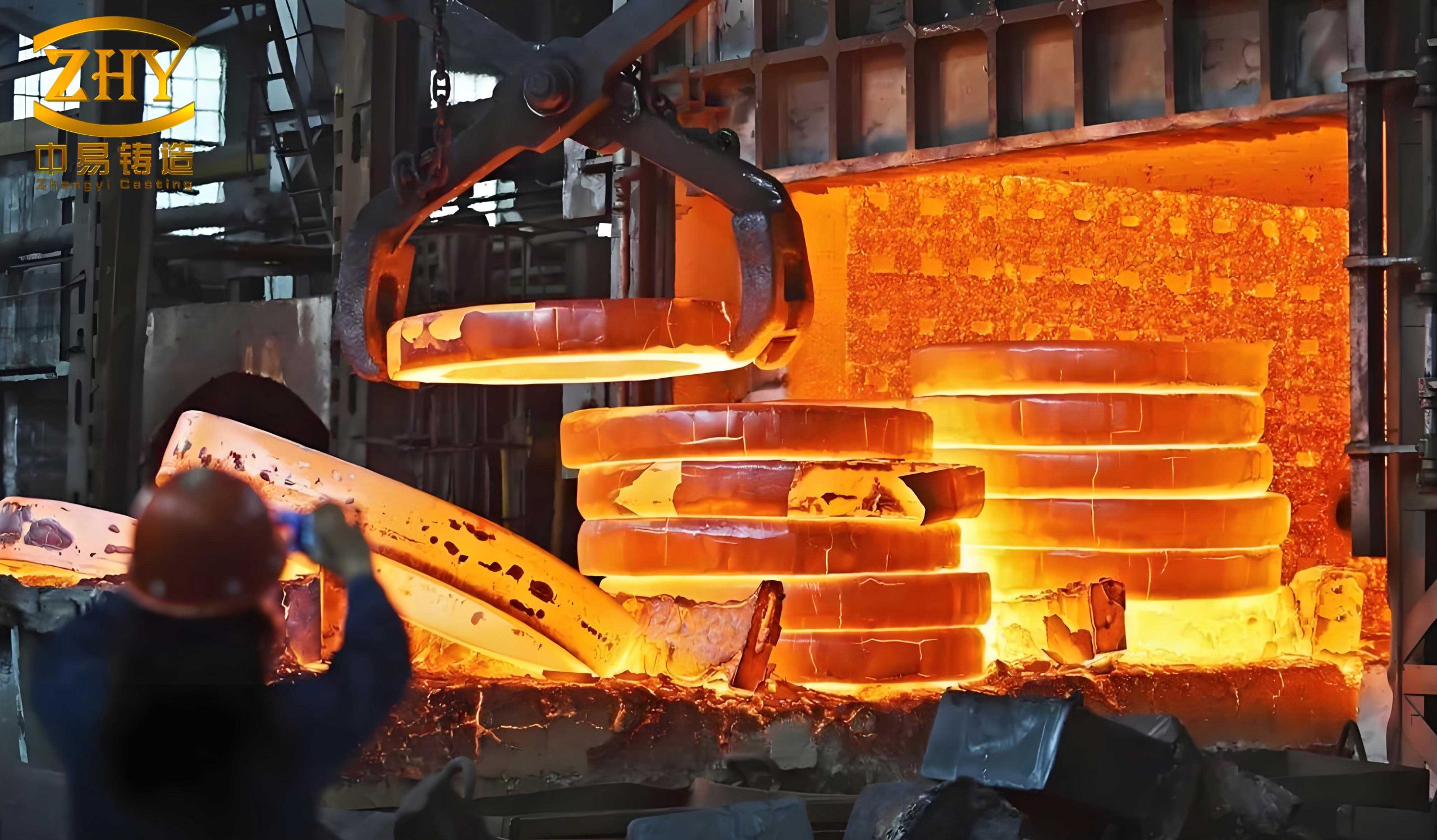
3. Identifying and Mitigating Common Heat Treatment Defects:
Based on this study, a guide to key heat treatment defects in ZL205A can be formulated:
| Defect | Primary Cause | Effect on Properties | Preventive Measures |
|---|---|---|---|
| Overburning / Incipient Melting | Solution temperature exceeding the eutectic melting point (~548°C) or local hot spots. | Catastrophic loss of ductility and strength, formation of voids. | Precise furnace calibration (±5°C), use of protective atmosphere, avoid excessive temperature. |
| Insufficient Solution | Temperature too low or time too short for complete dissolution of CuAl₂. | Lower-than-expected peak strength after aging. | Ensure adequate soak time (15-18h for heavy sections), verify furnace uniformity. |
| Quench Cracking/Distortion | Excessive thermal stresses during rapid quenching from solution temperature. | Cracking or warping of the component. | Optimize quench medium temperature and agitation; consider polymer quenchants for complex shapes. |
| Under-Aging | Aging temperature too low or time too short; precipitation sequence halted at GP zones. | Strength and hardness below specification. | Follow established time-temperature parameters; use witness coupons for hardness verification. |
| Over-Aging | Aging temperature too high or time too long; coarsening of θ” to θ’ and θ. | Decrease in strength and hardness, though sometimes increased dimensional stability. | Strict control of aging furnace; for T6 temper, avoid extending times beyond the plateau. |
| Property Non-Uniformity | Temperature gradients in large furnaces during solution or aging; varying section thicknesses. | Different properties in different areas of the same casting. | Improved furnace circulation and loading patterns; consider step-heating for very thick sections. |
The mathematical relationship for the risk of over-aging can be conceptualized. The average precipitate radius $\bar{r}$ increases with time during over-aging, often following a relationship like:
$$ \bar{r}^n – \bar{r}_0^n = K t $$
where $\bar{r}_0$ is the initial radius at the start of coarsening, $n$ is an exponent (often ~3 for diffusion-controlled coarsening), $K$ is a temperature-dependent rate constant, and $t$ is time. This underscores that over-aging accelerates with temperature. The associated strength drop $\Delta \sigma$ can be related to the increase in inter-precipitate spacing $\lambda$:
$$ \Delta \sigma_{\text{precip}} \propto \frac{1}{\lambda} $$
and since $\lambda$ increases as precipitates coarsen ($\lambda \propto \bar{r}$), strength decreases.
Conclusion
This systematic investigation into the heat treatment of large-scale ZL205A aluminum alloy castings has elucidated the critical process-structure-property relationships. The optimized T6 protocol—a rigorous solution treatment at 538°C for 15-18 hours followed by aging at 175°C for 4-6 hours—successfully produces a microstructure dominated by a fine dispersion of coherent θ” precipitates. This microstructure delivers a stable plateau of high strength (σ_b > 410 MPa, σ_{0.2} > 335 MPa) while maintaining adequate ductility.
Most importantly, this work provides a scientific and practical framework for understanding and avoiding common heat treatment defects. From preventing overburning through precise temperature control to avoiding under- or over-aging by adhering to the identified aging plateau, the insights gained are directly applicable to industrial production. The extended solution time is confirmed as essential for sand castings to eliminate the as-cast intermetallic network, and the identified aging window offers valuable operational flexibility. By mastering these heat treatment principles, the full potential of the high-strength ZL205A alloy can be reliably realized in demanding aerospace applications, ensuring component integrity, performance consistency, and mission success.