
In my extensive experience with white cast iron, particularly the high chromium variants used in grinding ball applications, I have come to appreciate the intricate balance required to achieve optimal performance. The journey from raw materials to a finished, durable grinding ball involves careful selection of chemical composition, precise casting techniques, and controlled heat treatment. This article, drawn from years of hands-on practice, aims to share insights on how to navigate these processes effectively, focusing on the robust material known as high chromium white cast iron. The term ‘white cast iron’ will recur throughout, emphasizing its central role in abrasion-resistant components.
The cornerstone of any high chromium white cast iron formulation is its chemical composition. This decision directly dictates the microstructure, hardness, toughness, and ultimately, the service life of the grinding ball. Unlike research laboratories that may experiment with exotic alloys, practical production must balance performance with cost, leveraging locally available resources. The primary elements—carbon and chromium—play the most decisive roles, but a symphony of other alloying elements fine-tunes the final properties.
Carbon content is the primary regulator of carbide volume in white cast iron. Higher carbon increases carbide quantity and hardness but at the expense of toughness, making the material brittle. Lower carbon can lead to undesirable carbide networks at grain boundaries. For grinding balls, which require a compromise between wear resistance and impact toughness, a hypoeutectic composition is standard. The eutectic carbon point in high chromium white cast iron is not fixed; it decreases as chromium content increases. This relationship can be expressed with the following formula:
$$ \alpha = 4.4\% – 0.054 \times \omega(Cr) $$
Here, $$ \alpha $$ represents the eutectic carbon content (in weight percent), and $$ \omega(Cr) $$ is the weight percent of chromium. For instance, with 15% Cr, the eutectic carbon is approximately 3.6%. Based on operational demands, I typically recommend a carbon range of 2.4% to 2.8% for grinding balls made from high chromium white cast iron.
Chromium is the element that fundamentally transforms the nature of the carbides in white cast iron. When present in amounts below 12%, it forms M3C-type carbides [(Fe,Cr)3C] with a hardness around 1060-1240 HV. However, when chromium exceeds 12%, the more desirable M7C3-type carbides [(Fe,Cr)7C3] emerge, boasting a superior显微 hardness of 1500-1800 HV and better corrosion resistance. Excessive chromium (over 20%) may lead to M23C6 formation, which is less favorable. Therefore, controlling chromium between 14% and 17% is optimal. The ratio of chromium to carbon (ω(Cr)/ω(C)) is another critical parameter, peaking in performance around a value of 7.1.
The effects of other alloying elements are summarized in the table below, which I have compiled from practical observations to guide production:
| Element | Primary Role in White Cast Iron | Recommended Range (wt.%) | Key Effects & Notes |
|---|---|---|---|
| Manganese (Mn) | Stabilizes carbides, enhances hardenability, reduces red-shortness. | 0.5% – 1.0% | Promotes austenite retention; higher levels (3-5%) can yield as-cast austenitic structures. |
| Silicon (Si) | Deoxidizer, improves fluidity, but reduces hardenability. | 0.5% – 1.0% | Kept low to prevent pearlite formation in the matrix during heat treatment. |
| Copper (Cu) | Significantly improves hardenability, strengthens matrix. | 0.4% – 0.8% | Cost-effective alternative to nickel; excess can cause embrittlement due to copper-rich phases. |
| Molybdenum (Mo) | Greatly enhances hardenability, refines grains, increases carbide hardness. | 0.5% – 1.5% | Essential for thick-section castings; balances hardness and toughness. Its effect interacts with the Cr/C ratio. |
| Vanadium (V) | Powerful carbide stabilizer, refines structure, increases hardness. | 0.07% – 0.15% | Dramatically improves wear resistance but reduces impact toughness; synergistic with Mo. |
| Titanium (Ti) | Forms hard TiC, refines grains, purifies grain boundaries. | 0.1% – 0.5% | Helps inhibit crack initiation and improves overall strength. |
| Sulfur (S) | Impurity, forms low-melting sulfides. | < 0.05% | Detrimental to fluidity and promotes hot tearing; must be minimized. |
| Phosphorus (P) | Impurity, forms brittle phosphide eutectics. | < 0.07% | Reduces toughness and strength by forming networks at grain boundaries. |
The interplay of these elements defines the capabilities of the white cast iron. For example, molybdenum’s influence on hardness can be visualized through empirical data. While a precise universal formula is complex, the trend shows that even small additions of Mo (e.g., 0.5-1.0%) significantly elevate the quenched hardness, especially in alloys with a high Cr/C ratio. Vanadium’s impact is more nuanced; it markedly increases the显微 hardness of carbides and the matrix but causes a steep drop in Charpy impact energy. This trade-off necessitates careful balancing, often by combining V with Mo to achieve a favorable composite of properties.
Moving from composition to production, the casting process for high chromium white cast iron is pivotal. Melting is typically performed in medium-frequency induction furnaces to ensure precise temperature control and compositional homogeneity. My standard charge consists of low-silicon pig iron, steel scrap, and ferroalloys (like high-carbon ferrochromium for cost efficiency). To minimize oxidation, about one-fifth of the chromium is placed at the furnace bottom initially, with the remaining alloys added slowly during melting after the base irons have liquefied.
Pouring temperature is a critical parameter. High chromium white cast iron has good fluidity, but the temperature must be controlled to avoid defects. The liquidus temperature for a typical 15% Cr white cast iron is around 1250°C. I recommend a pouring temperature superheat of 50-100°C, resulting in a range of 1350-1400°C. Exceeding 1480°C during tapping should be avoided to prevent excessive oxidation and gas pickup. Lower pouring temperatures within this range promote finer grain structure and reduce shrinkage porosity, provided cold shuts are avoided.
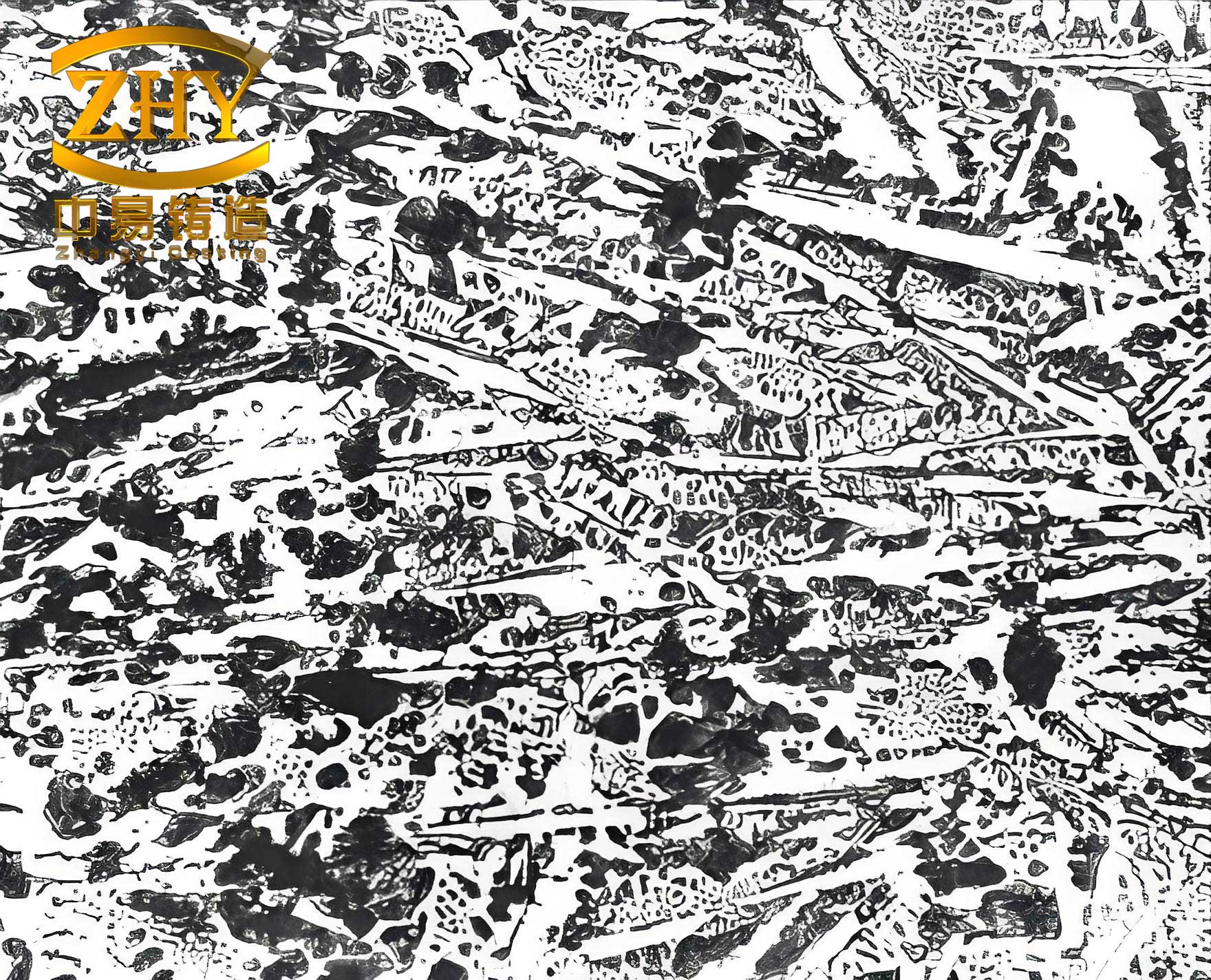
Inoculation or modification treatment is a powerful tool to enhance the properties of white cast iron. The inherent brittleness of this material often stems from the continuous, sharp-edged morphology of the M7C3 carbides. Through modification, we aim to spheroidize these carbides, break their networks, and disperse them as isolated globules or short rods. This transformation reduces stress concentrations and crack propagation paths, thereby improving toughness without sacrificing hardness. Effective modifiers for white cast iron often contain rare earth elements (e.g., Cerium), alkali metals (Potassium, Sodium), or combinations thereof. They serve a dual purpose: modifying carbide morphology and purifying the melt by deoxidation and desulfurization. In my practice, additions ranging from 0.8% to 1.5% of specific rare earth compounds or complex alkali-based modifiers have yielded microstructures with 15-25% globular carbides in an austenitic or martensitic matrix, significantly boosting impact resistance.
The solidification characteristics of high chromium white cast iron are mushy, meaning a wide solid-liquid coexistence zone. To promote directional solidification and minimize internal shrinkage, I employ metal molds combined with high-pressure head feeding systems. This practice helps shift shrinkage defects into the risers and results in a denser, more refined casting—a crucial step for demanding applications like grinding balls.
Heat treatment is the final, transformative step for high chromium white cast iron. The as-cast structure typically consists of austenite, some martensite, carbides, and often undesirable pearlite. To unlock the full potential hardness and achieve the best toughness-hardness balance, a tailored heat treatment is essential. The standard process involves austenitizing, quenching, and tempering.
The austenitizing temperature for this type of white cast iron usually falls between 960°C and 980°C. The holding time depends on the section size; for grinding balls, 2 to 4 hours is common. The presence of copper (around 0.5-0.8%) can stabilize austenite, sometimes necessitating longer holding times (up to 6 hours) to ensure adequate transformation. After austenitizing, the castings are quenched, typically in air or oil depending on the alloy’s hardenability and size, to form a martensitic matrix embedded with hard carbides.
The quenched white cast iron is very hard but may retain residual austenite and high internal stresses. A tempering or stress-relief operation follows. For maximum hardness and wear resistance with reduced brittleness, a low-temperature temper in the range of 200-300°C is effective. In some high-impact scenarios where an austenitic matrix is desired for its toughness, a simple high-temperature aging treatment (e.g., 500-600°C) can be performed to relieve stresses without causing major phase transformations.
The relationship between heat treatment parameters and final hardness can be conceptually modeled. While exact equations depend on specific composition, a general representation of the quenching hardness (HQ) as a function of austenitizing temperature (TA) and alloy content might be expressed as:
$$ H_Q \approx f(T_A, \omega(Mo), \omega(V), \omega(Cr)/\omega(C)) $$
where a higher TA (within the austenitizing range) and increased levels of Mo and V generally contribute to higher achievable hardness in the martensitic white cast iron matrix.
To consolidate the typical compositional window for a cost-effective, high-performance grinding ball made from high chromium white cast iron, I present the following summary table based on cumulative industrial experience:
| Element | Weight Percent (wt.%) | Rationale for White Cast Iron |
|---|---|---|
| Carbon (C) | 2.4 – 2.8 | Controls carbide volume; balances hardness and toughness in hypoeutectic white cast iron. |
| Chromium (Cr) | 14.0 – 17.0 | Ensures formation of hard M7C3 carbides; key to wear resistance in this white cast iron. |
| Manganese (Mn) | 0.5 – 1.0 | Enhances hardenability and austenite stability of the white cast iron matrix. |
| Silicon (Si) | 0.5 – 1.0 | Acts as a deoxidizer; kept low to maintain hardenability of the white cast iron. |
| Copper (Cu) | 0.4 – 0.8 | Improves hardenability cost-effectively in white cast iron alloys. |
| Molybdenum (Mo) | 0.5 – 1.5 | Critical for through-hardening, especially in larger sections of white cast iron castings. |
| Vanadium (V) | 0.07 – 0.15 | Refines carbides and increases matrix hardness in white cast iron; used judiciously with Mo. |
| Titanium (Ti) | 0.1 – 0.5 | Grain refiner and strengthener for the white cast iron microstructure. |
| Sulfur (S) | < 0.05 | Harmful impurity to be minimized in quality white cast iron. |
| Phosphorus (P) | < 0.07 | Harmful impurity to be minimized in quality white cast iron. |
In conclusion, the successful production of grinding balls from high chromium white cast iron is a testament to metallurgical craftsmanship. It requires a deep understanding of how each element shapes the microstructure and properties of this remarkable white cast iron. By meticulously controlling the chemistry, adopting proper melting and inoculation practices, and applying precise heat treatment, one can consistently produce grinding balls that offer an outstanding combination of wear resistance and impact toughness. The journey with white cast iron is one of constant learning and refinement, but the reward is a durable, high-performance product capable of withstanding the harsh conditions of milling operations. The principles outlined here, grounded in practical experience, serve as a reliable guide for harnessing the full potential of high chromium white cast iron.