
In my extensive experience with foundry operations, the successful production of high-integrity high manganese steel castings hinges upon a profound understanding and meticulous control of thermal parameters throughout the melting and casting process. High manganese steel, renowned for its exceptional work-hardening capability and abrasion resistance, presents a unique set of challenges during solidification. Its casting behavior is intrinsically linked to temperature, making the adage “high temperature melting, low temperature casting” not merely a suggestion but a foundational principle. This article delves into the scientific rationale behind this principle and outlines a comprehensive framework for its practical implementation, focusing relentlessly on the critical stages that define quality in high manganese steel casting.
The fundamental characteristic governing the solidification of high manganese steel is its narrow freezing range. The alloy has a liquidus temperature ($T_L$) of approximately $$T_L \approx 1410^\circ \text{C}$$ and a solidus temperature ($T_S$) near $$T_S \approx 1390^\circ \text{C}$$. This results in a crystallization interval ($\Delta T_{cr}$) of only about:
$$\Delta T_{cr} = T_L – T_S \approx 20^\circ \text{C}$$
This narrow interval confers excellent fluidity to the molten steel, but it is paired with a relatively high linear shrinkage coefficient. Consequently, the solidification mode is highly sensitive to thermal gradients. If the pouring temperature is excessively high, the prolonged solidification time and steep thermal gradients promote the formation of coarse columnar grains, enlarged shrinkage cavities, and micro-porosity. These defects severely degrade the castings’ impact toughness ($a_k$ value), wear resistance, and thermal crack resistance, while also increasing the volume fraction of undesirable carbides in the as-cast microstructure.
The Imperative of Controlled Melting Temperature
Optimal quality in high manganese steel casting begins in the furnace. The melting temperature must be sufficiently high to ensure proper metallurgical reactions, effective degassing, and inclusion flotation, yet not so high as to cause excessive oxidation and gas pickup. A refined melting practice is the first pillar supporting low-temperature pouring. From my practice, maintaining a molten bath temperature between $1500^\circ\text{C}$ and $1550^\circ\text{C}$ during the refining stage proves most effective. At this range, the steel viscosity is low, allowing non-metallic inclusions to float out efficiently. Furthermore, this temperature provides the necessary thermal head to accommodate a crucial holding time before tapping.
The importance of this holding, or “killing,” time cannot be overstated. A deliberate holding period of 5 to 8 minutes after final alloying and temperature adjustment is essential. This practice serves multiple purposes: it allows for final homogenization of temperature and chemistry, enables residual inclusions to coalesce and rise into the slag, and permits dissolved gases to escape. The relationship between holding time ($t_h$), inclusion removal rate, and final steel cleanliness can be conceptually modeled. While the kinetics are complex, a simplified representation of inclusion floatation can be given by Stokes’ law, modified for practical foundry conditions. The terminal velocity ($v$) of a spherical inclusion rising through the steel melt is:
$$v = \frac{2 g r^2 (\rho_s – \rho_i)}{9 \eta}$$
where $g$ is acceleration due to gravity, $r$ is the inclusion radius, $\rho_s$ and $\rho_i$ are the densities of the steel and inclusion respectively, and $\eta$ is the dynamic viscosity of the steel. This equation highlights why higher superheat (lower $\eta$) and time ($t_h$) are critical for cleanliness.
Deoxidation: The Cornerstone of Sound Castings
The quality of a high manganese steel casting is directly proportional to the effectiveness of deoxidation. Inadequate deoxygenation leads to elevated levels of oxide inclusions, particularly manganese silicates (MnO·SiO₂), which drastically impair mechanical properties. For instance, an increase in oxide content can reduce wear resistance and increase the propensity for hot tearing by several orders of magnitude. Therefore, a multi-stage deoxidation strategy is paramount.
The process starts with a well-reduced furnace slag. The state of slag deoxidation is quantitatively assessed by the combined content of iron oxide (FeO) and manganese oxide (MnO). My operational target is to maintain their sum below a critical threshold before tap:
$$(\text{%FeO} + \text{%MnO})_{\text{slag}} < 1.0\%$$
Achieving this requires careful diffusion deoxidation using carbon or silicon-carbide powders during melting. Final deep deoxygenation is performed in the ladle. A common and effective sequence involves adding ferrotitanium approximately 1-2 minutes before tap for preliminary deoxidation and grain refinement, followed by a final aluminum kill just before the steel leaves the furnace. The residual aluminum content in the steel must be controlled within a precise window to avoid secondary issues:
$$0.15\% \leq [\text{Al}]_{\text{residual}} \leq 0.25\%$$
This ensures thorough deoxidation without excessive formation of aluminum nitride or other detrimental compounds.
Furthermore, the use of rare earth (RE) alloys for modification treatment offers significant benefits. Added during the ladle fill (e.g., when the ladle is one-third full), rare earth elements act as powerful deoxidizers and desulfurizers. More importantly, they modify the morphology and size of remaining inclusions, transforming harmful elongated sulfides and oxides into small, globular, and dispersed particles. This modification dramatically improves both the dynamic toughness and wear performance of the final high manganese steel casting.
The Core Principle: Analysis of Pouring Temperature Effects
Pouring temperature is the most critical variable in determining the as-cast structure and properties of high manganese steel. Lowering the pouring temperature reduces the thermal gradient and the total heat content that must be dissipated during solidification. This promotes a finer, more equiaxed grain structure and minimizes shrinkage defects. The relationship between grain size ($d$) and pouring temperature ($T_p$) can be empirically described by an equation of the form:
$$d = k \cdot \exp\left(\frac{-Q}{R T_p}\right)$$
where $k$ is a constant, $Q$ is an apparent activation energy related to nucleation, and $R$ is the gas constant. Lower $T_p$ directly results in a smaller $d$.
The mechanical property improvements are profound. For example, reducing the pouring temperature from $1460^\circ\text{C}$ to $1420^\circ\text{C}$ (as measured by an optical pyrometer) can lower the ductile-to-brittle transition temperature (DBTT) by as much as $40^\circ\text{C}$ to $50^\circ\text{C}$. This is a critical enhancement for components subjected to impact loading in service. The following table summarizes the decisive influence of pouring temperature on the microstructure and key mechanical properties of a standard ASTM A128 Gr. B-4 (Mn12%) type high manganese steel, based on aggregated production data.
| Pouring Temperature (Optical Pyrometer, °C) | Austenitic Grain Size (ASTM No.) | Yield Strength $\sigma_{0.2}$ (MPa) | Tensile Strength $\sigma_u$ (MPa) | Elongation $\delta$ (%) | Impact Toughness $a_k$ (J/cm²) | Relative Wear Resistance Index |
|---|---|---|---|---|---|---|
| 1480 – 1470 | 1 – 2 (Coarse Columnar) | 340 – 360 | 650 – 680 | 18 – 22 | 25 – 35 | 0.85 – 0.90 |
| 1460 – 1450 | 3 – 4 (Mixed Structure) | 360 – 380 | 680 – 720 | 22 – 28 | 35 – 50 | 0.95 – 1.00 |
| 1440 – 1430 | 5 – 6 (Fine Equiaxed) | 380 – 410 | 720 – 760 | 28 – 35 | 50 – 80 | 1.05 – 1.15 |
| 1420 – 1410 | 6 – 7 (Very Fine) | 400 – 430 | 740 – 780 | 30 – 38 | 70 – 100 | 1.10 – 1.20 |
The data unequivocally demonstrates that a reduction in pouring temperature refines the grain structure and enhances strength, ductility, toughness, and wear resistance simultaneously. However, the principle of low-temperature pouring is not absolute; it must be balanced against casting geometry. For thin-sectioned or small castings, excessively low temperature risks misruns and cold shuts. In such cases, a moderately higher temperature within the $1440^\circ\text{C}$ to $1450^\circ\text{C}$ range may be necessary to ensure complete mold filling. The goal is to identify and maintain the lowest practicable pouring temperature for each specific casting design and molding condition.
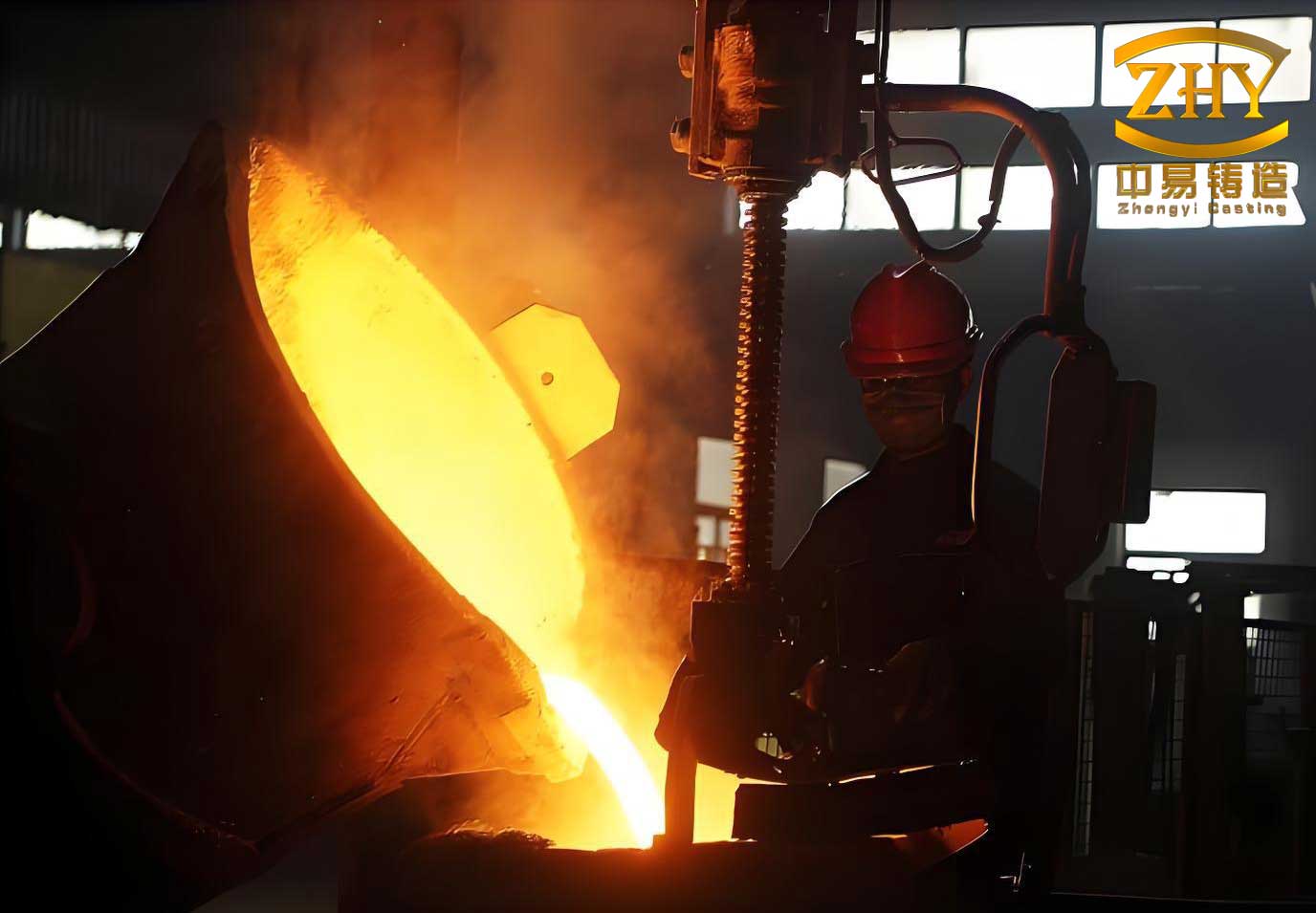
Implementing Low-Temperature Pouring: Practical Systems and Controls
Adhering to a low pouring temperature regimen requires a holistic approach encompassing equipment, logistics, and human factors. It is a system-wide discipline. First, ladle preparation is critical. The ladle lining and, especially, the nozzle and stopper assembly must be preheated to a minimum of $800^\circ\text{C}$ to prevent premature freezing of the steel at the gate. During the holding period after tap, it is common practice to use a gas torch to locally reheat the stopper seat area, maintaining it free of solidified metal.
Second, logistics on the pouring floor must be optimized. Molds should be arranged in a sequence that aligns the pouring basins along a straight path for the crane trolley. This minimizes crane movement and allows for rapid, sequential pouring. The crane operator must be skilled in smooth, precise, and swift handling to minimize temperature drop during transfer and pouring. Every second of delay between ladle opening and the end of pour translates into a lower effective pouring temperature.
Third, process discipline is non-negotiable. This includes strict control over the “ladle-to-ladle” or “heel” practice. Some advanced foundries operating large furnaces strictly limit the amount of residual steel left in the ladle after a series of pours (e.g., to a maximum of 200 kg) to prevent the chilling effect of a large, cold steel heel on the next batch of molten steel. This is a clear indicator of a foundry’s commitment to the low-temperature high manganese steel casting philosophy.
Integrated Process Parameter Summary
To synthesize the discussion, successful high manganese steel casting relies on the interlocking control of parameters from melting through pouring. The following table provides a consolidated view of the key control points and their targets.
| Process Stage | Control Parameter | Target Value / Condition | Primary Objective |
|---|---|---|---|
| Melting & Refining | Final Melting Temperature | $1500 – 1550^\circ\text{C}$ | Low viscosity for inclusion removal, adequate superheat. |
| Holding (Killing) Time | $5 – 8 \text{ minutes}$ | Inclusion floatation, temperature homogenization. | |
| Slag & Deoxidation | Slag Basicity & (FeO+MnO) | Basic Slag, (FeO+MnO) $< 1.0\%$ | Prevent reoxidation, ensure effective deoxidation. |
| Final Deoxidation Sequence | FeTi (pre-tap) + Al (tap) | Deep deoxidation, grain refinement. | |
| Residual Aluminum | $0.15 – 0.25\%$ | Ensure full deoxidation without excess. | |
| Modification (Optional) | Rare Earth Addition | Ladle addition at ~1/3 fill | Inclusion morphology control, enhanced toughness. |
| Pouring Preparation | Ladle/Nozzle Preheat | $>800^\circ\text{C}$ | Prevent freezing at gate, ensure smooth pour. |
| Steel Transfer & Pouring Logistics | Optimized mold layout, skilled crane op. | Minimize temperature loss, ensure rapid pouring. | |
| Casting | Standard Pouring Temperature | $1420 – 1440^\circ\text{C}$ (Optical) | Fine grain structure, minimize shrinkage defects. |
| Pouring Temperature for Thin Sections | $1440 – 1450^\circ\text{C}$ (Optical) | Ensure complete mold filling. |
Conclusion: A Philosophy of Thermal Discipline
In conclusion, the production of superior high manganese steel castings is an exercise in rigorous thermal management. The narrow freezing range of the alloy demands a strategy that capitalizes on its inherent fluidity while forcefully mitigating the defects associated with high shrinkage. This strategy is embodied in the integrated control of melting practice, systematic deoxidation, and, most critically, the disciplined implementation of low-temperature pouring. The mechanical property data leaves no room for doubt: lower pouring temperatures, within the practical limits imposed by casting geometry, yield finer grains, higher toughness, and greater wear resistance. Achieving this consistently requires more than just furnace control; it necessitates a comprehensive system encompassing ladle management, pouring floor logistics, and skilled personnel. By viewing the entire process through the lens of temperature control—from the first arc strike in the furnace to the moment the mold is filled—foundries can reliably unlock the full performance potential of high manganese steel casting, ensuring components that meet the demanding service conditions for which this remarkable material is famed.