
Throughout my career dedicated to advancing die casting processes, I have consistently confronted the challenge of porosity in casting. Porosity in casting is not merely a surface imperfection; it is a critical internal defect that compromises structural integrity, pressure tightness, and overall component reliability. Successfully minimizing porosity in casting requires a holistic, systems-based approach. From my hands-on experience and numerous process optimizations, I have distilled the fight against porosity in casting into four interconnected pillars: melting and alloy preparation, mold and gating system design, die casting machine parameter control, and the application of die lubricants. While all are important, I find that mold design offers the greatest leverage for improvement, and within machine parameters, two elements—shot sleeve fill ratio and the slow-to-fast shot transition point—are frequently underestimated. In this article, I will share my insights, employing formulas and tables to encapsulate complex relationships, and illustrate these principles with a detailed case study. My goal is to provide a comprehensive resource that empowers engineers to systematically reduce porosity in casting.
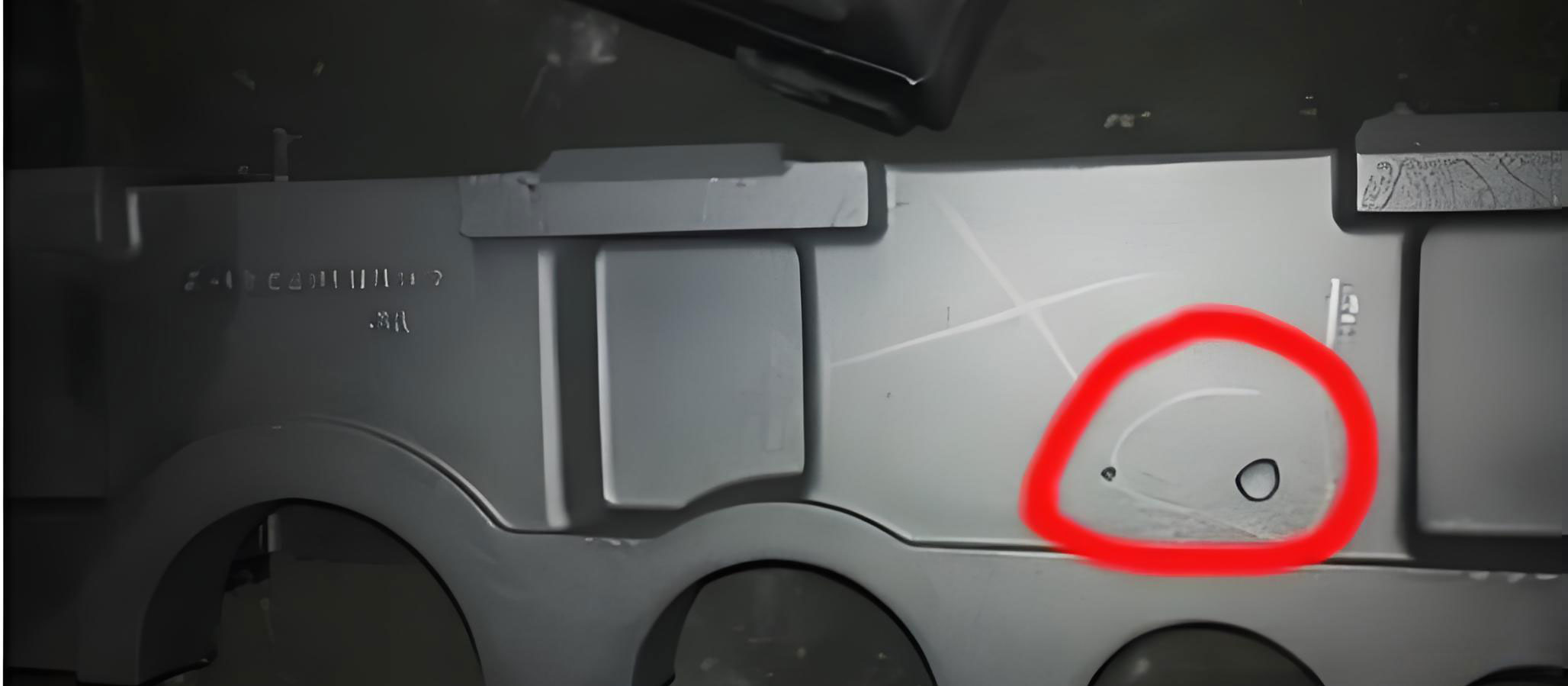
The visual representation of porosity in casting, as shown, underscores the importance of this defect. To combat it, we must first understand its sources. Porosity in casting primarily originates from entrapped air, shrinkage during solidification, and gases released from the melt or die lubricant. My strategy focuses on prevention through process control.
1. Melting and Alloy Preparation: The Foundation
The journey to minimize porosity in casting begins at the furnace. A melt laden with dissolved hydrogen or oxides is a primary source for gas porosity. I emphasize rigorous melt treatment and temperature control. The solubility of hydrogen in aluminum alloys, for instance, follows Sieverts’ law:
$$ C_H = k_H \sqrt{P_{H_2}} $$
where \( C_H \) is the hydrogen concentration, \( k_H \) is the solubility constant, and \( P_{H_2} \) is the partial pressure of hydrogen. This relationship highlights why degassing is critical; reducing \( P_{H_2} \) above the melt lowers \( C_H \). Rotary degassing with inert gas is my preferred method. Furthermore, excessive superheat temperature can increase gas solubility and promote oxidation, both contributing to porosity in casting. The table below summarizes key melting parameters and their influence on porosity in casting.
| Melting Parameter | Optimal Range/ Practice | Effect on Porosity in Casting | Mechanism |
|---|---|---|---|
| Melt Temperature | Alloy-dependent, typically 680-750°C for Al | High temp increases gas solubility & oxidation. | Higher \( k_H \) and dross formation trap gas. |
| Holding Time | Minimize | Prolonged holding increases hydrogen pickup. | Extended exposure to furnace atmosphere. |
| Degassing Method | Rotary impeller with Ar/N2 | Significantly reduces hydrogen content. | Bubbles strip H2 from melt via partial pressure differential. |
| Charge Material Quality | Clean, dry, pre-heated | Reduces initial gas and moisture. | Prevents introduction of H2O and hydrocarbons. |
Effective melt handling reduces the gas load delivered to the die, forming the first defense against porosity in casting.
2. Mold Design: The Pivotal Element
In my view, the mold, particularly the gating and venting system, is the most powerful tool to control porosity in casting. Its purpose is to orchestrate a laminar fill that systematically drives air out through vents before the metal seals them. Poor design leads to turbulent flow, air entrapment, and dead zones—all nurseries for porosity in casting. The key principles I advocate are directional solidification and sequential filling.
The geometry of the runner and gates determines the metal velocity and flow pattern. To minimize turbulence and air entrainment, I calculate the gate velocity to stay below a critical threshold. The energy balance for a fluid stream suggests a relationship for the onset of turbulence that entrains air:
$$ We = \frac{\rho v^2 d}{\sigma} $$
where \( We \) is the Weber number, \( \rho \) is melt density, \( v \) is velocity, \( d \) is characteristic length (e.g., gate thickness), and \( \sigma \) is surface tension. For many aluminum alloys, I aim to keep the gate velocity below 40 m/s to maintain a \( We \) number that discourages jetting and splashing. The fill time \( t_f \) is also critical and relates to the gate area \( A_g \):
$$ t_f = \frac{V}{A_g \cdot v_g} $$
where \( V \) is the cavity volume and \( v_g \) is the gate velocity. A balanced gating system ensures all gates see similar pressure and flow rates. The table below outlines major mold design factors affecting porosity in casting.
| Mold Design Factor | Design Principle | Impact on Porosity in Casting |
|---|---|---|
| Gate Location & Direction | Direct flow along walls, avoid impingement. | Promotes air evacuation; impingement causes turbulence and entraps air. |
| Runner System | Tapered, hydraulically balanced, smooth transitions. | Reduces flow separation and air entrainment in the system itself. |
| Overflow & Vent Design | Strategic placement at last fill areas, adequate cross-section. | Provides escape path for air and cold, contaminated metal. |
| Die Cooling Layout | Promotes directional solidification from far end to gate. | Reduces shrinkage porosity in casting by ensuring feed paths remain open. |
| Surface Finish | High polish in cavity, appropriate texture in vents. | Smoother flow, less friction, and better air escape through vents. |
Optimizing these elements is the most effective long-term strategy to combat porosity in casting.
3. Die Casting Parameters: Precision in Execution
Even with a perfect mold and melt, incorrect machine settings can induce porosity in casting. The two parameters I find most consequential are the shot sleeve fill ratio and the precise point where the slow shot transitions to the fast shot.
Shot Sleeve Fill Ratio (FR): This is the ratio of the volume of molten metal to the total volume of the shot sleeve chamber. It is a fundamental yet often overlooked variable. A low fill ratio means a large air volume sits atop the metal in the sleeve. During the slow shot phase, if the plunger speed is too high, this air can be turbulently engulfed into the metal, becoming a primary source of porosity in casting. I define fill ratio as:
$$ FR = \frac{V_m}{V_s} = \frac{A_s \cdot L_m}{A_s \cdot L_s} = \frac{L_m}{L_s} $$
where \( V_m \) is melt volume, \( V_s \) is sleeve volume, \( A_s \) is sleeve cross-sectional area, \( L_m \) is melt length in sleeve, and \( L_s \) is total sleeve length. For critical parts, I strive for a fill ratio above 50%, ideally 60-75%. This minimizes the air column and allows for a more controlled slow shot. The “critical velocity” \( v_c \) during the slow shot to avoid drawing in air from the top of the sleeve can be approximated by considering a wave formation condition:
$$ v_c \approx \sqrt{g \cdot h} $$
where \( g \) is gravity and \( h \) is the height of the melt pool in the sleeve. A higher fill ratio increases \( h \), thus allowing a higher \( v_c \) without卷气, providing a wider process window.
Slow-to-Fast Shot Transition Point: This is the plunger position where the machine switches from the first phase (slow shot, meant to push metal into the runner without卷气) to the second phase (fast shot, meant to fill the cavity). If this transition occurs too early—before the metal has completely filled the runner and reached the gates—the accelerating plunger can force air in the runner into the cavity. If too late, the metal front may cool too much, leading to cold shuts and mist runs. The optimal transition point \( P_t \) is just as the metal reaches the gates. It can be estimated from geometry:
$$ P_t = L_s – (L_{runner} + L_{sprue} + \delta) $$
where \( L_{runner} \) and \( L_{sprue} \) are equivalent lengths of the runner system, and \( \delta \) is a small safety margin. Modern machines with real-time control allow fine-tuning this point based on plunger position or hydraulic pressure feedback.
Other parameters like intensification pressure and die temperature also play key roles. Intensification pressure must be applied promptly after cavity fill to feed shrinkage, reducing shrinkage porosity in casting. The following table integrates key parameters.
| Parameter | Symbol/Formula | Recommended Practice | Rationale for Reducing Porosity in Casting |
|---|---|---|---|
| Shot Sleeve Fill Ratio | \( FR = L_m / L_s \) | >50%, ideally 60-75% | Minimizes air volume in sleeve, reduces air entrainment during slow shot. |
| Slow Shot Plunger Velocity | \( v_{slow} \) | 0.2-0.5 m/s, below \( v_c \) | Prevents wave formation and air ingestion in the shot sleeve. |
| Fast Shot Velocity | \( v_{fast} \) | 3-6 m/s (at gate) | Ensures rapid cavity fill before metal skins over, but must be balanced with venting capacity. |
| Transition Point | \( P_t \) | Metal at gates, verified by pressure trace | Ensures slow shot evacuates sleeve/runner air before fast shot commits metal to cavity. |
| Intensification Pressure | \( P_{int} \) | 80-100% of machine max, applied within 30 ms | Compresses existing pores and feeds shrinkage, reducing overall porosity in casting. |
| Die Temperature | \( T_d \) | 150-250°C (Al alloys), balanced gradients | Promotes laminar flow, reduces thermal shock, aids venting, and directs solidification. |
4. Die Lubricants (Release Agents): The Subtle Influencer
While often considered a ancillary, die lubricants can contribute to porosity in casting if misapplied. They are essential for part release and die cooling, but excess or improperly vaporized lubricant can generate steam or volatile gases that become trapped. I prefer water-based lubricants with controlled viscosity and apply them using fine mist systems to ensure a thin, even film. The amount should be the minimum required for release. The relationship between lubricant film thickness \( \delta_l \) and gas generation can be conceptualized. If the film is too thick, the heat flux \( q” \) from the die may not fully vaporize it before metal arrival:
$$ q” \cdot t_{contact} < \rho_l \cdot L_v \cdot \delta_l $$
where \( \rho_l \) is lubricant density, \( L_v \) is latent heat of vaporization, and \( t_{contact} \) is time between spray and shot. This incomplete vaporization leads to boiling and gas entrapment, directly causing porosity in casting. Therefore, synchronized application and drying time are crucial.
5. Integrated Case Study: Solving Porosity in a Structural Cover
I recall a project involving a structural cover component made from an aluminum-silicon alloy. The part had a mass of approximately 850g, with nominal wall thickness of 3mm, and required pressure tightness. Initial production yielded a staggering scrap rate of 40-50% due to porosity in casting, primarily identified by leak testing and machining reveals.
Initial Setup & Analysis: The machine had a locking force of 2500 tons, using a shot sleeve of 100mm diameter. The original gating system featured three gates. Flow simulation and short shots revealed that two of the gate flows converged and impinged, creating a turbulent zone that trapped air. Furthermore, one gate location prematurely sealed the main venting path along the parting line. The shot sleeve fill ratio was a meager 35%, calculated as:
$$ FR_{initial} = \frac{850g / (2700 kg/m^3)}{(\pi \cdot (0.1m)^2 / 4) \cdot 0.45m} \approx 0.35 $$
This low FR meant a large air column was present. The slow shot speed, though set low, likely still caused some air entrainment due to the shallow metal pool. The fast shot transition was set empirically and was likely too early.
Corrective Actions Implemented:
1. Mold Redesign: I led a redesign focusing on flow direction. We eliminated the gate causing impingement and redirected the remaining gates to promote wall-hugging flow. Runner cross-sections were increased slightly to reduce velocity, and overflows were repositioned at the last fill areas. The new design aimed for sequential fill and efficient venting.
2. Shot Sleeve Optimization: We changed the shot sleeve to a “short sleeve” with a diameter of 80mm. This increased the fill ratio dramatically:
$$ FR_{new} = \frac{850g / (2700 kg/m^3)}{(\pi \cdot (0.08m)^2 / 4) \cdot 0.35m} \approx 0.71 $$
This 71% fill ratio significantly reduced the air volume in the sleeve.
3. Parameter Recalibration: The slow shot speed was recalculated based on the new melt depth \( h \) in the sleeve. Using \( h = FR_{new} \cdot D_{sleeve} \) conceptually, the allowable slow shot speed increased, providing more stability. The transition point was meticulously set using a dummy shot to determine the exact position where metal filled the runner. Intensification pressure was set to 90 MPa with a delay of less than 20 milliseconds.
Results: The outcome was transformative. Leak test rejection rates dropped from over 40% to near zero. Machined surfaces showed no visible porosity in casting. The process became robust and repeatable. This case cemented my belief that a scientific approach to fill ratio and transition point, coupled with intelligent mold design, is paramount to eliminating porosity in casting.
6. Conclusion and Future Perspectives
Minimizing porosity in casting is an achievable goal through disciplined application of principles across melting, mold design, machine parameters, and auxiliary processes. As I have detailed, special attention must be paid to the shot sleeve fill ratio and the slow-fast shot transition—parameters that directly govern the amount and behavior of air in the system before cavity fill. The fight against porosity in casting is a battle for control: control of gas content, control of flow, and control of solidification. Advanced tools like real-time monitoring, pressure curve analysis, and sophisticated simulation software are invaluable, but they must be guided by fundamental understanding. By persistently applying the strategies and formulas discussed—from calculating fill ratios to optimizing gate velocities—engineers can systematically drive down defect rates, enhance product performance, and achieve new levels of quality in die casting. The pursuit of zero porosity in casting remains a challenging frontier, but with integrated process mastery, it is within reach.