
In my extensive experience within the foundry industry, the production of components with wall thicknesses at or below 1 mm represents a formidable frontier in precision investment casting. The technical manuscript provided details a successful campaign to cast a 205 mm long part from ZG0Cr17Ni4Cu4Nb stainless steel, targeting a hardness of 26-32 HRC. This achievement underscores the profound capability of precision investment casting when process discipline and meticulous design converge. The core challenge lies in achieving complete mold filling and sound metallurgical structure in sections so thin that they verge on the theoretical limits of metal flow and solidification. This article, drawn from a first-person perspective of process engineering, will delve deeply into the methodologies, scientific principles, and rigorous controls that enable the reliable manufacture of such ultra-thin-walled castings through precision investment casting. We will expand upon the referenced process, incorporating fundamental theories, extended parameter analyses, and generalized best practices to form a comprehensive guide exceeding 8000 tokens in scope.
The essence of precision investment casting, or lost-wax casting, is its ability to produce net-shape components with exceptional surface finish and dimensional accuracy. For thin-walled structures, this process is uniquely suited but demands extreme optimization. Every variable—from wax rheology and ceramic shell permeability to melt superheat and thermal gradient management—becomes critically magnified. The succeeding sections will dissect the entire value chain, emphasizing why precision investment casting is the nonpareil choice for such applications.
1. Material Foundation and Metallurgical Design
The selection of ZG0Cr17Ni4Cu4Nb, a precipitation-hardening stainless steel, is strategic. Its combination of corrosion resistance and strength post-aging is vital for the component’s service life. However, its casting behavior, particularly fluidity and hot tearing susceptibility, must be carefully managed. The chemical composition is the first checkpoint in precision investment casting quality assurance.
| Element | C | Si | Mn | Cr | Ni | Cu | Nb | S | P |
|---|---|---|---|---|---|---|---|---|---|
| Specification | ≤0.07 | ≤1.0 | ≤1.0 | 15.5-17.5 | 3.0-5.0 | 2.6-4.6 | 0.15-0.45 | ≤0.030 | ≤0.035 |
To achieve the target mechanical properties, the melt chemistry must be tightly controlled. A typical charge calculation for precision investment casting aims to compensate for melt loss and ensure the final composition sits optimally within the specification window. The fluidity of the melt, crucial for filling 1 mm sections, is influenced by composition. An empirical relationship for fluidity length ($L_f$) can be considered:
$$L_f = k \cdot \frac{\Delta T_{sup}}{viscosity}$$
where $k$ is a mold constant, and $\Delta T_{sup}$ is the superheat. Elements like silicon and carbon can affect both the superheat range and viscosity, necessitating precise charge makeup.
| Property | Tensile Strength (MPa) | Yield Strength (MPa) | Elongation (%) | Reduction in Area (%) | Hardness (HRC) |
|---|---|---|---|---|---|
| Requirement | ≥ 1000 | ≥ 800 | ≥ 5 | ≥ 10 | 26 – 32 |
2. The Ceramic Shell: Engineered Permeability and Strength
The heart of the precision investment casting process for thin walls is the ceramic shell. It must be strong enough to withstand metallostatic pressure and handling, yet sufficiently permeable to allow air and wax residue to escape during dewaxing and metal pouring. For a 1-mm wall, the shell’s thermal properties also dramatically affect the cooling rate. The standard shell build sequence is a symphony of layered engineering.
| Layer | Slurry Type | Slurry Density (g/cm³) | Stucco Material & Grit (Mesh) | Drying Time (h) | Critical Function |
|---|---|---|---|---|---|
| 1 (Prime) | Silica Sol + Fused Alumina Flour | 2.48 – 2.52 | Fused Alumina Sand, 70 | >24 | Provides final surface finish, high refractoriness. |
| 2 | Silica Sol + Fused Alumina Flour | 2.05 – 2.10 | Fused Alumina Sand, 46 | – | Builds strength and bridges primary layer. |
| 3-6 (Back-up) | Silica Sol + Chamotte Flour | 1.80 – 1.85 | Chamotte Sand, 30/60 to 16/30 | 6 – 8 | Provides bulk strength and insulation. |
| Seal | Silica Sol + Chamotte Flour | 1.80 – 1.85 | – | 6 – 8 | Seals surface, enhances green strength. |
The drying kinetics between layers are paramount. Incomplete drying leads to shell cracking or delamination. The drying time $t_d$ for a layer can be approximated by a diffusion-based model:
$$t_d \propto \frac{\delta^2}{D}$$
where $\delta$ is the layer thickness and $D$ is the effective moisture diffusivity, a function of slurry composition and ambient conditions (temperature, humidity, airflow). For the prime layers in precision investment casting, extended drying ($>24$ h) is non-negotiable to prevent defects like veining or rat-tails on the delicate cast surface.
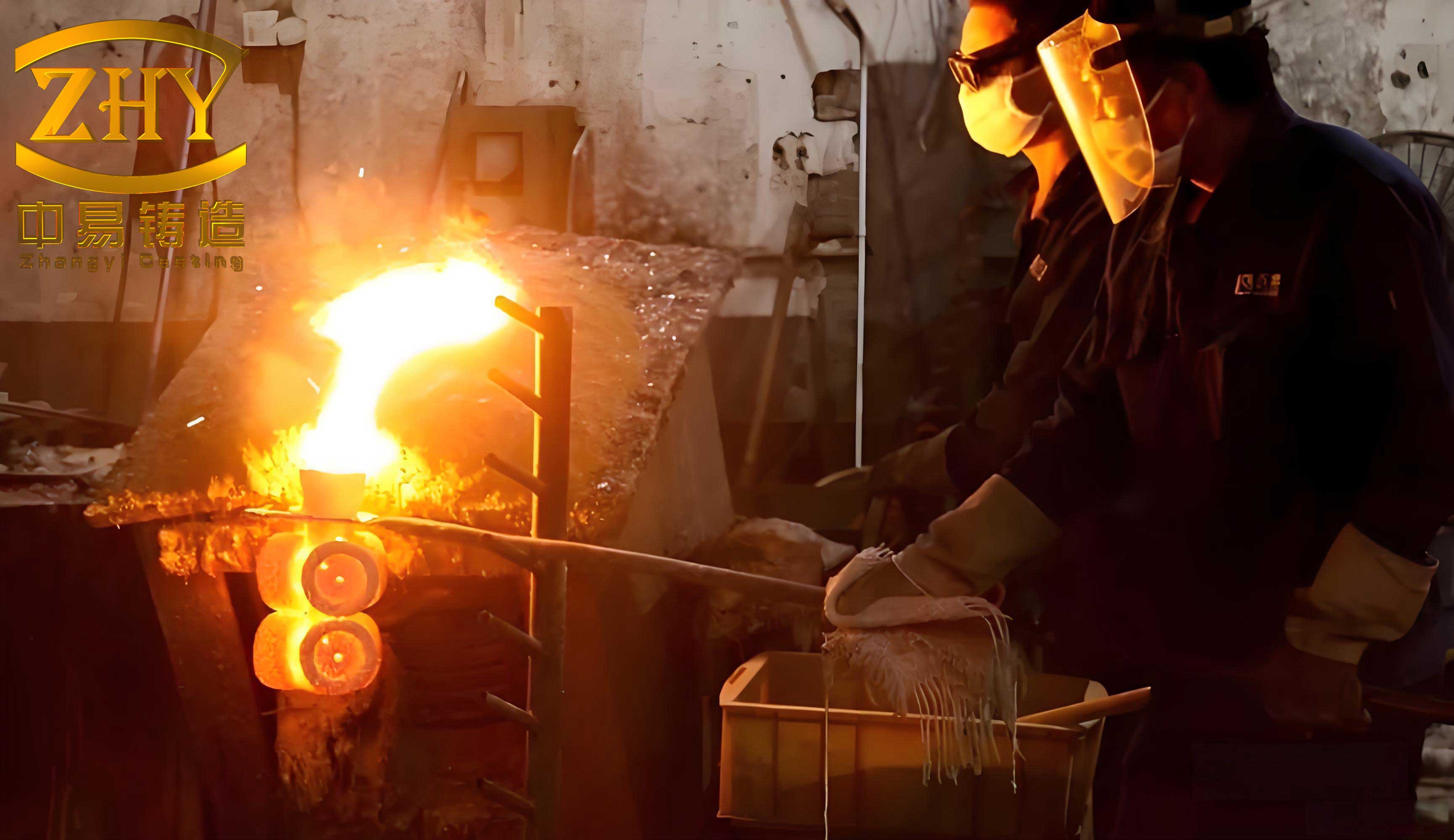
The image above exemplifies the intricate geometries and excellent surface quality achievable through disciplined precision investment casting processes, akin to the thin-walled component discussed.
3. Melt Dynamics and Pouring Physics
Molten metal must traverse thin, intricate channels to fill the mold. The governing principles are derived from fluid dynamics and heat transfer. The pressure head ($\Delta P$) required to overcome fluid friction and surface tension in a channel of thickness $d$ (1 mm) is significant. A simplified form of the momentum equation (Navier-Stokes) for laminar flow in a narrow passage can be considered:
$$\Delta P = \frac{12 \mu L v}{d^2} + \frac{2 \sigma \cos \theta}{d}$$
where $\mu$ is dynamic viscosity, $L$ is flow length, $v$ is average velocity, $\sigma$ is surface tension, and $\theta$ is the contact angle. This equation highlights why superheat (reducing $\mu$) and rapid pouring (increasing $v$ via $\Delta P$) are essential in precision investment casting of thin sections.
The melt practice for precision investment casting thus involves stringent protocols:
- Charge Calculation: Based on the target analysis, a typical charge for ZG0Cr17Ni4Cu4Nb is formulated.
| Element | C | Si | Mn | Cr | Ni | Cu | Nb | Balance (Fe) |
|---|---|---|---|---|---|---|---|---|
| Target | 0.05 | 0.75 | 0.40 | 16.10 | 4.00 | 3.20 | 0.28 | Remainder |
- Shell Preheating: The shell is fired to $(1090 \pm 10)^\circ\text{C}$. This eliminates residual volatiles, sinters the ceramic for strength, and reduces the thermal shock upon metal entry. The heat transfer during pouring is a transient conduction problem. The temperature field $T(x,t)$ can be modeled by:
$$\frac{\partial T}{\partial t} = \alpha \frac{\partial^2 T}{\partial x^2}$$
where $\alpha$ is thermal diffusivity. A hot mold reduces the rate of solidification at the metal-front, aiding fill.
- Pouring Parameters: Pouring temperature: $(1680 \pm 10)^\circ\text{C}$. Time from furnace tap to mold fill complete: $< 12$ seconds. This short time window minimizes heat loss. The solidification time $t_s$ for a thin wall can be estimated using Chvorinov’s rule modified for a plate:
$$t_s = B \cdot \left( \frac{V}{A} \right)^n = B \cdot \left( \frac{d}{2} \right)^n$$
where $B$ and $n$ are constants depending on metal and mold properties, $V$ is volume, $A$ is cooling surface area, and $d$ is thickness. For a 1 mm wall, $t_s$ is extremely short, demanding rapid, uninterrupted filling—a hallmark challenge in precision investment casting.
4. Gating, Feeding, and Solidification Design
For thin-walled castings, the traditional role of feeders (risers) to compensate for volumetric shrinkage is often secondary to ensuring fill. However, localized thick sections (like mounting lugs or flanges) can create shrinkage porosity if not fed. The gating system must therefore serve a dual purpose: facilitate rapid fill and provide minimal feeding where needed.
In the referenced part, gates were positioned at thicker boss areas, and backside vents/feeders were incorporated. The modulus method, a cornerstone of precision investment casting feeding design, states that a feeder solidifies later than the casting if:
$$M_f > k \cdot M_c$$
where $M_f$ and $M_c$ are the geometric moduli (Volume/Surface Area ratio) of the feeder and casting section, and $k$ is a safety factor ($>1$). For a thin wall with $M_c \approx 0.5$ mm, designing an effective feeder is impractical; hence, the alloy’s wide solidification range and process controls must prevent microporosity.
5. Post-Casting Thermal Processing: Metallurgy in Action
For precipitation-hardening steels like ZG0Cr17Ni4Cu4Nb, heat treatment is integral to achieving properties. The three-stage process—homogenization, solution treatment, and aging—transforms the as-cast microstructure.
- Homogenization: $(1150 \pm 10)^\circ\text{C}$, 1-1.5 h, air cool. This treatment reduces microsegregation (coring) from the rapid solidification inherent in precision investment casting. The diffusion length $x$ can be estimated by $x \approx \sqrt{D_{eff} t}$, where $D_{eff}$ is an interdiffusion coefficient for the segregating elements.
- Solution Treatment: $(1040 \pm 10)^\circ\text{C}$, 1-1.5 h, air cool. This takes the alloying elements (Cu, Nb) into solid solution, creating a supersaturated martensitic matrix upon cooling. The driving force for precipitation in the subsequent step is the degree of supersaturation, $\Delta C = C_0 – C_{eq}$, where $C_0$ is bulk concentration and $C_{eq}$ is equilibrium solubility at aging temperature.
- Aging (Precipitation Hardening): $(550 \pm 10)^\circ\text{C}$, 2-2.5 h, air cool. Fine coherent precipitates (e.g., Cu-rich or Ni-Nb phases) form, impeding dislocation motion. The increase in yield strength $\Delta \sigma_y$ can be described by the Orowan bypass mechanism or chemical strengthening models:
$$\Delta \sigma_y \propto \frac{G b}{L}$$
where $G$ is shear modulus, $b$ is Burgers vector, and $L$ is the inter-precipitate spacing. This step delivers the final 26-32 HRC hardness.
To prevent decarburization during high-temperature stages, a protective ceramic coating (mimicking the prime shell layers) is often applied—another nuance specific to precision investment casting where surface integrity is paramount.
6. Process Control and Metrology: The Quality Bastion
The success of precision investment casting for such demanding parts hinges on uncompromising process control. A 5S-based quality system ensures discipline. Key operational checkpoints include:
- Wax Injection: Pressure: 2.0 MPa, Hold: 20 s. Wax viscosity must be consistent. The shear-thinning behavior of wax is critical for replicating the 1 mm section.
- Shell Drying: Controlled humidity ($\sim$60% RH) and airflow ($\sim$1-2 m/s) are maintained. The drying rate must avoid skin formation that traps liquid.
- De-waxing: Typically autoclave steam de-waxing. The rapid heating vaporizes wax; shell permeability dictates success without cracking.
- Finishing: Cutting gates with minimal remnant ($\le$3 mm), followed by blasting with fine alumina ($40-70$ mesh) at low pressure ($\le 0.4$ MPa) to avoid distortion.
Dimensional inspection employs dedicated fixtures, profile gauges, and optical comparators. For complex contours, coordinate measuring machine (CMM) verification is indispensable. Non-destructive testing (NDT) like fluorescent penetrant inspection (FPI) and radiography are mandated to detect surface and subsurface flaws that could be catastrophic in thin sections.
7. Theoretical Underpinnings and Advanced Considerations
Pushing the boundaries of precision investment casting for ultra-thin walls invites deeper scientific inquiry. Several advanced models can be employed:
Filling Simulation: Computational fluid dynamics (CFD) software solves the full Navier-Stokes equations coupled with volume-of-fluid (VOF) methods to track the metal-air interface. This predicts mist runs, cold shuts, and air entrapment. The governing equations are:
$$\nabla \cdot \vec{v} = 0$$
$$\rho \left( \frac{\partial \vec{v}}{\partial t} + \vec{v} \cdot \nabla \vec{v} \right) = -\nabla p + \mu \nabla^2 \vec{v} + \rho \vec{g} + \vec{F}_{st}$$
where $\vec{F}_{st}$ is the surface tension force, critically important at the 1-mm scale.
Solidification Modeling: Finite element analysis (FEA) simulates temperature history, predicting grain structure, shrinkage porosity, and residual stress. The energy equation includes latent heat release $L$:
$$\rho c_p \frac{\partial T}{\partial t} = \nabla \cdot (k \nabla T) + \rho L \frac{\partial f_s}{\partial t}$$
where $f_s$ is solid fraction. This helps optimize gating and cooling to achieve directional solidification where possible.
Mechanical Property Prediction: Empirical relations based on composition and cooling rate can estimate as-cast properties. For instance, secondary dendrite arm spacing (SDAS), $\lambda_2$, which refines with increased cooling rate $R$ ($\lambda_2 \propto R^{-n}$), influences tensile strength via the Hall-Petch relationship for the dendritic cells.
8. Conclusion: Synthesizing the Precision Investment Casting Doctrine for Thin Walls
The successful production of a 1-mm thick, high-integrity casting from a precipitation-hardening stainless steel is a testament to the power of a fully integrated and disciplined precision investment casting approach. It is not a single trick but a holistic system encompassing materials science, fluid dynamics, heat transfer, and rigorous quality management. This process has demonstrated that precision investment casting is capable of transcending traditional wall-thickness limitations. Key takeaways include: the non-negotiable requirement for prime shell integrity and permeability; the criticality of high superheat and ultra-fast pouring to outrun solidification; the necessity of tailored thermal processing to unlock alloy potential; and the imperative of statistical process control at every step. As industries demand ever lighter, stronger, and more complex components, the role of advanced precision investment casting will only expand. Future developments may involve active cooling of molds, nanoparticle-enhanced slurries for thinner shell layers, and real-time adaptive control of pouring parameters using machine learning fed by sensor data. The journey to master ultra-thin-walled casting via precision investment casting is continuous, driven by relentless innovation and an unwavering commitment to precision.