
The relentless advancement of aerospace vehicles demands components that are not only geometrically complex but also possess exceptional specific strength, high-temperature capability, and corrosion resistance. This evolution has positioned the investment casting process as a cornerstone technology for manufacturing critical flight components, such as engine casings and structural frames, in an integrated manner. However, the development of large, intricate castings from advanced high-temperature titanium alloys presents a formidable set of challenges. These materials, designed for service beyond 550°C, often exhibit poor fluidity and a pronounced tendency for hot tearing compared to conventional alloys like Ti-6Al-4V (TC4). This necessitates a highly tailored approach to the entire investment casting process chain, from pattern design to post-casting treatments. Our research focuses on overcoming these hurdles in the production of a large-scale skeleton component from ZTi55A alloy, a next-generation high-temperature titanium alloy.
The target component is a prime example of modern design complexity: a large, non-axisymmetric, semi-open structure with maximum dimensions of approximately 1600 mm x 800 mm and wall thicknesses consistently under 3 mm. Fabricating such a part as a single, sound casting in ZTi55A requires a meticulous, step-by-step strategy to manage stress, ensure complete filling, and control metallurgical quality. Our foundational work began with a segmented approach to de-risk the overall investment casting process.
Phase 1: Segmented Casting – De-risking the Investment Casting Process
Recognizing the inherent cracking sensitivity of ZTi55A, the initial strategy decomposed the large skeleton into three logical segments: fore, middle, and aft. This segmentation deliberately placed weld joints in areas of greater and more uniform thickness, facilitating subsequent electron beam welding. A bottom-gating system was designed for each segment to promote tranquil mold filling, directional solidification, and effective degassing—critical factors in the investment casting process for reactive alloys like titanium.
Pattern fabrication employed laser rapid prototyping, enabling swift, mold-free production and easy design iteration. Dedicated anti-distortion and inspection fixtures were crucial for maintaining the dimensional fidelity of the large wax assemblies. The ceramic mold system was built using a composite refractory material (a blend of Y2O3 and ZrO2) and a novel binder. The shelling sequence involved robotic slurry dipping, followed by stuccoing with various grades of alumina-zirconia and alumina sands, culminating in a robust, multi-layer shell.
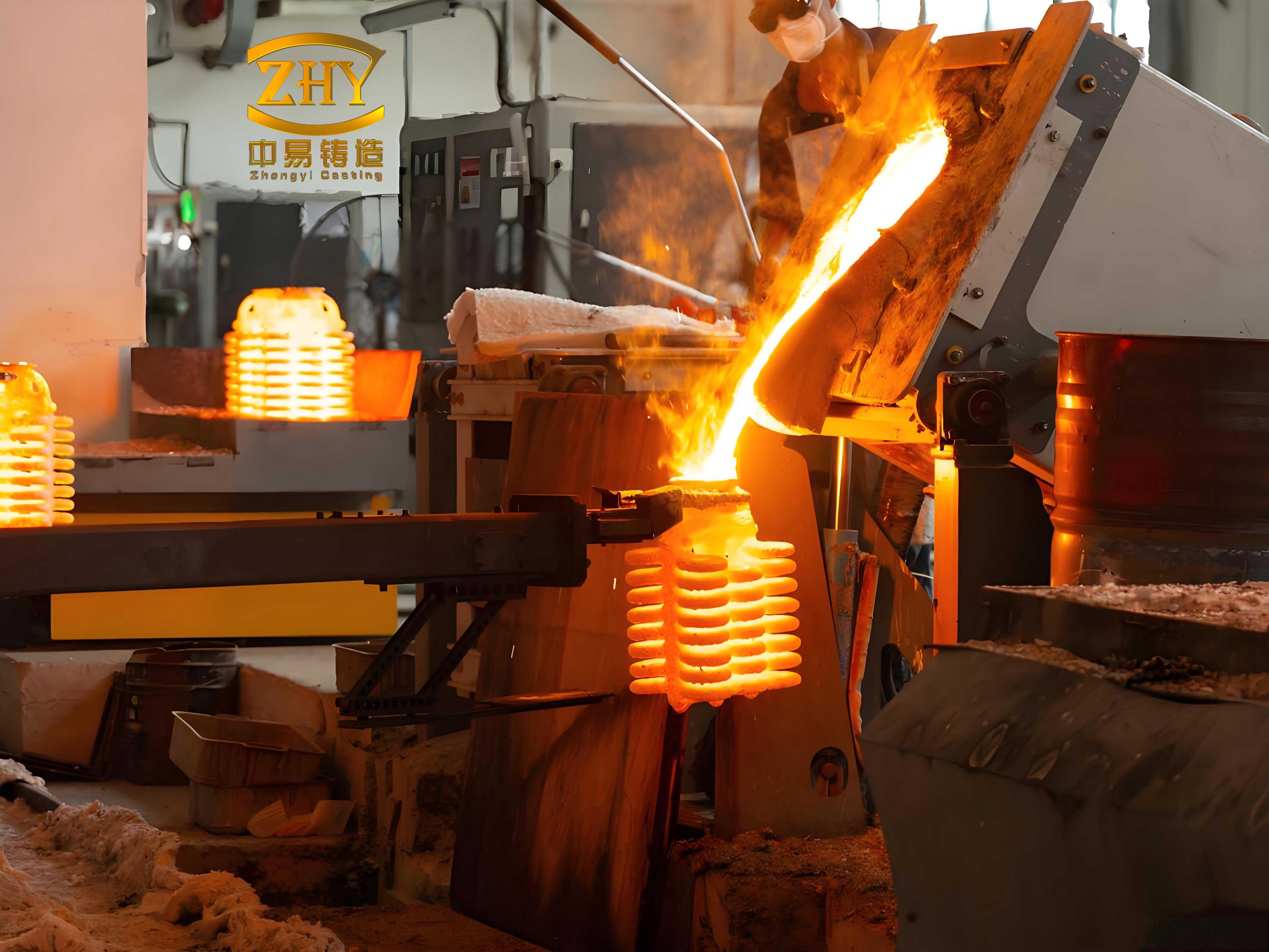
A pivotal parameter in this investment casting process was the “hot mold” pouring technique. The fired ceramic molds were preheated to 400-450°C before being rapidly transferred to the vacuum arc melting furnace. This practice significantly reduces the thermal gradient during metal pouring and solidification, thereby lowering thermal stress and the propensity for crack initiation. The melting current was elevated to between 45,000 and 50,000 A to increase superheat, improving metal fluidity. Post-pouring, the molds were insulated to further slow the cooling rate. The result was three segment castings with excellent surface finish, full fill, and no visually detectable cracks. Chemical analysis confirmed the composition was within the specified range for ZTi55A alloy, as shown in the comparison below.
| Alloying Element | Standard Specification (wt.%) | Measured in Segment (wt.%) |
|---|---|---|
| Aluminum (Al) | 5.2 – 5.8 | 5.66 |
| Tin (Sn) | 3.0 – 4.0 | 3.61 |
| Zirconium (Zr) | 2.5 – 3.5 | 2.9 |
| Molybdenum (Mo) | 0.2 – 1.0 | 0.7 |
| Silicon (Si) | 0.1 – 0.5 | 0.29 |
| Niobium (Nb) | 0.2 – 0.7 | 0.38 |
| Tantalum (Ta) | 0.2 – 0.7 | 0.36 |
| Oxygen (O) | ≤ 0.20 | 0.17 |
Phase 2: Integral Casting – Synthesis and Optimization
Building on the insights from the segmented investment casting process, we proceeded to tackle the monolithic casting of the full skeleton. Key learnings informed several critical design-for-manufacture (DFM) modifications to the pattern and process:
- Stress Concentration Mitigation: Fillet radii at stress-prone thin-thick transitions were increased on the pattern. After casting, these areas are machined back to the final required profile, eliminating the crack-initiating sharp geometry from the solidification stage.
- Shell Integrity Assurance: Small, deep recesses that risked inadequate shell drying and subsequent inclusions were filled in the casting. These features are subsequently created via post-casting machining, guaranteeing dimensional accuracy and shell reliability.
- Feeding Optimization: Riser sizes were strategically enlarged to more effectively draw shrinkage porosity away from the critical casting body, ensuring soundness after Hot Isostatic Pressing (HIP) and riser removal.
- Pattern Reinforcement: Extensive use of process ribs and strengthening plates was incorporated into the wax pattern to rigidize the structure against warpage during the investment casting process.
The gating system was a scaled-up version of the successful bottom-gate design. The full-scale wax pattern was assembled from laser-fabricated sections on a dedicated, rigid fixture to prevent handling deformation. Extreme care was taken to prevent ceramic inclusions: mold cavities were meticulously inspected and cleaned after the high-temperature firing cycle. The same hot-mold pouring protocol was employed. The outcome was a fully formed, integral ZTi55A skeleton casting with complete fill and excellent surface characteristics, marking a significant milestone in the investment casting process for this alloy.
Post-Casting Treatment: Acid Pickling and Repair Welding
The completion of the investment casting process is only the first half of the journey. Post-casting treatments are equally critical for achieving the final component properties. For titanium castings, two paramount steps are the removal of the alpha-case contamination layer and the repair of any allowable casting anomalies.
Alpha-Case Removal via Controlled Pickling
The reaction between molten titanium and the ceramic mold forms a hard, brittle, oxygen-enriched surface layer called the “alpha-case.” This layer must be completely removed, as it severely degrades fatigue life and ductility. The thickness of this layer ($d_{\alpha}$) is influenced by several factors inherent to the investment casting process, including mold temperature ($T_m$), pouring superheat ($\Delta T$), and the reactivity of the shell material. For a given shell system, we observed a correlation between casting section thickness ($t$) and $d_{\alpha}$, likely due to variations in local solidification time.
We determined the required pickling time ($t_{pickle}$) based on experimental measurement of the alpha-case thickness and the empirically determined chemical etching rate ($R_{etch}$) of the ZTi55A alloy in our specific acid solution. The governing relationship is:
$$ t_{pickle} = \frac{d_{\alpha}}{R_{etch}} + t_{safety} $$
Where $t_{safety}$ is a small additional time factor to ensure complete removal. For our process, with a conservative $d_{\alpha}$ estimate of 0.4 mm and an $R_{etch}$ of 0.014 mm/min, the calculated $t_{pickle}$ was approximately 30 minutes. The pickling solution formulation was a critical parameter, optimized as:
$$ \text{Solution Vol. Ratio: } HF_{(40\%)} : HNO_{3_{(65\%)}} : H_2O = 1 : 3 : 6 $$
This formulation effectively dissolved the brittle layer without excessive attack on the sound base metal.
Development of a Cracking-Resistant Repair Welding Procedure
Due to the size and complexity of the component, the presence of minor, repairable defects is a reality in the investment casting process. However, ZTi55A’s susceptibility to weld cracking posed a major challenge. Our objective was to develop a procedure that kept the total stress during welding ($\sigma_{total}$) below the material’s yield strength ($\sigma_y$) at the welding temperature. $\sigma_{total}$ is a function of thermal stress from the temperature gradient ($\nabla T$), solidification shrinkage strain ($\epsilon_{sh}$), and transformation strain ($\epsilon_{tr}$).
$$ \sigma_{total} \approx f(\nabla T, \epsilon_{sh}, \epsilon_{tr}) $$
To minimize $\nabla T$ and thus $\sigma_{total}$, we instituted a multi-stage preheating protocol:
1. Global preheat of the entire casting to 350-400°C before placing it in the vacuum welding chamber.
2. Intensive local preheating of the repair zone to 600-800°C using the welding arc itself prior to depositing filler metal.
The welding parameters were strictly controlled to minimize heat input and strain rate:
| Parameter | Optimal Range | Purpose |
|---|---|---|
| Welding Current (I) | 50 – 100 A | Low heat input |
| Travel Speed (v) | 2 – 3 mm/s | Controlled deposition |
| Post-Weld Slow Cooling | Localized insulation | Reduce cooling rate/quenching stress |
Furthermore, a post-weld stress relief treatment using ultrasonic vibration was applied immediately after cooling, followed by a full vacuum stress-relief anneal within 12 hours. This comprehensive protocol successfully eliminated cracking in repair welds, a critical achievement for qualifying the overall investment casting process for high-reliability applications.
Consolidated Process Parameters and Summary
The successful production of the ZTi55A large skeleton casting was the result of synthesizing and optimizing a vast array of parameters across the entire investment casting process chain. The table below summarizes the key final parameters that define this tailored process.
| Process Stage | Key Parameter / Material | Specification / Value |
|---|---|---|
| Pattern & Mold Making | Pattern Fabrication | Laser Rapid Prototyping + Stabilization Fixtures |
| Primary Refractory | Y2O3/ZrO2 Composite (ZM) | |
| Binder System | Novel Composite Binder (ZYM), ZM:ZYM = 5:1 | |
| Shell Building & Firing | Stucco Sequence | 1x Fine Al-Zr, 8x Alumina, 1x Seal Coat |
| Drying Condition | 22±2°C, 40-60% RH, 10-12 hrs/layer | |
| Firing Temperature | Peak ~1000°C (see profile) | |
| Preheat before Pour | 400 – 450°C (Hot Mold) | |
| Melting & Pouring | Alloy | ZTi55A (Ti-5.5Al-3.5Sn-3Zr-0.7Mo-0.4Nb-0.4Ta-0.3Si) |
| Melting Current | 45,000 – 50,000 A | |
| Pouring Method | Bottom Gating, Static Pour | |
| Post-Casting (Chemical) | Alpha-Case Pickling | HF:HNO3:H2O (1:3:6), 30 min |
| Chemical Etch Rate (Retch) | ~0.014 mm/min (for above solution) | |
| Post-Casting (Repair) | Global Preheat | 350 – 400°C |
| Local Preheat | 600 – 800°C (Arc preheat) | |
| Repair Welding | 50-100 A, 2-3 mm/s, Vacuum | |
| Post-Weld Treatment | Ultrasonic Stress Relief + Vacuum Anneal |
In conclusion, the fabrication of large, complex thin-walled structures in advanced high-temperature titanium alloys like ZTi55A is a multidisciplinary challenge. It requires a holistic and highly adaptive approach to the entire investment casting process. Success hinges not on a single silver bullet but on the precise integration and control of numerous interlinked steps: from intelligent pattern design and robust ceramic mold engineering, through carefully thermoregulated melting and pouring, to rigorously developed post-casting chemical and welding treatments. This investigation demonstrates that by systematically addressing the unique behavioral characteristics of the alloy at each stage—particularly its fluidity and cracking sensitivity—the investment casting process can be successfully leveraged to produce high-integrity, near-net-shape components that meet the demanding performance criteria of next-generation aerospace systems. The methodologies and parameters established here provide a foundational framework for the continued expansion of the investment casting process into the realm of large-scale, high-temperature titanium alloy components.