
The pursuit of enhanced wear resistance in grinding media has long been anchored to chromium-alloyed cast irons. While effective, the economic landscape, characterized by volatile prices for alloying elements like chromium, imposes significant pressure on production costs. Forged steel balls, though an alternative, present their own challenges: a steep hardness gradient from surface to core (HRC 58-62 vs. 42-48) often compromises their overall durability in severe impact-abrasion environments, and their cost remains tightly coupled to the price fluctuations of steel billets.
This scenario has catalyzed the development and adoption of Carbidic Austempered Ductile Iron (CADI). This material paradigm offers a compelling synergy of surface hardness (typically HRC 50-55) and core toughness, resulting from a unique heat treatment that transforms the metallic matrix. A fundamental, yet often overlooked, economic advantage of using spheroidal graphite cast iron lies in its density. The presence of non-metallic, spherical graphite nodules reduces the overall density of CADI balls to approximately 7.3 t/m³, compared to 7.7-7.8 t/m³ for chromium cast irons and forged steel. This 6-7% reduction in weight translates directly to a lighter mill charge, reducing the starting torque and operational power draw of grinding mills, leading to estimated energy savings of 5-8%. This operational efficiency, combined with the material’s intrinsic wear performance, underscores the total economic benefit of CADI grinding balls. Driven by industry demand, our production practice has focused on refining the entire manufacturing chain—from melting and casting to precise heat treatment—to consistently produce high-quality CADI balls. This article details our comprehensive approach, grounded in systematic process control and optimization.
Foundry Practice for Spheroidal Graphite Cast Iron Grinding Balls
Molding and Pattern Design
The foundation of a sound casting is laid during molding. For spheroidal graphite cast iron grinding balls, we employ permanent metal molds. A single mold cavity is designed to produce four balls simultaneously. The gating and risering systems are created using resin-coated sand cores placed at strategic locations within the metal mold. This hybrid approach combines the benefits of high cooling rate from the metal mold with the flexibility of sand for complex feeding channels. The high thermal conductivity and rigidity of the metal mold promote rapid solidification, leading to a finer and more uniform distribution of graphite nodules—a critical prerequisite for subsequent heat treatment. Prior to pouring, the metal mold is preheated to a temperature between 250°C and 300°C to prevent thermal shock and ensure proper filling. A practical technique involves inserting small steel bars (e.g., 4.5mm x 4.5mm x 10mm) into the mold’s vent holes; this allows gases to escape while preventing molten metal from leaking through these vents.
Design and Control of Chemical Composition
The chemical composition is the genetic code determining the final properties of the spheroidal graphite cast iron. For CADI, the goal is to balance graphitization potential, hardenability, and carbide formation.
- Carbon and Silicon: As the primary graphitizing elements, C and Si govern the amount and morphology of graphite. A higher carbon equivalent (CE) increases graphite content but can deteriorate nodularity if inoculation is insufficient or trace harmful elements are present. Elevated C and Si also promote a ferritic matrix in the as-cast state. Since the matrix will be transformed during austempering, the focus is on achieving a high nodule count without excessive ferrite. We control the carbon content between 3.5-3.6 wt.% and silicon between 2.3-2.5 wt.%. The Carbon Equivalent can be estimated by:
$$ CE = \%C + \frac{\%Si + \%P}{3} $$
A target CE is typically maintained below 4.5 to ensure sound castings and good response to austempering. - Phosphorus and Sulfur: These are detrimental elements. P forms hard, brittle phosphide eutectics at grain boundaries, severely impacting toughness. S interferes with nodulizing treatment. We source low-P, low-S steel scrap and pig iron, aiming for base iron levels of $w(P) \le 0.06\%$ and $w(S) \le 0.06\%$, with lower values being preferable.
- Manganese: Mn is a potent promoter of hardenability, helping to achieve the desired austempered structure throughout the cross-section of larger balls. However, it is a strong segregating element, tending to concentrate at cell boundaries, which can facilitate the formation of martensite or pearlite during cooling. Therefore, its content is carefully controlled in the range of 0.7-0.8 wt.%.
- Alloying for Hardenability: For larger diameter balls (e.g., >100 mm), additional alloying is necessary to suppress the formation of high-temperature transformation products (pearlite) during the quench to the austempering bath. Common alloying elements include Molybdenum (Mo), Copper (Cu), and Nickel (Ni). Their effects are summarized below.
- Chromium: As a strong carbide former, Cr enhances hardness and wear resistance by promoting the formation of hard (Fe,Cr)₃C carbides. However, excessive Cr leads to coarse carbides and a marked reduction in impact toughness. For a balanced property profile, Cr content is maintained between 1.1-1.2 wt.%.
The target composition for a Ø110 mm grinding ball is presented in Table 1.
| C | Si | Mn | P | S | Cr | Cu | Mo | Ni |
|---|---|---|---|---|---|---|---|---|
| 3.6 | 2.4 | 0.8 | <0.06 | <0.06 | 1.2 | 0.5 | 0.3 | 0.3 |
| Element | Primary Function | Effect on Hardenability | Considerations for CADI |
|---|---|---|---|
| Mo | Strong hardenability enhancer, refines carbides. | Very High | Most effective alloy, but expensive. Reduces transformation kinetics during austempering. |
| Cu | Moderate hardenability, promotes pearlite suppression. | Medium | Less prone to segregation than Mn. Can improve corrosion resistance. |
| Ni | Austenite stabilizer, improves hardenability and toughness. | Medium-High | Does not form carbides. Very effective in heavy sections, but costly. |
| Cr | Carbide former, increases hardness and wear. | Medium | Must be balanced with toughness. Content >1.5% risks excessive brittle carbides. |
Nodulizing and Inoculation Treatment
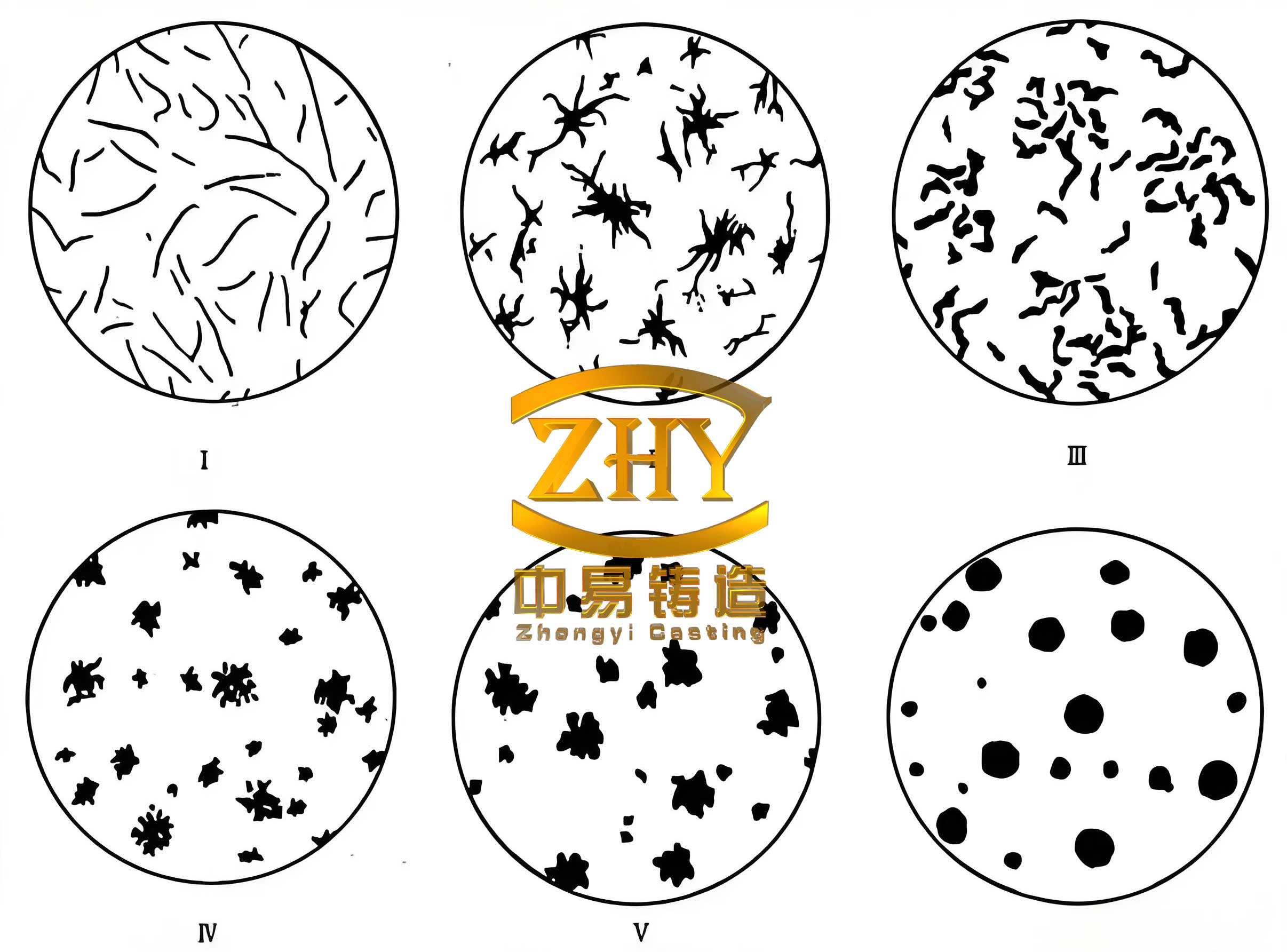
This is the most critical step in producing high-quality spheroidal graphite cast iron. The success of the subsequent austempering process is entirely dependent on achieving a high nodule count and superior nodularity (spheroidal shape). A nodularity rating above 80% (Graphite Shape Type I, II, III) and a small, uniform nodule size (finer than ASTM size 6, i.e., < 0.05 mm) are essential. Higher nodularity provides more nucleation sites for the austenite-to-ausferrite transformation and results in superior mechanical properties.
Our practice involves a multi-pronged strategy:
- Charge Materials: We select clean, low-tramp element pig iron and steel scrap to minimize the presence of anti-nodularizing elements like Ti, Pb, Sb, and As.
- Base Iron Preparation: The base iron is superheated to approximately 1480°C to ensure complete dissolution of nuclei and to reduce sulfur content. A pre-inoculation or deoxidation step may be employed to condition the melt before the final treatment.
- Treatment Process: We use the standard sandwich method in a preheated treatment ladle. A rare-earth-containing magnesium ferrosilicon alloy (6-8% Mg) serves as the nodulizer. It is placed at the bottom of the ladle, covered by a layer of inoculant (75% FeSi), and then topped with a steel plate or punch. The weight of the cover is about 0.3% of the expected iron weight. The molten iron is poured onto the plate, initiating the reaction. The Mg treatment effectively lowers the sulfur content to below 0.015% and provides the necessary residual magnesium ($Mg_{res} \approx 0.03-0.05\%$) for nodule stability.
- Inoculation: Effective inoculation is paramount for achieving a high nodule count and preventing undercooled graphite (chunky or vermicular). We employ a combination of late stream inoculation during transfer to the pouring ladle and, if necessary, mold inoculation. The reaction products are thoroughly skimmed.
- Pouring Window: To prevent fade—the degradation of nodularity due to magnesium loss and nucleation site dissipation—the treated iron must be poured within 10 minutes of treatment completion.
The efficiency of the nodulizing treatment can be conceptually related to the residual magnesium and the initial sulfur level, often expressed as:
$$ \text{Nodularity Potential} \propto \frac{Mg_{res}}{S_{initial}} $$
A higher ratio generally correlates with better and more stable nodule formation.
The Austempering Heat Treatment: Transforming the Matrix
The defining characteristic of CADI is its ausferritic matrix, achieved through an isothermal quenching process. This treatment converts the as-cast ferritic/pearlitic matrix of the spheroidal graphite cast iron into a unique aggregate of acicular ferrite and high-carbon, thermally stabilized austenite. This structure provides the optimal combination of strength, wear resistance, and impact toughness.
The austempering process for our Ø110 mm spheroidal graphite cast iron balls consists of the following meticulously controlled stages, represented by the thermal profile below:
- Preheating: The balls are slowly heated to 490°C in a batch furnace and held for 220 minutes. This step minimizes thermal stresses and ensures uniform temperature distribution before the austenitizing stage.
- Austenitization: The temperature is raised to 780°C (15 min soak) and then to the final austenitizing temperature of 920°C. The balls are held at this temperature for 300 minutes. During this stage:
- The as-cast microstructure fully transforms to homogeneous austenite, saturated with carbon from the dissolution of surrounding graphite nodules. The equilibrium carbon content in austenite ($C_\gamma$) at this temperature can be approximated by the solubility limit on the Fe-C phase diagram, typically reaching 0.6-0.8 wt.%.
- The holding time is critical. It must be sufficient to achieve a uniform austenite composition but not so long as to cause grain coarsening or excessive oxidation. The required time ($t_A$) depends on section size ($d$), chemical composition, and nodule characteristics. An empirical relationship can be considered:
$$ t_A \approx k \cdot d^n $$
where $k$ is a constant dependent on alloy content and nodule count, and $n$ is an exponent typically between 1.5 and 2.
- Quenching and Isothermal Transformation: After austenitization, the balls are rapidly transferred to a salt bath maintained at 250°C. The quench must be fast enough to avoid the nose of the pearlite transformation curve on the Time-Temperature-Transformation (TTT) diagram. The high hardenability imparted by Mn, Cu, and Mo is crucial here. The balls are held in the salt bath for 150 minutes. During this isothermal hold, the high-carbon austenite decomposes not into pearlite, but into the desired ausferrite:
$$ \text{Austenite} (\gamma_{high-C}) \xrightarrow[\text{250°C, 150 min}]{\text{Isothermal}} \text{Acicular Ferrite} (\alpha) + \text{High-Carbon Austenite} (\gamma_{HC}) $$
The carbon rejected during ferrite formation further enriches the remaining austenite, stabilizing it against transformation to martensite upon final cooling to room temperature. - Cooling and Cleaning: After the isothermal hold, the balls are air-cooled to below 80°C. The salt adherent is then removed in a cleaning system.
- Tempering (Stabilization): A final low-temperature temper at 230°C for 300 minutes is conducted. This step relieves any residual micro-stresses from transformation and further stabilizes the retained austenite, ensuring dimensional stability and consistent performance in service.
| Process Stage | Temperature (°C) | Time (min) | Atmosphere / Medium | Objective |
|---|---|---|---|---|
| Preheat | 490 | 220 | Air | Uniform heating, stress relief |
| Austenitize | 920 | 300 | Protective (Carbon potential ~0.6) | Full homogenization, C saturation of γ |
| Quench & Isothermal Hold | 250 | 150 | Nitrate-Nitrite Salt Bath | Formation of Ausferrite (α + γHC) |
| Temper / Stabilize | 230 | 300 | Air | Stress relief, austenite stabilization |
The kinetics of the isothermal transformation can be modeled using the Johnson-Mehl-Avrami-Kolmogorov (JMAK) equation:
$$ f = 1 – \exp(-k t^n) $$
where $f$ is the transformed fraction, $t$ is the isothermal holding time, $k$ is a rate constant dependent on temperature and composition, and $n$ is the Avrami exponent. For the bainitic ferrite reaction in spheroidal graphite cast iron, $n$ typically ranges from 0.8 to 1.5.
Performance Evaluation and Microstructural Analysis
Microstructural Characterization
The quality of the starting spheroidal graphite cast iron and the effectiveness of the austempering process are validated through metallographic examination. Samples are sectioned, polished, and etched with nital (e.g., 5% HNO₃ in ethanol). Analysis reveals:
- Graphite Morphology: A well-nodularized structure with a nodularity rating of 1-2 (per ISO 945) and a nodule size of ASTM 6 or finer is confirmed. A high nodule count provides numerous, uniformly distributed sites for the nucleation of acicular ferrite, leading to a refined and homogeneous ausferritic matrix.
- Matrix Structure: The matrix consists primarily of the desired ausferrite: dark-etching, acicular ferrite laths in a background of light-etching, stabilized austenite. Uniformly distributed, blocky (Fe,Cr)₃C carbides are also present, contributing to abrasion resistance. The absence of large, interconnected carbide networks or significant amounts of martensite or pearlite is critical for good toughness.
The volume fraction of retained austenite ($V_\gamma$) is a key parameter influencing toughness and can be estimated from X-ray diffraction or carefully calibrated image analysis. An optimal range for CADI grinding balls is often between 25-35%.
Mechanical Property Testing
To quantify performance, standard test specimens are machined from the heat-treated balls. Charpy V-notch or un-notched impact specimens (10mm x 10mm x 55mm) are prepared, ensuring they are free from casting defects like shrinkage porosity. Hardness is measured on the cross-section at various points (surface, mid-radius, center) to verify uniformity.
| Property | Test Method / Condition | Measured Values | Average | Technical Requirement |
|---|---|---|---|---|
| Macrohardness | Rockwell C Scale (HRC) | 51.0, 51.8, 52.8, 54.2, 55.5, 51.5, 52.0, 53.0 | 52.7 | ≥ 50 HRC |
| Impact Toughness | Un-notched Charpy (J/cm²) | 12.0, 12.2, 13.0 | 12.4 | ≥ 8 J/cm² |
The results consistently surpass the minimum requirements. The hardness of ~53 HRC indicates excellent resistance to abrasive wear, while the impact toughness of ~12.4 J/cm² confirms good resistance to fracture under impact loading—the hallmark of a well-processed spheroidal graphite cast iron after austempering.
The final properties can be related to microstructural features through empirical relationships. For instance, hardness often correlates with the fineness of the ferrite laths and the amount of carbides, while impact toughness is strongly influenced by nodularity, retained austenite stability, and the absence of brittle phases. A simplified constitutive model for yield strength ($\sigma_y$) might consider contributions from the ferritic lath size (Hall-Petch), solid solution strengthening, and dispersion strengthening from carbides:
$$ \sigma_y = \sigma_0 + k_y \cdot d^{-1/2} + \sum_i (K_i \cdot C_i^{2/3}) + \sigma_{disp} $$
where $d$ is the effective ferrite lath spacing, $C_i$ is the concentration of solute $i$, and $\sigma_{disp}$ is the strengthening from carbides.
Conclusion and Process Philosophy
The production of high-performance Carbidic Austempered Ductile Iron (CADI) grinding balls is a symphony of interdependent processes, each requiring meticulous control. The journey begins with the production of a superior grade of spheroidal graphite cast iron, where the focus must be on achieving the highest possible nodularity and a fine, uniform graphite distribution. This is non-negotiable; the ausferritic transformation and the final mechanical properties are fundamentally anchored to this initial microstructure.
The chemical composition is a deliberate balancing act, tailored to the specific section size of the ball. Elements like Cr, Mo, Cu, and Ni are judiciously added to achieve the necessary hardenability for complete transformation during the quench, while carefully managing the trade-off between carbide-induced hardness and toughness.
The austempering heat treatment is the transformative core of the operation. It is not merely a heating and cooling cycle but a precisely timed and temperature-controlled phase transformation. The parameters—austenitizing temperature and time, quench delay, isothermal bath temperature, and holding time—must be optimized based on the specific chemistry and nodule characteristics of the spheroidal graphite cast iron component. The subsequent tempering stabilizes the structure, ensuring consistency in service.
Our practice demonstrates that achieving the target properties of HRC 50-55 and impact toughness >12 J/cm² is entirely feasible. The key lies in a holistic, system-wide approach to quality. Every step, from charge selection and melt control to molding, nodulizing, and the precision of the heat treatment furnace, is governed by strict protocols and continuous monitoring. This comprehensive and rigorous process management is what ultimately guarantees the stability, consistency, and superior performance of CADI grinding balls, delivering not only enhanced wear life but also the significant operational benefits of reduced density and energy consumption. The successful manufacture of this advanced material thus represents a significant competitive advantage, blending metallurgical science with disciplined production engineering.