
The demand for high-performance components in rail transportation, particularly for high-speed trains and locomotives operating across vast geographical regions with severe winter temperatures dipping below -40°C, has been a significant driver for advanced material development. Critical safety components like gearbox housings require exceptional reliability and fracture resistance under these harsh conditions. This necessity has catalyzed the rapid advancement of ultra-low temperature (ULT) nodular cast iron, with service temperatures extending down to -60°C. Standards such as TJ/JW 065-2015 and T/CFA 02010103-1-2020 have formalized the technical requirements for -40°C grades. This article details our comprehensive, first-hand experience in establishing robust production control for -40°C ULT nodular cast iron components and extends into fundamental research exploring the path towards reliable -60°C performance, with a focus on elemental effects on impact toughness.
The transition from standard ductile iron to grades capable of retaining ductility and toughness at sub-zero temperatures represents a pinnacle of foundry metallurgical control. It necessitates a holistic approach, intertwining meticulous casting design, advanced molding techniques, precise melting and treatment practices, and rigorous process discipline. The following sections will dissect this integrated methodology, demonstrating how a synergy of engineering and metallurgy enables the consistent manufacture of high-integrity components.
Production Process Control for -40°C Nodular Cast Iron Components
1.1 Product Technical Specifications
The production system was developed to meet the demanding specifications for two primary gearbox housing applications, each with distinct material and quality requirements.
| Material Grade | Tensile Strength, Rm (MPa) | Yield Strength, Rp0.2 (MPa) | Elongation, A (%) | Impact Energy at -40°C, KV2 (J) |
|---|---|---|---|---|
| EN-GJS-400-18LT (QT400-18L) | ≥ 400 | ≥ 240 | ≥ 18 | ≥ 12 (Avg.), ≥ 9 (Min.) |
| EN-GJS-500-7LT (QT500-7L) | ≥ 500 | ≥ 320 | ≥ 7 | ≥ 4 (Avg.), ≥ 3 (Min.) |
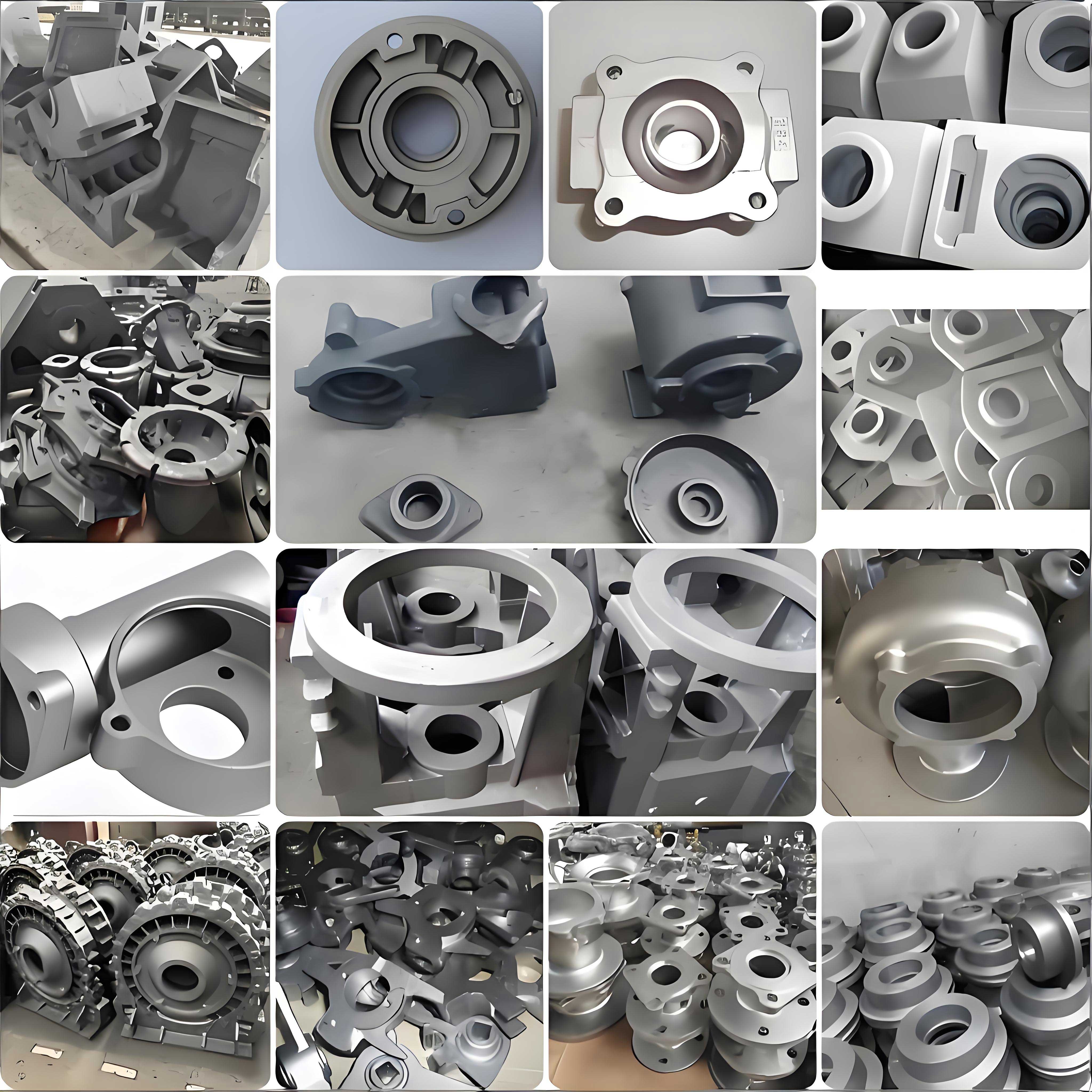
Urban Rail Gearbox (EN-GJS-400-18LT): The housings are of a quasi-circular design with dominant wall sections of 8-12 mm, weighing between 130-170 kg. The stringent quality requirements mandate surface quality equivalent to Level 1-2 per EN 1369:1997 and internal soundness meeting Level 2 per ASTM E 446/E 186 standards.
Locomotive Gearbox (EN-GJS-500-7LT): These are larger, more complex structures weighing 290-390 kg, with wall thicknesses ranging from 10-16 mm and isolated heavy sections up to 88 mm. The specifications call for surface quality of Level 2 or better (EN 1369:1997) and internal soundness assessed to Level 3 (ASTM E 446/E 186).
1.2 Casting Process Design
The gating and feeding design is paramount for achieving sound, defect-free castings in thin-walled, complex geometries typical of gearboxes.
For Urban Rail Gearboxes (QT400-18L): A semi-pressurized gating system was employed. The key to its success lies in the specific area ratios, designed to ensure calm filling and minimal turbulence:
$$ \sum A_{\text{choke}} : \sum A_{\text{runner}} : \sum A_{\text{pouring basin}} = 0.8 : (1.2 \text{ to } 1.5) : 1 $$
The choke is placed at the ingate, with the largest cross-section in the runner. This configuration reduces metal velocity in the runner, promoting a smoother fill compared to a fully pressurized system. Simulation-optimized parameters, including a metallostatic head of 200 mm, effectively eliminated jetting, splashing, and secondary oxidation. Strategic placement of risers on upper flanges and bearing bosses, complemented by chills at the parting line and lower bearing areas, ensured directional solidification and eliminated shrinkage porosity.
For Locomotive Gearboxes (QT500-7L): A bottom-gating system from both sides along the parting plane was developed. This design features two tiers of thin, wide, and uniformly distributed ingates (4 upper, 6 lower). The sequential filling, initiated from the lowest ingates upward, creates a favorable thermal gradient with hotter metal at the top, promoting sound feeding into the risers. Heavy sections are fed using exothermic sleeves, while external chills are applied to secondary hot spots to control solidification. This approach effectively mitigates risks of shrinkage, cold shuts, and mistruns.
| Component Type | Gating System Type | Key Design Principle | Feeding Strategy |
|---|---|---|---|
| Urban Rail Gearbox (QT400-18L) | Semi-Pressurized | Controlled velocity via area ratios; simulation-optimized head pressure. | Risers on upper sections + chills on lower sections. |
| Locomotive Gearbox (QT500-7L) | Parting-Line Bottom Gating | Sequential, calm fill from multiple tiers of ingates. | Exothermic risers on heaviest sections + external chills. |
1.3 Molding Process
A no-bake furan resin sand process was selected for its dimensional accuracy and shakeout properties. The system was fine-tuned for low sulfur and nitrogen introduction, critical for ULT nodular cast iron.
- Base Sand: High-purity silica sand (>95% SiO2) with a concentrated grain size of 40-70 mesh and zero fines content.
- Binder System: A modified, environmentally friendly “wood-scent” furan resin with very low nitrogen (≤0.07%) and free formaldehyde (≤0.03%). A low-sulfur curing agent (total acidity 40-44% as H2SO4) was used at 30-40% of resin weight. This combination provides high strength with minimal sulfur emission.
- Mold Coating: A two-layer coating system: a primary alumina-based refractory wash followed by a graphite-alcohol facing coat to prevent metal penetration and sand burning.
| Material | Key Parameter | Specification / Value |
|---|---|---|
| Base Sand | SiO2 Content | > 95% |
| Grain Fineness (AFS) | Concentrated 40-70 mesh | |
| Fines Content | 0% | |
| Furan Resin | Nitrogen Content | ≤ 0.07% |
| Free Formaldehyde | ≤ 0.03% | |
| Viscosity | 38-42 mPa·s | |
| Addition Rate | 0.9 – 1.1 wt.% of sand | |
| Curing Agent | Type / Sulfur Content | Low-Sulfur Type |
| Addition Rate | 30 – 40% of resin weight |
1.4 Melting and Treatment Practice
The chemical composition is the foundation of low-temperature properties. Strict control over all elements, particularly trace elements, is non-negotiable.
| Element | QT400-18L (Ferrritic) | QT500-7L (Mixed Matrix) |
|---|---|---|
| C | 3.3 – 3.9 | 3.3 – 3.9 |
| Si | 1.7 – 2.3 | 1.7 – 2.3 |
| Mn | < 0.20 | < 0.20 |
| P | < 0.035 | < 0.035 |
| S (Base Iron) | < 0.020 | < 0.020 |
| Mg (Residual) | 0.02 – 0.05 | 0.02 – 0.05 |
| Cu | 0 – 0.3 | – |
| Ni | 0.3 – 1.2 | 0.5 – 1.5 |
Charge Make-up & Melting: The charge consists of high-purity pig iron (low Ti, Mn), specifically selected steel scrap, crystalline graphite carburizer, returns (0-50%), and alloying elements like nickel and copper. Melting is conducted in a medium-frequency induction furnace. The sequence involves melting scrap with carburizer first, followed by pig iron and returns. After slag removal at 1530-1560°C, final alloying adjustments are made. The tapping temperature for treatment is targeted between 1500-1530°C.
Nodularizing and Inoculation: This is the most critical metallurgical operation. A sandwich method with a covered ladle is used.
– Nodularizer: A low-rare earth, magnesium-ferrosilicon alloy (Mg: 4.5-5.5%, RE: 0.6-1.0%) is used at 1.1-1.3%.
– Inoculation: A powerful, complex inoculant containing Ba, Ca, and Al is applied in three stages:
1. Ladle Inoculation (Foundation): 0.5-0.7% added with the nodularizer.
2. Post-Inoculation: 0.7-0.9% added to the ladle after reaction.
3. Stream Inoculation (Final): 0.1-0.2% added during pouring.
The total inoculation practice can be represented by the sum:
$$ \text{Inoculation}_{\text{total}} = \text{Inoculation}_{\text{ladle}} + \text{Inoculation}_{\text{post}} + \text{Inoculation}_{\text{stream}} $$
$$ \text{Typical Range} = (0.5-0.7\%) + (0.7-0.9\%) + (0.1-0.2\%) \approx 1.3-1.8\% $$
This robust practice ensures a high nodule count (>100-300 nodules/mm²), small graphite size (Type I, Size 5 or finer), and minimizes chilling tendency. Pouring is conducted at 1390-1420°C under a slag cover.
1.5 Process Quality Control and Production Results
Consistency is achieved through standardization and systematic management. The entire casting process is broken down into 29 distinct operations, each governed by detailed control plans, PFMEAs, process flow charts, and work instructions (SOPs). A rigorous quality management system oversees everything from raw material certification and pattern management to batch traceability and non-conformance handling.
The effectiveness of this integrated control strategy is proven by production statistics over several years. For the -40°C nodular cast iron gearbox housings, the following results were consistently achieved:
| Metric | Result |
|---|---|
| Total Castings Produced | 43,789 pieces |
| Magnetic Particle Inspection (MPI) Pass Rate | 100% |
| Radiographic Testing (RT) Pass Rate | > 97.87% |
| Material Property (Mechanical Test) Pass Rate | > 99.85% |
| Overall Comprehensive Yield | > 92.75% |
The consistent yield above 92% for such technically demanding nodular cast iron components underscores the robustness of the established production and control system.
Technical Investigation into Impact Toughness at -60°C
Building on the stable production of -40°C grades, research was undertaken to understand the limiting factors for extending the service temperature of nodular cast iron down to -60°C. The study focused on the individual and combined effects of key elements—Silicon (Si), Manganese (Mn), Phosphorus (P), and Sulfur (S)—on the Charpy V-notch impact energy at -60°C.
2.1 Experimental Methodology and Materials
Three base material conditions were investigated to understand matrix effects: a fully ferritic grade (QT400-18LT, annealed), a ferritic-pearlitic mixed matrix grade (QT500-7LT, as-cast), and a pearlitic-ferritic grade (QT600-7L, as-cast). All melts were conducted in 100 kg medium-frequency furnaces using high-purity charge materials. Test castings were 25 mm Y-blocks produced in new furan resin sand molds coated with an anti-sulfur penetration wash to isolate the effect of molding materials. The microstructure for all test coupons showed a nodularity >95%, nodule count of 100-300/mm², and graphite size of 5 or finer.
| Element | QT400-18L (Annealed) | QT500-7L (As-Cast) | QT600-7L (As-Cast) |
|---|---|---|---|
| C | 3.3-3.9 | 3.3-3.9 | 3.3-3.9 |
| Si | 1.6-2.3 | 1.6-2.3 | 1.6-2.3 |
| Mn | 0.05-0.25 | <0.20 | <0.20 |
| P | 0.03-0.18 | <0.03 | <0.03 |
| S | 0.003-0.02 | 0.003-0.02 | 0.003-0.02 |
| Ni | 0.5-1.5 | 0.5-1.5 | – |
2.2 Analysis of Elemental Effects
Effect of Silicon (Si): For the fully ferritic QT400-18L, impact toughness decreases monotonically with increasing Si content. A particularly sharp decline is observed when Si exceeds approximately 1.9%. The lower the test temperature, the more severe the embrittlement. To achieve KV2 > 12 J at -60°C, Si must be controlled below 2.0%, preferably ≤1.9%. For the mixed-matrix QT500-7L, a similar but slightly shifted trend is observed, with an optimal window around 1.9-2.0% Si for best -60°C toughness. Silicon promotes two types of segregation: microsegregation (coring) within grains, which can be homogenized by annealing, and more critically, stable equilibrium segregation to grain boundaries. This grain boundary segregation reduces boundary cohesion and facilitates brittle fracture initiation at low temperatures.
Effect of Manganese (Mn): Contrary to some conventional wisdom, within the studied range for the annealed QT400-18L, Mn showed a slight beneficial effect on impact toughness, with values gradually increasing with Mn content. Mn is a weak carbide former, and its carbides are fully dissolved during the high-temperature graphiteizing anneal, negating its pearlite-promoting effect in the final microstructure. Its primary role becomes the suppression of harmful iron sulfides (FeS) through the formation of higher-melting-point, less detrimental manganese sulfide (MnS) inclusions. Since sulfur’s embrittling effect is amplified at lower temperatures, Mn’s role in neutralizing S becomes more critically beneficial at -60°C. This suggests that for annealed ferritic ULT nodular cast iron, a slight increase in Mn (e.g., up to 0.25%) can improve toughness consistency, provided P and S are very low.
Effect of Phosphorus (P): Phosphorus exhibits a classic embrittling effect. For QT400-18L, impact energy remains at a high level until a critical P content is reached, after which it drops precipitously. This critical threshold is approximately 0.07% P. Below this level, -40°C and -60°C impact energies exceed 12 J. Phosphorus has limited solubility in the iron matrix, which is further reduced by the presence of C, Si, and Ni. When its concentration exceeds solubility, it forms a hard, brittle ternary phosphide eutectic (steadite) at grain boundaries. This phase acts as a potent barrier to dislocation movement, creates stress concentration sites, and initiates microcracks, leading to low-energy cleavage fracture. The relationship can be conceptually described by a threshold function:
$$ \text{Impact Energy} \approx \begin{cases} \text{High}, & \text{for } [P] \leq [P]_{\text{crit}} \\\ \text{High} – k_P([P] – [P]_{\text{crit}}), & \text{for } [P] > [P]_{\text{crit}} \end{cases} $$
where $[P]_{\text{crit}} \approx 0.07\%$ and $k_P$ is a negative constant of high magnitude.
Effect of Sulfur (S): Sulfur is extremely detrimental to low-temperature toughness. For both QT400-18L and QT500-7L, impact energy declines steadily with increasing S content. A clear tolerance limit is observed around 0.012-0.015% S. To maintain KV2 > 12 J at -60°C for ferritic grades and > 4 J for mixed-matrix grades, S must be kept at or below 0.015%, with optimal performance below 0.012%. Residual sulfur primarily exists as FeS, which forms low-melting-point eutectic films along austenite grain boundaries during solidification. These films are virtually non-deformable and severely weaken grain boundary cohesion. The embrittling effect of S is highly sensitive to temperature, making its control the single most important factor for achieving -60°C performance in nodular cast iron.
| Element | Primary Mechanism | Optimum/Tolerance Limit for -60°C | Guideline for ULT Nodular Cast Iron |
|---|---|---|---|
| Silicon (Si) | Grain boundary segregation; solid solution strengthening of ferrite. | < 2.0% (Ferritic), ~1.9-2.0% (Mixed). | Minimize while maintaining castability and matrix control. |
| Manganese (Mn) | Neutralizes S as MnS; pearlite promotion (in as-cast). | Can be beneficial up to ~0.25% in annealed ferritic iron. | Use to control S morphology; keep low for as-cast grades. |
| Phosphorus (P) | Forms brittle phosphide eutectic (steadite) at grain boundaries. | < 0.07% (Critical threshold). | Keep as low as technically and economically feasible (<<0.05%). |
| Sulfur (S) | Forms weak FeS films at grain boundaries. | < 0.015% (Tolerance), <0.012% (Optimal). | Absolute minimization via charge, furnace, and molding practice. |
Conclusions
1. A systematic and holistic approach encompassing optimized casting design (semi-pressurized/bottom gating), controlled molding (low-N/S furan sand), precise metallurgy (strict chemistry, multi-stage inoculation), and rigorous process discipline enables the stable, high-yield production of -40°C ultra-low temperature nodular cast iron components. The demonstrated comprehensive yield exceeding 92% for complex gearbox housings validates this integrated control system.
2. The impact toughness of nodular cast iron at -60°C is critically sensitive to the levels of Si, P, and S. For ferritic grades targeting KV2 > 12 J, Si should be kept below 1.9%, P below 0.07%, and S below 0.012-0.015%. Manganese, when combined with a full annealing treatment, can have a slightly positive effect on toughness by mitigating sulfur’s impact, allowing for a modest increase up to ~0.25%.
3. Based on the production foundation for -40°C grades and the insights from elemental sensitivity research, it is technically feasible to develop nodular cast iron grades suitable for -60°C service. By refining the chemical composition windows—specifically pushing Si, P, and S to their lower practical limits—the target properties of KV2 (avg.) > 12 J and KV2 (min.) > 9 J for a ferritic grade (QT400-18L), and KV2 (avg.) > 4 J and KV2 (min.) > 3 J for a mixed-matrix grade (QT500-7L) at -60°C are achievable. This represents a significant extension of the performance envelope for nodular cast iron, unlocking its potential for the most demanding cryogenic applications.