
In the field of high-voltage electrical engineering, Gas Insulated Switchgear (GIS) has become a cornerstone for modern power transmission and distribution systems due to its compact design, high reliability, and excellent insulation properties. As a key component in GIS, the shell castings that enclose switching devices like disconnectors (DS) and earthing switches (ES) play a critical role in ensuring operational safety and integrity. These shell castings must withstand internal pressure from SF6 gas, provide mechanical support, and maintain a hermetic seal over decades of service. In this comprehensive analysis, I will delve into the intricacies of material selection for these aluminum alloy shell castings, focusing on the comparative evaluation of two prominent alloys: AlSi10Mg and AC4CH. The decision between these materials hinges on a balance of mechanical properties, casting performance, economic factors, and application-specific requirements. Throughout this discussion, the term ‘shell castings’ will be emphasized repeatedly to underscore their centrality in GIS manufacturing and performance.
The primary function of GIS shell castings is to form a sealed chamber that houses live conductors, insulation, and SF6 gas. This environment necessitates that the shell castings exhibit exceptional gas tightness to prevent SF6 leakage, which is both an environmental concern and a compromise to insulation integrity. Furthermore, these shell castings must possess sufficient mechanical strength to endure pressure fluctuations, short-circuit forces, and routine handling during installation and maintenance. Typical design pressures for these chambers range from 0.39 MPa to 0.80 MPa, but validation tests are far more rigorous. For instance, shell castings are subjected to a hydrostatic pressure test at twice the design pressure, often for 30 minutes, to check for deformation. A destructive test at 3.5 to 5 times the design pressure further verifies the safety margin. Additionally, a stringent gas tightness test requires that the annual SF6 leakage rate be less than 0.5%. These demanding criteria directly inform the material properties sought for aluminum alloy shell castings.
Aluminum alloys are favored for these shell castings due to their light weight, good corrosion resistance, and adequate strength-to-weight ratio. Within the aluminum-silicon (Al-Si) system, alloys like AlSi10Mg and AC4CH are prevalent. Their performance is largely dictated by silicon content and impurity levels, which influence casting behavior, mechanical properties, and conductivity. The following table summarizes the chemical composition specifications for these two alloys, which form the basis of their differing characteristics.
| Material | Si (%) | Mg (%) | Mn (%) | Fe (%) | Ti (%) |
|---|---|---|---|---|---|
| AC4CH (Similar to ZL101A) | 6.5–7.5 | 0.2–0.4 | ≤0.1 | ≤0.2 | ≤0.2 |
| AlSi10Mg (Similar to ZL104A) | 9.0–11.0 | 0.2–0.5 | 0.001–0.4 | ≤0.5 | ≤0.15 |
The silicon content is a pivotal factor. AlSi10Mg, with its higher silicon percentage, is closer to the eutectic point of the Al-Si system (approximately 12.6% Si). This proximity grants it superior casting characteristics. In contrast, AC4CH has a lower silicon content, placing it in a hypoeutectic region with a wider freezing range. This fundamental difference manifests in various performance metrics, which can be quantified through material science principles. For instance, the relationship between silicon content and properties like fluidity, shrinkage, and hot tearing tendency is critical for producing defect-free shell castings.
To understand the mechanical adequacy of these alloys for shell castings, we must examine their tensile strength, elongation, and hardness. The table below presents typical values for sand-cast and die-cast specimens, reflecting common manufacturing methods for large GIS shell castings.
| Material | Casting Method | Tensile Strength, σ_b (MPa) | Elongation, δ_5 (%) | Brinell Hardness, HB | Electrical Conductivity (% IACS) |
|---|---|---|---|---|---|
| AC4CH | Sand Casting | 225 | 3 | 75 | 40 |
| Die Casting | 245 | 5 | 85 | ||
| AlSi10Mg | Sand Casting | 220–320 | 1–4 | 80–110 | 37 |
| Die Casting | 240–320 | 1–4 | 85–115 |
From a mechanical standpoint, both alloys offer comparable strength and hardness, making either suitable for pressure containment in shell castings. However, AC4CH exhibits slightly better ductility and a consistent advantage in electrical conductivity (40% IACS vs. 37% IACS for AlSi10Mg). This conductivity difference, while seemingly small, becomes significant for shell castings that also serve as current-carrying components or where induced currents are a concern. For non-current-carrying shell castings—which constitute the majority of DS and ES enclosures—the mechanical and sealing properties take precedence.
The casting performance is where AlSi10Mg demonstrates clear advantages for producing robust shell castings. Key casting parameters include fluidity, shrinkage behavior, hot tearing tendency, and gas tightness. These can be modeled and compared. For example, fluidity (L) in spiral mold tests is influenced by composition and pouring temperature (T_p). An empirical relationship for Al-Si alloys near the eutectic can be approximated as:
$$ L = k_1 \cdot e^{-k_2 / (T_p – T_l)} $$
where \( k_1 \) and \( k_2 \) are material constants, and \( T_l \) is the liquidus temperature. AlSi10Mg, with its higher silicon content, has a lower liquidus temperature and narrower freezing range, leading to higher fluidity (\( k_1 \) is larger). This superior fluidity ensures better mold filling for complex geometries typical of GIS shell castings, reducing cold shuts and misruns.
Shrinkage is another critical factor. Total shrinkage (S_total) comprises linear shrinkage (S_linear) and volumetric shrinkage (S_vol). For hypoeutectic alloys like AC4CH, the wider solidification range promotes dispersed microporosity, while near-eutectic alloys like AlSi10Mg tend toward concentrated shrinkage pipes. The linear shrinkage can be estimated as:
$$ S_{linear} \approx \alpha \cdot (T_{pour} – T_{room}) + \beta \cdot \Delta f_s $$
where \( \alpha \) is the thermal contraction coefficient, \( \beta \) is the solidification contraction coefficient, and \( \Delta f_s \) is the fraction of solid formed. AlSi10Mg typically shows a lower linear shrinkage percentage but a higher volumetric shrinkage concentrated in the feeding zones. Therefore, proper riser design is paramount for AlSi10Mg shell castings to compensate for this concentrated shrinkage and prevent voids.
Hot tearing tendency (H), a major defect in castings, is inversely related to the alloy’s solidification range. A simplified model suggests:
$$ H \propto \frac{(T_{liq} – T_{sol})}{t_{solidification}} $$
where \( T_{liq} \) and \( T_{sol} \) are the liquidus and solidus temperatures, respectively. AC4CH has a larger temperature interval (\( T_{liq} – T_{sol} \)) than AlSi10Mg, making it more susceptible to hot tearing during the vulnerable stage of solidification when dendritic networks are forming. This makes AlSi10Mg a more forgiving material for producing sound shell castings, especially in sections with varying thickness.
Gas tightness, arguably the most critical property for GIS shell castings, is profoundly influenced by microstructure. The presence of microporosity or interconnected shrinkage defects can lead to leakage. AlSi10Mg, with its finer eutectic structure and lower tendency for dispersed microporosity, inherently provides better hermeticity. Experimental data indicates that AlSi10Mg shell castings can withstand higher pressures before leakage occurs compared to AC4CH counterparts. This directly translates to higher yield rates in production, as fewer shell castings are rejected during pressure tests.
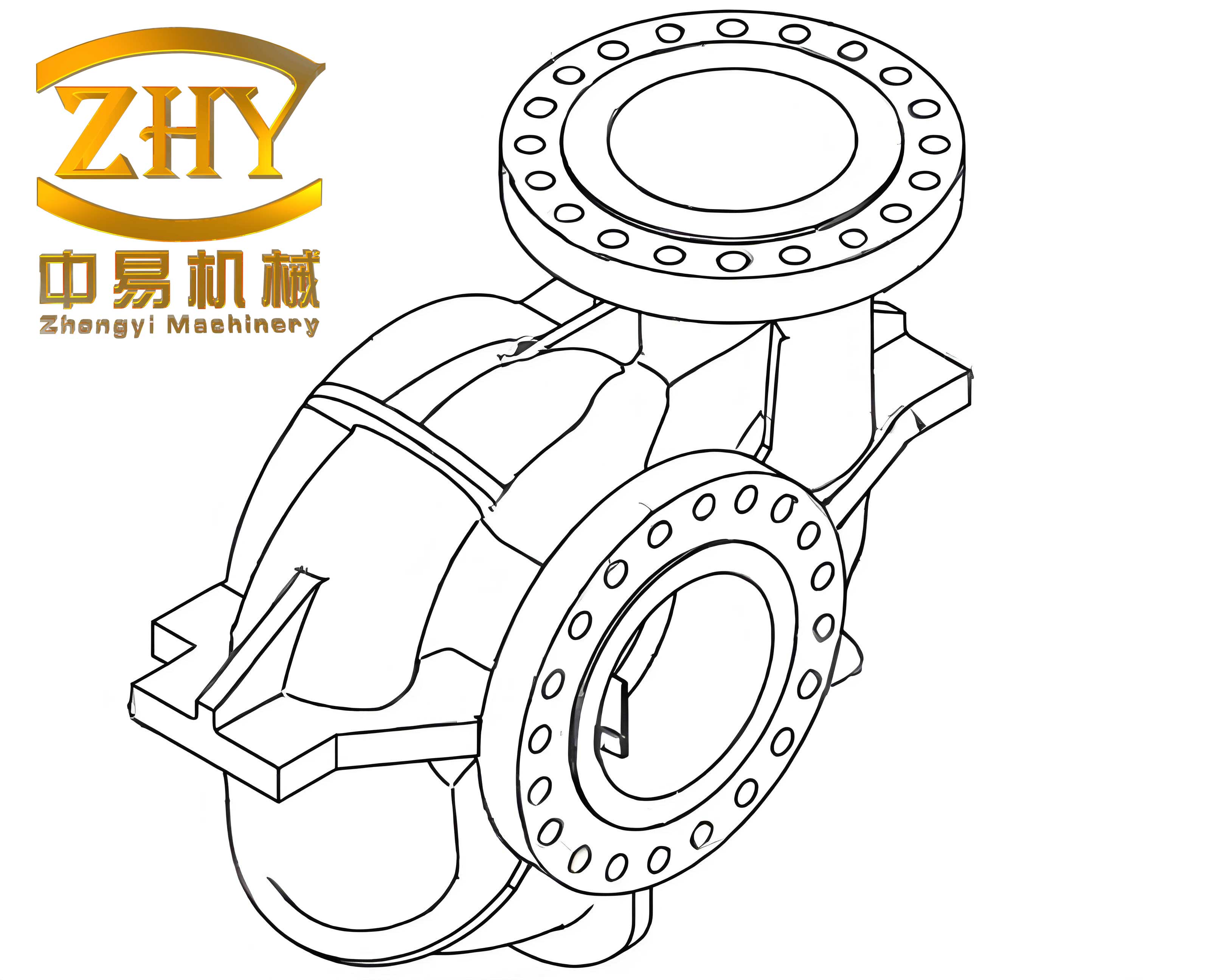
The image above illustrates a typical aluminum alloy shell casting for GIS, showcasing the complex geometry and integrated features that demand excellent castability. Producing such components with high integrity requires a material that balances flow characteristics with solidification behavior. AlSi10Mg’s near-eutectic composition makes it exceptionally suitable for such intricate shell castings, minimizing defects that could compromise the pressure boundary.
Beyond technical performance, economic considerations are decisive in material selection for shell castings. The cost structure for producing these components includes raw material expenses, melting and casting operations, heat treatment, machining, and scrap/rework costs. AlSi10Mg holds a significant advantage in several areas. Firstly, its raw material is less stringent regarding impurity control, particularly for iron (Fe ≤ 0.5% vs. ≤ 0.2% for AC4CH). This allows the use of lower-grade primary aluminum and a higher proportion of recycled foundry returns (up to 80-90% in some practices). In contrast, AC4CH requires high-purity inputs and limits the use of returns to avoid Fe accumulation, leading to higher virgin material consumption and waste. A simple cost model can be formulated:
$$ C_{total} = C_{material} + C_{processing} + C_{scrap} $$
$$ C_{material} = (1 – R) \cdot P_{virgin} + R \cdot P_{return} $$
where \( R \) is the return ratio, and \( P \) denotes price per unit mass. For AC4CH, \( R \) is restricted, raising \( C_{material} \). Assuming an annual production volume of 350,000 kg of shell castings, the additional cost for AC4CH due to restricted returns can exceed 1.1 million currency units, as previously indicated.
Secondly, the superior castability of AlSi10Mg directly impacts yield and rework rates. Let’s define first-pass yield (Y) as the percentage of shell castings that pass all quality tests (pressure, leak, dimensional) without repair. For AlSi10Mg, Y is typically higher due to better gas tightness and lower hot tearing. If Y_A represents the yield for AlSi10Mg and Y_C for AC4CH, with Y_A > Y_C, then the effective cost per good shell casting is lower for AlSi10Mg, even if its raw material cost per kilogram were slightly higher. The relationship is:
$$ C_{effective} = \frac{C_{total}}{Y} $$
Higher yield also reduces logistical burdens, inventory of semi-finished shell castings, and accelerates throughput—a vital factor in meeting the growing demand for GIS.
Thirdly, machining and finishing operations for shell castings, such as flange facing and drilling, are influenced by material hardness and microstructure. Both alloys have similar hardness ranges, so machining costs are comparable. However, the finer eutectic structure of AlSi10Mg can sometimes provide a smoother as-cast surface, potentially reducing cleaning and preparation time before coating or assembly.
Adopting AlSi10Mg for shell castings traditionally made from AC4CH necessitates adjustments in foundry practice. The gating and risering system must be redesigned to address the concentrated shrinkage tendency of AlSi10Mg. Risers need to be larger and strategically placed to ensure directional solidification toward these feeding sources. Chilling may also be employed to control solidification patterns in thick sections of the shell castings. Moreover, the higher silicon content can increase the propensity for oxide inclusion and gas pickup (hydrogen), requiring careful melt treatment through degassing and filtration. The heat treatment parameters (solution treatment, quenching, and aging) differ slightly; AlSi10Mg often employs a T6 treatment to maximize strength. Foundries must establish separate melting crucibles and return material streams for the two alloys to prevent cross-contamination, especially of iron content. These process adaptations, while requiring initial investment, are straightforward and well-documented in foundry engineering.
For conductive applications within GIS, such as shell castings that form part of the current path in busbar compartments or specific earthing arrangements, the higher electrical conductivity of AC4CH gives it an edge. The power loss (P_loss) due to resistive heating in a conductive shell casting can be expressed as:
$$ P_{loss} = I^2 \cdot R = I^2 \cdot \frac{\rho \cdot L}{A} $$
where \( I \) is the current, \( \rho \) is the resistivity, \( L \) is the current path length, and \( A \) is the cross-sectional area. Since resistivity \( \rho \) is inversely proportional to conductivity, a 7-8% higher conductivity for AC4CH translates to a corresponding reduction in \( \rho \) and thus \( P_{loss} \). For high-current applications, this can be a deciding factor. Therefore, a hybrid approach is optimal: use AlSi10Mg for the majority of pressure-containing, non-current-carrying shell castings (like DS and ES housings), and reserve AC4CH for specific conductive shell castings or components.
The evolution of GIS towards higher voltages (e.g., 1100 kV) and more compact designs places even greater demands on shell castings. Wall thickness optimization, integration of cooling fins, and complex internal geometries for gas flow management are emerging trends. Advanced simulation tools for casting process modeling (like MAGMAsoft or ProCAST) allow for virtual optimization of mold design and solidification for both alloys. These tools can predict defect formation, enabling pre-emptive design changes to ensure the integrity of shell castings. Furthermore, research into new aluminum alloy variants, such as those with strontium (Sr) modification for further refinement of the silicon eutectic, could push the performance envelope for shell castings even further.
In conclusion, the selection of material for aluminum alloy shell castings in GIS is a multifaceted decision that balances technical requirements with economic reality. For the vast category of pressure-containing, non-current-carrying shell castings, AlSi10Mg emerges as the superior choice. Its near-eutectic composition delivers excellent castability, resulting in high-yield production of shell castings with superior gas tightness—a non-negotiable attribute for SF6 containment. The economic benefits, stemming from lower material costs and higher production yields, are substantial and directly lower the overall cost of GIS units. While AC4CH retains its niche in applications requiring optimal electrical conductivity, the foundational components—the shell castings that form the sealed chambers—are most reliably and cost-effectively produced from AlSi10Mg. This analysis underscores that a nuanced, application-driven material strategy, rather than a one-size-fits-all approach, is key to advancing the reliability and affordability of gas insulated switchgear. The continuous focus on improving the manufacturing and performance of these critical shell castings will remain central to the evolution of power transmission technology.