
In our production of diesel engine crankshafts, we faced a significant challenge with slag inclusions, which severely impacted product reliability and manufacturing efficiency. These slag inclusions, primarily non-metallic impurities, led to high scrap rates, particularly during magnetic particle inspection where numerous fine magnetic traces were detected on the main journal surfaces. In some cases, large-area slag inclusions on the crank arms resulted in batch rejections. This issue prompted a thorough investigation into our casting processes, leading to targeted improvements that drastically reduced the occurrence of slag inclusions. This article details our approach, analyzing the formation mechanisms, key influencing factors, and effective countermeasures, all aimed at mitigating slag inclusions in nodular iron crankshafts.
Our production setup involves melting iron in a 10-ton large dual-acid cupola furnace. The tapping temperature ranges from 1380°C to 1420°C, with a pouring temperature between 1300°C and 1350°C. The chemical composition of the iron, both before and after treatment, is critical to understanding slag formation. Below is a table summarizing the typical chemical composition we maintain:
| Item | C (%) | Si (%) | Mn (%) | P (%) | S (%) | Mg (%) | RE (%) | Nodularity Grade | As-cast Pearlite (%) |
|---|---|---|---|---|---|---|---|---|---|
| Base Iron | 3.6–3.8 | 1.4–1.6 | 0.5–0.7 | <0.07 | 0.025–0.035 | – | – | – | – |
| After Treatment | 3.4–3.6 | 2.3–2.6 | 0.5–0.7 | <0.07 | <0.02 | 0.035–0.055 | 0.02–0.04 | ≥1 Grade | >80 |
Nodularization is achieved using a bell method with a Cu-Mg-Ni-Si-Fe alloy, where the nodularizing agent is pressed into the ladle. Each ladle holds 1.5 to 2 tons of iron. During tapping, dehydrated sodium carbonate is added to the runner for desulfurization, followed by primary slag removal before nodularization. This process, however, introduces variables that contribute to slag inclusions.
The formation of slag inclusions is a complex phenomenon driven by oxidation and impurity reactions. Slag inclusions consist not only of sulfides but also various oxides generated during nodularization. The primary reactions involve magnesium and rare earth elements reacting with oxygen and sulfur. For instance, the oxidation of magnesium can be represented as:
$$2\text{Mg} + \text{O}_2 \rightarrow 2\text{MgO}$$
Similarly, silicon oxidation contributes to slag formation:
$$\text{Si} + \text{O}_2 \rightarrow \text{SiO}_2$$
After nodularization, even with careful slag removal and the use of cover agents, secondary slag—essentially oxide scale—continues to form on the iron surface due to exposure to air. This secondary oxidation is a key source of slag inclusions. The primary slag primarily comprises MgO and other oxides, while secondary slag is rich in SiO₂, along with complex compounds of magnesium and rare earth elements. The difference in density between the iron (approximately 7.1 g/cm³) and slag inclusions (around 2.5 g/cm³) influences their distribution; however, process conditions can trap them within the casting.
To better understand the behavior of these slags, we analyzed their melting points and surface tensions, which affect their removal efficiency. The following table summarizes these properties at different stages:
| Stage | Melting Point (°C) | Surface Tension (N/m) |
|---|---|---|
| Initial Slag | 1450–1500 | 0.45–0.50 |
| After Mg Treatment | 1500–1600 | 0.35–0.40 |
| After Inoculation | 1400–1500 | 0.30–0.35 |
| After Cryolite Addition | 900–1000 | 0.25–0.30 |
As shown, after magnesium treatment, the slag becomes viscous with high surface tension, making it difficult to remove. Adding cryolite powder significantly reduces both melting point and surface tension, promoting slag fluidity and easier removal. This is crucial for minimizing slag inclusions.
Our investigation identified three major process changes that exacerbated slag inclusion formation. First, we switched from using sintered cast chips to scrap steel as charge material. Scrap steel often contains rust, irregular sizes, and excessive weight, increasing the iron oxide content in the melt. The oxidation of iron can be expressed as:
$$4\text{Fe} + 3\text{O}_2 \rightarrow 2\text{Fe}_2\text{O}_3$$
This introduced more FeO into the system, raising the oxidation potential and promoting slag inclusion formation. Second, we altered the cover agent from rice hull ash to a proprietary nodular iron cover agent. The nodular iron cover agent contained about 5% moisture and was primarily composed of SiO₂, which intensified oxidation and slag generation. In contrast, rice hull ash, mainly potassium carbonate, is moisture-free and acts as a reducing agent, preventing secondary oxidation. Third, we changed the pouring and cooling method from horizontal pouring with vertical cooling to horizontal pouring with horizontal cooling. Vertical cooling allows slag inclusions to float upward due to density differences, reducing entrapment. Horizontal cooling eliminates this benefit, increasing the risk of slag inclusions being retained in the crank arms and other sections.
These factors collectively led to a spike in slag inclusion rates. To address this, we implemented a series of countermeasures. First, we mandated the use of rust-free scrap steel to minimize iron oxide introduction. Second, we revised the covering practice: after slag removal and before pouring, we now add cryolite powder followed by rice hull ash. The cryolite powder decomposes at high temperatures, generating protective gases. The reaction can be simplified as:
$$\text{Na}_3\text{AlF}_6 \rightarrow 3\text{NaF} + \text{AlF}_3$$
At 1300°C, AlF₃ reaches a vapor pressure of 1 atmosphere, forming a protective layer that shields the iron from oxidation. Cryolite also lowers slag melting point and surface tension, as indicated in the table above, facilitating slag removal. The addition of cryolite transforms the slag into a thin, fluid layer that easily separates. However, care must be taken due to toxic fumes; we ensured proper ventilation. Third, we reverted to the horizontal pouring with vertical cooling method. This ensures that slag inclusions float toward the riser, away from critical casting areas. Fourth, we increased the tapping temperature to 1400–1440°C and the pouring temperature to 1320–1360°C. Higher temperatures reduce the affinity of magnesium and rare earths for oxygen, as carbon’s oxygen affinity increases with temperature, thereby suppressing oxide formation. The relationship between temperature and oxidation tendency can be described by the Arrhenius equation:
$$k = A e^{-E_a/(RT)}$$
where \(k\) is the oxidation rate constant, \(A\) is the pre-exponential factor, \(E_a\) is activation energy, \(R\) is the gas constant, and \(T\) is temperature. Higher \(T\) decreases the exponent for oxidation reactions involving Mg and Si, thus reducing slag formation.
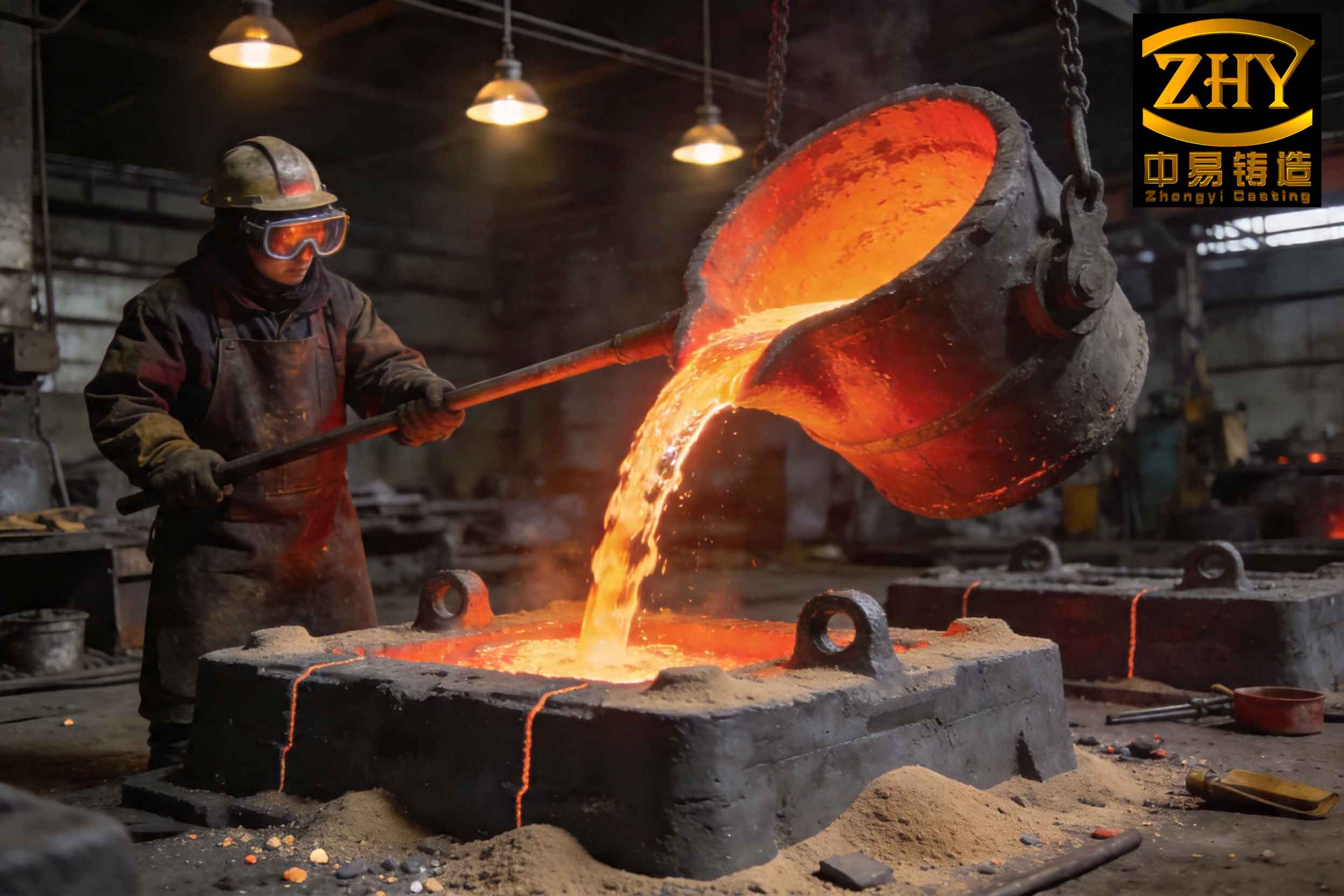
The effectiveness of these measures is evident in the dramatic reduction of slag inclusion defects. Prior to implementation, slag inclusion scrap rates exceeded 10%, but after adjustments, they stabilized below 1%. This improvement underscores the importance of controlling oxidation sources and optimizing process parameters. To visually represent the typical appearance of slag inclusions in castings, refer to the following image, which illustrates the morphology and distribution of these defects in a crankshaft section:
Furthermore, we conducted statistical analysis to quantify the impact. Using control charts, we monitored slag inclusion frequency over time. The data showed a significant downward trend post-intervention, with process capability indices improving from Cp < 1 to Cp > 1.5, indicating robust control. We also performed metallographic examinations to confirm the reduction in oxide particles within the matrix. The volume fraction of slag inclusions decreased from an average of 0.8% to less than 0.1%, as measured by image analysis software.
In summary, slag inclusions in nodular iron crankshafts are primarily driven by oxidation during melting and treatment stages. Key factors include charge material quality, cover agent composition, and cooling methodology. By adopting rust-free scrap steel, cryolite powder with rice hull ash covering, vertical cooling, and higher pouring temperatures, we successfully mitigated slag inclusion formation. These measures not only reduced scrap rates but also enhanced product reliability. Continuous monitoring and adherence to these practices are essential to maintain low levels of slag inclusions. Future work may explore advanced filtration systems or inert atmosphere pouring to further eliminate slag inclusions. The battle against slag inclusions is ongoing, but with systematic process control, significant improvements are achievable, ensuring high-quality castings for demanding applications.